Running between resistance and loss – in conversation with Dina Mimi
In Thousand Thrashing Arms (2024), artist and filmmaker Dina Mimi interweaves political and historical layers with the physicality of the struggle for freedom. From Nelson Mandela’s statue in Ramallah to archival footage of Palestinian resistance fighters, her films explore the relationship between physical resistance, archives, and liberation. In conversation with Line Ajan, Mimi reflects on the use of montage in her work and how dreaming of freedom remains an act of resistance. KLIK HIER VOOR DE NEDERLANDSE VERSIE

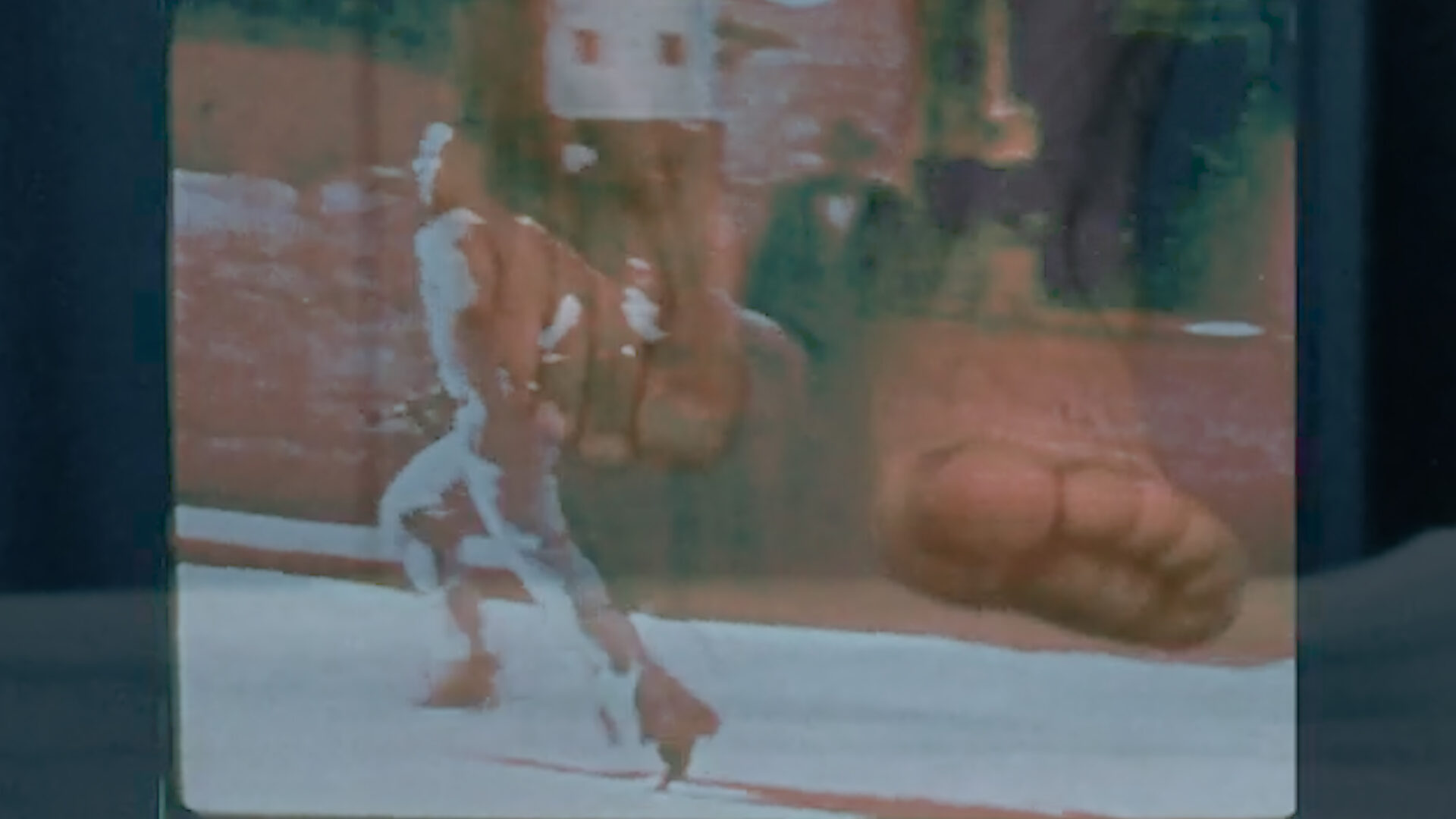
I wanted to begin this conversation with your most recent film Thousand Thrashing Arms (2024) because it is a pertinent introduction to both your artistic practice and your positionality as a Palestinian artist living in the Netherlands. The film is emblematic of your fascination with the politics of bodily movement, as well as freedom struggles, not just in relation to Palestine, but within a broader transnational framework. These themes are interwoven through a skillful editing, transposing a text read in isiXhosa with a montage of video X-rays of a human body, images you shot of Nelson Mandela’s 6-meter statue in Ramallah, and found footage of resistance fighters. This association rings ever more prescient a year and half after Israel’s genocide on Gaza, and after South Africa brought a case against Israel to the International Court of Justice. Did this historical event play a part in the making of the work?
‘This project began with me asking myself “What would be a work that makes sense in this moment?”. South Africa’s case against “Israel”, which was brought to the International Court of Justice in December 2023, naturally affected it – especially given South Africa’s own history of Apartheid. This is why the voiceover is in isiXhosa — a choice that also fits into my general approach to language in film. It’s important that English isn’t the dominant language heard in my work because I don’t want my audience to be mainly English speakers. I want my work to reach other people. While working on the film, I was already in conversation with my friend Simnikiwe Buhlungu and asked her to read this text I wrote in isiXhosa, which is her first language. And I was, in fact, in the Netherlands for the public hearings in January, and that was painful to witness because it revolved around Israel’s defense, which was particularly aggressive given the amount of space this narrative of “self-defense” takes in the media. So, of course, the work is about solidarity but it’s also about the body of Nelson Mandela’s statue in Ramallah. I wanted Mandela to be there in the body so to speak. The early months of the genocide were a time of grief, and as I was researching the statue – which was a gift from the city of Johannesburg– I started thinking about how it arrived in Palestine from overseas. I wondered about the practicalities of how it came, and how much time it took to ship it, because it’s humongous. It’s a replica of Mandela’s statue in South Africa, and it’s even larger than the original! All I could think about was this idea of crating the statue, wrapping the body, and then placing it in a box. By opposition, if —and that is a big if—the body of the martyr is collected in one piece, it then might be placed in a coffin and buried. Because of the grief felt during the genocide, because of the countless images of dead bodies, I was seeing on my screen, I started thinking that the movement of erecting a monument to Mandela feels like the counterpart to the movement of burying a martyr’s body.’
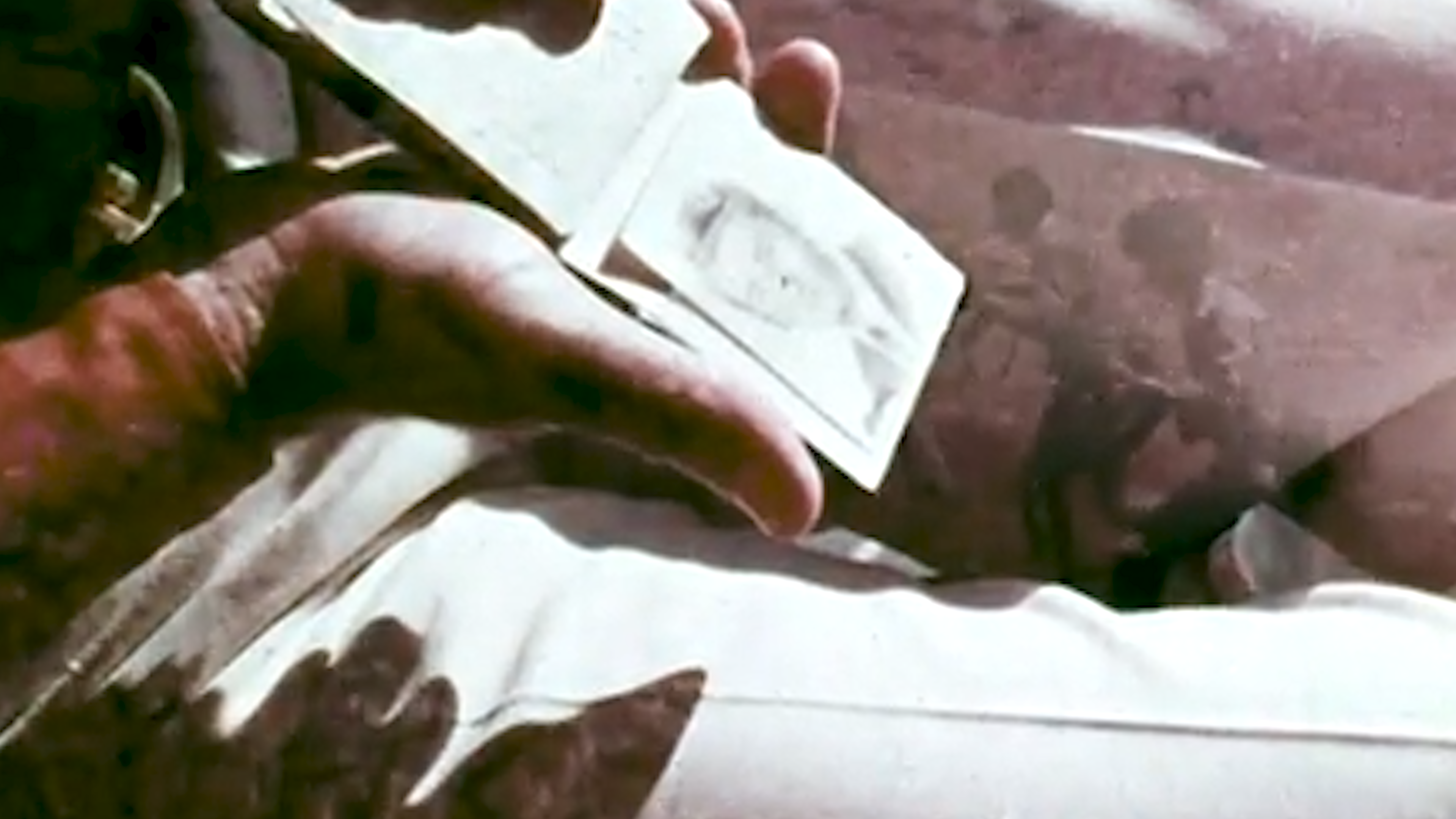
I thought your projects always emerged from the archive. It sounds like the archival research came after a fixation on the physicality of death. What were the archives you looked at? How did they impact your work?
‘In my artistic process, what is even more important than archival research is editing, and this work really came out of many hours of editing. I had downloaded footage I found online of Palestine shot between ‘1950s and the early 2000s by foreign NGOs or Israeli media. A lot of these images represent Palestinians as terrorists and uncivilized beings. They are dehumanizing. I was looking at them for hours, but my gaze was directed by a desire to subvert them. I thought: “Let me work with the footage that I want to play with.” Then, my fascination with bodily movement led me to footage from the ’60s about the human body and running. Later, that made me think of another archival footage, that we hear but don’t see in the film, which is an interview of Edward Saïd. The first thing we hear him say in the interview is: “The main impulse of people was to run, to get as far away from the fighting, from the terror, as possible”.’
The voice of Saïd talking about the visceral impulse to run is edited to a medical video of a runner on a treadmill. Similarly, in the first few moments of the film, there is a video x-ray of a foot as it slowly stretches: we almost feel the weight shift from the toes to the ankle. This editing highlights your embodied approach to freedom struggles. Could you expand on the physicality of resistance?
‘Saïd was referring to the 1967 Six-Day War, and how Palestinians had to run out of fear, out of terror. That, in turn, made me think of a quote from Frantz Fanon’s The Wretched of the Earth (1961) which we hear later in the film: “The first thing which the native learns is to stay in his place and not to go beyond certain limits. This is why the dreams of the native are always of muscular prowess; his dreams are of action and aggression. I dream I am jumping, swimming, running, climbing.” This sentence evokes the intuition of the native to run towards the siege in the moment of liberation. Looking through the archives at the same time, I found so many visuals of people running from terror, as well as people running towards a revolution. It made me think that one will run to shelter, but also to fight.’
Running is somewhere between fight and flight. In that sense, fugitivity can be considered a subversive form of fight. So, it’s another way to think about the embodiment of resistance, which is poetically addressed in your work The Melancholy of This Useless Afternoon (2022-23). I always linked this work to the notion of fugitivity as defined by Fred Moten & Stefano Harney. Watching it again, it dawned on me that it resonates with the story of the recently liberated Palestinian prisoner Zakaria Zubeidi.
‘Exactly. I began working on this film in 2021, which was the year that Zakaria Zubeidi and five other prisoners escaped the Gilboa Prison by digging their way out with spoons. I was obviously filled with a vengeful joy when I heard about the prison break. It was an indescribable feeling; I remember jumping from happiness. When the escape was made public, Birzeit University published Zakaria’s Master’s thesis titled The Hunter and the Dragon. 50 years of escaping from Israeli prisons. Everyone in Palestine became obsessed, everyone was reading it. While reading the thesis, I was researching the notion of fugitivity, but also thinking about how Zakaria practiced it: he was constantly on the move, constantly hiding, at times in graves. It’s a heroic, even a legendary, form of fugitivity. In a way, I was saddened by the publication of his thesis, because it revealed every hack and every trick he used.
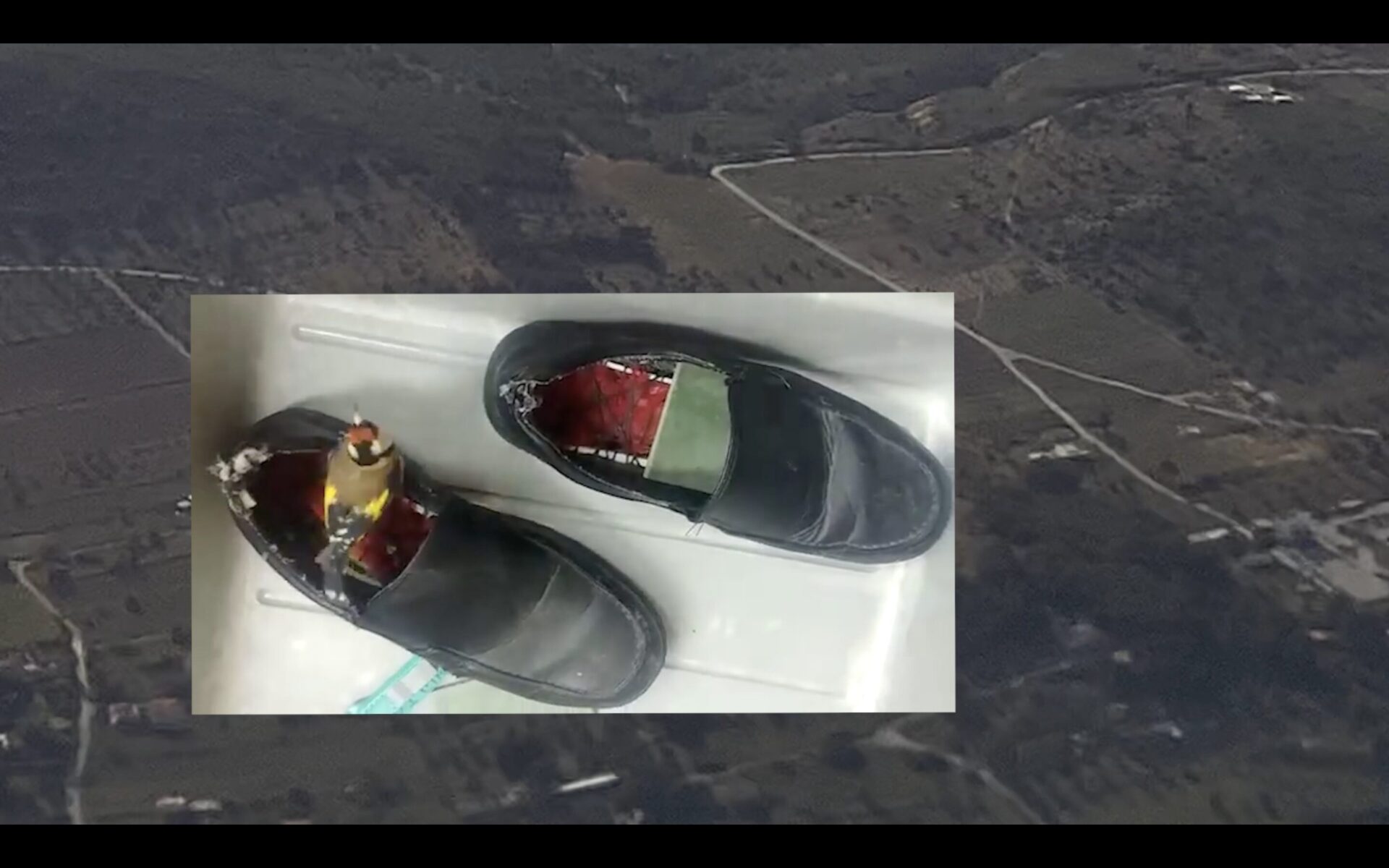
The Melancholy of This Useless Afternoon articulates these issues in two chapters. The first chapter layers images of birdsong competitions with recordings of revolutionary chants from Oman, Yemen and Palestine, and a voiceover reading a text I wrote on movement, loss, and revolutionary practice. The text includes an excerpt from Zakaria’s thesis about the exhaustion felt by fugitives because of the constant running and hiding. But he also writes about the knowledge of the land, the necessity of maneuvering the mountains and all of nature as a methodology and practice that Palestinian fugitives use to manage this perpetual escape. I was struck by the beauty and poetry of this passage: you need to know the trees so they can save you.
For me, the act of smuggling is similar to that of fugitivity, which brings us to the second chapter of the work. In parallel to my fascination with Zakaria’s story, I was accumulating images of bird smuggling, which I had started collecting in 2017 from Facebook groups. It’s a practice you see while riding the bus to cross the Allenby Bridge between Jordan and Palestine, which is the only accessible land border to another Arab country for Palestinians with Jerusalem IDs. Everyone on the bus to Jericho is a witness to and involved in this act of smuggling: people hide birds in tobacco packs, down the legs of their pants, or even in their shoes. They smuggle goldfinches from Jordan, not because they’re rare in Palestine, but because they are hard to hunt in the wild. It’s all about the value of the birds’ singing: you buy them for five Jordanian dinars, smuggle them, teach them how to sing, and then sell them for 100 to 2000 Jordanian dinars in Palestine. There are experts who assess the bird’s singing to price it. It’s a trade really, but I was obsessed with the act itself, specifically the gestures of wrapping the bird, hiding it, unwrapping it, and releasing it.
At the same time, I found out about Surinaamse Zangvogelvereniging, which is a songbird contest that takes place every summer here in the Netherlands, and in which the bird who can sing the most songs wins. In the Bijlmer area in Amsterdam – which is home to many Surinamese immigrants –, the contest is staged every Sunday from June to September, and features Twa-Twa birds. These are originally from Southeast Asia, and then were brought by the Chinese to Suriname, and South America, but they get smuggled into the Netherlands. Tracing their origin is like following colonial routes.’

And by juxtaposing these smuggling stories in the two chapters of the work (often displayed as two videos facing each other), you link past colonial routes to the current territorial fragmentation, checkpoints, and the spacio-cide in Occupied Palestine.
‘Definitely. I regard both smuggling practices as anticolonial revenge tactics.’
Like a step on the way to freedom. Our conversation began with grief, but your work guided us to resistance and freedom struggles. This oscillation between grief and liberation transpires in the title Thousand Thrashing Arms: it could refer to a gesture of mourning, as well as one of protest. It brings back this idea of the physicality of resistance, and how at the core of it there is a drive towards liberation. That freedom is not just a dream, it can be achieved, through resistance.
‘Dreams are the foundation of freedom. Dreaming of liberation is so important, because you cannot take that away from Palestinians. You are raised with this dream; it’s engraved in you. I remember my grandma telling me, “We will be free.” She transmitted the fundamentals of the land, of what belongs to us, of what is ours, through this dream of hers. So now, these ideals cannot be taken away from me. This is also why I included the quote from Fanon about dreaming of bodily movement and acts that seem mundane in Thousand Thrashing Arms. The daily act of dreaming of a basic thing — like resting on the land, walking on the land, eating from the land, going to the sea— is important.’
The importance of everyday acts and dreaming makes me think of the power of music, which is really evident in the soundtracks of your films. Your references are wide-ranging but are always imbued with political significance: in The Melancholy of This Useless Afternoon, you move us from the sound of the ocean to 1990s radio news, and the Palestinian resistant chant Ana Samed. Could you expand on the place of sound in your work?
‘The soundtrack of The Melancholy of this Useless Afternoon combines various songs that relate to childhood, be them educative chants or more playful ones, and this choice comes from my belief that education and games are also part of these daily acts of resistance. The soundtrack blends songs you hear a lot in Palestine as a child, with recordings of Omani children learning the alphabet or number from soldiers during the revolution, and finally this song from Wau Wau Collectif – Xale (Toubab Dialaw Kids Rhyme) which is almost like a game in itself. Together, they become a whole. For me, it’s a process of learning and asking: what is the film without the image? I like to think my soundtracks can have another life without the films.’
This segue into music reminds me of your love for the French song “Madame encore à boire” by the Algerian singer and musician Slimane Azem. The song is the starting point of the research you will be conducting during your upcoming residency at Triangle Astérides in Marseille. Could you elaborate on this project?
‘The project is still in the very early stages, but yes! This song is about going home after a long night of drinking, but it’s ultimately about the impossibility for Slimane Azem to go back home. He was exiled from Algeria for most of his life, and so, he sings what we in the Levant would call a mawwal, which evokes loss and longing, about the impossibility of going back home. It’s beautiful but extremely sad: Slimane is obviously drinking his pain away while singing in the Algerian dialect that no one in the bar (including the bartender who is a French woman) understands. But he keeps on singing, as if giving his all to Algeria, giving into the sadness and the grief.
While my personal experience is not the same, as I can go back home, it stills resonates with me because home is a complicated place, and it has become so for a lot of us. This made me think that I want to have a deep relation to the song and have create a profound relation with the Algerian people in Marseilles, specifically Algerian men. The project builds on my existing rapport with men of Algerian descent in Marseilles: whenever I visit this city, I get asked where I’m from, and when I say, ‘I’m Palestinian,’ these men start crying on my shoulder. They cry because, in their words, “they haven’t freed us”. They feel this sense of debt, even though no one has asked them to free us, and I am interested in that.
For me, to be in Marseille, surrounded by Algerian immigrants, and knowing the historical parallels and relations between Algeria and Palestine, is kind of like going home. And I think this is the question of the year: I’m finding myself surrounded by so many immigrants who want to go home — me included. It feels like Europe is over, and we are all looking to resolve the question of ‘What is home and what can we offer for home?’ I’m having this conversation every day with a different person, and this song is perfect for it.’
Dina Mimi is in residence at Triangle-Astérides in Marseille from April 22 to July 1, 2025.
Line Ajan
is curator and translator based in Berlin