Can Tarot Dismantle the Master’s House of Cards? NL + EN
Why does tarot exert such an attraction on artists, particularly in times of (poly)crisis? Whether it concerns creating new cards, spreads, interpretive frameworks, or methodologies, tarot and art have enjoyed a fruitful but not entirely uncomplicated love affair for centuries. It is a love that seems to flourish especially in disruptive times when existing critical frameworks fall short and a rapidly changing and unsettling world calls for new archetypal imaginaries. This article explores the magical moment where art, cards, and activism converge, balancing on the edge of different knowledge systems, swaying on a sea of correspondences and potentialities. GA NAAR DE NEDERLANDSE VERSIE HIER
When I receive carte blanche from the editors to write a piece about tarot and art, I naturally pull out my cards—tried and tested mirrors and guides that have steered me through many a project and life situation. Consulting an oracle is not without danger; its answers are not entirely without consequence. Those who force the oracle by imposing their own norms, or who try to extract desirable answers, will be led down destructive detours. A clear intention and an open, not-knowing attitude is crucial to allow an oracle to truth-say rather than pull the wool over one’s eyes.
As my hands shuffle the cards, I search for the actual burning question-behind-the-question: what hunger do older, ancestral forms of knowledge satisfy where rational, naturalistic frameworks evidently fall short? What makes tarot specifically attractive to artists specifically, in this specific moment in time? Or viewed through the eyes of the ever-present skeptic: are we dealing here with a kind of epistemological escapism or regression resulting from the dismay many feel regarding failing politics, advancing fascism, a damaged planet, a far from reassuring planetary future? Or is there, beyond contextual and material explanations, something else at play?
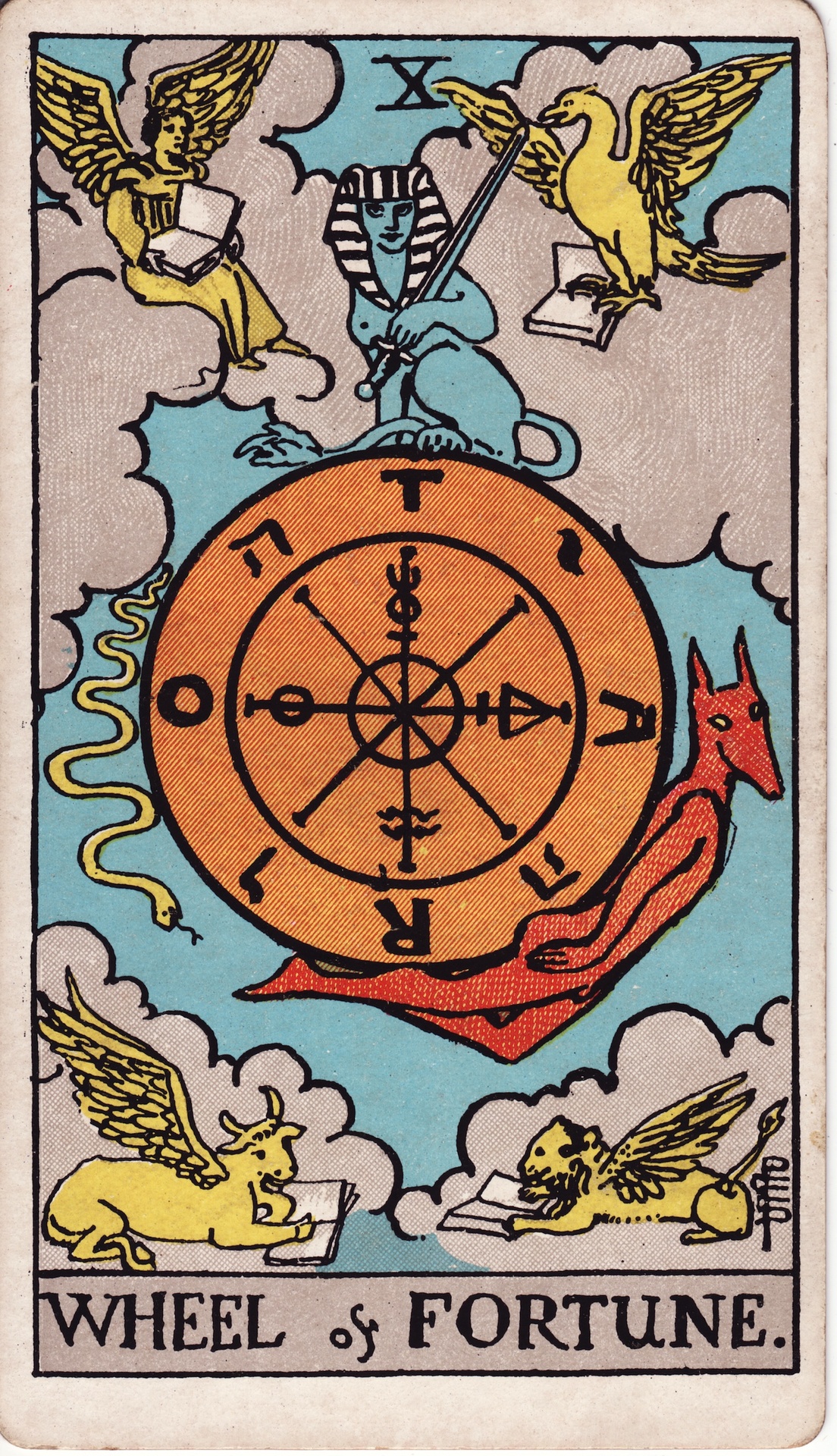
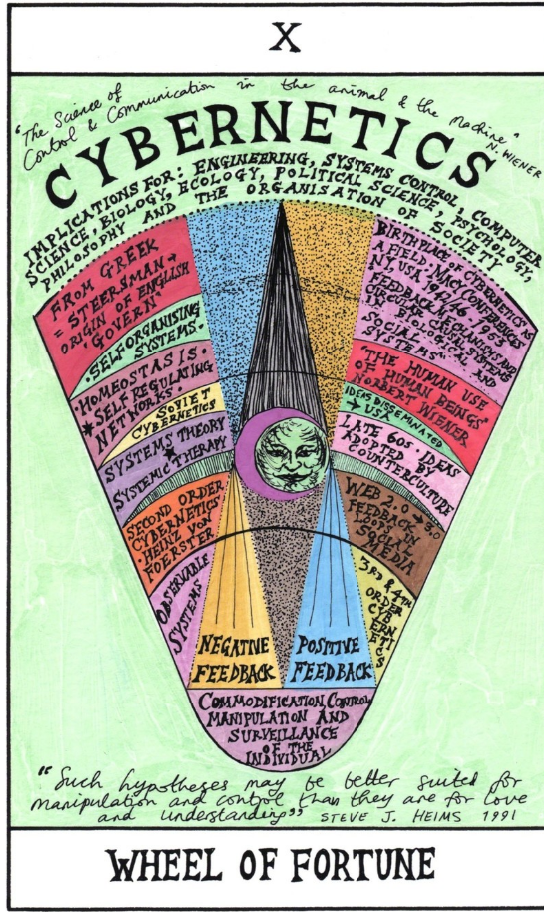
I draw card 10, the Wheel of Fortune. The wild card. Artist and friend Felizitas Stilleke, who studies various oracles in depth and actively applies them in her dramaturgical processes, subtly points out to me that Tarot finds my questioning still rattling. It must still come to the point, that is, find the only still point of the card: the pivot in the axle, or the unmoved mover that sets all change in motion without itself being affected by it. What is also striking is that the wheel hangs high in the air, as in the Rider-Waite-Smith deck, and is surrounded by three animals and an angel studying the mystery of these accelerated changes in their books. Or the wheel sways, as in the Tarot of Marseille, on a turbulent sea where everything is still merely potential and a clear direction has yet to manifest. In both cases, there is no grounding or foundation yet to give hands and feet to a new cycle of growth and transformation. Perhaps this is why Tarot also poses the counter-question: how do we place emptiness, silence, and not-knowing back at the heart of these impersonal and even transpersonal changes, which at any moment threaten to derail, with a wobble in the wheel that recalls the inherent unsatisfactoriness, instability, and friction of existence?
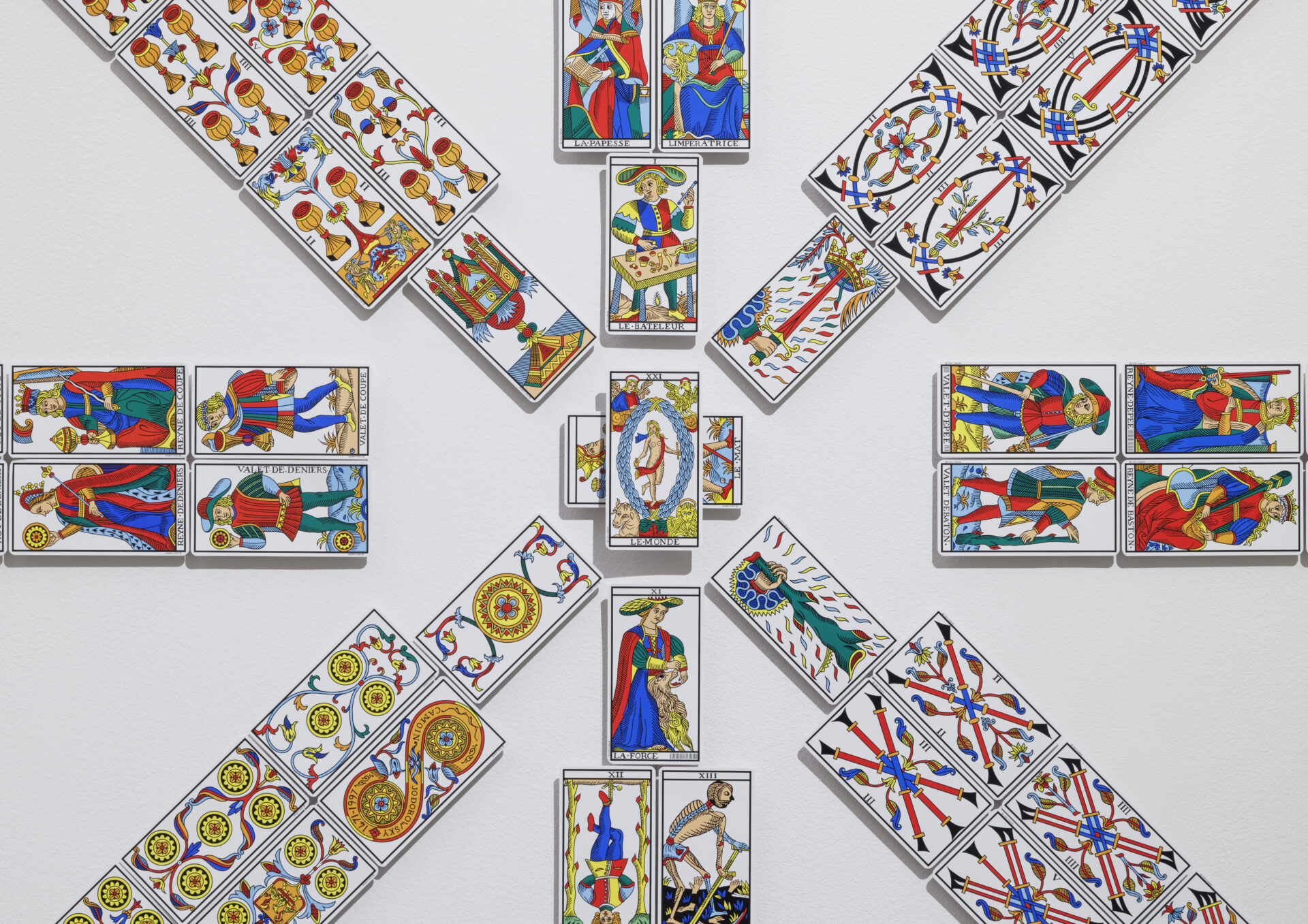
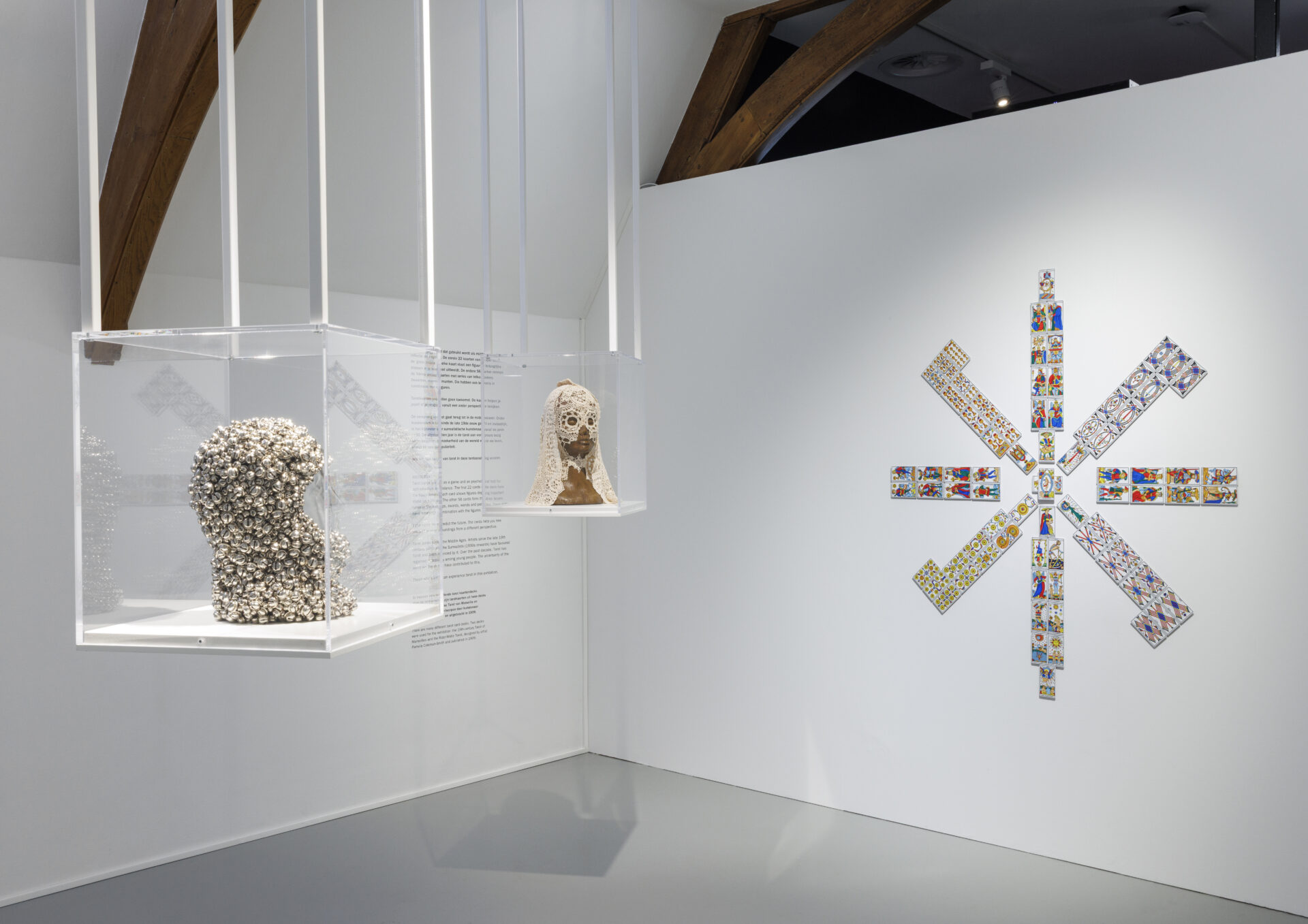
The first documented tarot cards appear around 1440–1450 in Northern Italy, eventually finding their most iconic form in 1760 in the Marseille deck at the hands of master cardmaker and royal engraver Nicolas Conver. Since then, many illustrious artists and occultists have attempted their own version: Pamela Colman Smith and Arthur Edward Waite (Rider-Waite-Smith deck, 1909), Lady Frieda Harris and Aleister Crowley (Thoth deck, completed in 1943), and more recently the reconstruction of the original Marseille deck by Alejandro Jodorowsky and Philippe Camoin (1998).
What makes tarot extraordinarily attractive is that it is not a sacred, untouchable artwork that can simply be placed in a display case, white cube, or on an altar. It is a tactile, openly magical object of use with a folk origin, made to be appropriated in a process that is best described by what the fox in Saint-Exupéry’s Le Petit Prince calls ‘apprivoiser’ [to tame]: a gentle, gradual growing of trust and connection with someone or something that is initially wild, strange, distant, and even a bit dangerous. A reading opens an intimate, relational space in which meaning is collectively sought through associative chains in which the archetypal and the personal can touch each other at their core. This collective process also opens the door to so-called ‘ancestral’ knowledge systems that do not rely on linear, causal, rational argumentation, but on a fine-meshed play of correspondences, sympathies, essences, and analogies that attract, repel, and, when they find the alchemical sweet spot, can even transform each other.
After a relatively long silence, coinciding with the more ironic nineties and noughties, interest in esoteric knowledge increases again after the economic crisis of 2008. Tarot decks are dusted off again and it becomes bon ton once more to openly admit that you ‘believe’ in astrology. Especially during and after the pandemic, an enormous proliferation of new tarot decks takes place that seek to queer the oracle (by, for example, removing the archetypes from a heteronormative and binary male/female framework), decolonize it (by weaving certain esoteric knowledge from the global majority into the existing archetypes), or repoliticize it (by, for example, making power relations and mechanisms of oppression more explicit in both representation and interpretation). Makers are not infrequently driven by the desire—and even an ethical imperative—to emancipate themselves from the dominant, naturalistic, Western-scientific knowledge system and from all the ‘elites’ who create that system. Their new and revised archetypal imaginaries undermine this dominance by reflecting other realities, ancestralities, and cosmovisions that generate fundamentally different ways of feeling, thinking, sensing and doing in a world that can consist of many worlds.
What is at stake here also touches lightly on what Walter Benjamin describes in The Storyteller (1936) as the loss of transmissible experience with the rise of modern, accelerated information consumption. The tarot reading shares something essential with the older, oral storytelling tradition he invokes: it takes place in a shared, relational space; it asks for attention and a specific temporality; it works through association, resonance, and repetition rather than through linear, conclusive argumentation. Where ‘information’ circulates quickly and just as quickly loses its value, a reading creates a constellation in which meanings condense. It is therefore not surprising that some artists invoke tarot—and other pre-modern technologies—as a way to ‘take back the dominant narrative,’ in a process that Chinua Achebe calls ‘re-storying’: refuting Eurocentric, colonial narratives and centering complex, indigenous perspectives, voices, histories, and cosmovisions that emerge from the so-called ‘global majority’.
Synchronicities
What cosmovisions are we actually talking about? Anthropologist Philippe Descola’s work is a major attempt to revise the Western separation between nature and culture, which underlies naturalism, and to present it as merely one of several possible ways to view and (re)structure the world. With this in mind, he distinguishes four fundamental ways (ontologies) in which cultures conceptualize the relationships between humans, non-humans, and the world: naturalism, animism, totemism, and analogism. The latter—analogism—is characterized by a fragmented cosmos that consists of countless entities that are fundamentally different not only in external appearance but also internally.
A gemstone, for example, is not merely a mineral with certain chemical properties, but an entity with a series of unique values, powers, influences, and correspondences, through which it can relate to other entities in a non-causal, from a scientific framework ‘inexplicable’ and ‘magical’ way. Humoral theory, feng shui, astrology, but also European Renaissance thought with its Great Chain of Being, the microcosm/macrocosm doctrine, and also tarot, are all manifestations of a world held together by powerful, mysterious deep structures and connections.
Within naturalism—the dominant worldview in the West—the meaning we give to things is a subjective, cultural construct that is separate from a shared universal biological foundation that we also share with other organisms. We can, for example, differ about what an apple personally means to us from our different backgrounds; it will fall from a tree everywhere in the world. Within analogism, on the other hand, an apple is not an ’empty signifier’ onto which we project our culturally conditioned, thus ultimately arbitrary meanings; the meaning is, as it were, contained in the apple itself, through which it behaves autonomously and fundamentally differently than, for example, a pear or a banana (and therefore does not fall from a tree without meaning). Every manifestation must therefore be approached and observed ‘on its own terms,’ so that it can appear to us with all its surprising, ‘magical’ properties that are completely self-evident from the logic of the apple itself.
Matter is thus within an analogistic worldview—to borrow a word from new materialism—not only vibrant, but also capable of moving and transforming through intention and a deep, embodied knowledge of its essential properties. It is therefore not surprising that certain artists feel more at home in such an analogical worldview, and in extension, also gratefully make use of an analogistic oracle like Tarot. In a fragmenting and fragmented world, in which we experience first-hand the shadow sides of a radical naturalistic worldview, finding other ontological frameworks is therefore perhaps also vital for artists for whom world and matter are anything but dead and inert, but full of agency and pregnant with meaning.
In practice, many cosmovisions are naturally not so neatly categorized under the four main ontologies that Descola distinguishes. Likewise, analogism is certainly not the only cosmovision to which tarot appeals. Is it possible, for example, to also invoke something like a ‘spirit’ through cards—and then not as metaphor, resonance, or correspondence, but as an ontological reality? Virtually all knowledge systems from the global majority are not purely material, but recognize spirits, dreams, and other more-than-human entities as real actors who can make very real interventions in everyday existence.
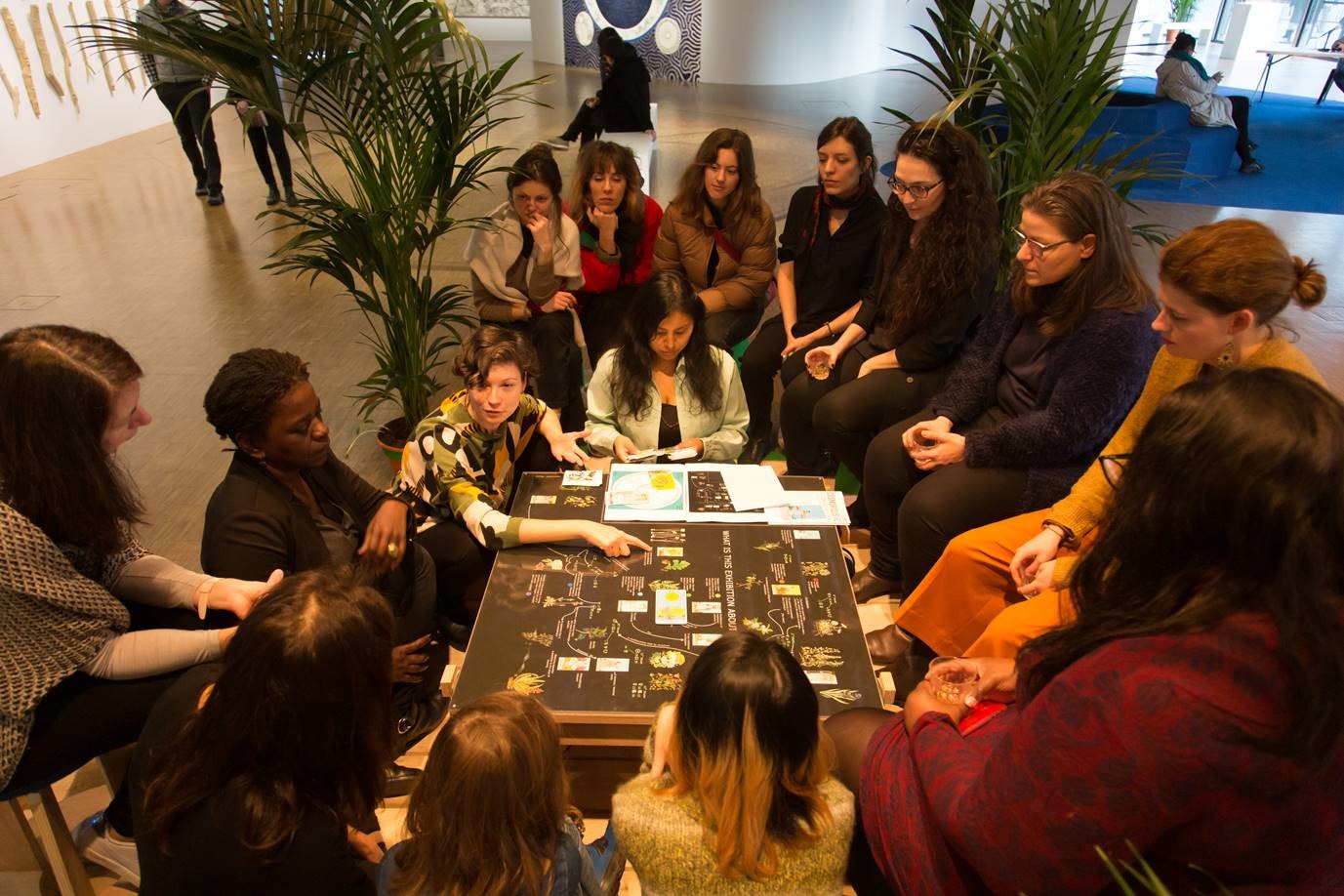
This brings me to one of the more interesting tarot activations I have encountered in my practice as an artist and observer: during the pandemic, artist and philosopher Valentina Desideri and Denise Ferreira da Silva began the so-called ‘poethical readings,’ collective sessions in which they attempt to arrive at a deep insight into the current moment using all kinds of “unreasonable tools,” such as astrology and tarot. Their starting point is a radical question that touches on the foundations of systemic and systematic oppression, which operates under the guise of ‘care’ and other high-minded values using an objectifying, distancing, and calculating rationality. If we take the ‘ethical imperative’ seriously and truly want to emancipate our knowledge systems from the excesses of dominant, naturalistic, Western-scientific frameworks, isn’t it more logical to invite ‘unreasonable, intuitive, ethical, non-colonial, anti-therapeutic, open, and complicating ways of reading’ in when we want to understand this current moment in time?
Walter Benjamin also functions here, by their own account, as inspiration, particularly in the way intuition can capture so-called “dialectical images”: history does not appear as a coherent, linear picture, but as a constellation of fragments and shards through which the past flashes up in the present. In one glance, a temporal image is intuitively grasped that encompasses our entire being.
“On one hand we use Walter Benjamin’s dialectical image, as the reading tools we use allow us to image the situation we are reading for, that is they halt time and expose the dialectics at play as a re/de/composition. And on the other hand, that image is not totalising, we are also fully immersed, or rather deeply implicated in the image ourselves.”
However, when asked in an interview whether they also invoke spirits as guides in their readings, Ferreira da Silva firmly replies that their practice is purely material:
“We have definitely departed from the tarot tradition of working with spiritual guides. Or to put it differently, we depart from the tradition of working with what is called spiritual, as opposed to material. We do, however, make use of forms (rituals and symbols) associated with the spiritual to engage in collaborative sense-making exercises, under the assumption that the elements for sense-making are outside (as well as also in) our minds, that we don’t have control over meanings, that the forms (the spread or the image of the card) host connections we don’t think about, and that previous readers (…) are also part of any reading we do.”
This raises the question of the extent to which this materialistic reinterpretation remains anchored in a Western epistemological framework that tolerates the spiritual only as form or method. How far can we go in this emancipation when we exclude realities and possibilities that are difficult for that same framework to digest? Must ‘the master’s house’ not be dismantled with tools that truly come from outside? How ‘spiritual’ does an artist dare to go without fear of losing credibility or being dismissed as too woo-woo by a modern (art) world dominated by both naturalism and materialism?
Perhaps true epistemological emancipation requires not only the decolonization of images and symbols, but also the possibility that an invisible world exists that goes beyond our understanding—without this automatically disqualifying within academic or artistic contexts.
I ask tarot what it thinks of this possibility, and it gives a clear multi-interpretable answer: XX: Judgment.
DIT ARTIKEL IS EERDER GEPUBLICEERD IN METROPOLIS M NUMMER 2 -2026 – STEUN METROPOLIS M NEEM EEN ABONNEMENT. ALS JE NU EEN JAARABONNEMENT AFSLUIT STUREN WE JE HET NIEUWSTE NUMMER GRATIS OP. BESTEL HIER