Memory takes root, when the witness is a tree – Ipeh Nur at Hotel Maria Kapel and Museum Arnhem
Ipeh Nur’s work sits at the intersection of history and memory, drawing on personal experience, resilience, and the imaginative interpretation of largely forgotten histories. In the exhibition Silent Song at Hotel Maria Kapel in Hoorn, she turns to the clove, once at the centre of one of the most profitable monopolies in colonial history, and to the cengkeh-afo, the oldest known clove tree, still standing on the Indonesian island of Ternate.
It is dusk outside during the opening of Silent Song. Monotonous chanting fills the chapel, its tones expand into the vaulted space. Paired with dimmed yellow light filtering through cloth and clove, it makes for a contemplative, near-silent setting.
Cengkeh kecil / Small clove
Harumnya kuat / Strong fragrance
Warm, bittersweet, and pungent; it is this fragrance of cloves that enters my body before anything else. The scent carries memory; the crackling of the ground buds in a kretek cigarette, the involuntary grinding of teeth on a clove my father had overlooked removing from the daging semur.[1] These memories are rooted in a family history entangled with Indonesia. Rooted too, is the tree standing at the centre of Hotel Maria Kapel.
Three weeks before, one week into her residency in Hoorn, I had met Ipeh in this same space. The tree, then still bare, towered above us and its presence already felt monumental within the chapel’s architecture. Seated cross-legged on the floor, Ipeh threaded cloves onto string. The scene brought to mind cloves spread across cloth, its corners held down by rocks, laid out on a pavement to dry in the Indonesian sun. But, Ipeh explained, holding up a Tupperware box filled to the brim, these cloves first had to be soaked until soft enough to handle. ‘From Indonesia,’ she confided with a grin. She had worried that cengkeh (Indonesian (Bahasa Indonesia) for cloves) might be too costly here.
Cloves arrived in Hoorn long before Ipeh did. Once referred to as ‘black golden fruit,’ the spice was so precious it was purportedly worth more than gold. When the VOC enforced its trade monopoly over the spice in the Moluccas, it tightly controlled scarcity: only 800 to 1000 tons of cloves were exported annually, while the remainder of the harvest was either burned or dumped into the sea.
For several years, Ipeh’s work has been concerned with the violent histories of colonial extraction in East Indonesia. In 2023, included in the group-exhibition Your Gold is not Our Glory at Hotel Maria Kapel, was her hand-drawn batik depicting the Banda massacre of 1621, when VOC naval officer Jan Pieterszoon Coen, born in Hoorn, ordered the execution of forty-four orang kaya.[2] These social and intellectual leaders of the island of Banda were beheaded to silence local resistance to Dutch demands in the nutmeg trade. Among the victims were the ancestors of historian Des Alwi, whose memoir of his childhood on the Moluccan island was Ipeh’s entry point into histories of erasure and their enduring cost (that continue to inform her research and practice).[3]
In the research for Silent Song, Ipeh again turned to literature first because, as she puts it, it allows her to imagine more freely. For her residency in Hoorn, she looked at Hanna Rambe’s historical novel Aimuna dan Sobori which follows two cousins whose family’s clove plantation is destroyed in the enforcement of the VOC’s monopoly, forcing them into fugitive lives.[4] Clove trees cultivated without permission, or deemed too numerous, were uprooted and burned to reduce supply and drive up prices. To enforce this policy, the VOC deployed fleets of traditional Moluccan warships, known locally as hongi, referred to in Dutch as hongitochten. Implemented under J.P. Coen, these extirpation expeditions were the tangible manifestation of the VOC’s spice monopoly in the Moluccas.
Ipeh had never been to the Moluccas before travelling to Ternate last year. She ascended the island’s Mount Gamalama. On the slope of the volcano, she found the cengkeh-afo, meaning ‘old clove,’ endemic to this island only, secretly planted and cultivated to protect it from eradication. Both subject to and site of violence, it had nonetheless survived nearly estimated four-hundred years of systematic destruction. Its age alone bears witness to the many histories and memories layered into the landscapes of the spice-producing islands.
Among its descendants stood a second-generation Afo tree, that had died after a government-built wall meant to protect it severed its roots instead. At the site of its remains, Ipeh found a single flower. The guide told her: the tree is greeting you.
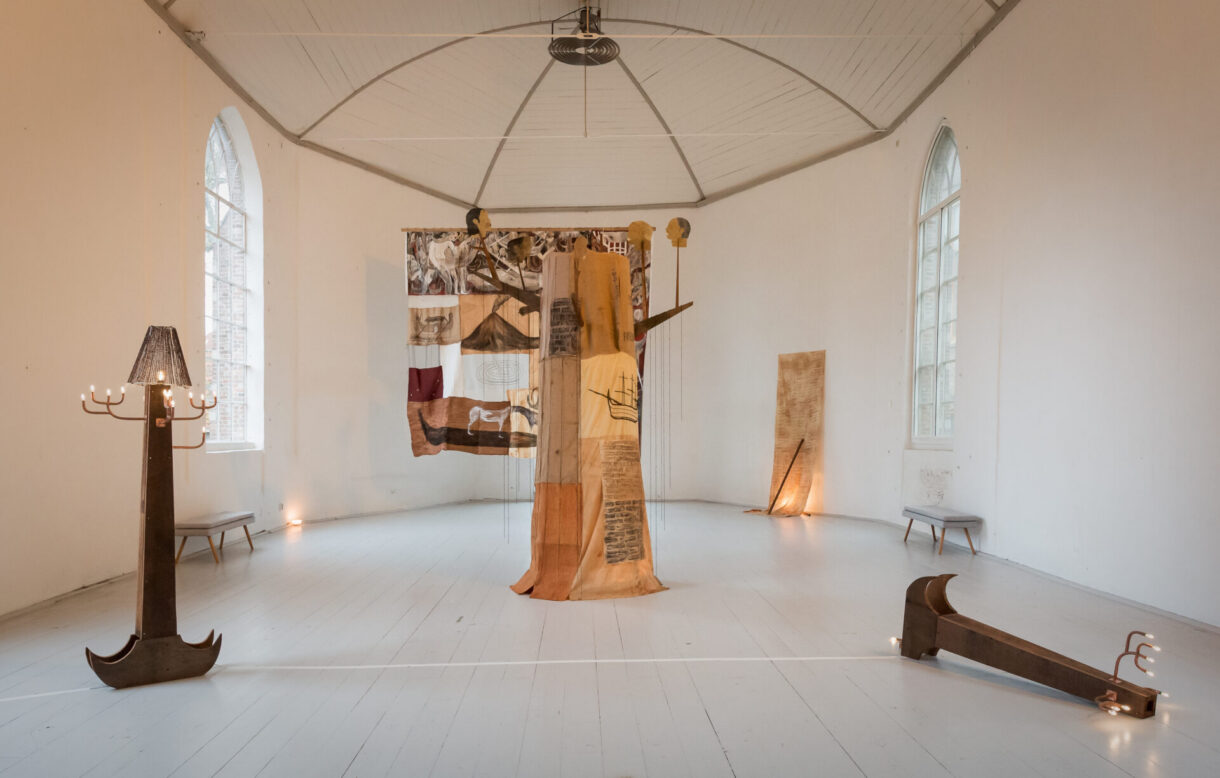
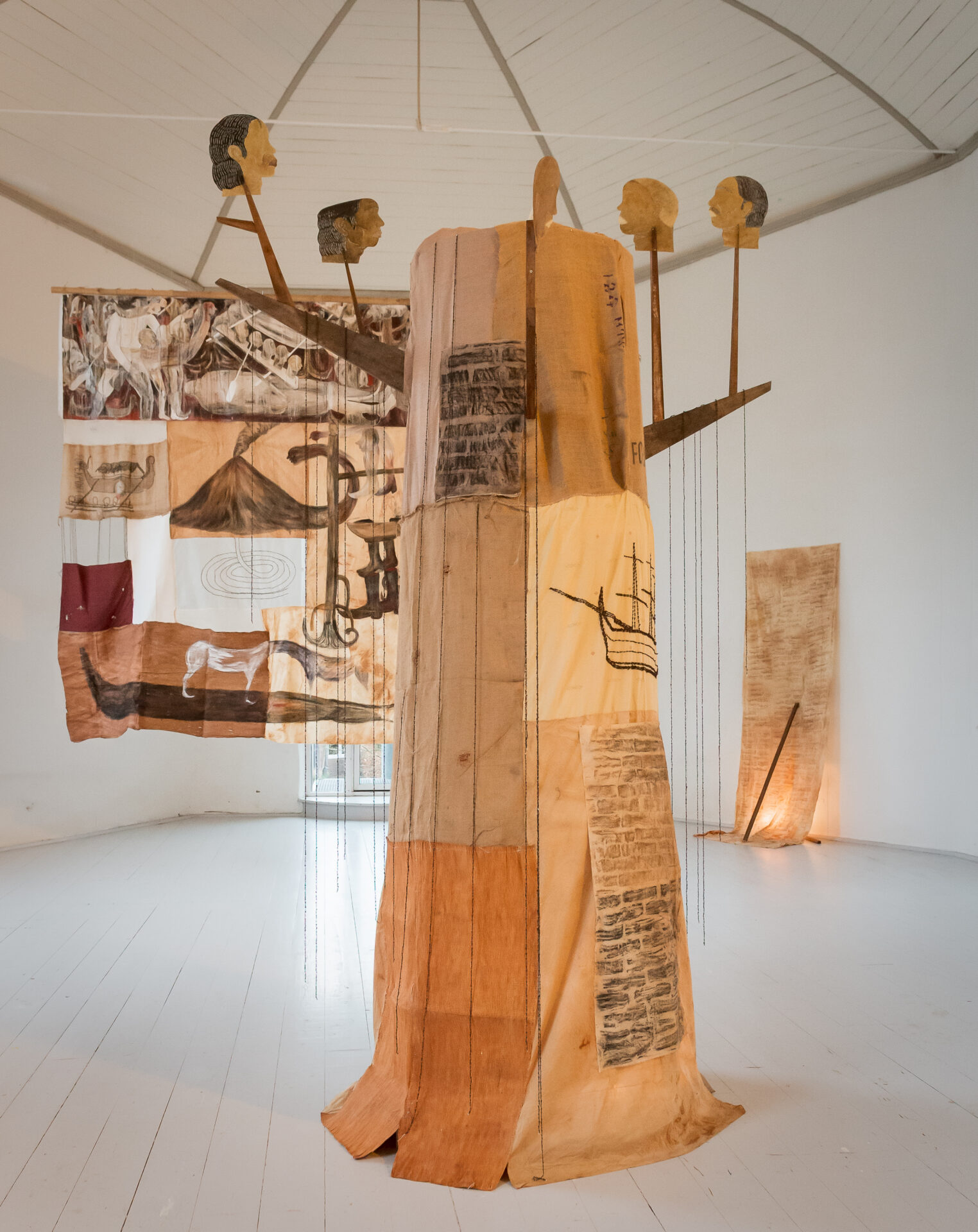
That, perhaps, is where Silent Song sprouted. For Ipeh, the Afo became the silent witness. The previously bare tree trunk is now draped in cloth dyed with clove extract; smoke motifs mark its surface, and embroidered onto the fabric are clove buds outlining the image of a three-masted vessel. Its branches, from which strings of cloves hang, point in every direction, their ends are crowned with two-dimensional profile heads, carved from dried water buffalo hide and reminiscent of wayang kulit silhouettes.[5]
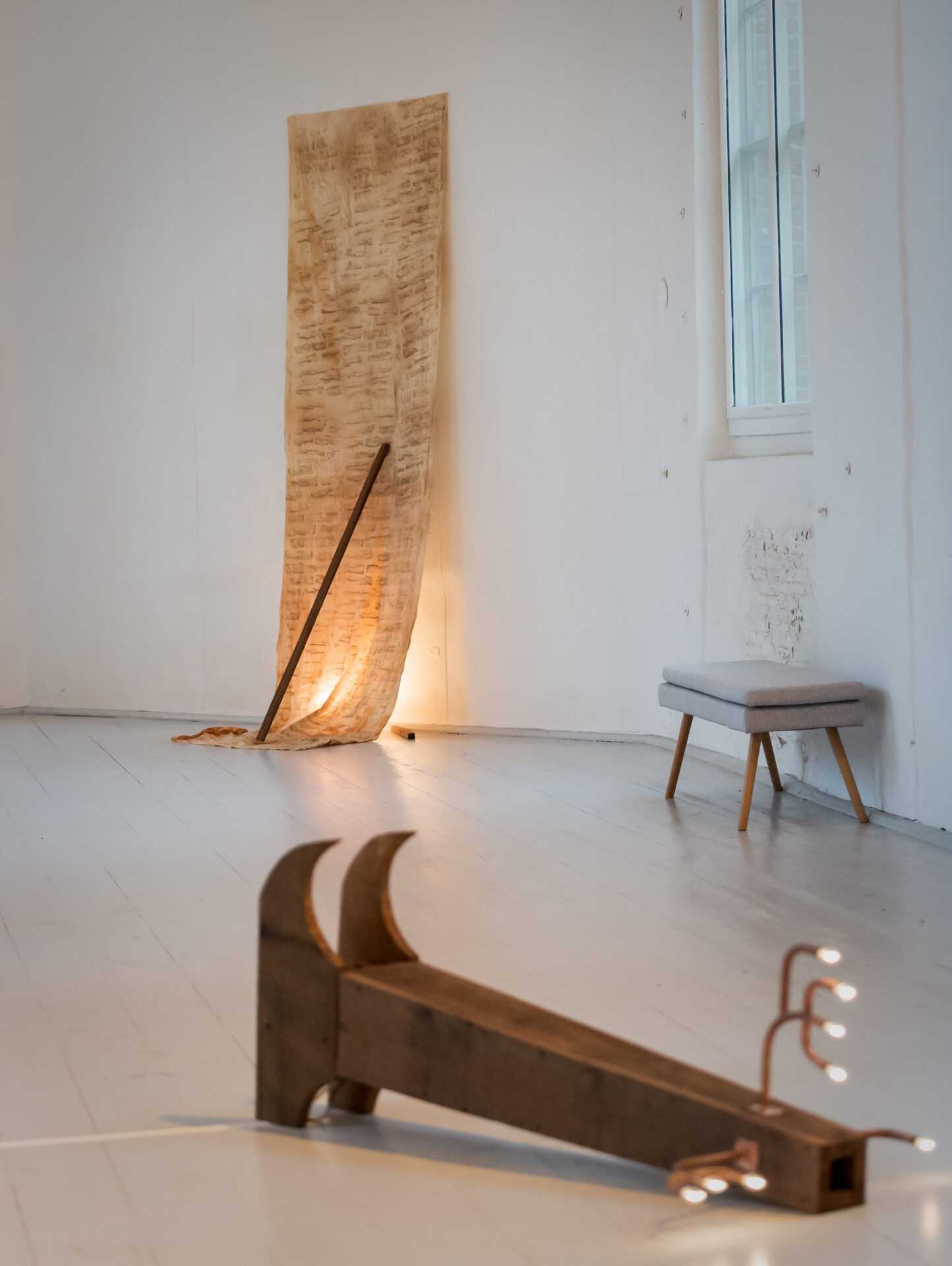
Two smaller wooden structures flank the Afo. They resemble trees, with root-like stems rising upward and candelabra-like arms as offshoots. One stands upright, adorned with a lampshade made from suspended clove-beaded threads. The other lies on its side, as if uprooted. The flickering of its many candle-shaped lights conjures the fires that wiped out the islands’ clove plantations.
A backdrop of what appears to be an unfurled sail hangs behind the tree, suspended horizontally from the ceiling. When we met, the fabrics that now make up this large-scale patchwork were neatly spread out across the chapel floor, in a mosaic of clove-dyed cloth, bark, and other materials, including a strip of tenun, a handwoven textile from Ternate. For Ipeh, materials or mediums are not mere symbols or metaphors, they carry a personal connection too. All pigments used in her paintings are derived from natural materials: soil, rocks, charcoal, clove, marble, and red oxide mineral. These pigments give form to detached, faceless heads and decapitated bodies, their visual fragmentation mirroring the displacement and uprooting wrought by the hongi. They man kora-kora, the traditional Moluccan canoes used in these expeditions; one vessel is embroidered with cloves onto a jute sack that is marked with the words ‘for export only’. Dark plumes billow across multiple panels, evoking burning trees, bodies, and homes.
The tree's age alone bears witness to the many histories and memories layered into the landscapes of the spice-producing islands.
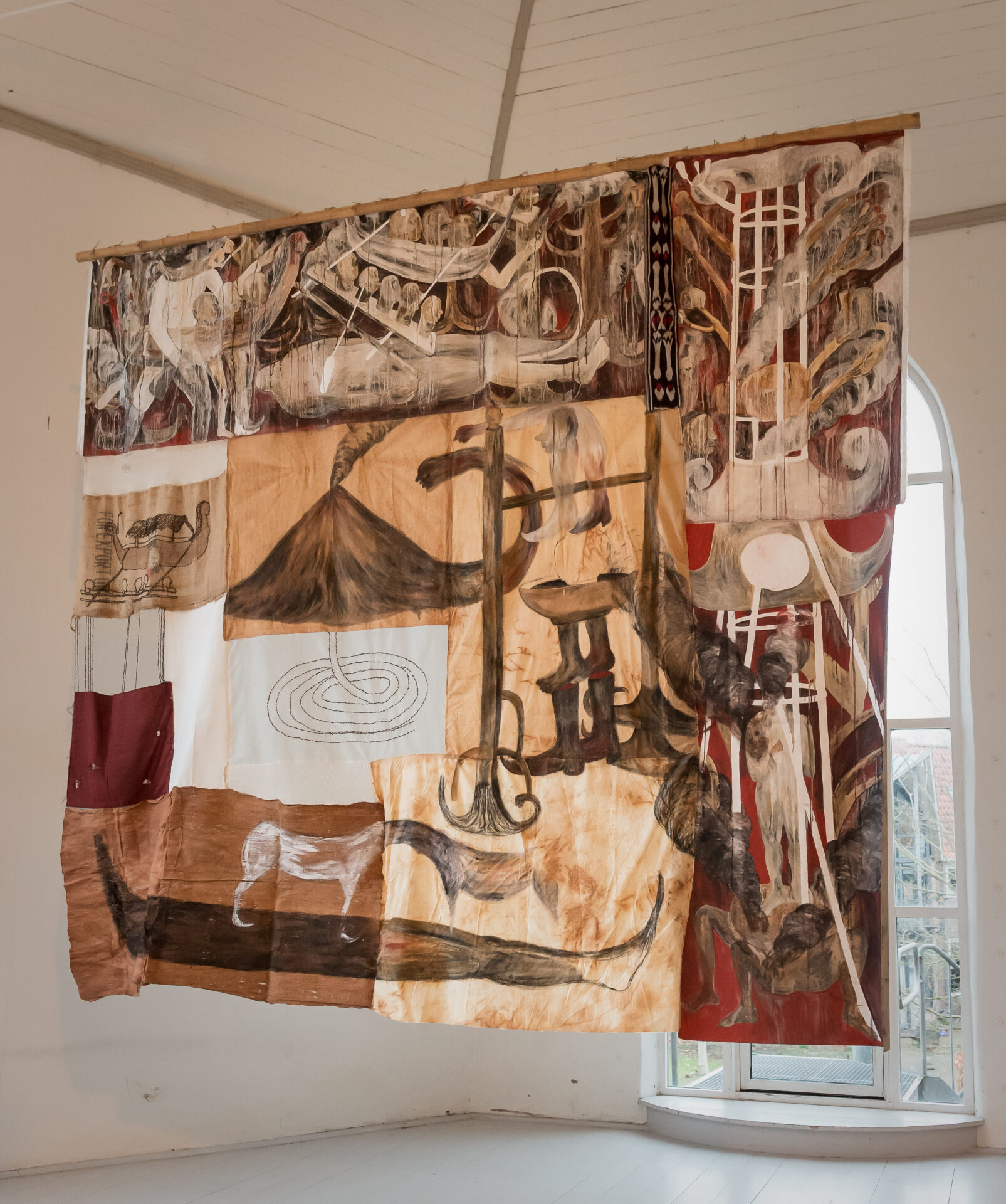
Colonial history is a fragrant history, and the material use of cloves in the installation is abundant; clove as spice, as commodity, but also as carrier of memory: bound to the land it came from, to the people who originally cultivated it, and to the violence done in its name.
The installation does not speak through material alone. In Ternate, Ipeh explored how memories of the hongi were passed down through oral tradition. In the past, she notes, the people used songs and folklore to explain or narrate a disaster, and they felt the spirits from the plants. A sound work emanates from inside her sculptural Afo, and deliberately so. To remember, she says, is to bring back those roots.
Part of the song was recorded in Ipeh’s hometown of Yogyakarta and is sung in both Indonesian and the indigenous language of Ternate. The composition adopts Gregorian chant, a tradition of liturgical singing historically bound to chapels and sacred spaces. Chosen, Ipeh underlines, for its sense of sorrow and emotion. That resonance of mourning and reverence is felt here: the restrained tonal range and recitative structure allow the words to carry their full weight.
The focus of the residency was not primarily on the figure of J.P. Coen but also on the experiences of Moluccans whose histories have long been marginalised while their oppressor remains commemorated on the city square. Ipeh turned to the local Moluccan community of Hoorn, inviting them to a kumpulan, an informal gathering, to share their memories of this history and collaborate in a process of writing and singing. She shaped their stories into mantra-like verses, that function as oral tradition does: returning to words until they are no longer recited but remembered and carried between voices over time.
Luka jadi kuat / the wound becomes strength
Api jadi cahaya / fire becomes light
Aku berdiri / I stand
Aku bernafas / I breathe
Aku tidak terbakar / I am not burned
Aku menyala terus / I keep burning on, I keep alight
These lines speak to the Afo as much as to people, to ancestors and their descendants alike. The extirpation policies displaced indigenous populations and severed them from their cultural roots, just as clove trees were uprooted from their soil. The parallel is not a metaphor so much as shared condition.
clove as spice, as commodity, but also as carrier of memory: bound to the land it came from, to the people who originally cultivated it, and to the violence done in its name.
In cultivating remembrance quite literally, Ipeh planted and tended her tree in Hotel Maria Kapel, as the people of Ternate did and continue to do on the slopes of Gamalama to not forget about their past.
To tell of a history that has been forgotten or suppressed is to know it cannot be narrated whole. It survives in fragments, dispersed across landscapes and people: in descendants of trees and uprooted communities, its material remainders, and in a novel or a song passed down, forwarded between voices over time. In Silent Song, Ipeh tends to those fragments as the community of Ternate tends to its lineage of Afo: to keep them alive. How such histories are carried, transmitted, and remembered, in itself, a form of history-making. ‘The past always manifests itself in the present, and memory shapes history,’ she reminds us.
Ipeh Nur’s solo show Silent Song at Hotel Maria Kapel in Hoorn is on show until March 14
The tree is on display at Museum Arnhem as part of the group-exhibition Bakudengar from March 10 – September 20, 2026.
[1] Daging semur, an Indonesian beef stew. Semur is derived from the Dutch verb of smoren, meaning ‘to braise’. Kretek is a cigarette made with a blend of Indonesian tobacco and cloves. The word kretek is actually an onomatopoeia for the crackling sound of the burning cloves.
[2] Orang kaya: literally “rich people,” a title for elites who held political authority on the Moluccan islands of Banda.
[3] In our conversation, Ipeh referred to this memoir as the “Banda Book.” Its full title is Friends and Exiles: A Memoir of the Nutmeg Isles and the Indonesian Nationalist Movement (2008).
[4] published in English as Cloves for Kolosia (2015).
[5] Wayang kulit is a type of shadow puppet of flat leather, carved out of dried cowhide and used in traditional Indonesian performance traditions.
Claire Schwarz
is an art historian and researcher