Ordering Political Order: Willem de Rooij – Valkenburg at Centraal Museum
In the exhibition Valkenburg at Centraal Museum Willem de Rooij brings together around thirty historical works of Dirk Valkenburg (1675-1721). Valkenburg was one of the first Europeans sent to Suriname to depict the plantations there. He also primarily painted hunting scenes and portraits of the eighteenth century Ductch who made their fortunes through colonial trade and slavery. De Rooij organizes this body of work to examine how colonial power dynamics shaped Valkenburg’s art. Laurens Otto visits the exhibition and wonders how these kinds of extractive relationships continue to influence the contemporary (art) world. GO TO DUTCH VERSION
I, a white art critic, was tasked by a white editor-in-chief to write about a white artist who creates work based on the colonial-era paintings of another white artist, Dirk Valkenburg. This chain of events might appear suspect (or somewhat depressingly typical), but it is precisely white people who should face the depletion, destruction, and violence underwriting the wealth that colonialism brought to the Netherlands.
The exhibition Valkenburg at Centraal Museum, Utrecht, organised by the contemporary artist Willem de Rooij, consists of some thirty historical works by Dirk Valkenburg (1675–1721). Valkenburg was renowned for his hunting scenes and portraits of Dutch elites who made their fortunes from colonial trade and slavery, but he is mainly of importance today for his depictions of Dutch plantations in Suriname. De Rooij has put his oeuvre on display to investigate how colonial power relations shaped Valkenburg’s work.
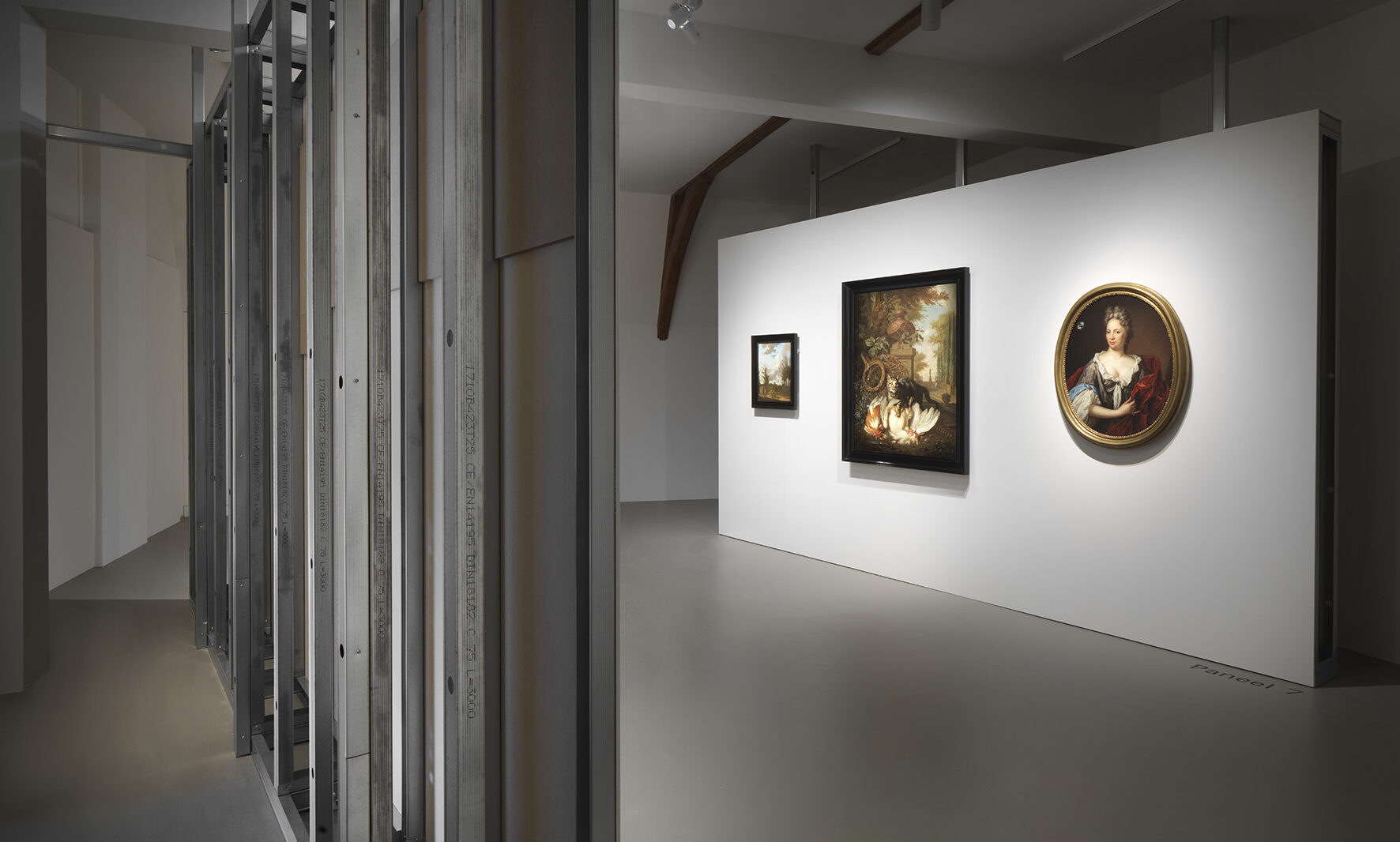
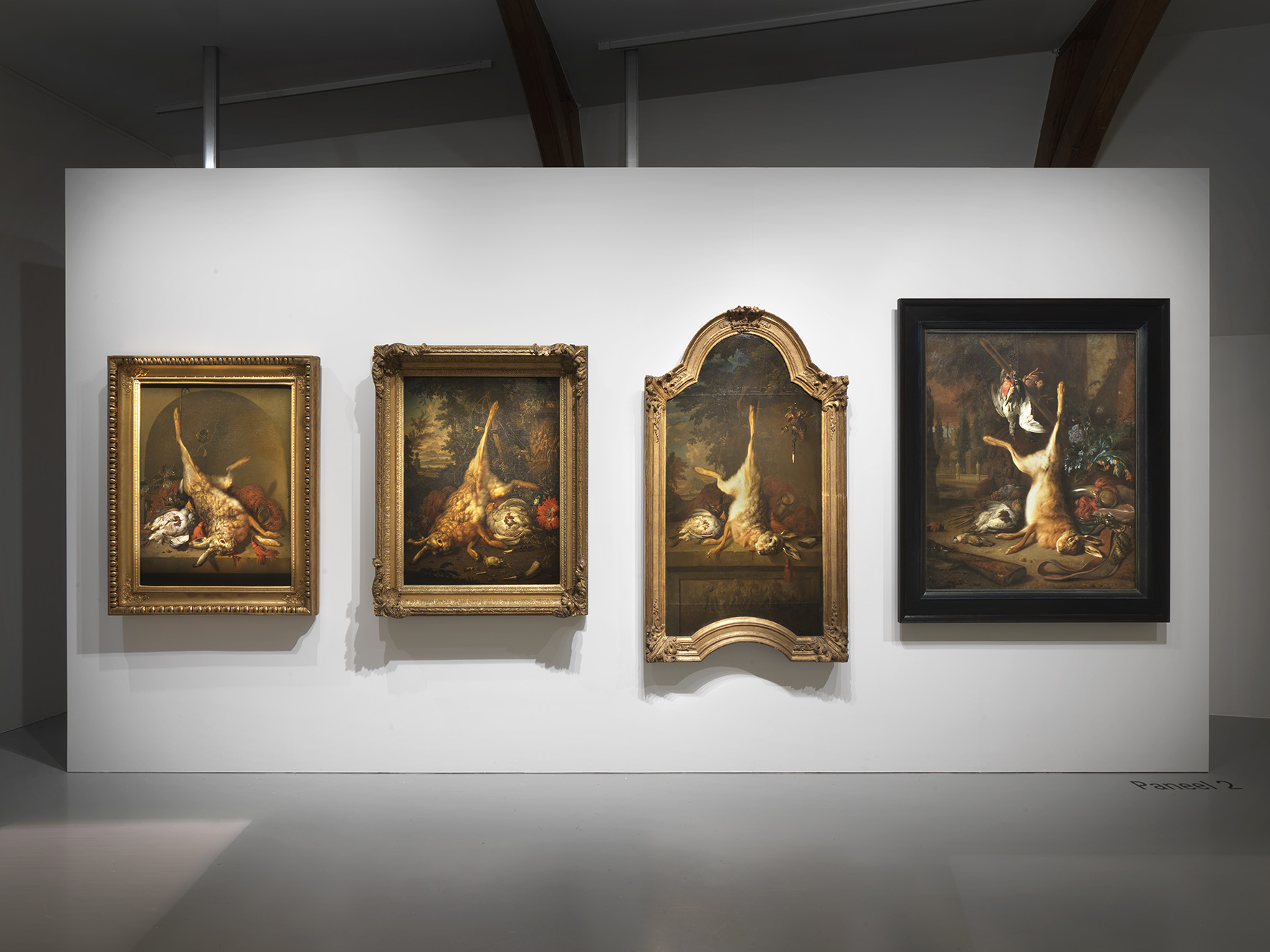
The exhibition is divided into thematic chapters, dubbed “panels.” It starts with a grouping of portraits that Valkenburg made of his various patrons. As De Rooij sharply analyses, all of these patrons derived their wealth from colonial extraction, and the slave trade specifically. The exhibition then passes through Valkenburg’s still lifes and hunting scenes, ending with his images of the plantation economy in Suriname, of which the depicted Dutch elites were essentially the face.
The Valkenburg works are hung on floating walls placed at a minimal distance from the actual museum walls, thus putting them in quotation marks of a sort, or perhaps on autopsy tables, all the better to dissect them. The noticeable repetition – one similar portrait after another, one almost identical hunting picture after another – illustrates the extent to which Valkenburg operated on commission. Presented as serial objects, the paintings become readily legible as symbols of power. The available codes (subject, composition, use of colour) for representing status and wealth suddenly appear limited, unimaginative. The works are drawn from various Dutch collections, including the royal collection in Denmark and the princely collection in Liechtenstein. Provenance – the pure sedimentation of extraction and expression of wealth.
Valkenburg, a painter of idealised scenes of money and power, was well positioned to become one of the first Dutch artists to document plantations in Suriname, which he did for two years, commissioned by the politician, plantation owner, and collector Jonas Witsen. Many of these works read today as crass inventories of people and land. The technical drawings made on the plantations have such an evidently practical purpose that it’s uncertain whether they can even be considered fine art. Yet Valkenburg’s Suriname paintings are historically important because they are among the few images of enslaved people from that period, produced on site.
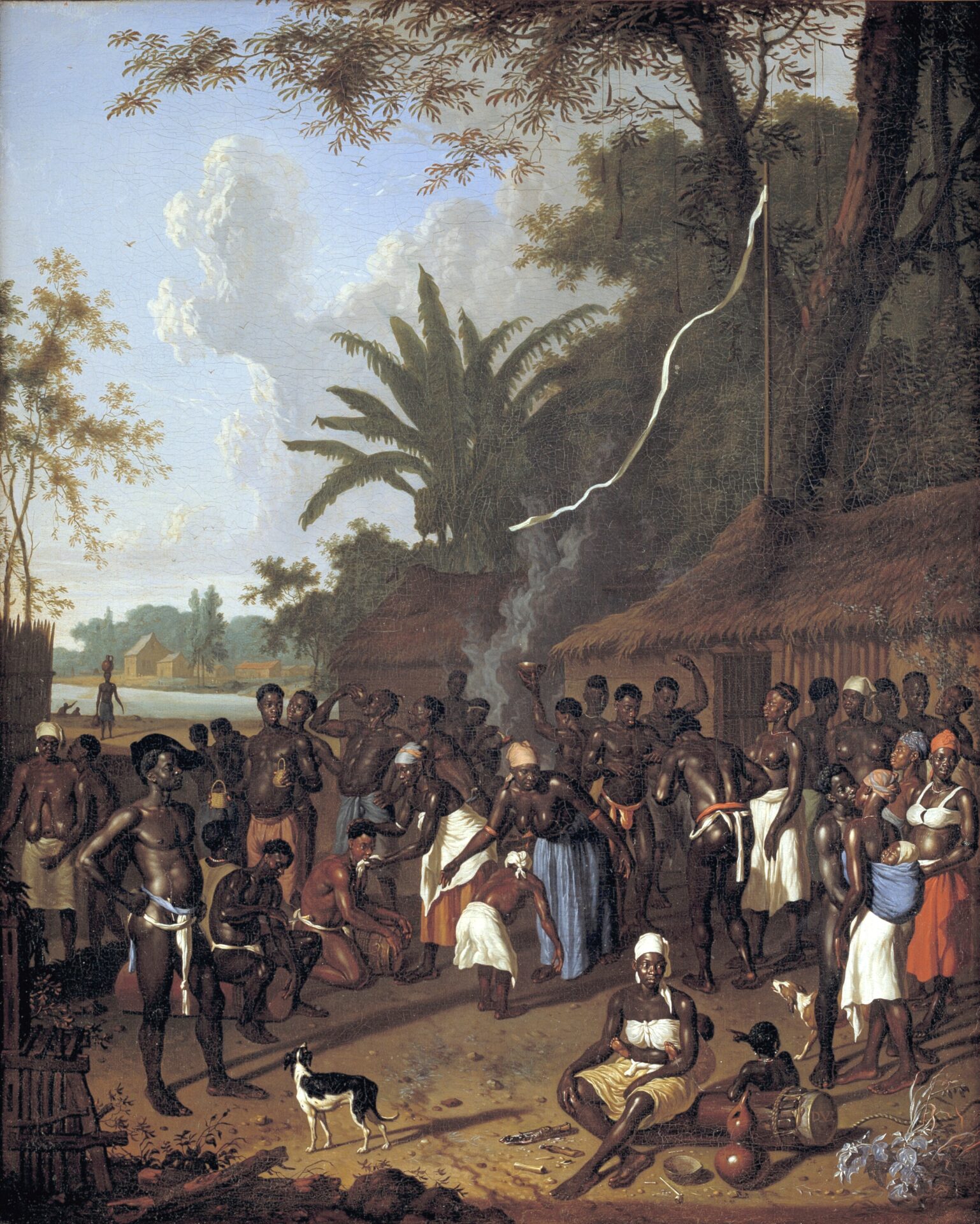
One that stands out, by departing from painting as purely a means of cataloguing capital is Gathering of Enslaved People on One of Jonas Witsen’s Plantations in Suriname (1707–8), drawn from the collection of SMK, the National Gallery of Denmark. In contrast to a distant, objectifying perspective, this view conveys closeness, humanity, perhaps even sincere curiosity. Here, people have faces and are depicted as individuals in the setting of a ceremony – not as anonymous objects performing forced labour.
One obvious question that occurs is not so much about the meaning of Valkenburg’s work, but rather what role De Rooij plays in this project. Its introductory wall text declares: “Valkenburg is a work of art by Willem de Rooij (born 1969).” But how exactly does De Rooij’s intervention differ from the effort of a typical curator? Clearly he has not only assembled the paintings, but also framed them, literally by meticulously arranging them on free-standing walls and thematically in the brochure and accompanying publication. The catalogue, edited by De Rooij and the historian Karwan Fatah-Black, consists of fifteen essays by (art) historians and anthropologists and Valkenburg’s catalogue raisonné. If Valkenburg diligently catalogued capital and symbols of power, De Rooij frames that project. His “ordering” consists of arranging like with like, but also juxtaposing items that seem dissimilar (plantations placed next to opulent still lifes).
De Rooij applied a similar strategy in his 2010 exhibition Intolerance, when he placed paintings by Melchior d’Hondecoeter (1636–1695), a painter of exotic birds, next to eighteenth-century ceremonial objects from Hawaii. Such a comparative analysis makes it possible to consider how images were used to serve the interests of the elites of a particular period. But I would like to propose that it would be more challenging, and also more dangerous, not just to present such research into the past, but also to examine how art production is intertwined with power in the present. It feels safe to talk about “the agenda of images,” but what is the agenda of good taste today? Who is allowed to speak, and who can take critical positions? And what about the partners, sponsors, and patrons upon whom every museum depends? It is seductively easy to regard ourselves (artists, curators, critics), however critical we may be, in contrast to Valkenburg – meaning, as anything other than mere court painters.

The present project started in 2006, when De Rooij began his research into Valkenburg’s contemporary, D’Hondecoeter. It resulted in an exhibition proposal for the Stedelijk Museum (aborted for possible conflict of interest, as De Rooij then served on the museum’s board), in a symposium, and now in the present exhibition and extensive publication. Taken as a whole, this constitutes an incredibly rich body of research. Yet the project almost completely fails to address the fact that the relationship between plantations and Western prosperity is not incidental, but structural, and ongoing. This is in line with recurrent blind spots of art history, a discipline often unable or unsuited to recognise material connections.[1] We live in a “Plantationocene”[2] – plantations are the matrix of our modernity. As engines, as oil (literally: palm oil is the cheapest possible fat, which is why the Anglo-Dutch conglomerate Unilever became so powerful), and as a conceptual framework, monoculture can be imposed upon people and nature, as much now as then.
Within that system, plantations are inextricably linked to art. Important Dutch museums, such as the Van Abbemuseum, Eindhoven, and the Stedelijk Museum Amsterdam, were founded with plantation money – not only profits directly derived from the plantations, but also options on expected future profits.[3] In his book Slavery and the Culture of Taste (2011), literary scholar Simon Gikandi specifically describes the above-mentioned Gathering of Enslaved People on One of Jonas Witsen’s Plantations in Suriname, and how such art was a convenient tool by which elites could distance themselves from and elevate themselves above the horrific violence that took place on the plantations. The financial relationship between the artist Valkenburg and the plantation owner and art patron Witsen is absolutely exemplary of the deep and fundamental relationship between art and extraction:
Through their patronage of art and taste, the slave-owning plantocracy . . . laundered its ill-gotten money and refashioned its identity. . . . Living an aesthetic life, even an eccentric one, transformed one from being the son of a crass Jamaican planter to a person of taste. And as men of taste, West Indian planters could deploy a kind of repressive mechanism in which the power of art and good taste would transform them into a cultural aristocracy, far removed from the primal scene of slavery that was their inheritance and duty. In these circumstances, the purity and cleanliness of art would counter the danger and excreta of slavery.[4]
It is impressive how lucidly and consistently Willem de Rooij dissects power structures. But persistently looking at colonial history, no matter how much filth is brought to light, nevertheless risks making it seem as if our Western hands today are clean. In meekly placing extractive dynamics in the past, always in pious, moralising language, museums avoid implicating themselves or we viewers in present structural inequality. Plantations are not a thing of the past; they underwrite our lives, and, in a sense, our disposition to critically reflect on them.
[1] This also explains the polemical position of the artist Renzo Martens, who has systematically questioned the mandate of critical art. The programmes he develops (in fits and starts) with plantation workers from the CATPC (Cercle d’Art des Travailleurs de Plantation Congolaise) are a demasqué of institutions that are interested in colonialism and postcolonialism as ideas, but not in the actual material relationships that make Western living standards (and therefore also art) possible. In spite of much sophisticated postcolonial discourse, no museum has settled its debt to plantations.
[2] First proposed by Donna Haraway. See Donna Haraway, Noboru Ishikawa, Scott Gilbert, Kenneth Olwig, Anna Tsing, and Nils Bubandt, “Anthropologists Are Talking – About the Anthropocene,” Ethnos 81, no. 3 (2015): 535–64.
[3] See “Handelshuis Van Eeghen,” City Archives of Amsterdam: https://www.amsterdam.nl/stadsarchief/nieuws/handelshuis-eeghen/. Cultural historian Nancy Jouwe published important research in her essay “The Stedelijk: A Museum in Imperial Amsterdam,” Stedelijk Szine, no. 1 (2021): https://stedelijkstudies.com/wp-content/uploads/2022/02/Szine-01.pdf.
[4] Simon Gikandi, Slavery and the Culture of Taste (Princeton, NJ: Princeton University Press, 2011), 149.
Willem de Rooij – Valkenburg at Centraal Museum, Utrecht, 13 September 2025 – 25 January 2026
Laurens Otto
is a curator and critic