Infinite multiplication – In conversation with Sandra Mujinga
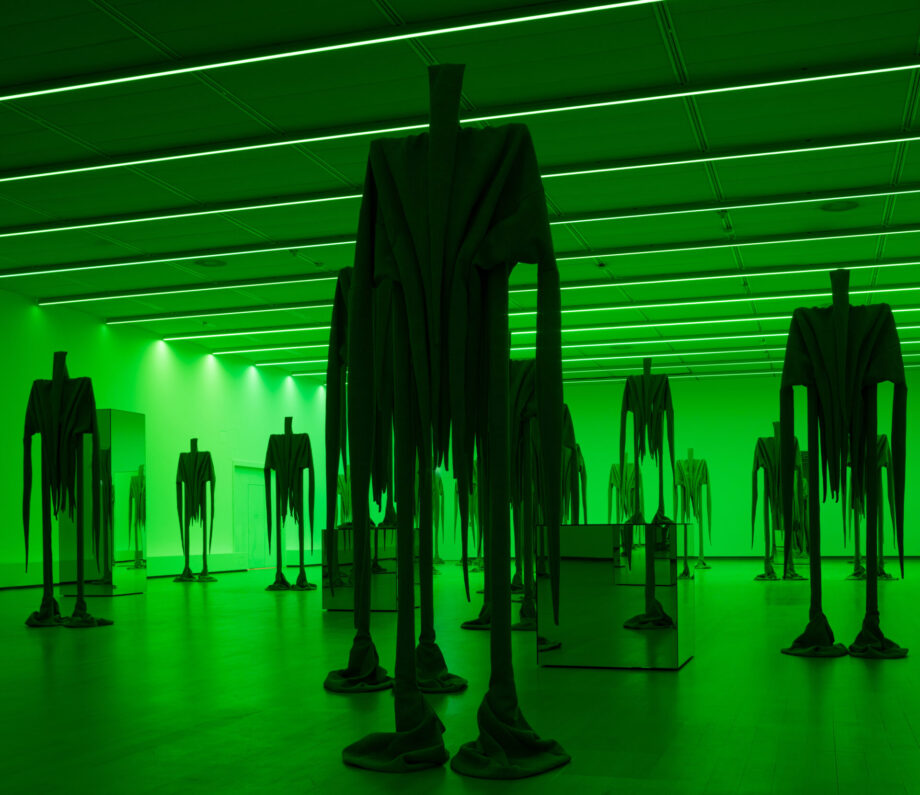
In Skin to Skin, in the basement of the Stedelijk Museum Amsterdam, Sandra Mujinga invites visitors to participate in a collective ritual of multiplication. With fifty-five virtually identical sculptures displayed simultaneously in a single space, she raises questions about origin and transformation, intimacy and camouflage, and the tension between hypervisibility and elusiveness.
Metropolis M To start: looking at your exhibition titles. These are specific, starting with Shapeshifters, Shadows of New Worlds, Midnight at and Spectral Keepers. Worldview was your first solo in the US Lack followed by I build my skin with rocks Fleeting Home, Time as a Shield and now Skin to Skin at the Stedelijk Museum. They sound like sequences, as scenes from a movie or episodes from a series. What are you trying to create and convey?
Sandra Mujinga: ‘It really depends on the show. Sometimes it’s like a conversation or to open up a world. I used for example certain sentences by [Edouard] Glissant and reframed them, like ‘I build my skin with rocks’. At Croy Nielsen I once used a title as a (store)sign you can perceive from the outside, while it derails what is actually happening on the inside. Titles are like storefronts. It’s a layered entry point, a way in. Those who grasp it, understand it. I see it as a different way of communication. Skin to Skin carries several meanings as well. It could be about intimacy and closeness, while it can also be read as a transference or transition from one skin to the next, which is quite brutal in a cloning sense. Have you seen Mickey 17?
MM What did you think about it?
SM ‘I consider it as a good rom-com. I was drawn to the humor and the dystopic framework. While he (the protagonist Mickey) was processing his past self as an inner child, dealing with things he had done with effects he could not control he also multiplied himself every time he died and got printed again. Thinking about these deaths, they become even more interesting.
MM The replication and the dying, the body being (re)printed again, relate to your work somehow.
SM ‘Him [Mickey] dying over and over again, made me think of Gaza: a testing ground for the military industrial complex where they use people to test new technology and weaponry. Mickey is thrown into all these different situations as well, whether it be about contamination, or about aliens that could read his mind or possibly kill him or eat him. The scientists just wanted to see how and how fast he dies in order to learn from his responses and to develop new approaches: a cure, vaccine or just knowledge through live research.’
MM We spoke before about all these films in relation to your practice. Arrival, Blade Runner, Alien, and many others. But you said a reading of your work through those films is too sci-fi or too futuristic, while your work is rooted in the actual reality of contemporary times; as an opposite to a distant, speculative or fictional future that most movies sci-fi depict.
SM ‘What I wanted to say was that I feel we just live in a time where we surpassed the term. You know, when in 2016 or something Black Mirror tweeted that they don’t have anything to add anymore. So I think sci-fi, or speculative futures used to be relevant, because they show the lack of left politics to come up with a different image or imagination for the future. And that’s when there was a Renaissance of sci-fi with Graham Harman, Quentin Meillassoux, China Miéville and all of those people. Now I feel we are just living in a time in which it is not a sub-genre anymore. The future is now.’
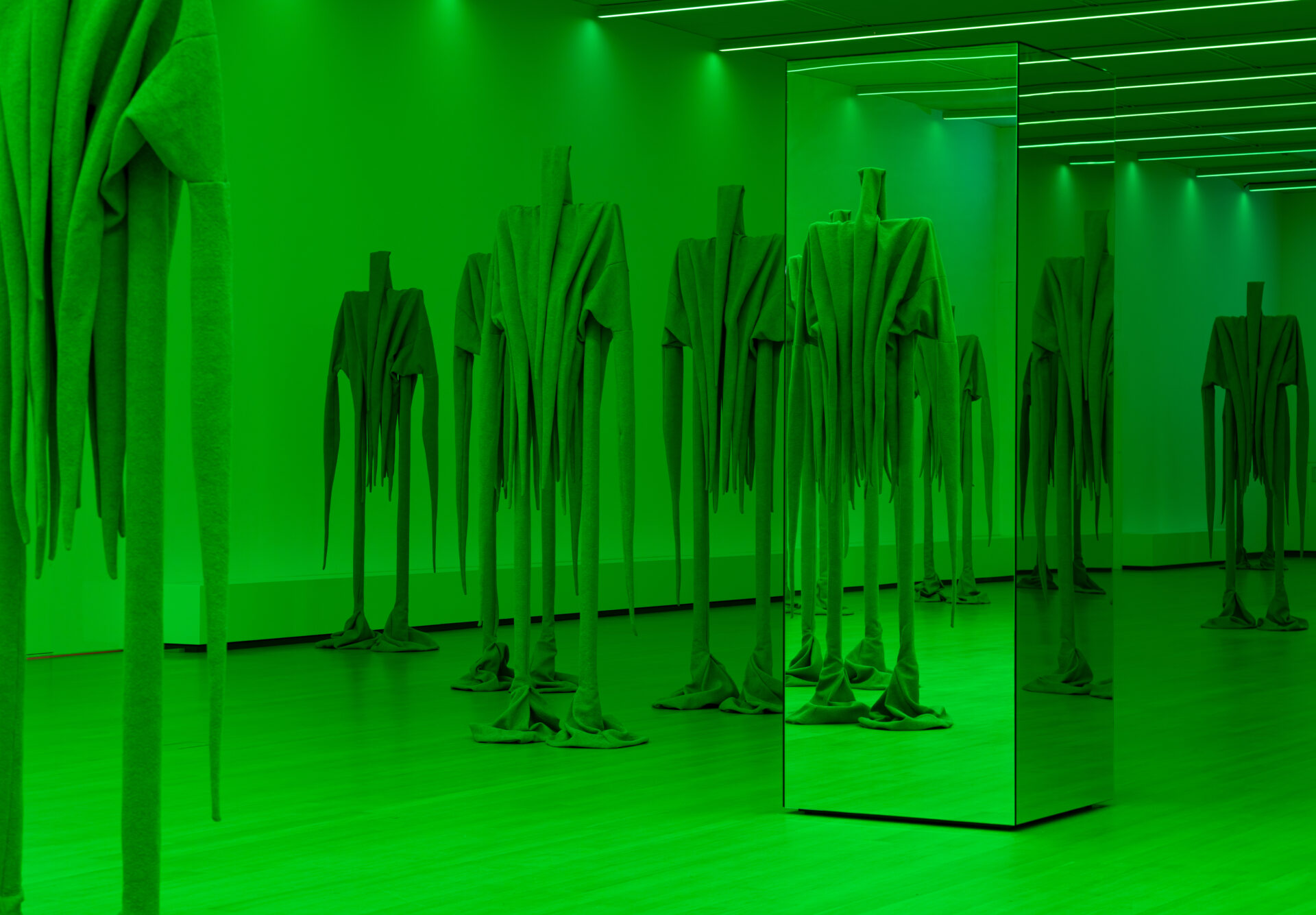
MM Thinking about images and imagination, I wonder how you relate to your work being disseminated through visuals? A lot of what the actual work is gets lost in translation. There often is sound, and the light is not just something for the photo, but it actually does something to the physical experience of the space.
SM ‘It’s interesting because I have a performance background, which is often not addressed. With performance you have to think about the documentation and how it would be interpreted in the future. And you don’t always document accurately, but you think about the way it comes across and can be edited. So you can stage it. Performance helped me to think about these ideas of how things appear in the future; and also how things will circulate.
I don’t think I make art as an illustration of what I’m reading, but it’s always in dialogue with my lived experience, and also with what I’m reading. In Norway, I was discussing diversity a lot, how to include people of color in art and how to be visible. I was always aware of what was projected onto me and what was expected of me. And I was thinking of ways to just be free. This idea of when you are in a club or just in a darkened room and no one is watching you, freedom grants you. And in the exhibition space, by making art, I envisioned creating structures to be as free as possible. It is like camouflage. I think of the green as a cloak. It is almost placing a green fabric over the sculptures and thereby protecting them. And how they circulate or are seen online: you will never really know what they actually look like. My galleries hate it (laughs).’
MM But you also used blue, an almost icy blue, before. At the Future Generation Art Prize exhibition in Kyiv for example (2024)?
SM ‘Yeah, and that was like the exact same blue that is in the fabric! It’s almost like this kind of plus plus or like this sort of erasure by using the exact same thing. The walls were painted the same blue too. Because of that, again, it became a play on hypervisibility. The fabric was one of those rolls you saw at my studio in New York (ISCP) that I got when I sourced for second hand fabrics. I did not know how to use it at first, but it turned out to be a really good sculptural canvas fabric. And I think in Belvedere (Skin to Skin will travel to Belvedere, Vienna in 2026), it will be quite interesting. It has a lot of daylight and I am very much into Oksana Timofeeva Solar Politics right now. I read her History of Animals at the academy which I loved and it connects to this old line by Negrestani where he says “the Sun is a brutal god”. I’ve been thinking about it ever since. The same goes for Doro in Wild Seed by Octavia Butler. He is a character that is basically death. And my question is: what would the sun be like if it could appear to us for the human gaze? In Leipzig with Fleeting Home (MdbK, 2023), I did not use any artificial light. The sun was a character in itself, because it was so present. That fascinated me. For Belvedere, I am still thinking about it.’
MM You have a DJ and producer background. How are these experiences of meaning to your work?
SM ‘Sound or music actually helped me to think about the sculptures. I like saying that my sound works are the ancestors of my sculptures. I recently came across this performance book with Peggy Phelan, around the same time I started making music again. I am the type of person who reads theory and then gets stuck with it for the rest of my life. I think through the same books over and over again. So I was reading Peggy Pellan on Unmarked: The Politics of Performance at the academy. She was talking about ideas on creating an immaterial presence. And I was like, I can create that with sound. And sound has always been the stepping stone or starting point to think of bodies that are not visible and traces. It becomes a gateway to think about ghosts or what is left.’
MM Nora Turato once said performance will be more present in the art world, as it’s the only thing that can prove it is actually real: it is here and now. You cannot fake the direct experience. Although there are probably ways, with holograms for example, but it is an interesting premise. Also, thinking about the question of what is real and perception. With AI, deepfakes and other technology. Worlds can be built, time stretches and people access subconscious layers, exist in different spaces or get lost in their own creations. I think this might also be interesting to you in the sense that it plays with perceptions and extending time connecting both to a multiplication level.
SM ‘It’s true. Actually, you have to read Alexis Pauline Gumbs book Undrowned. Black Feminist Lessons from Marine Mammals (2021). The book is about a way of learning from other living beings, not centering the human experience. She even speaks about how whales are breathing and how this can be tied to the black experience and survival. Alexis and I had a conversation for the publication of Skin to Skin. Then we were talking about time traveling and she was talking about ancestral meditation. In this sort of meditation you are accessing several past generations. And I am doing it myself in relation to a future self. I meet my old self: a 60 year old version of me. But I also meet my younger self. I’ve done inner child meditation, which means creating new memories.
Basically I can go to this place where I was at a certain age and then access her needs. When I come out of the meditation, it is fine because a woman came and helped me, and that was also me. You’re going back into time in order to create new memories in the here and now. I can do the same thing when it comes to the future, because the brain does not really know what is real and what is imagined, or what is past or future. So it is like using imagination as a way to create alternatives or solve problems or accessing this future or past version of yourself.
MM That sounds intense, but makes sense too. Does that feed into your practice?
SM ‘I never explicitly said that I use transgenerational meditation in my practice. But in a way, the exhibition does so. There exist multiple versions of oneself – in this case – of one body.’
'Sound or music actually helped me to think about the sculptures. I like saying that my sound works are the ancestors of my sculptures'
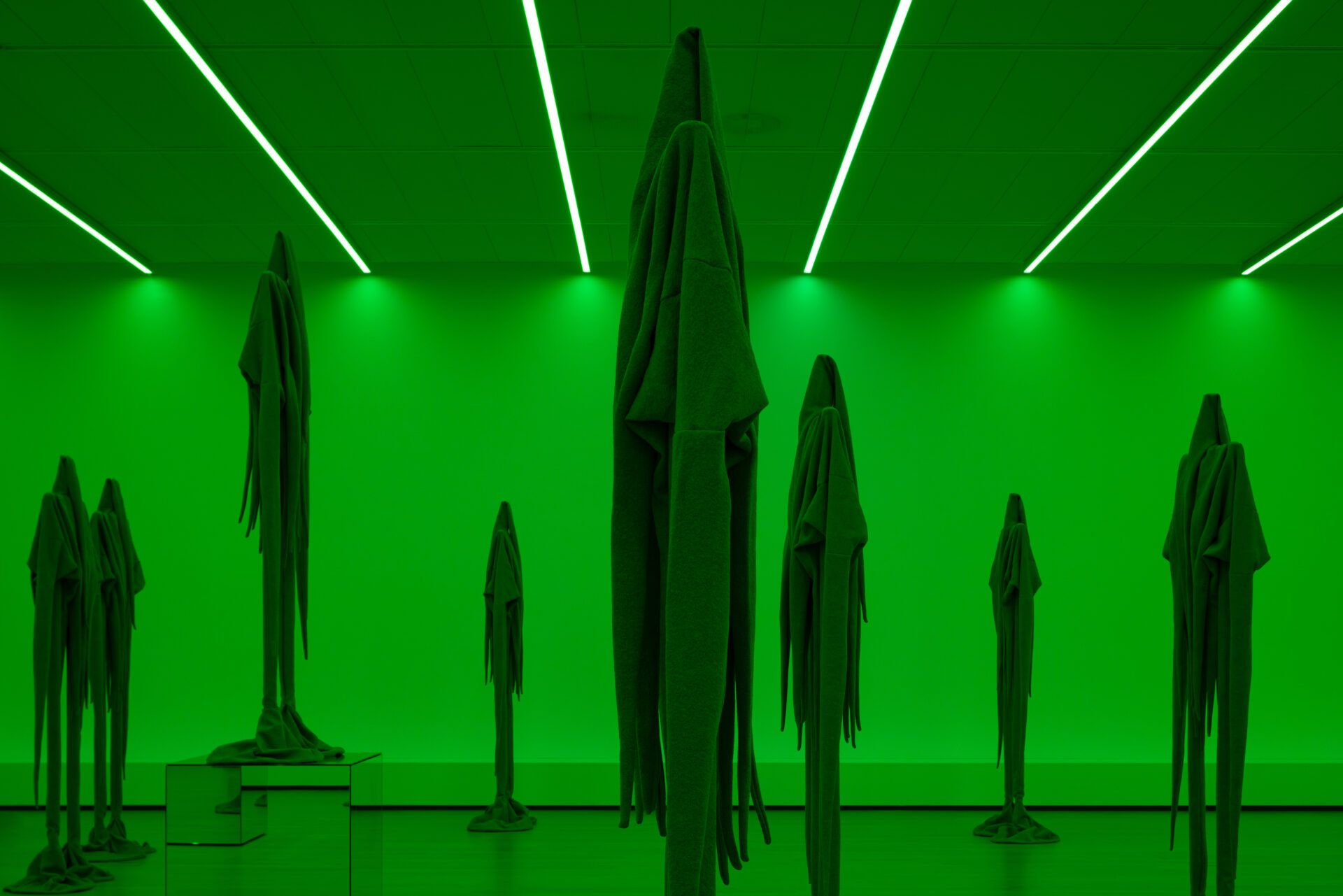
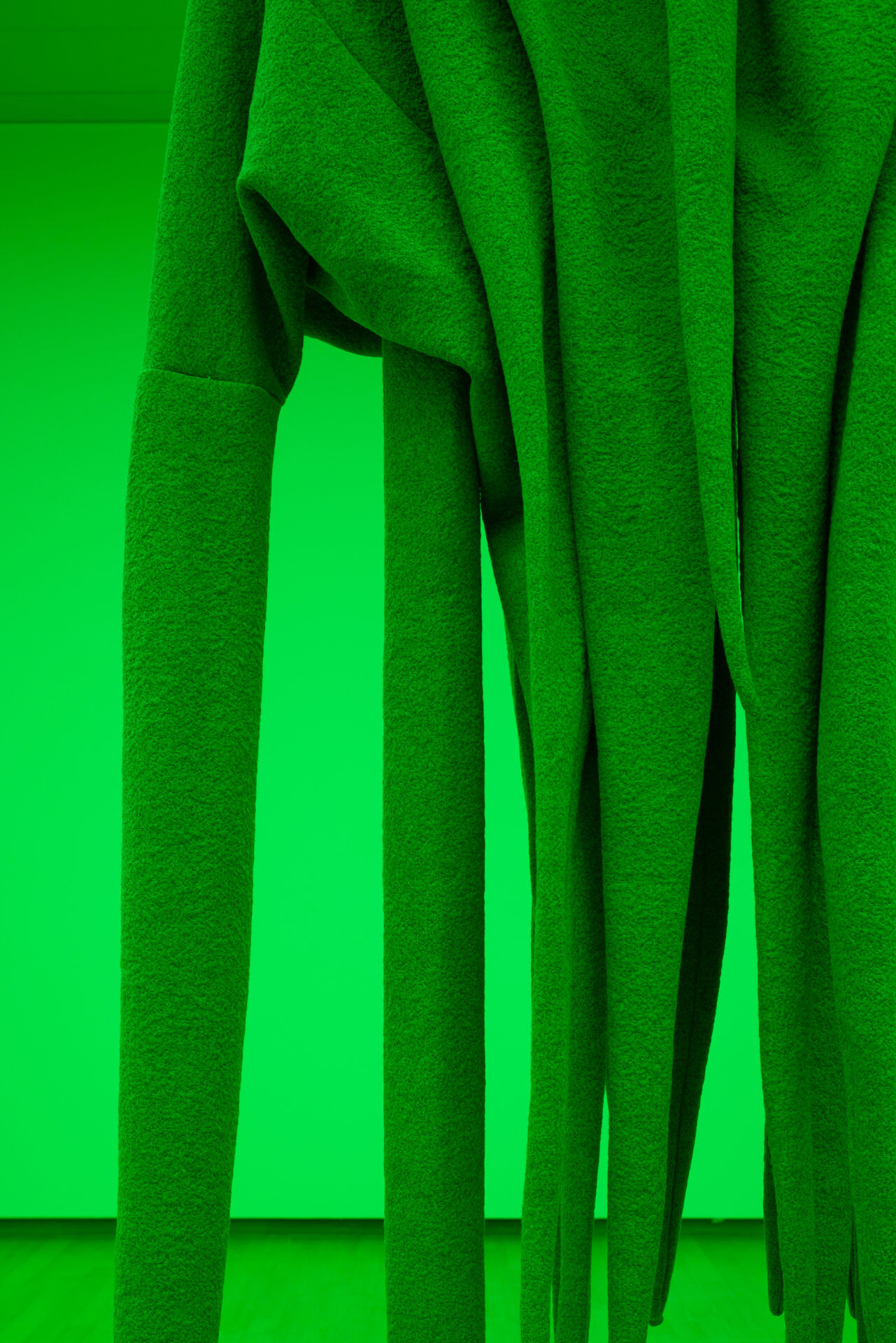
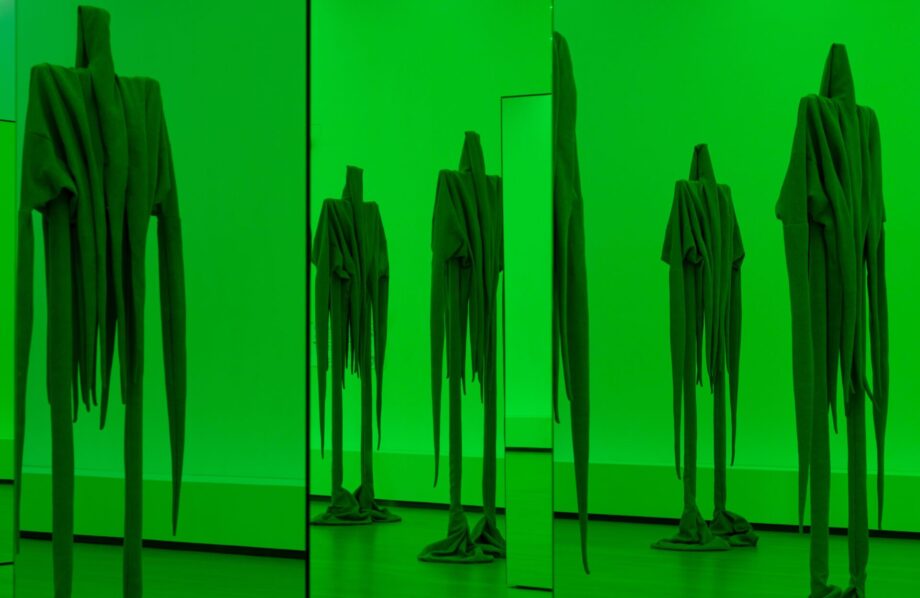
MM You have used various elements in your works: portals and visibility, access to different dimensions and different times. The work that was at MoMa and Guggenheim: Pervasive Light (2021), where one could never perceive the figure in its entirety. It is a fragmented digital presence that never showed itself completely. Similarly, I build my skin with rocks did this too. This entity behind a giant portal that would never fully disclose or present itself to the viewer. It takes time to get to see, know, perceive, and understand what is happening on the other side. These works were time based, and Skin to Skin is an installation. All the different dimensions or multiplications are present in the same space at the same moment. Still, you cannot really get to know them, or understand which one is the prototype and which one is a copy. In that sense, it is also camouflaging and obscuring. What are we looking at, what are they, as a collective body of 55 and as individual entities?
SM ‘Yeah. When you think of bodies as time capsules. That’s also something we talked about with Alexis [Pauline Gumbs]. Because with Time as a Shield, I was bombarded with advertisements on AI voice cloning, which made me think about the ageing voice, the intimacy of the voice which I think is quite beautiful. Over time the voice ages and I was thinking about that as a way of storing information and histories. And with Skin to Skin, the question indeed comes up: which was the first? Which one is number 1 and which is 55? That’s a way to build hierarchy, so I am not even going to mention which is the first, or which is the last. Then it becomes a way to perceive them as a collective, they are like a “we”. At the same time, the idea does start from the first one being multiplied. And it becomes a way to be invisible through being hyper-visible. So all of them choose to be visible at the same time.’
MM So it’s an all of us, or nothing type of thing.
SM ‘Yeah, well all of them of course store different time or information within their bodies, when you think of them as a capsule. I mean it’s like another strategy of finding ways of existing under surveillance or hiding in plain sight. Being in multiple places at the same time makes it kind of hard to police every single one individually. But also to police all of them; it becomes about collectivity. Ultimately they are one body, and by being multiplied their appearance becomes a sort of uniform. And of course there will be glitches, which you can also see in Mickey 17. Every version is the same person, but they are also different. The mirrored portals in the space will also give the audience an opportunity to not only look, but to be part of the we. ‘
A Dutch translation of this text was published in Metropolis M No 4 2025
Skin to Skin is on view till January 11th, 2026, at Stedelijk Museum Amsterdam