Beyond Collateral Status – Palestinian Presence at the Venice Biennale
The decision of the Venice Biennale to bring the Israeli Pavilion to the Arsenale has sparked considerable controversy about the political responsibility of the art world. If Israel remains visible at the world’s largest art exhibition, why does Palestine still lack a national pavilion? GO TO DUTCH VERSION
What defines a nation state? Is it territory, a flag, a shared culture, history, or international recognition? Of the 193 United Nations member states, 157 officially recognise Palestine as a sovereign state, which is more than 80%. If there is truth in numbers it never seems to apply to Palestine. Israel is recognised by 166 of the 193 member states, only a small numerical difference compared to Palestine, but a world away in treatment. Italy, like the Netherlands, does not recognise Palestine and as such, Palestine does not meet the Italian criteria for an official national pavilion at the Venice Biennale.1 This means that Palestinian artists and exhibitions run the risk of being perpetually relegated to “collateral events,” reflecting broader Palestinian exclusion from having a seat at the table in the international arena.
Palestinian collateral exhibitions at the Venice Biennale are a recent phenomenon. Palestine c/o Venice in 2009 at the 53rd Venice Biennale, curated by renowned Palestinian art historian Salwa Mikdadi, was the first of its kind. It presented works by Emily Jacir, Taysir Batniji, Khalil Rabah, Shadi HabibAllah, Jawad Al Malhi, and architecture duo Sandi Hilal and Alessandro Petti. Jacir’s site-specific project, stazione (2008-9), was to translate and display the stops of vaporetto Line 1 into Arabic to foreground Venice’s historical ties to the Arab world. Despite the Biennale’s approval, the municipal council censored it, deeming it divisive, and cancelling the project. Apparently, the mere sight of Arabic on the city’s hallowed vaporetto stops is enough to send Venetian officials into a tizzy.
Two years earlier, at the 52nd Venice Biennale in 2007, Jacir won the Golden Lion (for artists under 40) for her work Materials for a Film (2005-ongoing) in the international exhibition. The project traced the assassination of Palestinian writer Wael Zuaiter by Mossad agents in 1972 in Rome. Zuaiter was the first in a long list of assassinations of Palestinian cultural figures by the Israeli intelligence service.2 Jacir’s work becomes all the more poignant today in the light of Israel’s genocide in Gaza, the destruction of all cultural infrastructure, and the continued targeted killing of artists, intellectuals, and journalists. It demonstrates how Palestinian cultural production is perceived as a threat by the Israeli state because it draws on a long and rich heritage that ties Palestinians to their (home)land. Moreover, it amplifies Palestinian presence, historical and current, therefore undercutting Israeli hasbara (Zionist propaganda) that Palestine was “a land without a people for a people without a land”. Palestinian exhibitions at the Biennale might have been ramped up the past few years, but they still have been few and far between. Other notable official Palestinian collateral events include artists Bashir Makhoul and Aissa Deebi’s Otherwise Occupied (2013); the Connecticut-based Palestine Museum US’s project From Palestine with Art (2022); and Bethlehem-based Dar Jacir’s collaboration with the Artists + Allies x Hebron platform (founded by South-African artist Adam Broomberg and Palestinian human rights activist Issa Amro) South West Bank: Landworks, Collective Action and Sound (2024).
Stranglehold
There are multiple factors to consider the dearth of Palestinian presence at the Biennale: Israel’s continuing encroachment on the West Bank and, before the genocide, the suffocation of Gaza since 2007, have kept art communities in Palestine in a stranglehold. A punishing regime of curfews, permits, closures, and checkpoints have for decades curbed mobility of artists, artworks, and international exchange. Palestinian artists with Israeli citizenship (1948 Palestinians) have had to deal with increasing censorship, cancel culture, and funding cuts due to extremist ethno-nationalist cultural policies that demand loyalty to the Israeli state (in other words subscribe to its founding narrative and its Jewish character) and forbid commemoration of the Nakba.3 Add to this that on the whole international funding for Palestinian cultural initiatives has declined and the hurdles become very clear.
Within this whole context pressure from pro-Israel lobbies to keep Palestinian art and artists at bay from prestigious international art events, should not be discounted either.
By contrast, Israel has had a permanent pavilion at the Giardini since 1952. Throughout these 74 years Palestinian artists with Israeli citizenship, comprising 21% of the population, were not represented, with the sole exception of 1986, when Asad Azi and Ibrahim Nubani participated. Here again the problematic notion of “national representation” comes into play: what does national representation actually mean in an apartheid state? South Africa was banned in 1968 from participating at the Venice Biennale and only readmitted in 1993 when apartheid was being dismantled. Cue Israel, where decades of illegal occupation, land grab, settler violence, apartheid, ethnic cleansing, and now genocide, did not result in an official boycott. The international community’s shielding of Israel continues unabated. Indeed, it seems as if any action undertaken by the international community would be an admission of their own complicity in the matter. Apart from occasionally tut-tutting, there are no meaningful sanctions, boycotts, or efforts to isolate a genocidal state from the world stage. Israel continues to participate unpunished in international events like the Eurovision and the Olympic Games. Despite having breached its Association Agreement with the EU over human rights, it has not been suspended.4
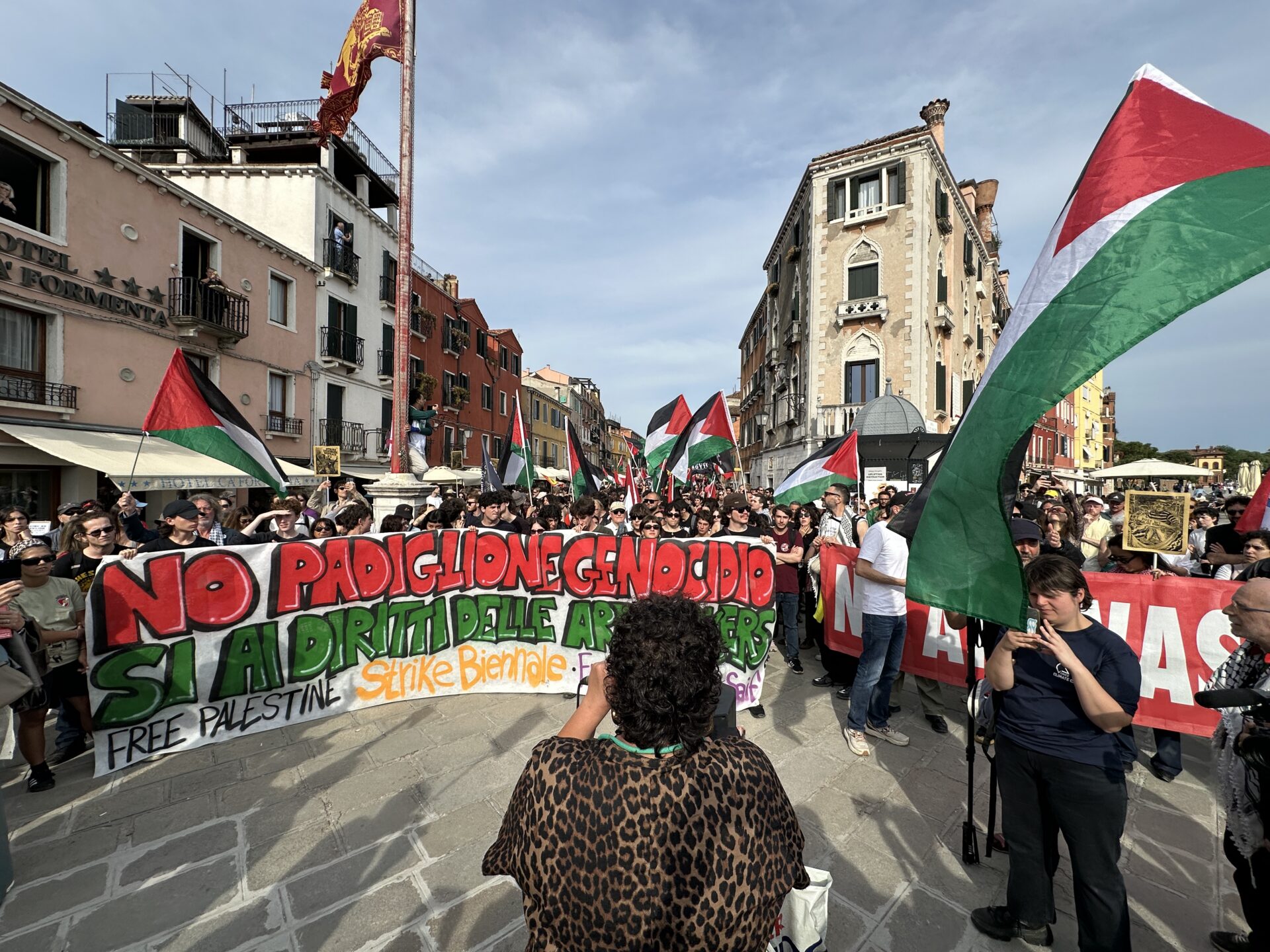
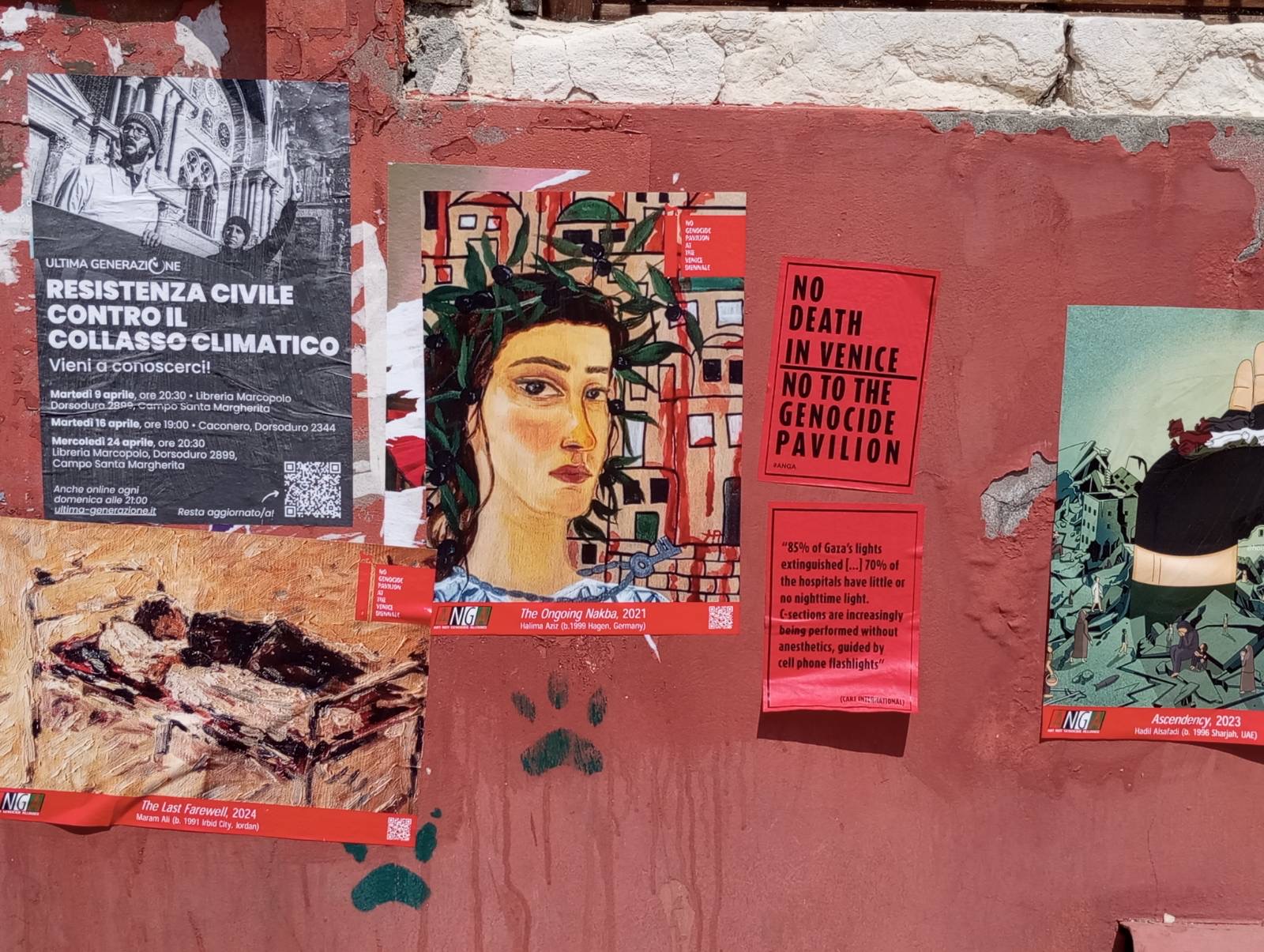
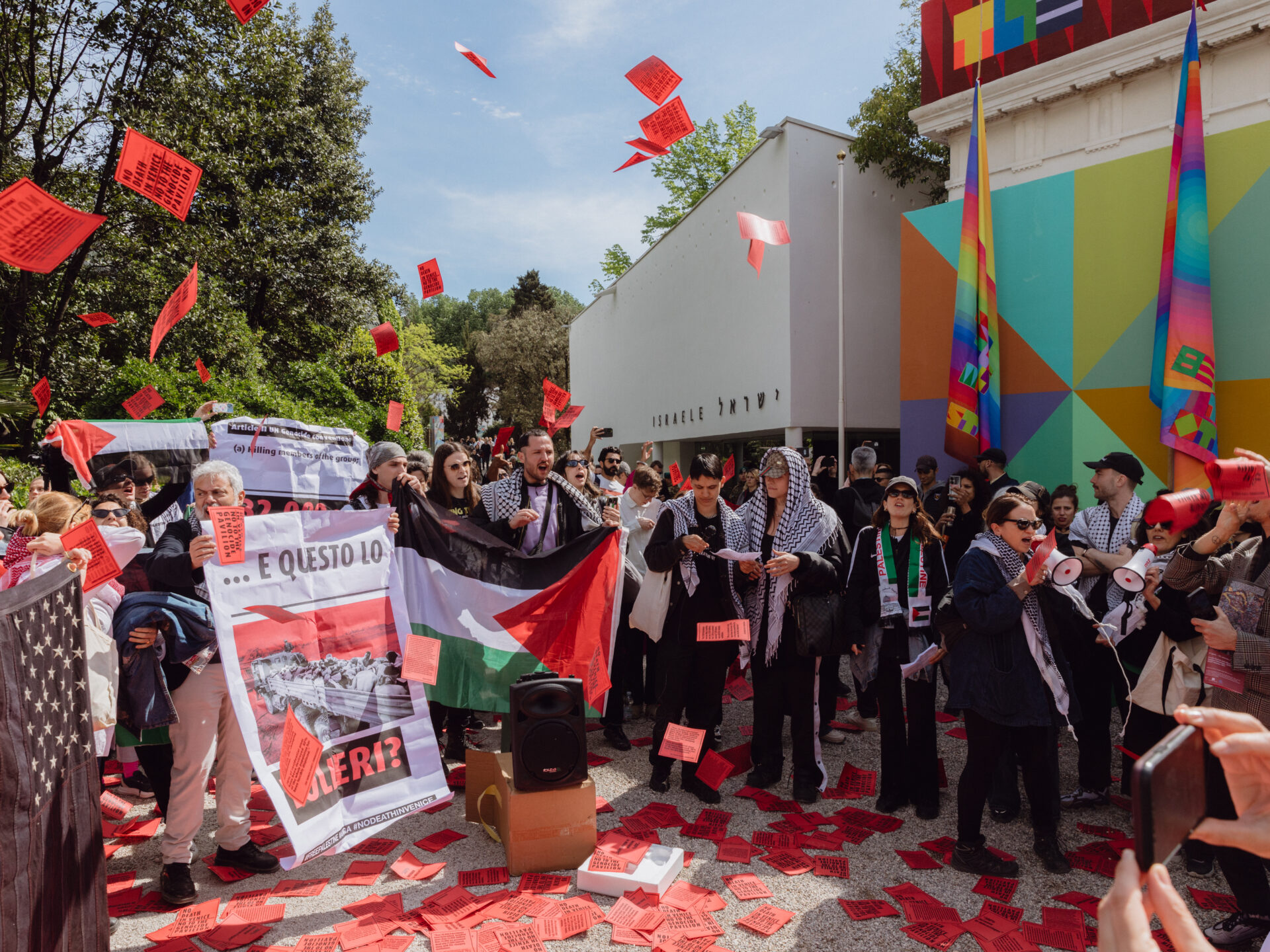
The Venice Biennale, then, is no exception to the blatant disregard of human rights and international law. It merely shows how the hypocrisy of the international community extends into the largest and most prestigious event in the international art calendar. Perhaps it is time to question the gold standard the international art world bestows on the Venice Biennale. To claim that the Biennale is a toothless apolitical tiger is clearly a misnomer as its boycott of apartheid South Africa illustrates. In addition, allowing Israel to participate—moreover offering it a pavilion inside the Arsenale while its pavilion in the Giardini undergoes renovations—is manifestly a politicised decision. And so, it falls on initiatives like ANGA (Art Not Genocide Alliance), an international group of artists, curators, writers, and cultural workers, to campaign for a boycott of Israel at the Biennale.5 In 2024 they reached 24,076 signatories during the Biennale’s 60th edition. By mid-March 2026 ANGA reports that 182 artists and curators participating in the Biennale had signed the call to exclude Israel from the 61st Biennale.6 While absolutely essential, these petitions—like the many solidarity demonstrations across the globe—have changed little on the ground. Nevertheless, it is on the grounds of the Giardini and the Arsenale that things must urgently change.
The art community is enamoured with words like solidarity and care but is seldom prepared to pay a price up front. Speaking out against genocide and for Palestinian self-determination has, however, cost people their jobs. The most recent casualty is the cancellation of the South African pavilion featuring artist Gabrielle Goliath and curator Ingrid Masonda by South Africa’s populist culture minister Gayton McKenzie after the project referenced the Gaza genocide. This is especially painful given South Africa filed genocide charges against Israel in December 2023 at the International Court of Justice. Imagine, then, if artists selected for national pavilions would relinquish their places to Palestinian artists in protest against their governments’ complicity. What would it mean if Palestinian artists would be able to present their work under fully credited national representation in the Giardini and Arsenale? The gesture would at least offer some form of historical repair.
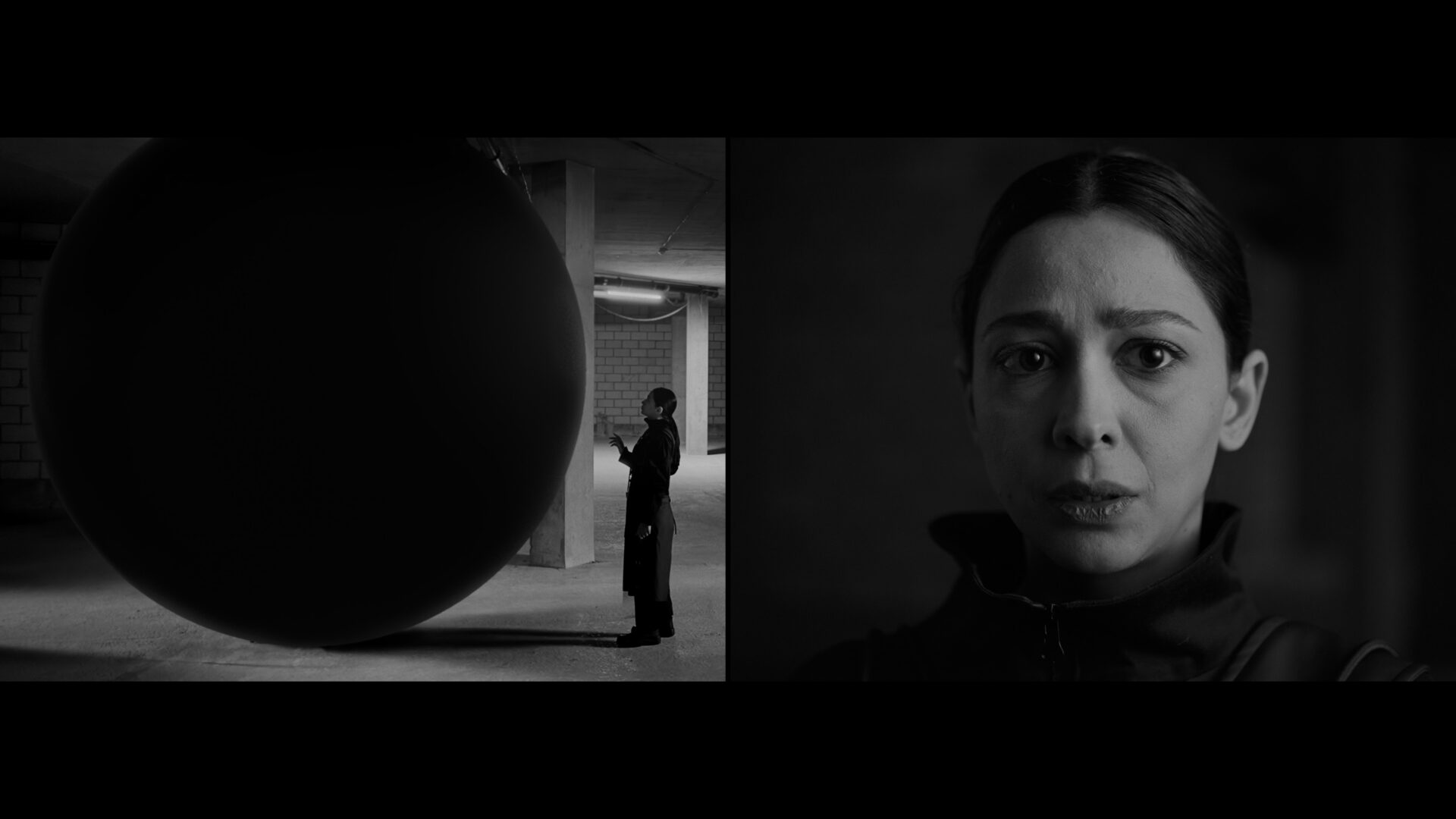
Till now, Larissa Sansour has been the only Palestinian artist to exhibit at a national pavilion in the Giardini, courtesy of her dual Danish citizenship. Her exhibition Heirloom (2019) for the Danish Pavilion, which I curated, questioned notions of national identity and the nation state in the aftermath of eco-disaster. This year, Palestinian-Saudi artist Dana Awartani, whose work was also featured in the previous biennale’s international exhibition, represents Saudi Arabia in the Arsenale. In the current context Palestinian artists can only exhibit in national pavilions under the auspices of their dual citizenship. This waters down their Palestinianess because ultimately, they are there to represent another country. Both Sansour and Awartani draw heavily on their Palestinian roots in their work. Nevertheless, their hyphenated identities such as Danish-Palestinian and Saudi-Palestinian, make these artists “safer” and “vetted” for international consumption. While Sansour has always been adamant in emphasising her background, and was fully backed herein by the commissioning Danish Arts Foundation, Awartani’s Palestinian descent is toned down. While mentioned in her biography on the official Saudi webpage, her practice is carefully repackaged as “foregrounding Middle Eastern cultural histories”.7
Making room
The sanitising of Palestinianess is real. Palestinian identity is still viewed as risky in an international Western art context. When Sansour and I worked on the Danish Pavilion, the externally hired PR-company at first suggested we remove “Palestinian” from Sansour’s biography to pre-empt possible fallout. The anti-Palestinian racism in such a demand was glaring, particularly given that Sansour’s work primarily calls attention to these types of erasures. Obviously, we refused, only to be treated to a list of insulting possible media questions to prepare, ranging from the artist inciting terrorism, sympathising with Hamas, to the work being antisemitic. We were advised to keep our answers to the media as general as possible to underscore the universality of the project, so it would not become solely about the Palestinian situation. Recalling the tone-deafness and insensitivity of the PR-company still makes my blood boil today. However, these attitudes and anxieties towards Palestinian identity are rife. It is as if the Palestinian experience can only be acceptable to the majority of Western institutions when it has been flattened, depoliticised, and defanged. Hence, turning Palestinians into what poet Mohammed El-Kurd has called “perfect victims,” though even here their victimhood should never be too loud or too conspicuous.
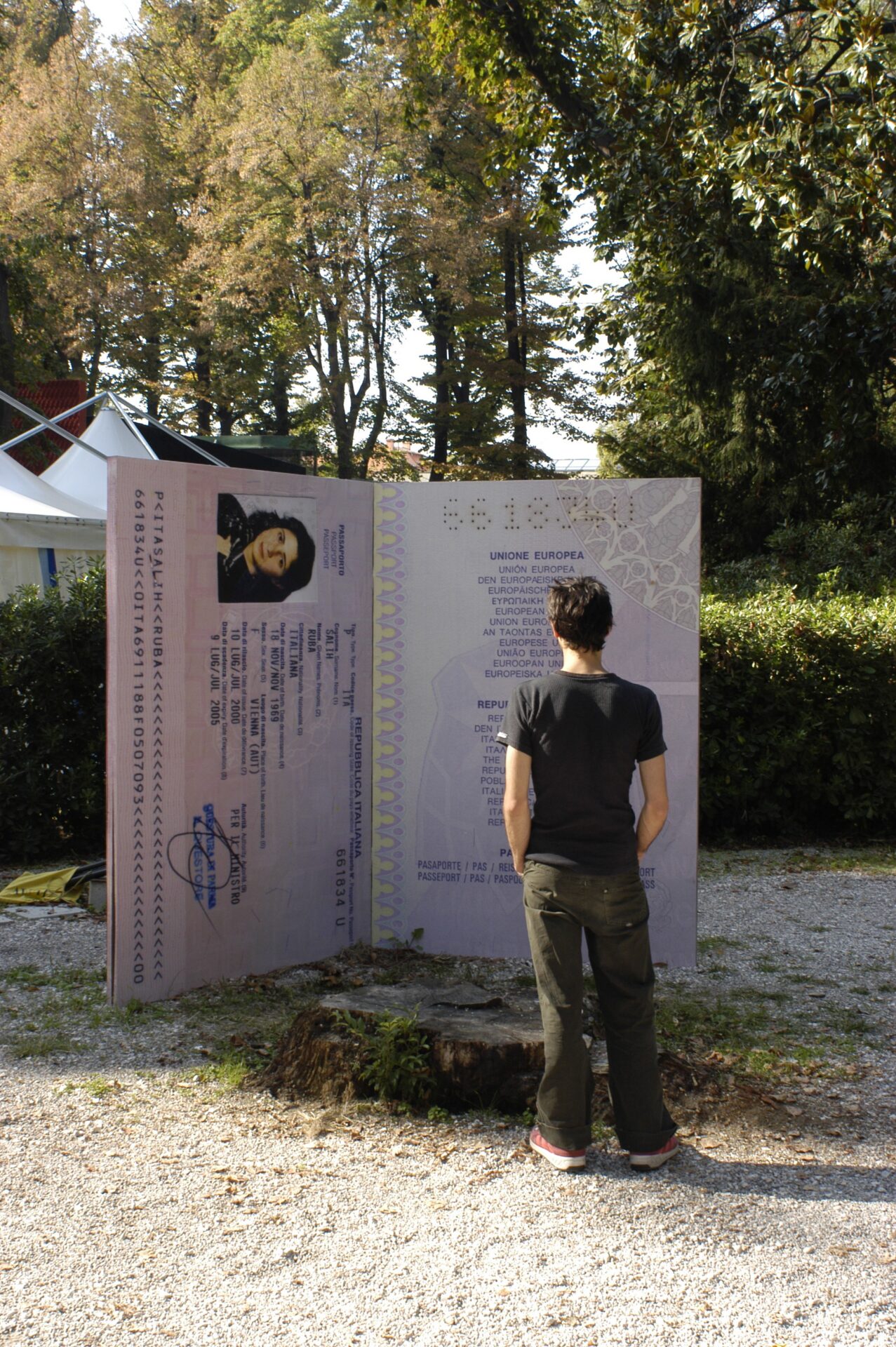
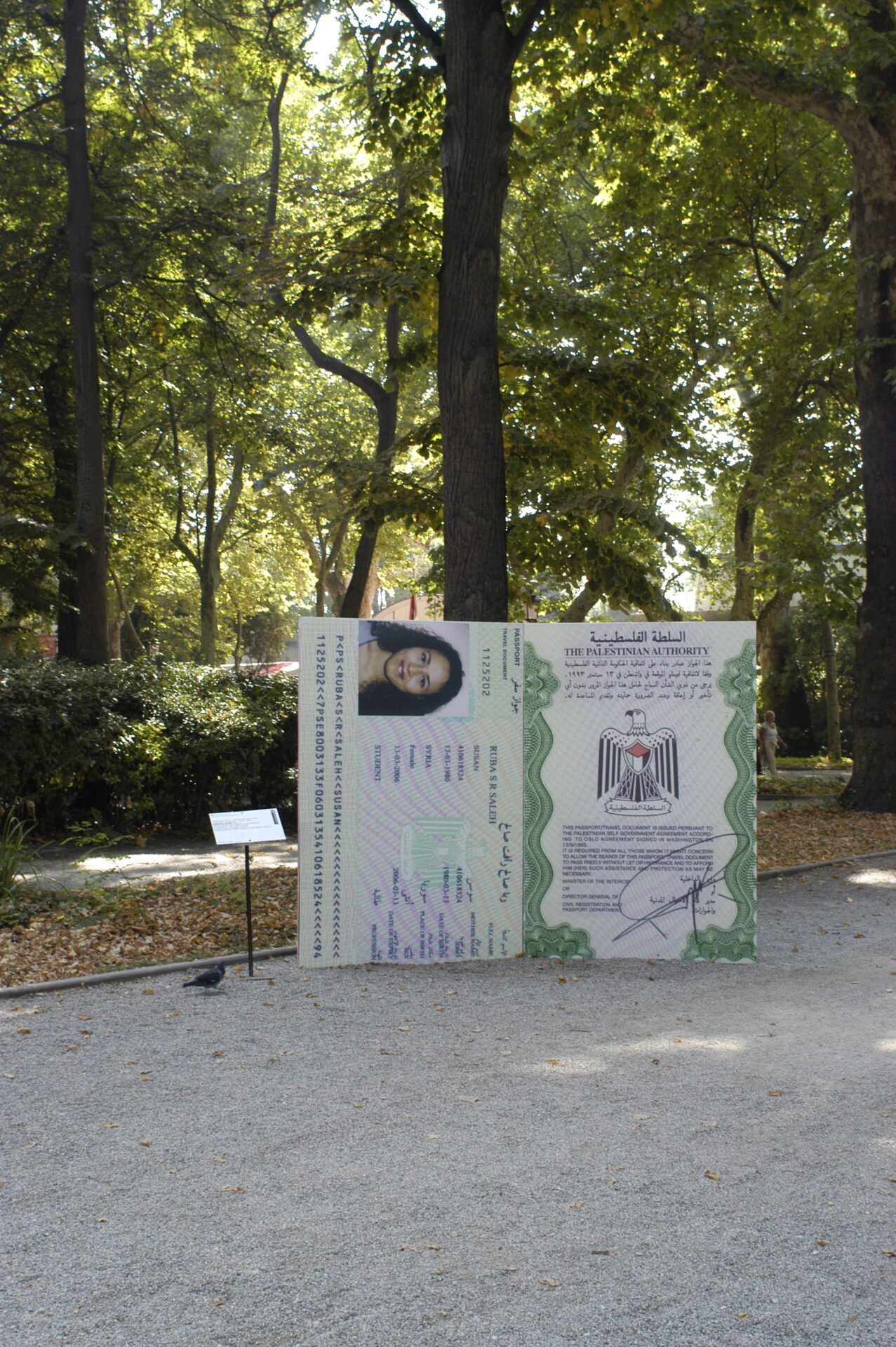
At a time when institutions like the British Museum succumb to pro-Israel lobby groups and Zionist talking points by erasing the word “Palestine” from some of their displays, the art community should take a stand.8 In 2003 curator of the 50th Venice Biennale Dreams and Conflicts Francesco Bonami wanted to include a Palestinian national pavilion, only to be met with allegations of antisemitism in the Italian press. Instead, architects Sandi Hilal and Alessandro Petti scattered ten over-sized Palestinian travel documents (passports, ID-cards, laissez-passers) across the Giardini in their project Stateless Nation (2003). I vividly remember seeing this inaugural Palestinian inclusion in the Biennale, and the acute point made by placing one such document between the Israeli and American pavilions. More than two decades onwards, it is high time to claim a permanent home for a Palestinian pavilion in Venice, beyond collateral status.
METROPOLIS M KAN NIET ZONDER JE STEUN
Trouwe lezers vormen het fundament van Metropolis M. Wij kunnen niet zonder je steun. Je kunt ons steunen door een jaarabonnement af te sluiten. Het eerste jaar krijg je 40% korting. Een regulier jaarabonnement kost 58 euro. Er zijn ook kortingsabonnementen. Studenten/65plussers/CJP-ers/Personen met een minimuminkomen en PLATFORM BK-leden betalen slechts 36 euro voor hun jaarabonnement. Op DEZE PAGINA lees je meer over de verschillende abonnementssoorten en kun je je direct aanmelden.
BIJ VOORBAAT DANK!
- The procedure’s page on the Venice Biennale’s website stipulates eligibility for national participation as follows: “The Countries whose independent Governments are acknowledged by the Italian Government.” See https://www.labiennale.org/en/art/2026/national-participations-procedure.
- Other well-known examples include writer Ghassan Kanafani (1936-1972); poet Kamal Nasir (1925-1973); cartoonist Naji al-Ali (1938-1987); journalist Shireen Abu Akleh (1971-2022); photo journalist Yasser Murtaja (1987-2018); radio journalist Ahmed Abu Hussein (1997-2018); university president Sufyan Tayeh (1971-2023); poet and scholar Refaat Alareer (1979-2023).
- The Nakba Law of 2011 “authorizes the Israeli Minister of Finance to withdraw state funds from any institution or body that commemorates ‘Israel’s Independence Day or the day on which the state was established as a day of mourning’, or that denies the existence of Israel as a “Jewish and democratic state.” See https://www.adalah.org/en/law/view/496. The Loyalty in Culture Bill put forward by the Minister of Culture Miri Regev “authorized the Ministry of Culture to deny budgets in advance for cultural institutions that negate the existence of the State of Israel as a Jewish and democratic state, disrespect state emblems, mark the Nakba Day, and so forth.” See https://www.acri.org.il/en/wp-content/uploads/2018/03/Overview-of-Anti-Democratic-Legislation-March-2018.pdf.
- Compare this to the outrage Russian participation has caused on governmental levels: 22 foreign and culture ministers have called for Russia’s exclusion and the European Commission has threatened to cut 2 million in funding to the Venice Biennale, citing breach of contract in ethical standards. See https://www.theguardian.com/artanddesign/2026/mar/12/venice-biennale-risks-losing-eu-funding-over-planned-russia-involvement?utm_source=FRIEZE&utm_campaign=169c6bcdbe-newsletter-will-eu-cut-venice-biennale-funding&utm_medium=email&utm_term=0_f0ebe20dcf-169c6bcdbe-208161398
- Also see https://www.internationaleonline.org/contributions/on-the-venice-biennales-decision-to-host-the-israeli-pavilion-in-the-arsenale/
- See https://anga.live/?utm_source=ig&utm_medium=social&utm_content=link_in_bio&fbclid=PAZXh0bgNhZW0CMTEAc3J0YwZhcHBfaWQMMjU2MjgxMDQwNTU4AAGnR7WTiZOs1aKmAd0BQm8NOjzOV-tQK_w3OblVt8PdNh8lw1zhl2RcB_2ZbHM_aem_1r_stGxdg-IWy1lyBpZodA
- See for reference: https://saudipavilion.org/art/dana-awartani-to-represent-saudi-arabia-at-biennale-arte-2026/
- See https://www.theguardian.com/culture/2026/feb/16/british-museum-removes-word-palestine
Nat Muller
is a curator, writer, and researcher based in Amsterdam.