Practices of refusal
Refusal is often understood as not wanting something. But in times of exhaustion, precarity and political disruption refusal can also be something else according to Anastasia Shin. A way to no longer accept the condition of that which exists. Through diverse artistic practices she understand refusal as a form of protest that does not need to be loud or visible to be heard. GO TO DUTCH VERSION
I came across Bartleby the Scrivener’s refusal before I had an idea of how much there would be to refuse in the labour market ahead of me.1 In a seminar titled: postcriticalities (inspired by theorist Irit Rogoff’s criticality) we discussed ways to refute, escape and circumvent the dire state of the culture we were about to graduate into.2 Herman Melville’s 1853 Bartleby the Scrivener: A story of Wall street has been riffed on by many white male philosophers including Agamben, Žižek and Deleuze all of whom have been suitably impressed by Bartleby’s polite refrain: ‘I would prefer not to’ reflected in the rejection of his clerical duties and refusal of extraneous tasks which resulted in his exemplary: further potential, keeping possibility alive, and refusing a given subjectivity, respectively.3 Narrated from the position of his employer both during and after his sacking, Bartleby fades out, as one metaphorically can in fiction. And yet meanwhile, ongoing refusals of a similarly quiet and generative nature have informed the development of a theory of refusal which nuances philosophical reflections on non-participation, and also accomplishes something else far more intersectional. Far from fading out, this is clarifying ways-of-being and values beyond (and before) capitalist productivity.
Words as tools have a way of picking up new meanings as they sharpen their use. Such is the way with refusal in how I’m looking at it here: with examples in text and meme and art (and its framing). Refusal never exists in a vacuum, the boundaries and limits to which it draws our attention are often the material and social conditions of its restraint. The struggles that refusal emerges from have already come some way; sometimes their boundaries only become visible as they are crossed. As the concept emerges from the standard verb ‘to refuse’, semantic weight is brought to bear on the uneven power dynamics it occurs within; between one group and another but also on a personal and private level. Just as reverse racism doesn’t exist, neither can the resistance tool of refusal be used by the oppressor. It’s come to the fore in recent years in various areas of inquiry, often grating against its academic confines including but not at all limited to: Indigenous studies, Black studies, cultural anthropology, and justice and border studies. Building on the call of decolonial theory, to break out of colonial paradigms of knowledge, refusal can also be a practice; a social and relational mode of engagement.4
A rejection of the status quo as livable
This reflects more than a disagreement. Tina M.Campt, Saidiya Hartman, Denise Ferreira da Silva and other Black feminist artists and scholars created the Practising Refusal Collective (PR Collective) to engage with the question: How do we write, think, perform, practice, visualize, engage, theorize, story, or enact a practice of refusal?5 PR Collective worked on a series of public events and collectively created a glossary of terms. In the context of Black Visuality, they produced this definition of refusal: refusal: a rejection of the status quo as livable and the creation of possibility in the face of negation i.e. a refusal to recognize a system that renders you fundamentally illegible and unintelligible; the decision to reject the terms of diminished subjecthood with which one is presented, using negation as a generative and creative source of disorderly power to embrace the possibility of living otherwise.6
Recognising a system, rejecting its terms, and feeling empowered by the possibility to live otherwise is demonstrated by the manifesto: Rest is Resistance (2022) by Tricia Hersey. Reflecting on her exhausted state, and the not-so-invisible systems of ableism, capitalism, patriarchy and white supremacy, that have led to it, she commits to another way of being which is rooted in rest. She resolves to slow-down, to self-preserve, to rest, and to return to a space of possibility. Hersey contextualises this as a call from her ancestors, to reclaim rest where they couldn’t and she calls for an end to Grind culture where self-worth is tied to how much you are getting done. This becomes a collective exercise in her project The Nap Ministry where people gather to sleep and dream together in space that she holds open for this purpose. Hersey came to the idea of rest-as-resistance when she was at graduate school studying, working and parenting. Momentum for the project built quickly as others who felt the ramifications of their own depletion gathered to collectively occupy what Hersey labels a ‘DreamSpace’ of potential. The simple components of the installation include mats, pillows and an altar depicting black ancestors resting. Her book has since become mainstream; she travels and talks to spread its message, it’s a very public declaration of refusal that brings histories of exploitation to light.
Evading physical and mental capture
Authors of The Undercommons—Fred Moten and Stefano Harney—note the ongoingness of this process when they illuminate refusal with the idea of fugitivity. They discuss Harriet Tubman’s escape noting that escape is never a finished event. Having been enslaved, as Tubman runs, she is not running towards citizenship and a compromised subjectivity, it is away from the entire system that produces her as an object. Embracing fugitivity instead means a committed refusal that’s less publicly performed, but nonetheless gains momentum and creates space for community e.g., an undercommons.7 Ideas that are lived, in bell hooks terms: ‘when our lived experience of theorizing is fundamentally linked to processes of self-recovery, of collective liberation, no gap exists between theory and practice. Indeed, what such experience makes more evident is the bond between the two – that ultimately reciprocal process wherein one enables the other.’8
The creation of: ‘disorderly power’ noted in the PR Collective’s definition of refusal, sounds like it holds the potential to disrupt but if the same inhumane day to day conditions persist, I wonder what structures refusals continuance relies on? What could a networked response which takes fugitive form create? In China, ‘Tan Ping’ (躺平) or ‘lying flat’ has given form and image to the quiet bubbling of a generation’s collective rejection of rat-race conditions in education and employment which often involve the ‘996’ work week (9am til 9pm, 6 days a week).9 Structurally this refusal relies on the possibility of contributing to (online) discussion, posting anonymously and maintaining an oblique approach that mutates as it is censored. In meme form, fat cats stretching out and the metaphor of chives (‘Chives are difficult to cut when lying down’) give variation to the image of reclined young people.10 Tan Ping relates to Bartleby’s refusal of work, the Nap Ministry’s anti-grind stance and all could refer to the bodily limits described that symptomise rising global levels of Burnout. Visually, the second part of the pictographic compound: 平 can be seen as a level, balanced scale, but as well as being flat or level, it can also indicate a peaceful calm. Like Rest is Resistance, Tan Ping also has a manifesto stating its own terms in its own words. The anonymous manifesto states: ‘The body has no connection to possession and distribution, and the land is uninterested in management and governance. A radical Tangpingism marks a complete rejection of the current order. The Tangpingists make a merciless mockery of institutional inclusion, and are indifferent to any kind of praise or criticism.’11 Tan Ping mutates as it plays out over social media, using algospeak and evading the censorship that tries to extinguish its rebuttal of the ‘Chinese Dream’.12
Refusal (not wanting) is about desire (wanting)
Collective persistence can have a cumulative effect: boycotting products, maintaining minority languages, and tending to sacred land are all commitments that stem from refusal in the face of an unequal power dynamic. Though refusal emerges in the face of oppression and a multitude of global crises, it holds onto hope (the possible in the face of the probable) and a sense of unfinishedness which doesn’t have to have it all worked out.13 This is part of the appeal, you start from where you are, or perhaps return to what you feel, especially when the status quo has told you to think (and feel) differently. Tang Ping refuses to compete in a conveyor belt employment-consumption lifestyle, Hersey rebuts productive-value with divinity and has a religious certainty that backs her trust in Rest is Resistance. But without religion, there is also a sense of integrity and commitment to uncertainty which goes deeper than a projected false-knowing. Perhaps a commitment to humanity. I think of Rosa Parks – refusing to give up her seat to whiteness. Rooted in everyday struggle, with an element of self-regard that sparked historical changes for many more than herself. Parks’ action was surrounded by the logic of a stifling whiteness, but her refusal harnessed power.
These examples zig zag through time. And perhaps each moment will continue to need new terms to re-clarify the conditions. But to ‘embrace the possibility of living otherwise’ contains hope that another way of being is possible. Rather than seeing an immediate change or result, refusal creates through the clear allegiance that it shows. Anthropologist Carole McGranahan has theorized refusal as ‘social and affiliative’. She describes its non-neutral stance as …a deliberate move toward one thing, belief, practice, or community and away from another.’14 When the concept makes a return to both curatorial and artistic practice it is often at a position of one remove, through the companion terms like: freedom, hope, and solidarity. Refusal now, is a commitment to the otherwise. It means creating space outside of colonial knowledge paradigms for example following circular time and oral reasoning, or relating differently-we don’t see it-but it informs an artistic approach in the invisible and un-published elements of research and practice.
The deliberate move towards a system of distribution that fosters connection and support is instigated in the work of artist duo WORKNOT! Who make a conscious step away from alienating, competitive individualised practices and towards other collective structures like mutual aid. Since 2020 they have utilised the form of a ‘Fictional Dispatch’, with bike messenger collaborator Tomi Hilsee, delivering small packages of carefully bound texts and gifts; objects that vary depending on the crisis at hand and the contributions of those involved. Sometimes it’s cigarettes, sometimes stickers, they tell me. If Rest is Resistance wants to illuminate the collective imaginary beyond the grind, and PR collective’s re-definition of terms, including refusal,, points out its ‘generative and creative source of disorderly power to embrace the possibility of living otherwise’ WORKNOT! also go beyond rest/rejuvenation as a means to maintain capitalist productivity and take a more fugitive stance. They say of the 2020 edition of the project: ‘The question of visibility came back here at the moment of the exhibition “opening”. How could these things that were moving around between our houses and bike messenger’s bags and “dispatch”, be documented and displayed? But also, why must they be documented and shown, and perhaps even, for whom? The collection of a bike messenger’s redacted manifests and their logbook was made publicly visible in the exhibition display, offline and online. This unarchivable and undocumentable process is against the economy of display that constitutes the professional field’s principle of visibility as a way of valuing labour and its allocated resources.’15 WORKNOT!, who were recently nominated for the 2026 Dolf Henkes Prize, return to distributing solidarity packages by bike courier, for their contribution to the nomination exhibition at TENT. This year, the prize is dedicated to social practices with nominees who are committed to self-organization, solidarity, and the power of collective narratives.
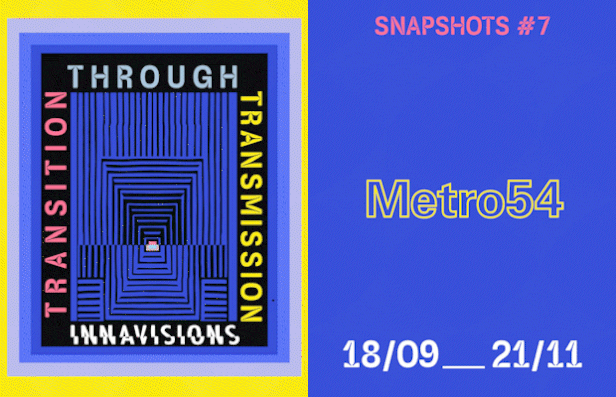
At Metro54 in Amsterdam in the current exhibition: Practising Freedom and Refusal the works are described as ‘offerings’ and the exhibition itself is part of a larger project ‘Sustaining the Otherwise’, which has focussed on creating a space for dialogue for artists, activists, scholars and writers. Whilst visiting, I stumbled upon a workshop which is neither noted nor open to the public, about ‘Chosen Family’. At another similarly almost-private convene at Rotterdam project space turned reading-room Available and the Rat under the title: BORDERBORDER banned books are read, and the moment for collective study is framed as a way of keeping knowledge alive through reading together in the name of collective liberation. This is where refusal opens to pockets of community where hope and possibility are engaged with with the support of others and again, without a necessary conclusion – within uncertainty space is created for an unforeseen imaginary to emerge. Some of these examples exist within art spaces, others are enacted in everyday life. I sense that it’s in the less visible gatherings, where a commitment to values sparks or is strengthened. Without conclusive linear endings, refusal makes a return, building on structures already rooted in contemporary practices.
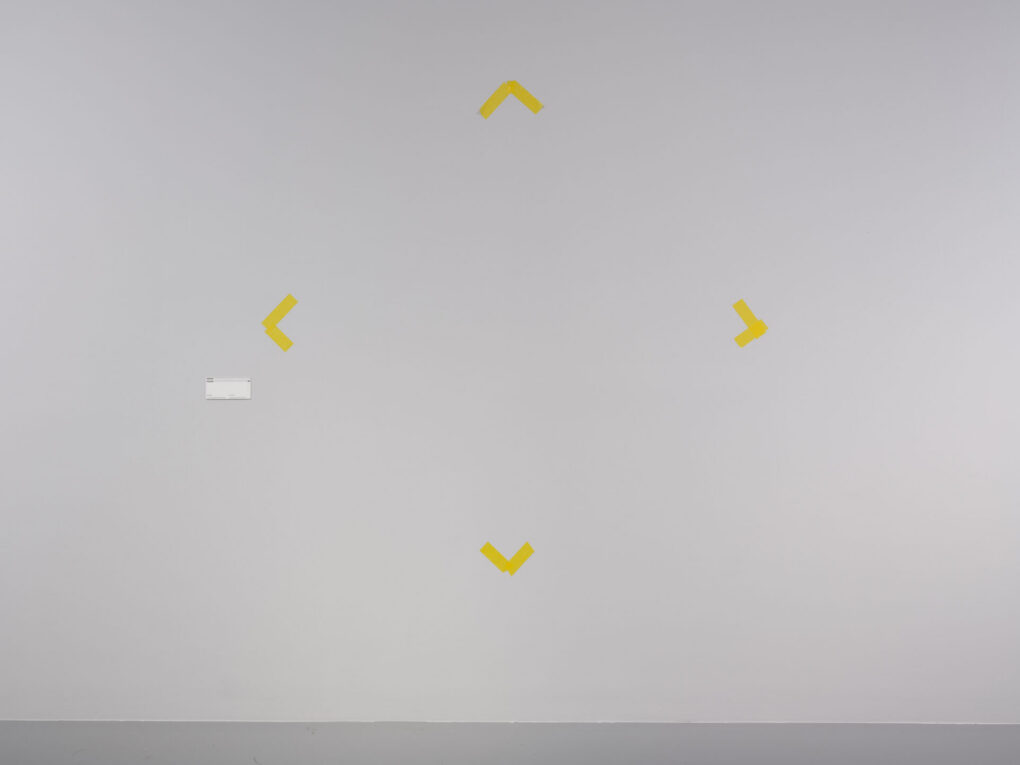
Out of Office (Still Here)
Nest, Den Haag
1.5 t/m 16.8.2026
- Spathopoulou, Aila, en Isabel Meier. “Practising Refusal as Relating Otherwise: Engagements with Knowledge Production, ‘Activist’ Praxis, and Borders.” Fennia: International Journal of Geography 201, nr. 2 (december 2023). https://doi.org/10.11143/fennia.137167.
- https://www.womenandperformance.org/ampersand/29-1/campt.
Anastasia Shin
is an artist, writer and editor based in Rotterdam