Re-mapping the soil
Soil is more than just the ground we plant our feet on: it shapes and nourishes us, can imprison or liberate us, and provides endless food for thought. The traveling exhibition Soils in Eindhoven, a collaboration between art institutions in Australia, Indonesia, and the Netherlands, reflects on the meanings and possibilities of earth. Nuraini Juliastuti shook the sand from her sneakers and visited the exhibition, which will be on display at the Van Abbe this summer, in Melbourne, where it was shown last fall.
Soil provides a path into thinking about the world and society, both old and new, in their most complex forms. Many pressing matters are inextricably linked to the idea and materiality of soil. Think, for instance, of the inhabitants of 18 kampungs on Rempang Island (Riau Islands Province in Indonesia) who are facing forced eviction and relocation due to the government’s plan to build Rempang Eco City in their land; the ongoing Palestine and Israel conflict; or the recent rejection of the proposal to recognise the First Nations people in the Australian constitution and to include their political agency in parliament. These matters are ruptures and eruptions which reveal the true colours of long-term organised soil-based violent systems.
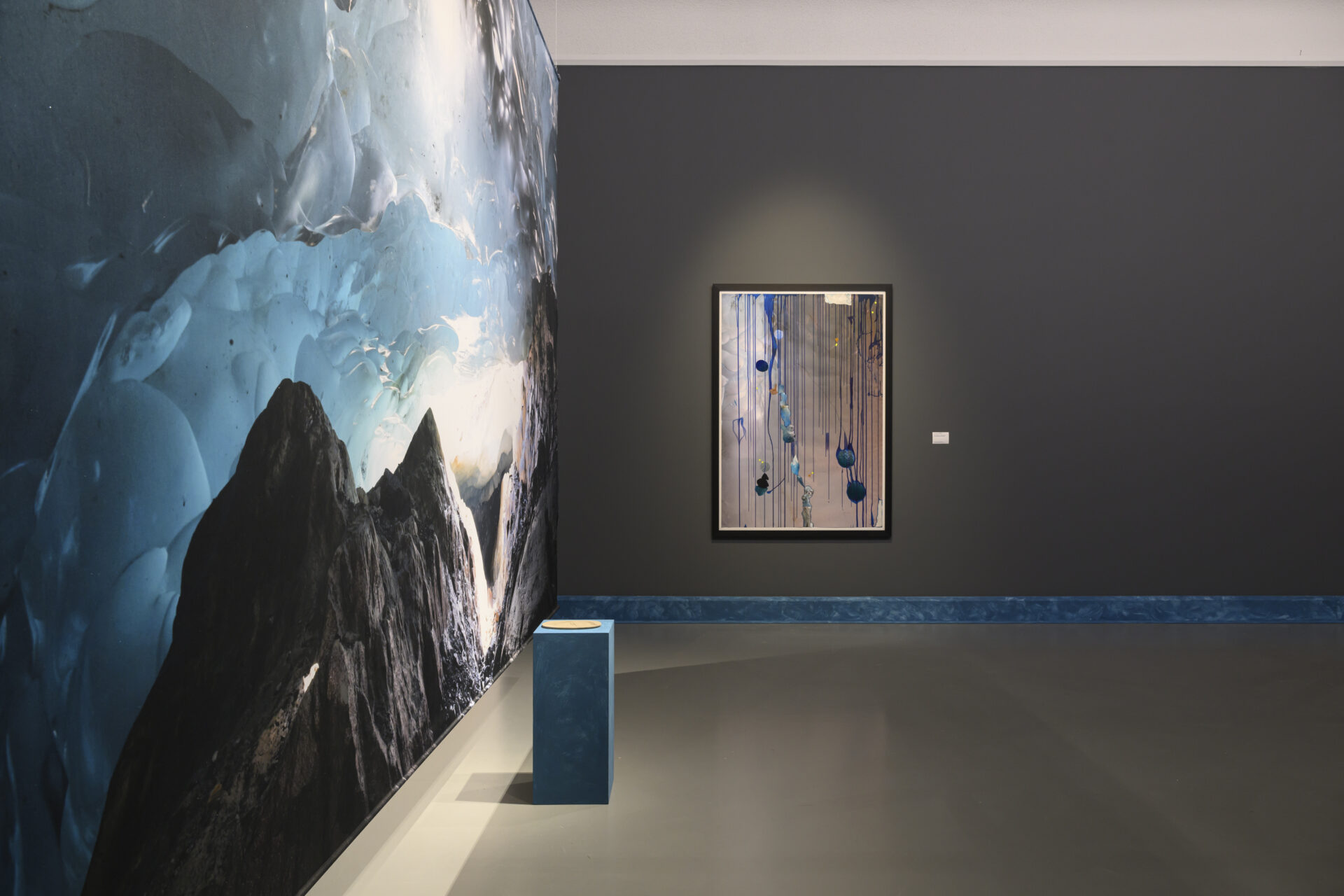
The potentials and possibilities of thinking about soil as both material and metaphor, are explored in the exhibition The Soils Project, which I saw at TarraWarra Museum of Art in Victoria, Australia last fall. The exhibition is the result of an ongoing research collaboration between the TarraWarra museum, platform for social and ecological justice Struggles for Sovereignty (Yogyakarta, Indonesia) and the Van Abbemuseum (Eindhoven, the Netherlands). Currently, the exhibition is on show at the Van Abbemuseum, under the shorter title Soils.
Walking through the exhibition, the question arises what it means to develop a project that focuses on soil, when people are currently suffering in their unceded territories. What does hope mean in a context where reconciliation and reparations seem to be constantly out of reach? The Soils Project is a temporary artistic project which takes place within the context of art and cultural institutions, but for some people soil is a lifeline. It is a matter to defend and reclaim, through nurturing memories, establishing a path of radical pedagogy to instil a sense of identity and relearn forgotten knowledge of ancestors. This is often achieved by exercising physical force, and sacrifices of sweat, blood and death.


The dirt on my sneakers
It is not possible to think about The Soils Project without thinking of my own position which oscillates between the Netherlands, Indonesia and Australia. I used to live in Naarm (the Indigenous name of Melbourne), before migrating to the Netherlands. My perceptions of Australia are partly shaped by how strict the Australian Border Force and its biosecurity policies impose regulations regarding the import of natural products — dairy and egg products, fruit and vegetables, meat, poultry and seafood, plant materials, live animals, animal products, nuts, seeds, beans, grains and anything that could be contaminated with soil, seeds and water — brought to Australia by the diverse travellers. The intention of such policies is to sanitise the land from any kinds of wildness and unruliness.
I went to The Soils Project at the TarraWarra Museum during my recent family visit to Australia last summer. Prior to the visit, I had spent some time in Indonesia for holidays and doing a bit of work with my family. When my plane started to descend on the so called ‘Australian territory’ sometime in mid-August, the inflight entertainment screen on the passengers’ seats showed the state’s strict biosecurity policies. On landing at Melbourne Airport, I felt obliged to declare that my sneakers might still contain dirt and soil from Mollo, East Nusa Tenggara, the last place that I visited in Indonesia. As the detection dogs sniffed my suitcases and sneakers, I thought that actually, it would not be possible to discard these soils. They will always be carried and spread.


Institutional entanglements
The collection of the TarraWarra museum, as well as the building, is derived from the personal collection of Marc and Eva Besen. The museum stands on the land of the Wurundjeri people who have inhabited the land for thousands of years. The British Settler society took over the land and caused the displacement of the First Nations. I want to begin by demonstrating an Acknowledgement of Country, for I have also been a guest on Wurundjeri land. I would like to acknowledge that the Wurundjeri people are the real owners of the land on which the TarraWarra Museum is located. It has always been and always will be Aboriginal land. I pay my respects to the elders, past, present, and emerging.
Tarrawarra, the name of the area, is a Wurundjeri Woiwurung word which means ‘slow moving water.’ Such a name suggests the quietness of the landscape. However, this description should not be taken at face value, for it may imply that nothing harmful has ever happened there. There is no such thing as a quiet place in a context where the existence and rights of the First Nations peoples are continuously denied. As Peta Clancy, one of the artists included in The Soils Project, visualises in her works, beneath all the seemingly serene and beautiful landscapes hide the violent past and the extractive nature of colonialism.


The exhibition The Soils Project was developed in cooperation with the Van Abbemuseum in Eindhoven: an institution which derives its wealth from Henri van Abbe and the indentured labour and coolies in the tobacco plantations in Sumatra during the Dutch colonial occupation in Indonesia. Organised between the Australian and Dutch-Indonesian contexts, the project intervenes in the tensions between (in the case of Australia) Colonial Settler and the First Nations societies on the one hand, and the colonial masters and the afterlives of slavery (in the case of Indonesia and Netherlands).
The TarraWarra Museum, Van Abbemuseum and Struggles for Sovereignty use the word ‘fellow travellers’ to refer to various artists, thinkers and community organisers who take part in the project as fellows and companions. The exhibition does not only show the works of the artists (whom I refer to here as fellows), but it also includes traces of collaboration and thinking processes conducted with various allies and comrades.
I imagine that the allies, comrades and fellow travellers turn into fellow listeners, fellow doers, fellow changers, fellow makers, fellow storytellers, and more importantly, fellow dreamers. In the cultural sense of the First Nations, dreaming means a way to connect with the past, the present and the future. Story-making and storytelling play an important role to facilitate the process. As Zena Cumpston writes in the monograph which accompanies the exhibition, soil acts as a clever messenger to deliver messages about the layered ‘people’s way of seeing, that Country is alive, shifting and transforming to form connections, that Country knows’. The colours of the soils in D Harding’s work As I Remember It contain the stories and the knowledge about the ownership of the land. The soil knowledge is not transmitted through the authorities of the engineers. The soils ceased to be the resource to manage and utilise for human’s purposes. The performance of the rawness of the soils, their colours, textures, emotions, creates a specific kind of entanglement and attachment that is faithful and inseparable from one’s sense of identity.


Mapping the soil
Many works in The Soils Project address different kinds of technologies which have been utilised to extract and explore the lands. They show that mapping, photography and radio are not innocent. During colonial times, cartography was used to delineate and devise strategies for extracting the natural resources of the land. In these contexts, the land was always imagined to be an empty territory. The historical introduction of photography in Indonesia connected to how photography was used as a scientific technology to observe the local natives. It was also used to document the excavation process of cultural and civilisation artefacts lying in the soils.
In different ways, the fellows show attempts to reclaim technologies through reversing their extractive and destructive nature and redirecting their purposes to repair a sense of injustice in the communities. Radio was initially introduced to connect the Netherlands and Indonesia, or the Dutch East Indies, at the time. The local independence movement shows that the revolutionary fighters and thinkers had been redirected to spread and instil ideas and concepts about freedom. This paved the way for building a sense of nationalism through the formation of Bahasa Indonesia as a national language and the rise of independent mass media. One of the fellows in the project, Riar Rizaldi, presents a work in which he explores the ruins of Radio Malabar, the first transmitter built by the Dutch East Indies government in Bandung (West Java), to discuss the geological excavation in the area.
Yurni Sadariah’s work Rangan Territories Map was made in collaboration with the Paser indigenous community in Rangan, East Kalimantan. The work shows how territorial mapping is conducted through identifying what used to be here but is not here anymore, and tracing what is still available. The making of the Rangan Territories Map employs the perspectives of the people who have been dispossessed of lands and tradition due to large scale conversion of traditional lands into palm oil plantations, logging and state-sponsored transmigration programmes.
A possible current application for this work is within the development planning of Indonesia’s new capital in Penajam Paser Utara, East Kalimantan. The name of the new capital is Ibu Kota Nusantara, which literally translates to ‘Nusantara Mother City.’ The development of this new capital has provoked controversial debates for a number of reasons, one of the most pressing being that the development of the capital infrastructures has caused further displacement of the Sepaku and Paser indigenous communities in the area. The colonial roots of transmigration and the development of new capital lie in the fact that the land of the indigenous communities are always imagined to be empty, or less dense, and readily available to be appropriated to fulfil the authorities’ agendas.


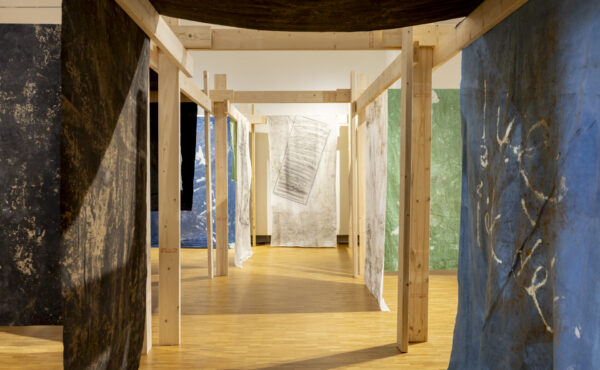
The large Rangan Territories Map hangs on the wall of the exhibition space. On the map intricate lines can be seen which move in all directions. This multiple directionality suggests that once one has decided to go below, against the grain of the colonial and neoliberal territorial-making directions, it might create alternative ways of seeing and behaving towards the soils. I feel that the Rangan Territories Map is closely connected with another work in the exhibition, made by Lian Gogali and Institut Mosintuwu, titled Ovarium Nature. This work consists of two paintings of large scale women’s ovaries filled with seeds and leaves of various plants surrounding Poso, where Institut Mosintuwu is located. The womb is portrayed as the last fortress of nature, the nurturing soil for when everything seems to have no hopes. It encourages us to expand the definition of territory which goes beyond geographical locations.
Another work that seems to connect with these works is Aldo Ramos’ video work, Soil is a Weaving of Memories. In it, Ramos uses the framework of weaving as a reliable technique to develop connections with the soils and the ancestors. I watched the video and noted down some of the phrases that appeared as captions on the screen. Retyping the words here, they emerge like a poem, or a mantra of some sort, providing energies to those who need it.
Thinking- soil, think with soil
Outwards, to all the relations around us
In a spiral shape
Every step keeps a thought
The second, the third and the hundred
As the first thought, the umbilical cord
Weaving the memories of the soil
Taking a different approach, Moelyono’s works Tandak Samira and Berkaca Dulu serve as a constant reminder that despite everything, it is vital to name those people who have fought relentlessly for their lands. Both paintings have been modelled on other paintings: Rembrandt’s The Night Watch and Raden Saleh’s The Arrest of Pangeran Diponegoro. Moelyono puts forward ludruk, a form of traditional performance in East Java where the stories of agrarian conflicts are staged and kept alive. Through mimicry the works serve as a playful act to emphasise the colonial roots of the land conflicts.
Another instance of reframing occurs in the works of Bunga Siagiaan and Ismal Muntaha, who present their work as the research output of their self-organised institution called Badan Kajian Pertanahan (BKP), which can be translated to The Office for Land Analysis. There is a strong authoritative tone in the BKP, which alludes to the fact that along with the development of land struggles, the relations with the state will also be renewed. The BKP works reflect the tendency of Jatiwangi Art Factory, the art space with which Bunga and Ismal are closely affiliated, to develop their projects in close connection with the local authorities in their ecosystem. The question arises what is at stake in building close collaborations with state institutions, while the same state also keeps on marginalising and oppressing the communities.


Eindhoven
I want to end this text with a final reflection on a work included in the exhibition: Boerenzij – The Rural Side (2023) by Wapke Feenstra of My Villages. Feenstra’s involvement in My Villages is rooted in defending the rural areas of the Netherlands. These rural areas and village cultures and economies are being increasingly threatened under the pressure of neoliberalism. The soil is always layered with a strong feeling of inclusion and exclusion. While My Villages poses valid questions regarding village knowledge preservation, it seems valid to ask how The Soils Project creates forms of technology to build solidarity across the histories of land struggles in Europe and beyond. This would mean sensitising the project with diverse roots of land conflicts which gives rise to various maps of refuge, escape, refugees and migrants. This is one of the main challenges that this project will have to face.
Soils is on view at Van Abbemuseum, Eindhoven, until november 24
Fellows and fellow travellers in The Soils Project:
Uncle Dave Wandin (Wurundjeri) and Brooke Wandin (Wurundjeri), Wandoon Estate Aboriginal Corporation; Peta Clancy (Bangerang); Megan Cope (Quandamooka) and Keg de Souza; D Harding (Bidjara, Ghungalu and Garingbal); Badan Kajian Pertanahan (Bunga Siagian & Ismal Muntaha); Beyond Walls (Armando Ello, Jeremy Flohr, Glenda Pattipeilohy, Suzanne Rastovac); Wapke Feenstra; Lian Gogali and the Institut Mosintuwu and Poso communities; Moelyono; Pluriversity Weavers: Seynawiku Izquierdo Torres, Dwasimney Del Carmen Isquierdo Torres, Dwanimako Arroyo Izquierdo, María Eufemia Arroyo Izquierdo (Kwarte Umuke community, Sierra Nevada de Santa Marta Columbia), Ana Bravo Pérez, Aldo Ramos, Aliki van der Kruijs, LI Yuchen; Riar Rizalddi; Yuri Sadariah and the Sekolah Adat members and Rangan Adat communities; Diewke van den Heuvel; Rolando Vázquez.
Nuraini Juliastuti