Against Latin American Art
Against Latin American Art
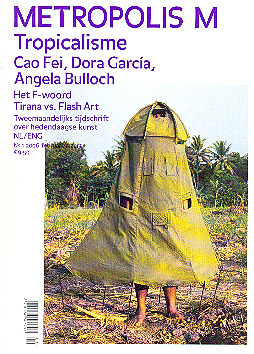
Does it make sense anymore in the global world we live in, to link one’s identity to a specific location? Where, for example, does a place like Latin America begin and end? In the past notions such as tropicalism were developed to define art from a particular region. Now however, according to Gerardo Mosquera, it is time to think about art from Latin America differently.Art and ID cards do not get along. Identity can be a burden, and perhaps no other area in the world has struggled so much with it as Latin America. Already at the end of the 70’s Brazilian critic Frederico Morais linked our identity obsession with colonialism, and proposed a ‘plural, diverse, and multifaceted’ idea of the continent, product of its multiplicity of origin.1 Indeed, the very notion of Latin America has always been very problematic. Does it include the Dutch and Anglo Caribbean? Chicanos? Does it embrace indigenous peoples who often do not speak European languages? Is what we call Latin America part of the West or the non-West? Does it contradict both, emphasizing the schematization of such notions? In any case, today the United States, with more than thirty million inhabitants of ‘Hispanic’ origin, is without doubt one of the most actively Latin American countries, and in a not so distant future will come to have the third largest Spanish speaking population, after Mexico and Spain. In some stores in Miami there are signs which say ‘English Spoken’.Nevertheless, the idea of Latin America has not yet been discarded, as is the case with the idea of Africa, considered by some African intellectuals to be a colonial invention.2 The self-consciousness of belonging to a historical-cultural entity misnamed Latin America is maintained, but problematized. At the same time, and as a result of the pressure to enhance or build identities of resistance vis-à-vis Europe and United States, we have been inclined to define a Latin American self by means of all-encompassing generalizations, which have coexisted with the fragmentation imposed by nationalisms. Mudimbe’s question ‘What is Africa?’ is also pertinent in our area: what is Latin America?3 It is, among other things, an invention that we can reinvent. We are now beginning to situate ourselves more within the fragment, juxtaposition and collage, accepting our diversity as well as our contradictions. The danger is that of coining, against modernist totalizations, a post-modern cliché of Latin America as a realm of total heterogeneity.4 Another trap is the assumption that Latin American art is simply derivative of the Western centres, without considering its complicated relationship with the problematic notion of West. Although the general situation has changed in recent years, art from Latin America is often asked to explicitly manifest difference or satisfy expectations of exoticism. As a result, some artists are inclined towards otherizing themselves, in a paradox of self-exoticism. This paradox is still more apparent because the ‘Other’ is always us, never them. Self-exoticism reveals a hegemonic structure, but also the passivity of the artist of being complacent at all costs. However, two new routes can be observed on the continent. On the one hand, there is the internal process of overcoming the neurosis of identity among artists, critics, and curators. This brings with it a tranquillity that permits greater internalizing in artistic practice. On the other hand, Latin American art is beginning to be valued as an art without surnames. Instead of demanding that it declare its identity, art from this region is now being recognized more and more as a participant in a general practice that does not by necessity show its context and that on occasion refers to art itself. Artists from Latin America, like those of Africa or Southeast Asia, have begun, slowly and yet increasingly, to exhibit, publish, and exercise influence outside of ghettoized circuits. When I stated that the best thing that was happening to Latin American art was that it was ceasing to be Latin American art, I was also referring to the problematic totalization that the term carries. Some writers prefer to speak of ‘art in Latin America’ instead of ‘Latin American art’, as a de-emphasizing convention that tries to underline, its rejection of any globalizing generalization. Art from Latin America has been intermittently displacing the paradigms that had guided its practice and valuation. These paradigms were related to certain generalizations that are still recognized as depictions of a slippery Latin American cultural identity, or that of some specific regions: tropicalism, magic realism, mestizaje (miscegenation), the baroque, the constructive impulse, revolutionary discourse, etc. These categories were however justified, and served the efforts of ‘resistance’ against ‘imperialist’ cultural penetration. They had a notable rise in the 60’s, within a militant Latin Americanism characteristic of the historical period marked by the Cuban Revolution and guerrilla movements. However, these ideologies came to over-construct these categories with a totalizing effect, to the extent that they have become stereotypes for the outside gaze.Latin American artists have participated in the global development of what we could schematize as an ‘international art language’. But to a considerable extent they have done so in their own manner, and by introducing differences. Such difference in terms of meaning is one of the changes enacted with respect to the totalizing paradigms ¬–such as tropicalism- which I have referred to, given that these paradigms procured a characteristically Latin American language right from the start. The new artists seem less interested in showing their passport. Cultural components act more within the discourse of works than in relation to its explicit visuality, even in cases in which these were based upon the vernacular. This does not mean that there is no Latin American ‘look’ in the work of numerous artists, or even that one cannot point to certain identifying traits of some countries or areas. The crucial distinction lies in the fact that these identities begin to manifest themselves more by their features as an artistic practice than by their use of identifying elements taken from folklore, religion, the physical environment or history. This sort of anti-tropicalism implies the presence of the context and of culture understood in its broadest meaning, and interiorized in the very manner of constructing works or discourses. Thus, contemporary Brazilian art is identifiable more by the manner in which it refers to ways of making art than just projecting contexts. They are in fact identities and contexts that participate in the construction of the ‘international art language’ and in the discussion of contemporary ‘global’ themes. Their intervention brings with it anti-homogenizing differences that build the global from positions of difference, underlining the emergence of new cultural subjects in an international arena that until recently was under lock and chain. We cannot say that this arena is now open, but that it does have more doors, and that these can be opened with different kinds of keys.
Gerardo Mosquera