To Walk Otherwise: Naming, power, and the city in the age of digital drift
What does it mean to move through a city, a history or a memory on foot? In an age where naming confirms power structures and technology constantly tracks people, walking takes on political significance. This essay explores walking as resistance, as counter-cartography and an embodied response to the question of who is allowed to feel at home where.
Recently I binge-watched Adolescence. All four episodes on Netflix. That was a few days ago, yet I still remember a certain moment clearly—a ping from my phone. An email: a request to write, whilst watching. Somewhere, between Netflix and Hotmail, these seemingly disparate threads became intrinsically linked. Converging around our notions of movement, memory, and place, what follows is a personal reflection on walking as a research practice. I explore how histories and identities can be erased or reimagined, and what role walking plays in resisting or reinforcing these changes.
For me, walking is precisely about meanderings; the mapping of entry points—thoughts, feelings, talks, ideas, films, books, TV, reflections and place. It’s important to share that type of complex cartography and what that looks like in terms of the departure points for this piece: Walking as Research Practice (Twemlow & Cardoso, 2022), a walking tour of Afrikaanderwijk, Rotterdam, Cihad Caner’s exhibition at Kunstinstituut Melly, Adolescence, a four-part drama on Netflix, and Donald Trump’s Gulf manipulations. But first, let me circle back.
Whatever our personal baggage, we all carry a unique constellation of lived coordinates: (dis)ability, gender, race, age, religion, class. These are not isolated traits but intersecting influences, shaped by systems of power. We bump up against other species, share time and resources whilst dwelling together. It’s therefore almost impossible to move without the subjective weight of the world on one’s shoulders. Walking is never neutral; it’s political, embodied and deeply relational.
Drawing on theory, Édouard Glissant talks of the “right to opacity,” resisting the imperial urge to know, name, and reduce others to what is legible. This also resonates with a concept Trinh T. Minh-ha used in her documentary film practice, of “speaking nearby.” A way of staying close to people or place without assuming access or authority—a refusal to speak about or for the other, choosing instead to remain proximate, attuned and in dialogue.
These ideas crystallise in Walking as Research Practice, edited by Alice Twemlow and Tânia A. Cardoso. The collection offers rich theoretical and practice-based insights into walking as an embodied, sensory methodology—emphasising modes of inquiry that resist or reimagine dominant spatial logics. Contributors include Esther Polak, Emily Richardson, and Geert Mul, amongst others. The book spans diverse practices—psychogeography, feminist walking, sonic mapping, (un)mapping and data-driven walks.
In the chapter, “Walking between the disciplinary and the tactical,” Maria Persu, an independent cultural researcher, reframes walking from Michel de Certeau’s everyday tactics to a posthuman, biopolitical practice. She foregrounds disability activism as a form of spatial resistance, using movement to confront discriminatory power structures in search of radically inclusive alternatives. Within contemporary artistic discourse, walking practices can be positioned as aesthetic, epistemic and political, or all the above. Simply put, this publication demonstrates its power to traverse.
Designed by Jana Sofie Liebe, the book’s form embodies its content. A coverless gauze-bound spine folds flat to cradle softly in one’s palm. The paper is tactile, the edges raw. There is an invitation to annotate the blank sides. It requests readers to engage with it as a living tool, collapsing the space between thought and body, between page and pavement. Throughout this article, the book traces a path—physically through my hands and my thought process.
Twemlow integrates walking into both pedagogy and research at the Royal Academy of Art (KABK), asking: “Does the walk activate our senses, or do our senses demand that we walk?” As a mode of inquiry that cultivates presence, rhythm, and relational attunement, she encourages students to use walking as both method and critique to challenge extractive architectures of control. Now in its second edition, Walking as Research Practice, still feels radical not only in form, but in its commitment to collaborative exploration of the boundless boundaries of walking research.
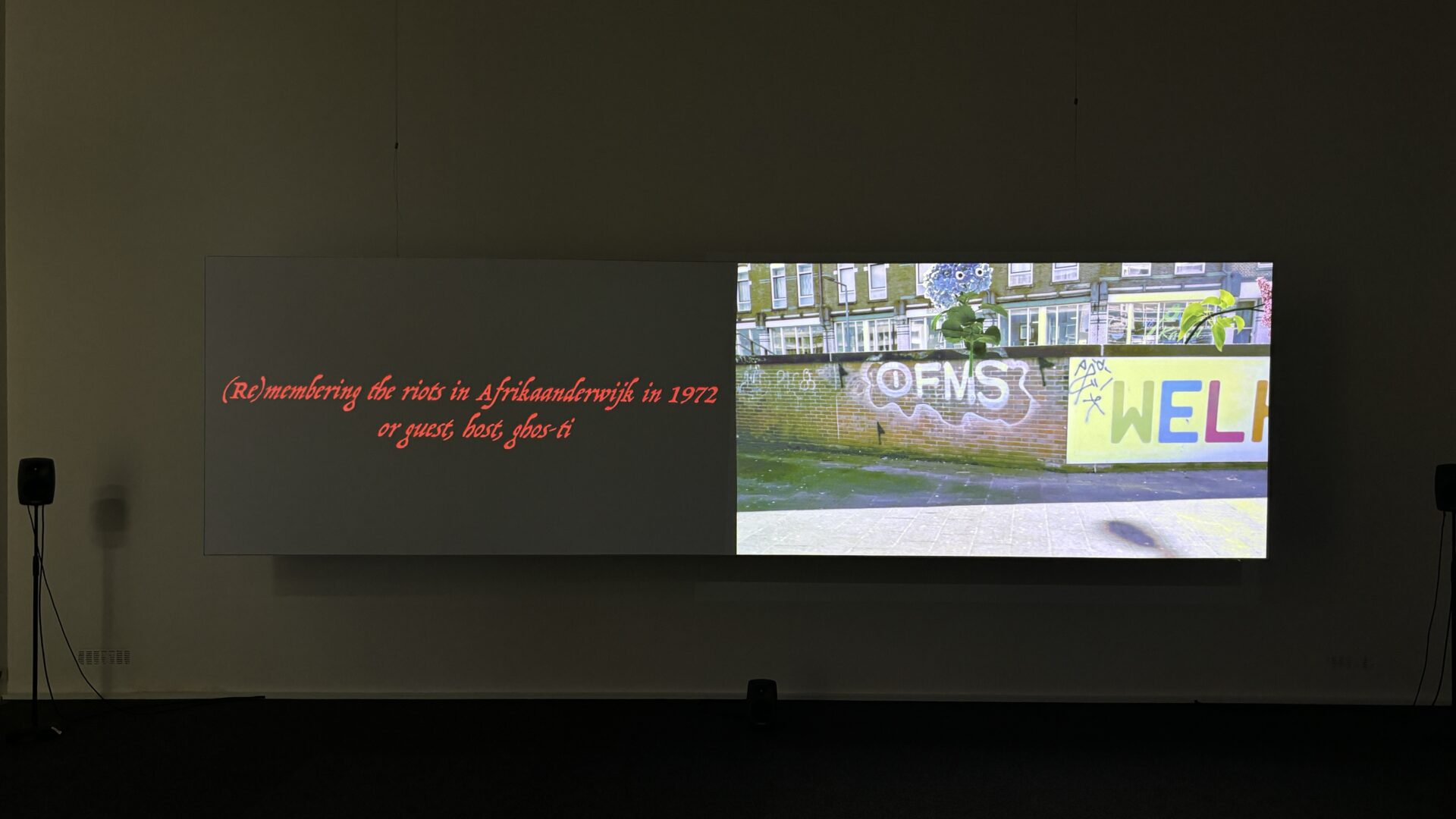
But what does it mean to walk in a city where layers of perspective differ or have been paved over? To fully activate mind and body on this topic, I sign up for a Taal Tour in Afrikaanderwijk, developed by Cihad Caner and Hannah Dawn Henderson. The walk parallels Caner’s solo exhibition at Kunstinstituut Melly in Rotterdam: (Re)membering the Riots in Afrikaanderwijk in 1972 or guest, host, ghos-ti, reanimating the largely forgotten 1972 riots in which guest workers were violently targeted.
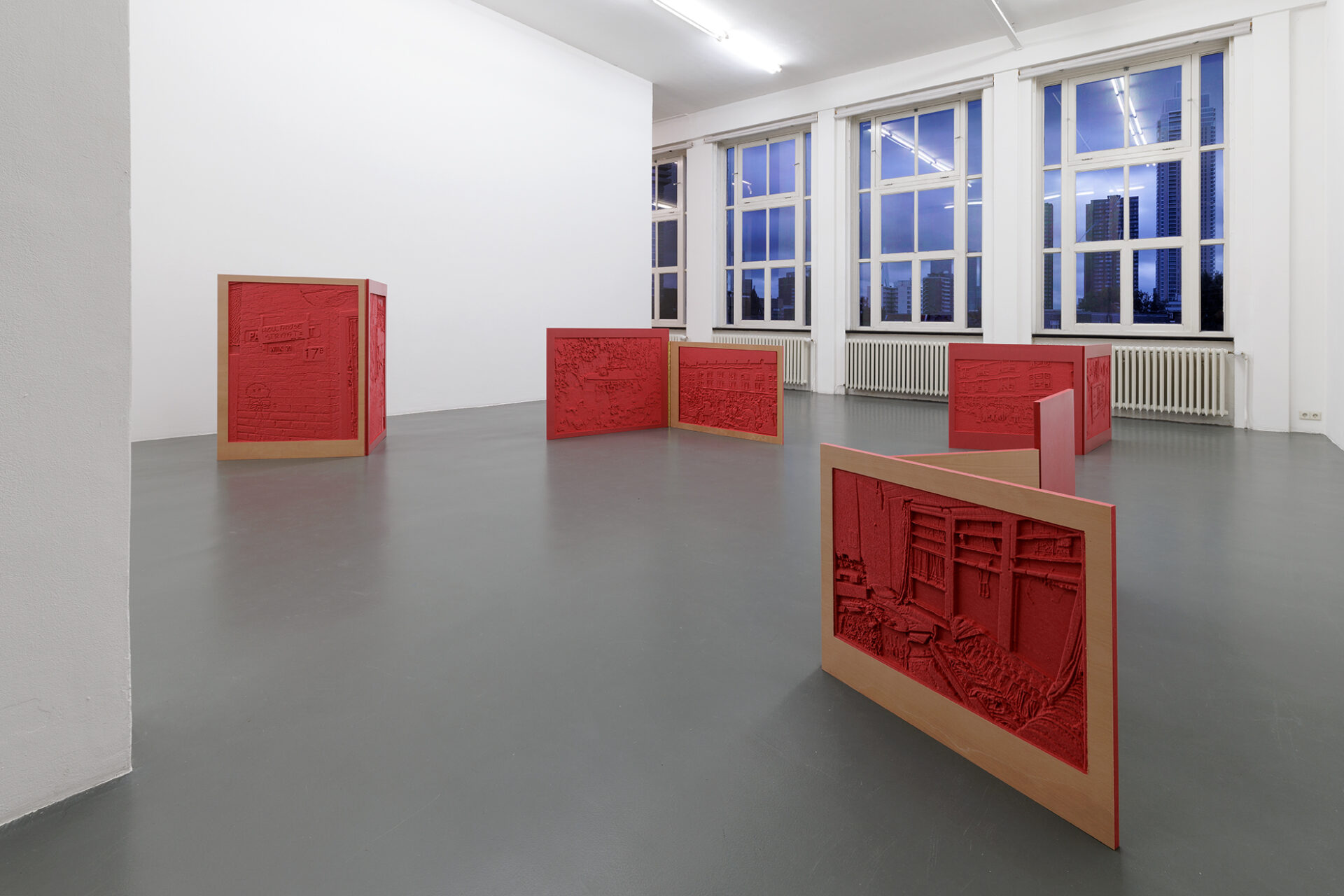
As preparation for the walk, I first visit the exhibition. I’m struck by the spatial irony: Caner’s sculptural reliefs—red MDF panels etched with archival imagery of domestic interiors, street scenes, and protests—fragmented memories of the riots and their aftermath, set against the gallery’s floor-to-ceiling windows. The imposing Rotterdam skyline looms as an unspoken witness. The city interrupts, reasserting itself, casting its shadow. This only helps in sharpening the work’s central questions: Who belongs here? Who decides? Whose memories are preserved—and who is rendered invisible?
In the adjacent room, Caner’s film unfolds. Weaving three narratives—Henderson’s research into colonial street names in Afrikaanderwijk; a reenactment of the 1972 riots blending archival footage with present-day recreations; and residents’ reflections on gentrification, displacement, and marginalisation—it reveals layered histories embedded in the memory of both people and place.
Caner’s use of non-linear narrative, fictional characters, and multilingual dialogue resists fixed interpretation. As with Glissant’s theory on opacity, the film insists on multiplicity. It does not offer closure but asks viewers to sit with the instability of memory—to acknowledge the way history is always being rewritten. When connected to the walking element of Caner’s practice, through a community of languages extending beyond the walls of the gallery, this research becomes powerfully activated. Walking then becomes an act of political reclamation—where bodies in motion begin trace erased histories back into visibility.
As I leave the exhibition, making my way to Afrikaanderwijk, my phone buzzes: low battery. The anxiety is immediate. I rely on my device for connection, money and navigation. Suddenly, the feeling of vulnerability creeps in. This moment exposes a truth: walking is not always emancipatory. What happens when our walks are not shaped by physical terrain, but by digital architectures? Movement is often mediated by access, technology, (in)dependence—and, for me, a charged phone. I’m also conscious we do not all share the same privileges.
Looping back to Caner’s film, and Adolescence—the Netflix series that first tethered me to this writing request. I think about form and the importance of platform. Filmed in one continuous take, each Netflix episode plays back through my mind like an anxiety-ridden walk. As with Caner’s reenactments, Adolescence refuses to resolve neatly, exploring how identities are constructed and dismantled, how memories are recorded and retrieved, the effects and disintegration that sometimes follows. Jamie, the adolescent protagonist, is constantly watched, negotiated: through school, family, the legal system, and public perception. The shifting narrative focus destabilizes any singular “truth” about who he is — reinforcing the unfixed, relational nature of identity and the unreliability of memory.
I experience this drama not only as something I watched, but as a kind of spectral companion—the aftermath lingering. Streaming, I realise, is a kind of digital dérive. Unlike research approaches, these platforms shape how we consume stories. We drift from show to show, crossing genres and borders. We pause, return, abandon. Our viewing habits resemble urban wandering—nomadic and fragmented but unlike walking, these encounters rarely restore us to the body. They are connection without conjunction.
As with Jamie, the adolescent, algorithmic drifting flattens sensory awareness, reshaping how we feel, perceive ourselves and others. In contrast, physical movement—the act of walking—reasserts presence. It anchors us and enables relational meaning.
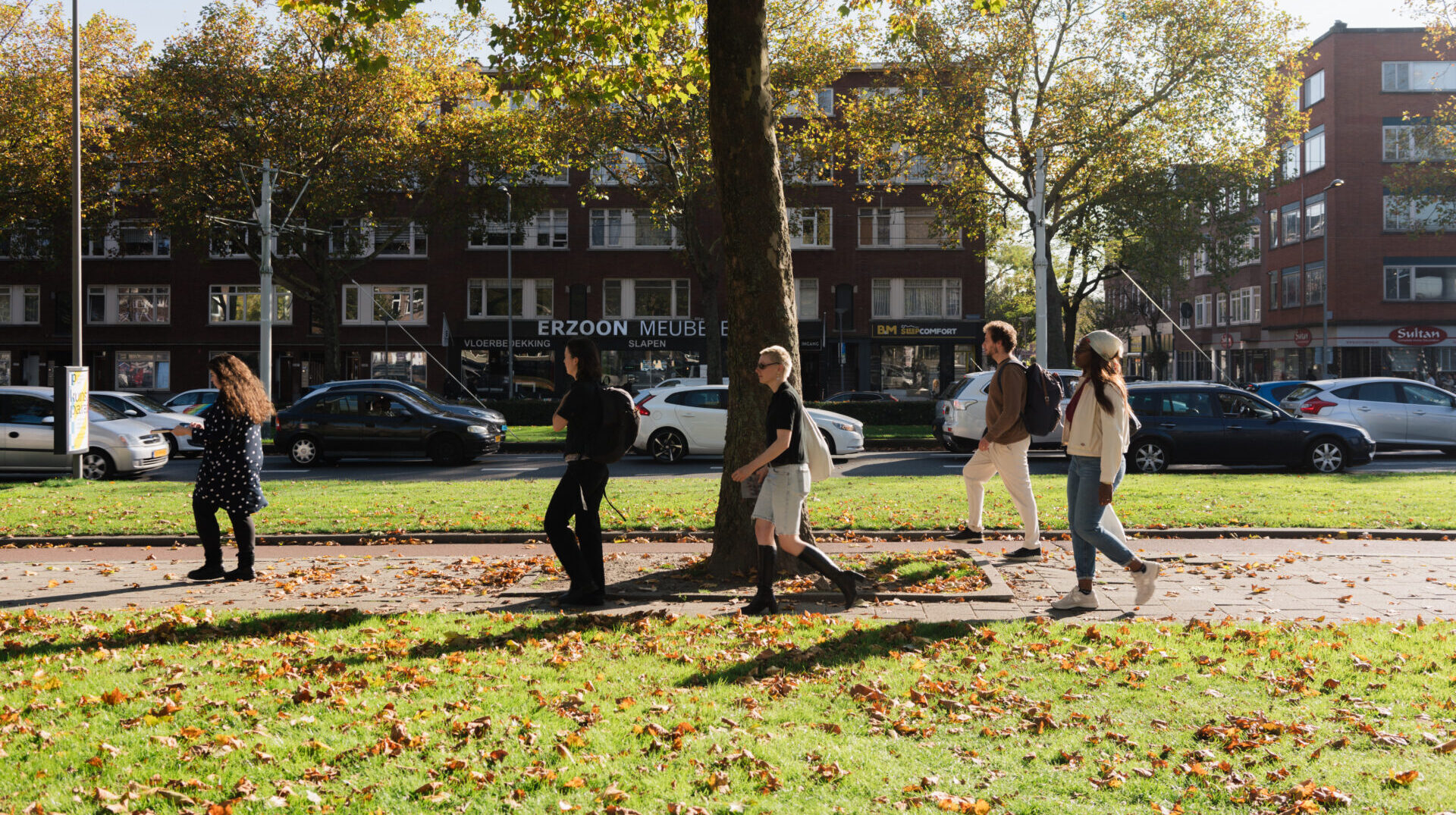
I finally arrive near our meeting point. Jamie leaves my mind. The Santos coffee warehouse looms, like much of the area, wrapped in the sheen of urban renewal. This series of guided tours is run in collaboration with Ontdek Rotterdam Anders. I’m met by the wonderfully knowledgeable and equally enthusiastic art mediator, Gino van Weenen. We quickly connect via football teams and my hometown, Liverpool. Another portside city deeply shaped by colonial trade routes. We are also joined, with much insight by Sofía Hernández Chong Cuy, former director of Kunstinstituut Melly.
In August 1972, tensions in Afrikaanderwijk reached boiling point when a Turkish landlord evicted a Dutch woman from her home. The incident ignited national unrest. Anti-immigration protesters poured into the neighbourhood. Homes were attacked; communities terrorised. Migrant residents were positioned as outsiders. The riots exposed the racialised fault lines running through the city, showing how fragile the idea of home becomes when belonging is conditional.
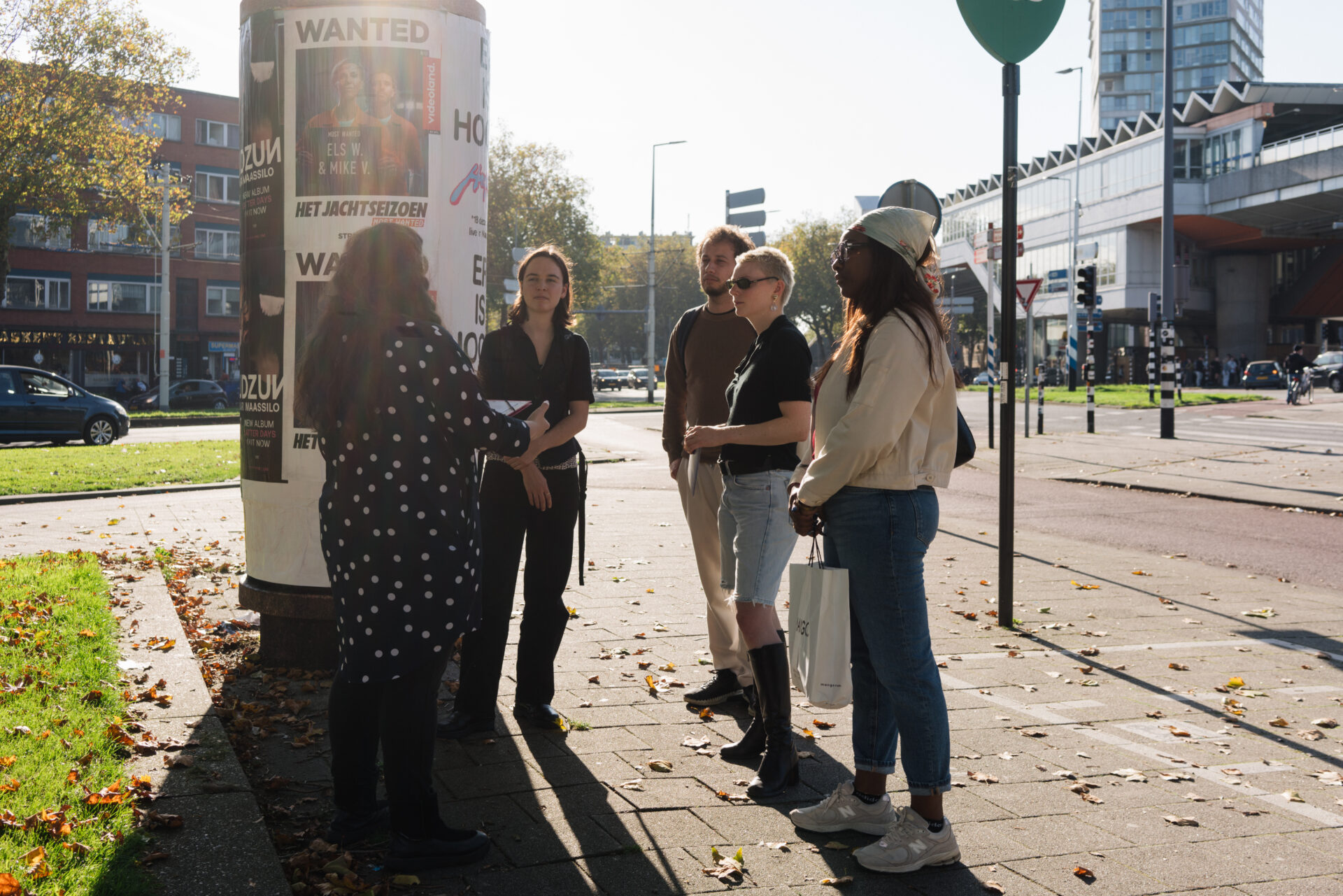
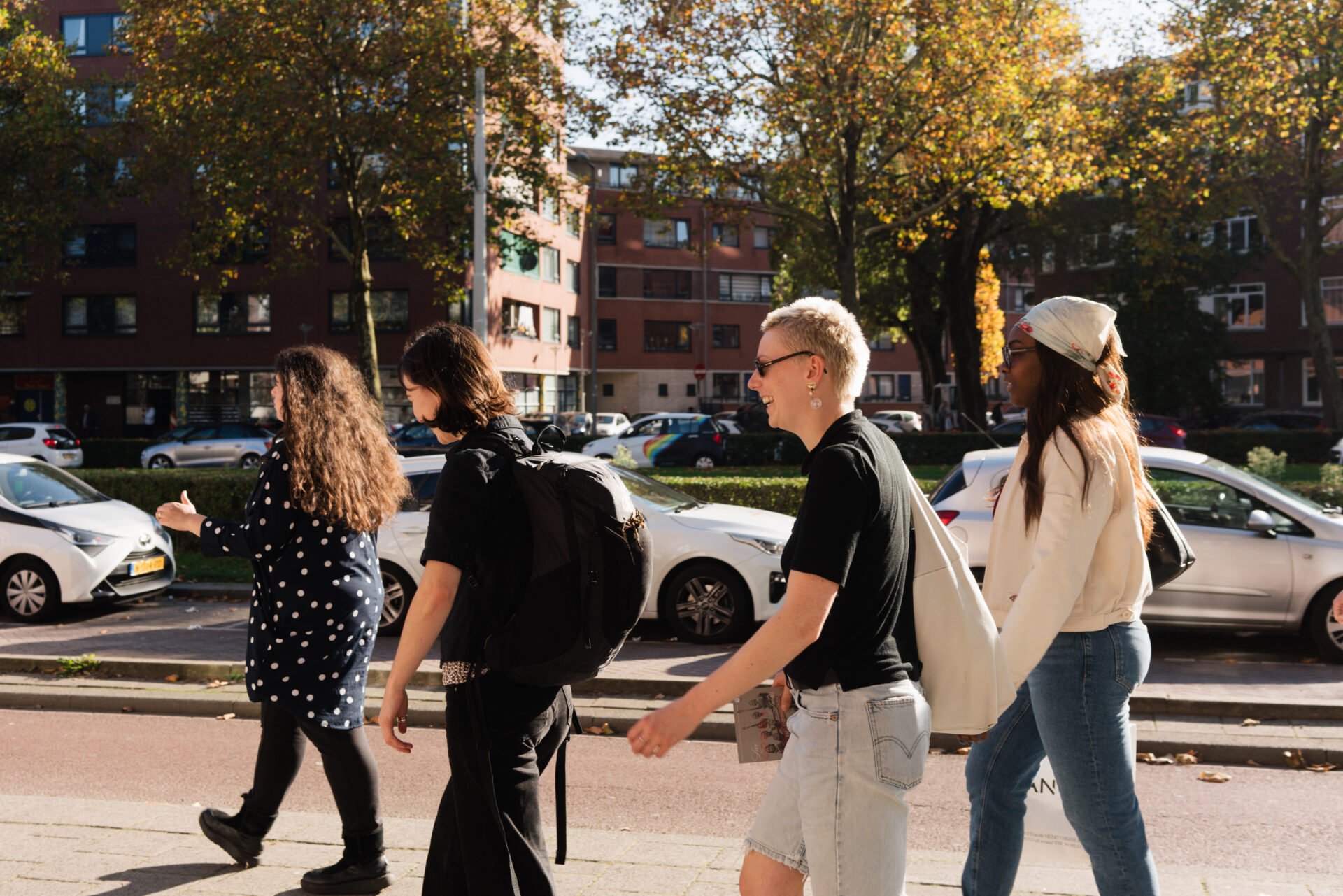
Although the buildings marked by the riots are long gone, the street names still remain. As we walk the neighbourhood, Weenen shares how deeply Afrikaanderwijk is steeped in colonial reference. The name itself commemorates the Anglo-Boer War. Key figures such as Christiaan de Wet, Joseph Chamberlain, and Paul Kruger—men responsible for, and complicit in, Dutch settler colonialism in South Africa, have their names hung, standing guard over every street corner.
Visible signs of redevelopment initiatives signal waves of gentrification, they threaten further displacement and a manipulation in the social fabric of this neighbourhood. These cycles of capitalist marginalisation mirror earlier forms of colonial and economic exploitation.
Suddenly, we stumble into the market. Focus shifts. Senses ignite.
Lemons, green not quite ripe. Stacked pyramids. Trodden grass. Sweet potatoes. Frying onions. Children weaving. Squeaky prams. Cobblestones. Voices, scents, warmth. Conversations. Spiced heat. Sizzling. Food. Dancing, not walking. Through sense alone, this neighbourhood resists erasure.
Caner’s research trails begin to converge—forming a counter-cartography. Walking here becomes a mode of embodied inscription. Histories aren’t just recalled; they’re experienced. The walker becomes part of the place. I’m reminded of a line from Walking as Research Practice:
“Like a reader scribbling notes in the margins of a book, the walker in the city leaves behind their own notations, and the city responds by leaving notes within the walker.”
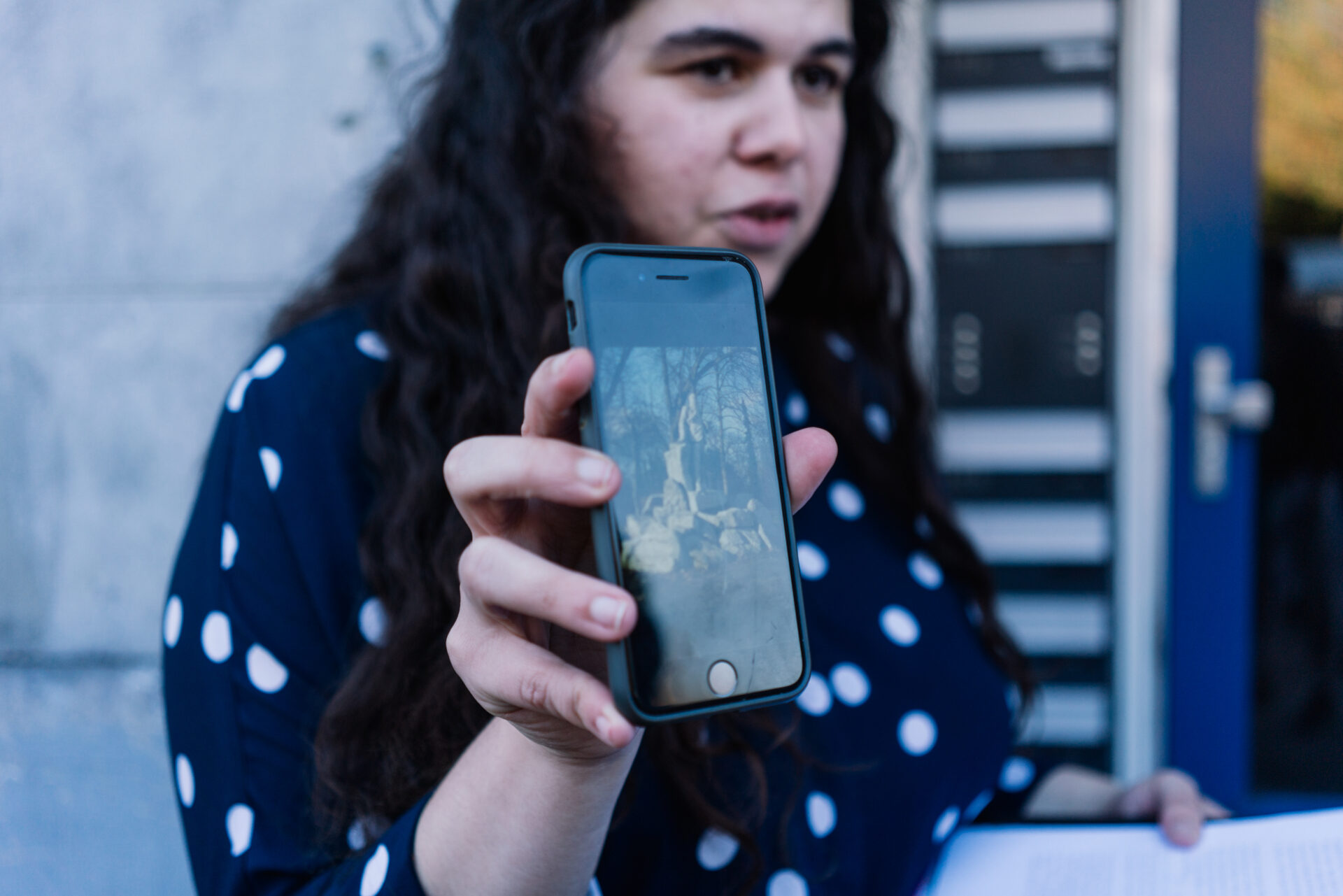
On entering Afrikaanderplein, we pause at the Monument voor de gastarbeider. Designed by Hans van Bentem, the obelisk punctures Rotterdam’s skyline—a tribute to those once deemed temporary. Each component carries symbolic weight: eight coloured stones for countries of origin; terrazzo referencing North African craft; ship’s steel nodding to the port economy; the Eiffel Tower motif and Mediterranean sun honouring migrant labour. Around us, the market hums. We linger. The conversation turns to monuments and the politics of naming.
Calls to rename the streets of Afrikaanderwijk have surfaced repeatedly, though action has yet to materialise. The issue resonates with our fellow walker, Hernández, who, responding to demands for institutional accountability, led the public consultation that culminated in the renaming of Kunstinstituut Melly in 2021. Formerly Witte de With Centre for Contemporary Art,
For Hernández, renaming was not merely symbolic gesture. Over three years, the institution held extensive community consultations, using artistic research and public engagement as tools to confront colonial legacies embedded in public space. By “speaking nearby,” and always in relation, Hernández helped reposition the institution’s identity while responding to global movements like Black Lives Matter.
Renaming can function as an intervention—an interruption of dominant narratives that seek to naturalise historical violence. It prompts urgent questions: Who do we choose to honour? Who gets remembered? Who is granted the authority to decide? Our conversation takes a turn.
In recent months, “The Trump Gulf” has played out—the Gulf of Mexico, now also referred to as the Gulf of America. Unlike the participatory renaming of Kunstinstituut Melly, this exemplifies naming as authoritarian spectacle. In using language to assert dominance, erase histories, and overwrite collective memory. As Michel de Certeau reminds us, such moves are “strategies of power“: naming not as recognition, but as territorial inscription—an attempt to monumentalise whiteness and capitalist nostalgia.
In her book, Infinite City: A San Francisco Atlas (2010), Rebecca Solnit explores the layered histories and geographies of place through a series of imaginative maps and essays. Her assertion that “naming is the beginning of justice,” emphasises the significance of naming—not only in how we remember, but as a means to return. It’s an act of recognition, a way of addressing historical injustices. Through walking and movement, as we pass through place, names are not merely footnotes, but often inscriptions of power. They may either perpetuate erasure or open space for recognition and repair.
But are maps are ever modifying. In digital space, the politics of naming persist. In Adolescence, we encounter ideological territory such as Andrew Tate’s so-called “Maniverse.” Multiple sites of toxic hyper-masculinity positioned as aspirational. This is more than naming—it is algorithmic domination, staking claims on unregulated digital terrain. Where cartographies of so-called empire once spread across oceans and land, they now proliferate through domain names, prompts, hyperlinks, hashtags, and followers, following influencers, who are always optimizing, always influencing.
As these departure points make clear: protecting our digitally imagined futures is as urgent as safeguarding the physical future and pasts threatened with erasure. This takes on particular significance in a time when artificial intelligence takes a firmer grasp of the wheel and digital wandering—through streaming, scrolling, and algorithmic drift—often supplants physical experience. As attention becomes increasingly commodified and political discourse collapses into spectacle, walking as an artistic research practice has never felt more vital. As both resistance and repair, walking insists on opacity, complexity, and encounter. It reclaims the right to move, to (re)name in relation, and it provides us with the power of possibility, to remember otherwise.
An edited Dutch translation of this text was published in Metropolis M No 2-2025 -Tegenspel
Adolescence, created by Jack Thorne and Stephen Graham, directed by Philip Barantini, Netflix, 2025.
Alice Twemlow and Tânia A. Cardoso (eds), Walking as Research Practice (Amsterdam: Roma Publications, 2023).
Édouard Glissant, Poetics of Relation, trans. Betsy Wing (Ann Arbor: University of Michigan Press, 1997)
Michel de Certeau, The Practice of Everyday Life, trans. Steven Rendall (Berkeley: University of California Press, 1984)
Rebecca Solnit, Infinite City: A San Francisco Atlas (Berkeley: University of California Press, 2010)
Trinh T. Minh-ha, “Speaking Nearby: A Conversation with Trinh T. Minh-ha,” interview by Nancy N. Chen, Visual Anthropology Review 8, no. 1 (1992)
Kaylie J. Stuart
is an artist and writer