What kind of future? – Manifesta 16 Ruhr
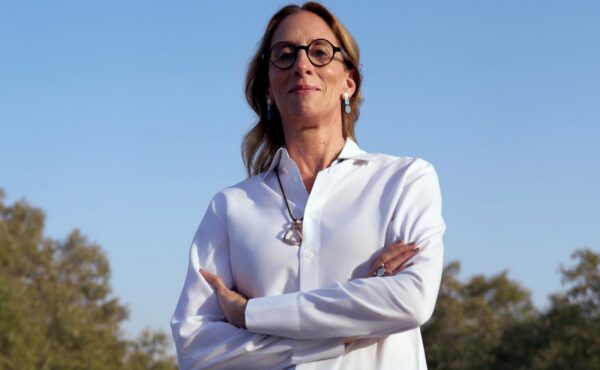
Maike Hemmers, who is from the Ruhr region, is visiting Manifesta 16 Ruhr. She is curious about the exhibition’s social ambitions, which, as always with Manifesta, are lofty. “This is not a Church” aims to give the many vacant churches in the area a new purpose. Will that plan work? GA NAAR NEDERLANDSE VERSIE
For its 16th iteration the nomadic art biennial Manifesta takes place in the Ruhr region of Western Germany, placing itself in different cities closely connected through the metropolitan character of the region. The theme ‘This is not a Church’ lays the basis of their curatorial focus. If a church is not a functioning place of worship and religious community anymore, what can it become?
I grew up in a small village on the periphery of what is considered the Ruhr region. Manifesta’s creative mediators ask how to protect the social importance of the churches, and whether the transformation of their function can ‘now contribute to the formation of a more just and pluralistic society?’[1] They hint at a region divided along political, economic, and social lines. My curiosity about Manifesta 16 is about more than just its artistic ambitions; it is about how their inquiry translates to or affects people who live there. Because this region is mine too, I focus less on the art itself and more on the encounters Manifesta provides, and what people share with me there. With 12 churches to visit, 107 artistic participants, and an extensive public program, my observations cannot be conclusive but are rather a reflection on specific moments I encountered.
The open countryside that I know feels far from the diffusion and density of Ruhr. Looking at it on a map, the area is a fossilized cluster without visible borders between the different cities. Colloquially we call the region Ruhrpott, or just Pott – the melting pot of the coal mine production. Ruhr is entrenched with this industry; this is visible in every aspect of the landscape. Many bridges, mostly short and horizontal, for transport and with heavy metal freight train tracks. Row after row of alike looking square and grey working class houses, where you meet a mix of many nationalities and origins, starting in the 1960s with the so-called Gastarbeiter*innen (guest workers). Especially the group of workers coming from Turkey has a special place in this show. In the 1990s most mines had closed. Over the years many of these industrial spaces turned into recreational areas, into parks and forests. Some mines turned into cultural space; the best known of which is Kokerei Zollverein in Essen, where the opening of Manifesta took place. While Nordrhein-Westfalen is one of Germany’s wealthiest federal states, the region holds stark differences in structural debt and poverty, especially in the cities that make Ruhr.[2]
After the destruction of World War II, over a thousand churches were built anew in this region, many of them called Pantoffelkirchen (slipper churches), nestled inside neighbourhoods so people didn’t even have to trade slippers for shoes to get there. Later on, when the Wirtschaftswunder gained speed, many were shaped by Modernist focus on essential geometry. They offered new ideas and ideals in impressive form: a new and enlightened society, stripped off unnecessary ornaments, and (seemingly) freed from adhering to monumental atrocities. Now, there is a gaping decline: around 20.000 churches are said to be defunct in the coming decade.
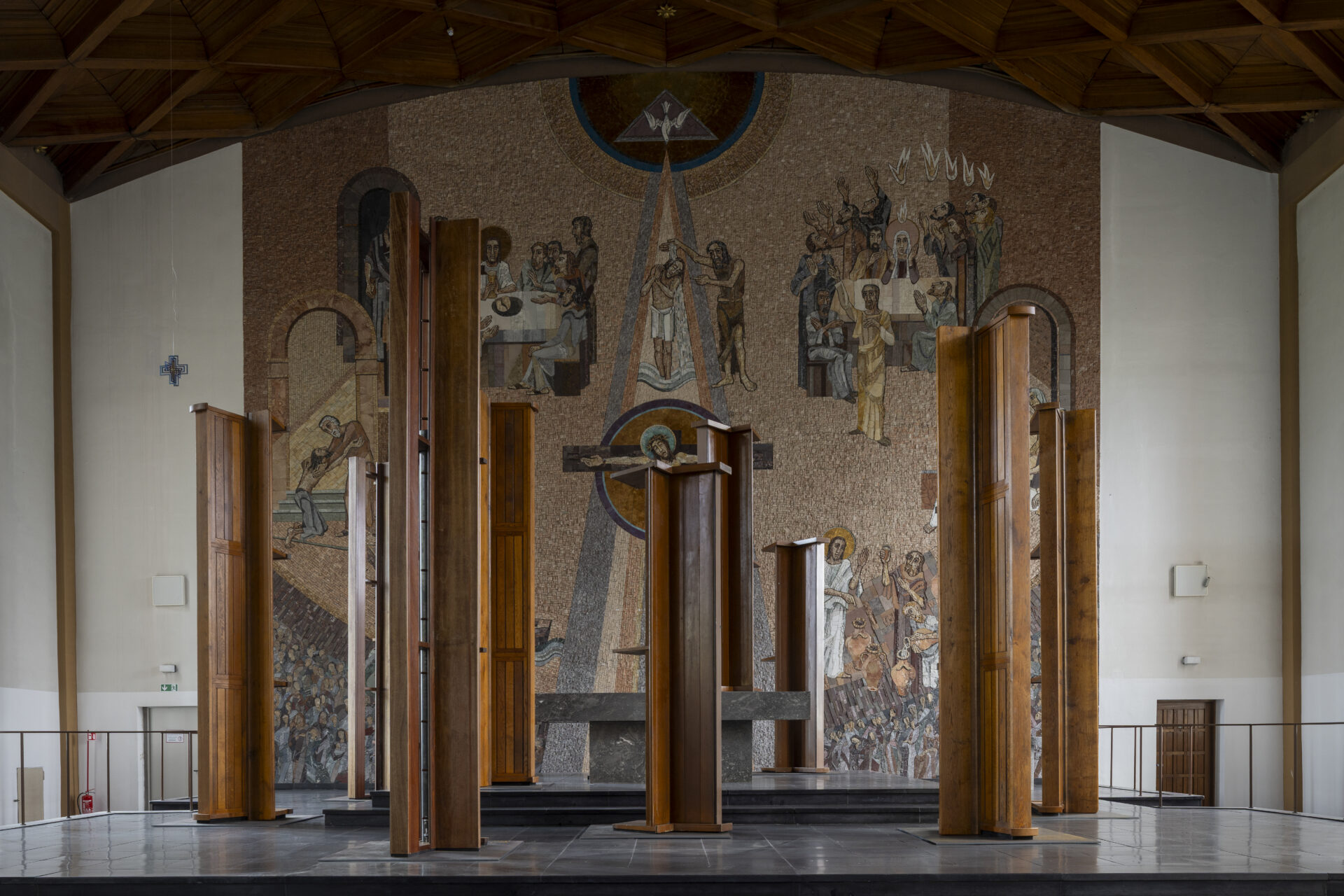
Overview
Twelve churches were selected as venues and all are situated in four cities of Ruhr: Duisburg, Essen, Gelsenkirchen and Bochum. Most of them already have a different function, ranging from storage for a local baker, a future architecture office, or social-cultural programming. Rather than suggesting new orientations for the use of these buildings, Manifesta chose these for representational reasons, location and feasibility in joining a biennale setting. And of course their intrigue and architectural style. While spread out over the region, and demanding quite some travel, it is possible to see much of the biennale in around two days.
The churches don’t present one coherent exhibition proposition but six different angles coming from the individual and duo teams of curators, or in Manifesta’s terms: creative mediators. The two individual curators Josep Bohigas and Gürsoy Doğtaş present thematic presentations. The rest consist of inter-generational duos who chose to present exhibitions of different experiences and perspectives: René Block together with Leonie Herweg, Krzystof Kosciuczuk and Anda Rottenberg, and Michael Kurtz with Henry Meyric-Hughes.
Manifesta 16 has a very extensive public program, that is partially bound to each church, and partially formulated through the program of Manifesta 16+. Through an open call 16 projects were selected that take place in the wider region to further the local grounding towards its various communities. Manifesta also has been able to keep the entrance free.
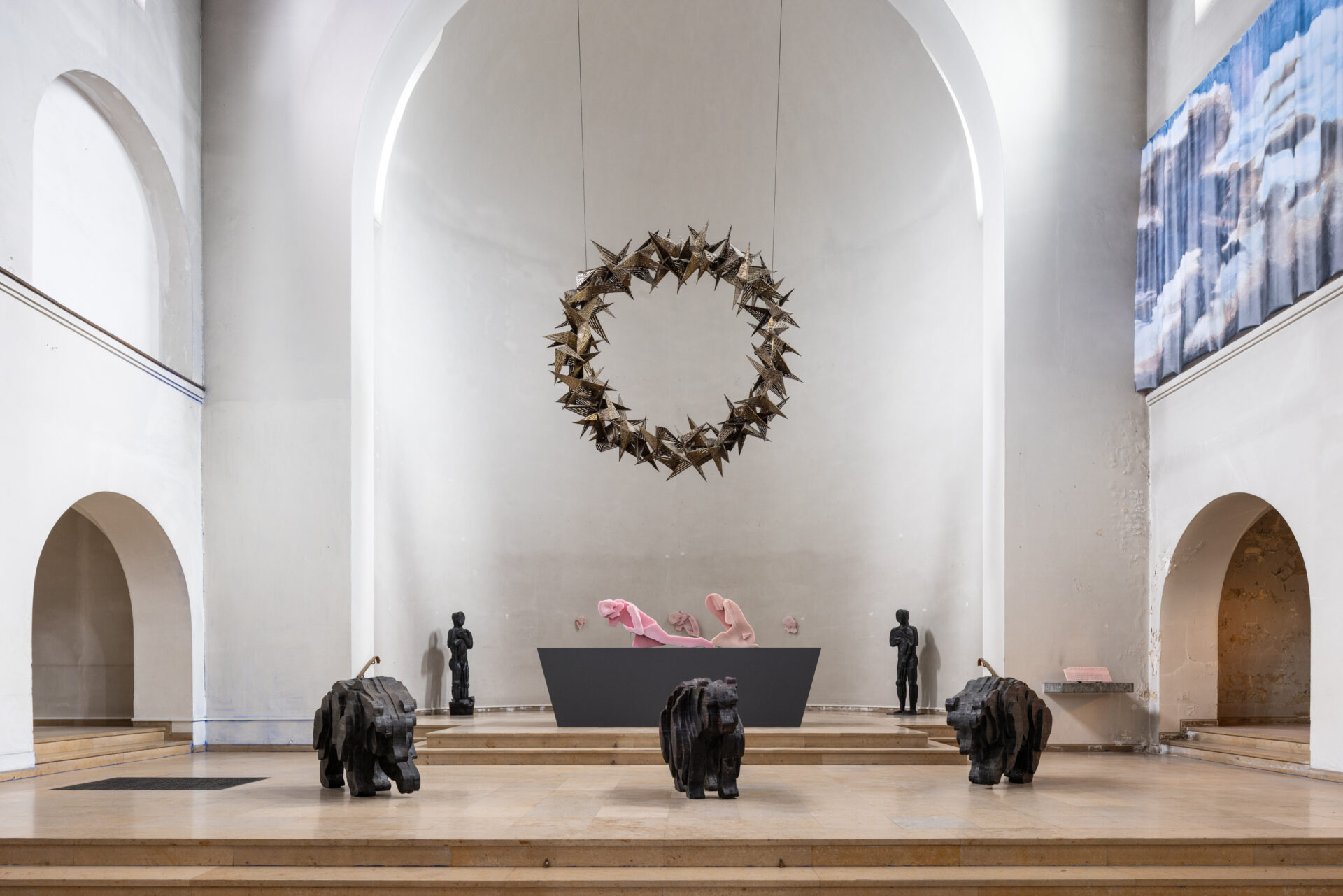
What enlivens it
Josep Bohigas researched the urban and social conditions of the area well ahead of Manifesta’s official start, and his findings are bundled in the publication Urban Vision. It is an extensive study on the region’s built structure, and how it became what it is now. During the press conference and through Urban Vision, Bohigas points us to what lies behind the interest in the infrastructure of churches: what enlivens it, the network that makes a neighborhood.
Manifesta’s founding director Hedwig Fijen goes a bit further by pronouncing the biennale to be an incubator for change. The biennale is speculative and so imagines the future we want to build together. The neighbors shouldn’t just be mere viewers of the arts but participants, and co-shape what the biennale opens up to them.[3] We don’t walk on slippers to the closest church anymore, so what is it then that can bring our different but immediate lives together? But also, what kind of participation is possible considering the environment it’s operating from?
During the opening weekend of Manifesta, days of trial for The Ulm 5 was also taking place. They are a group of activists from Palestine Action Germany, arrested for violent property damage against an Israeli arms firm. They are charged as belonging to a criminal organization, a charge usually brought against groups of organized crime. In the last years it has been increasingly used in similar cases of political protest. Also the cultural world has been affected by these changing perspectives on public life in Germany. Freedom of speech has been limited. Art institutions censor themselves, avoiding controversy and possible repercussions. If the biennale is rooted in this local context, what kind of shaping is actually possible, and what kind of art can hold it?
The cultural world has been affected by these changing perspectives on public life in Germany. Freedom of speech has been limited. Art institutions censor themselves, avoiding controversy and possible repercussions. If the biennale is rooted in this local context, what kind of shaping is actually possible, and what kind of art can hold it?
Not by sight
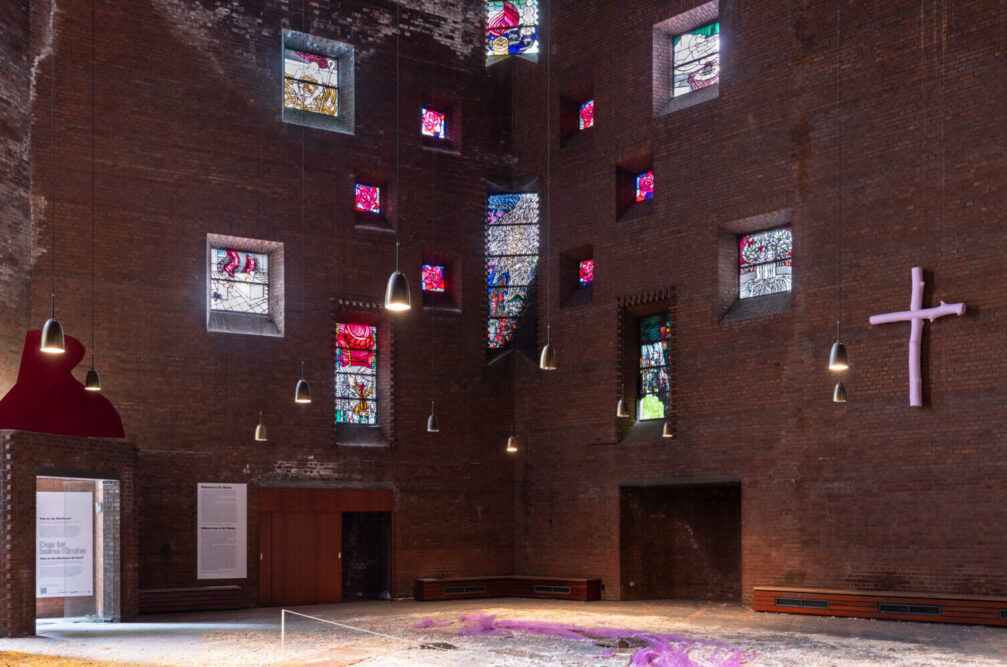
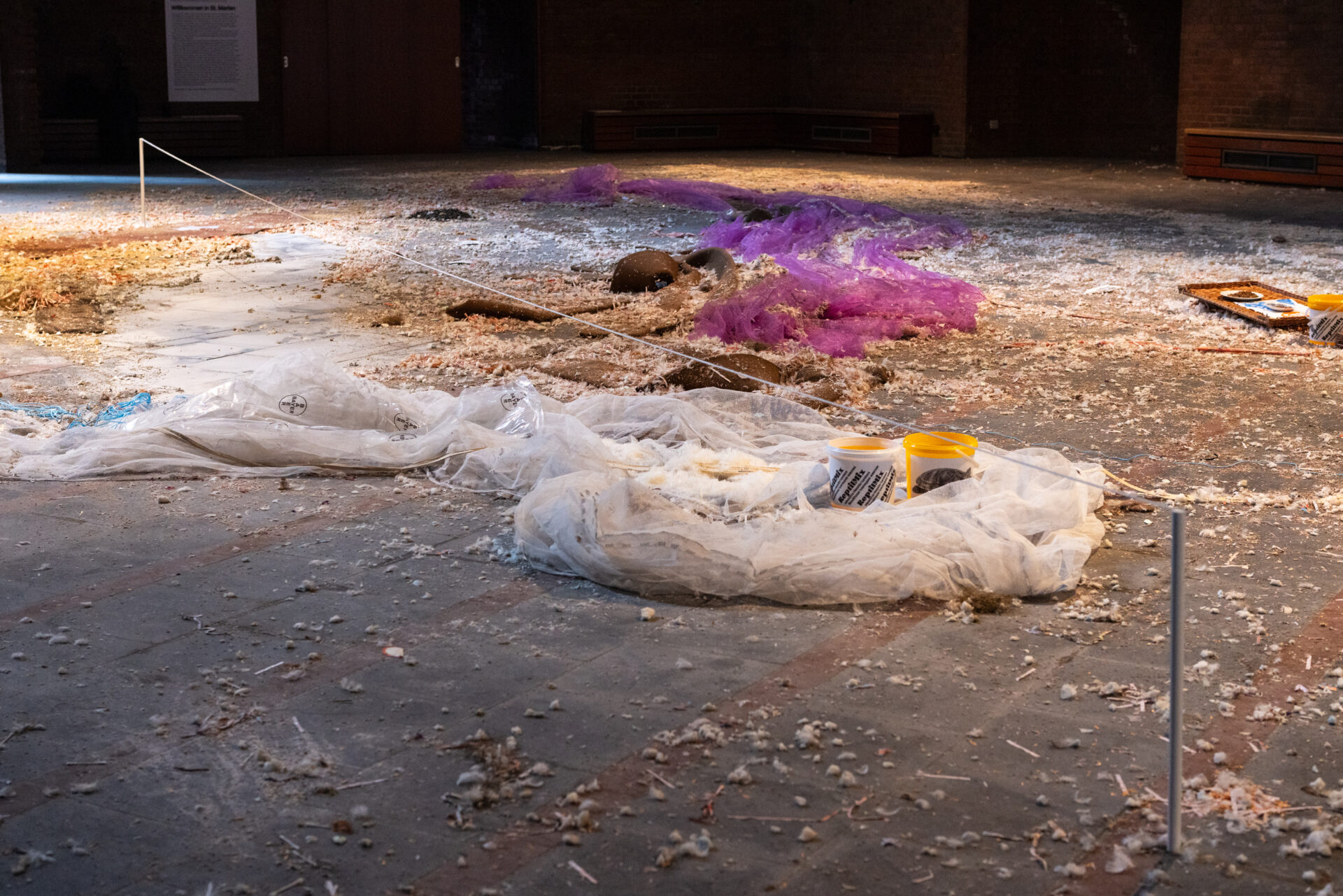
St. Marien (Essen) is one of the churches without a clear future. Its tall red brick facade is evocative of enormous mining buildings. Rising in between high trees, it sits opposite a lively playground. The walls are punctuated by small stained glass windows of a striking visual quality by artist Manfred Ott. The church was curated by René Block and Leonie Herweg. Spread out over the floor of the wide open space are heaps and traces of small package material, sawdust, feathers, strips of paper, lavender, and some of the church’s original church pew upholstery. Untitled (2026) by Jason Dodge looks like something lively happened, the residue of a party or strange ritual, and we are invited to wander through it. The playful arrangement of unconstrained and leftover materials lifts some of the heaviness of the imposing building.
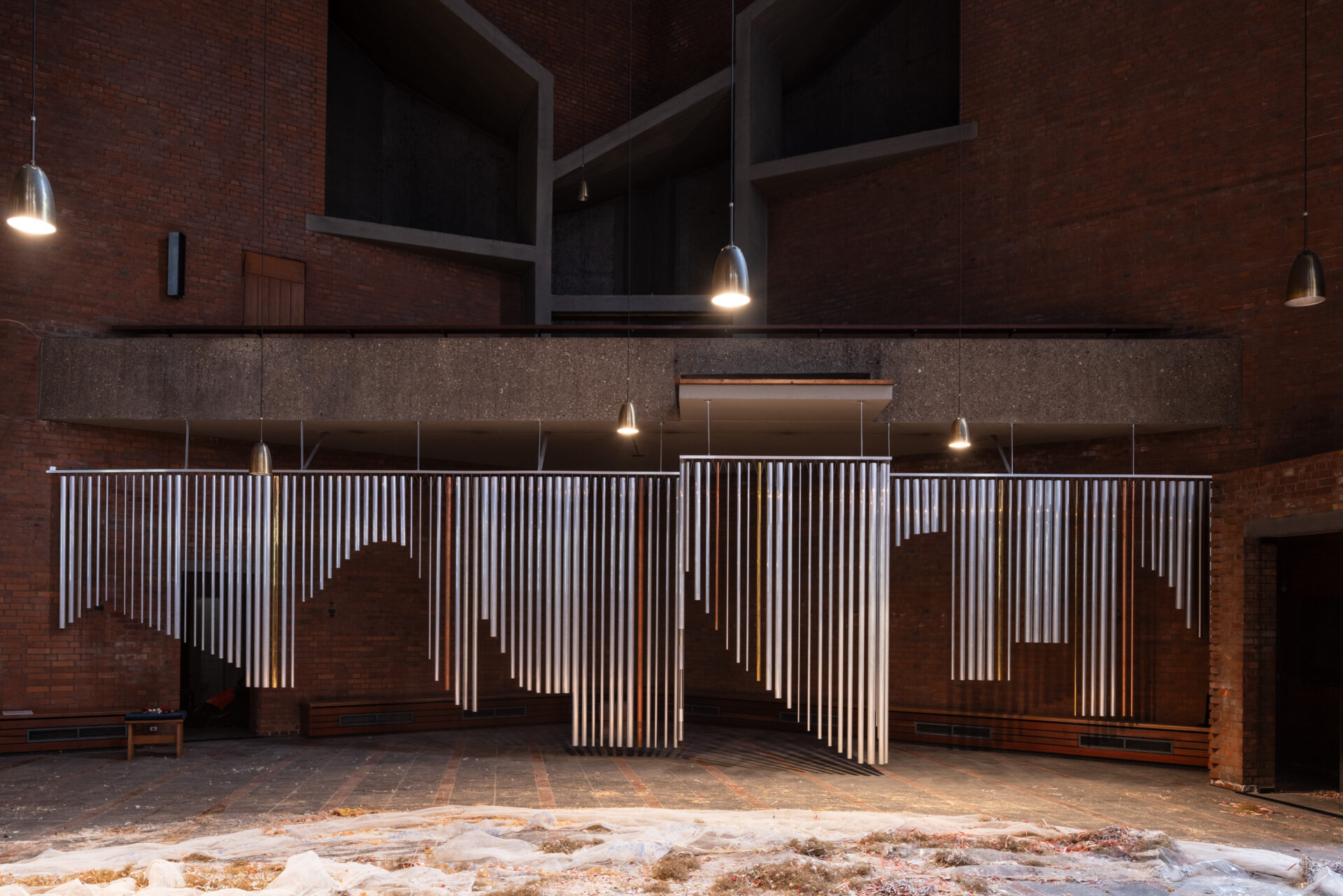
I ask one of the hosts if this work shifts the visitor’s experience of spatial magnitude. She shrugs, and points instead to Variation on Godspeed in 4/4 Time (2026) by William Engelen. The row of aluminium, steel, brass and copper tubes is hanging where the church’s organ once stood. She tells me how neighbors peek in out of curiosity but don’t return (a story repeated to me in almost every church). But she approached the neighborhood children frequently passing by to go to the playground. Invited by her to come and play the tubes, they have since come in often just to perform a bit. Inspired, I hit the chimes with the provided mallets, and feel delighted by the random and clear sounds echoing through the vastness of the hall.
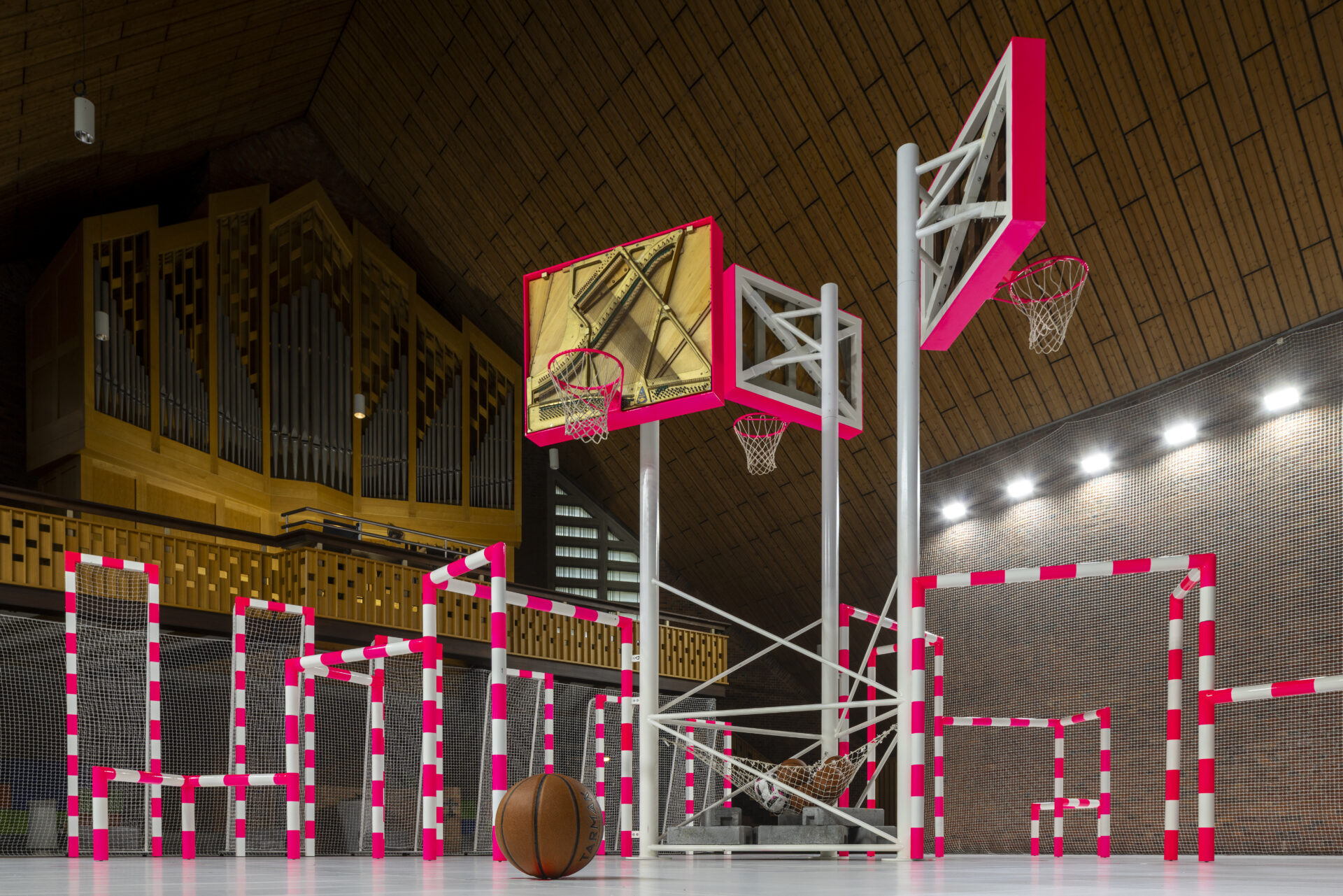
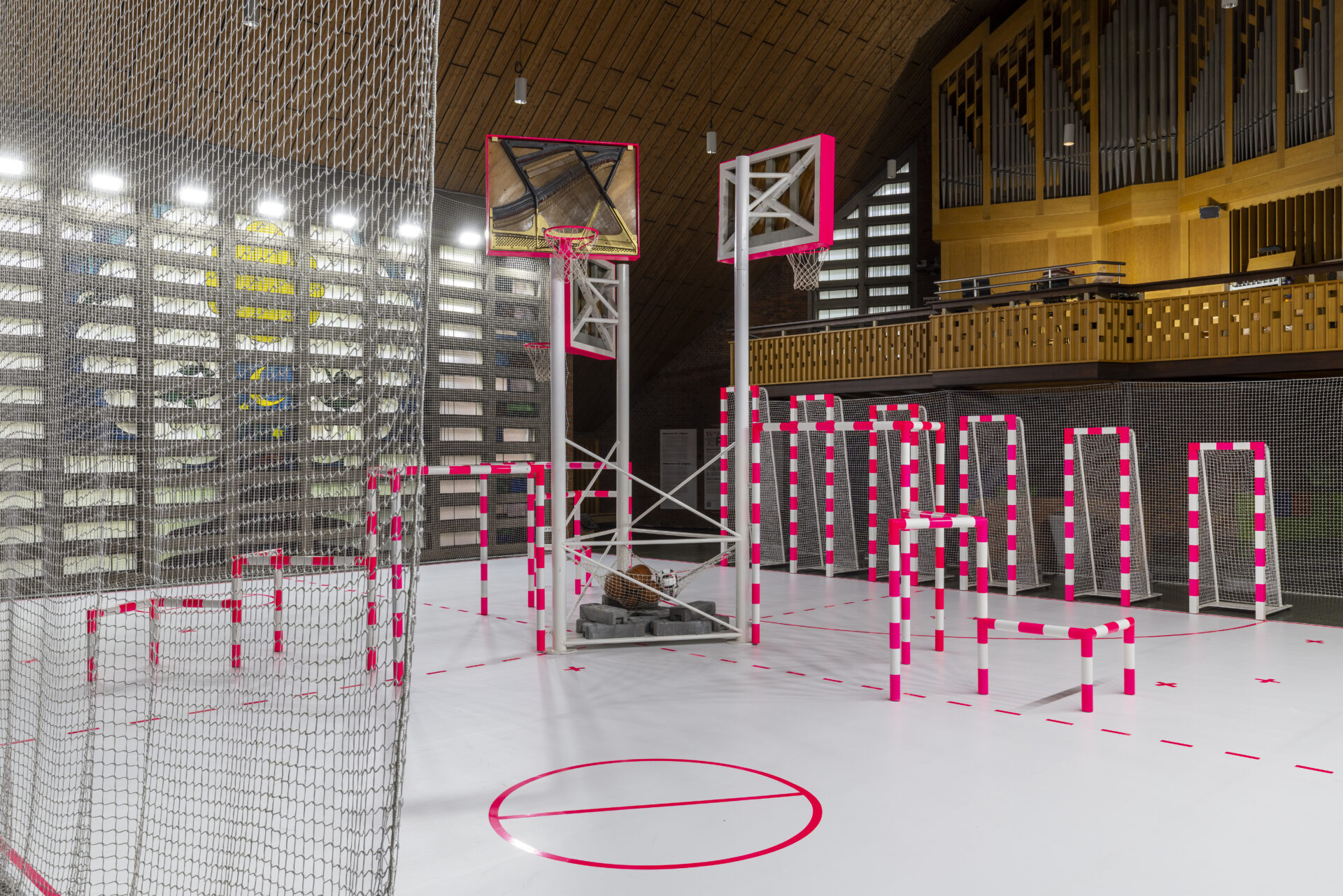
Even more inviting is St. Ludgerus in Bochum. The church pews are reconstructed by Curro Claret to become a tribune for the playfield of FAIL LOUDER (2026) by CaboSanRoque with FLEXO ARQUITECTURA. Visiting as part of the press group, I notice how quickly our bodies and attitudes change once we are allowed to play and run around there.
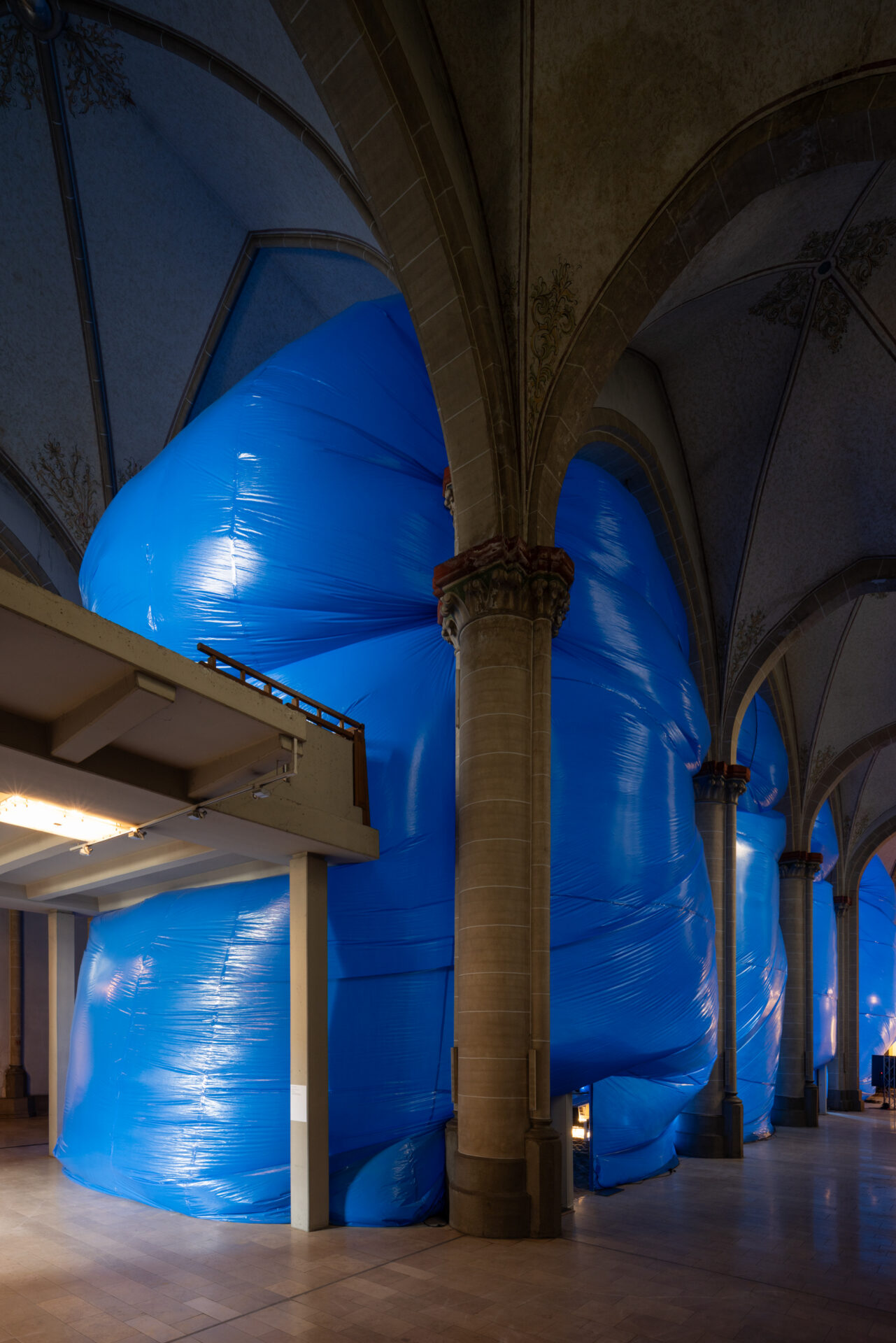
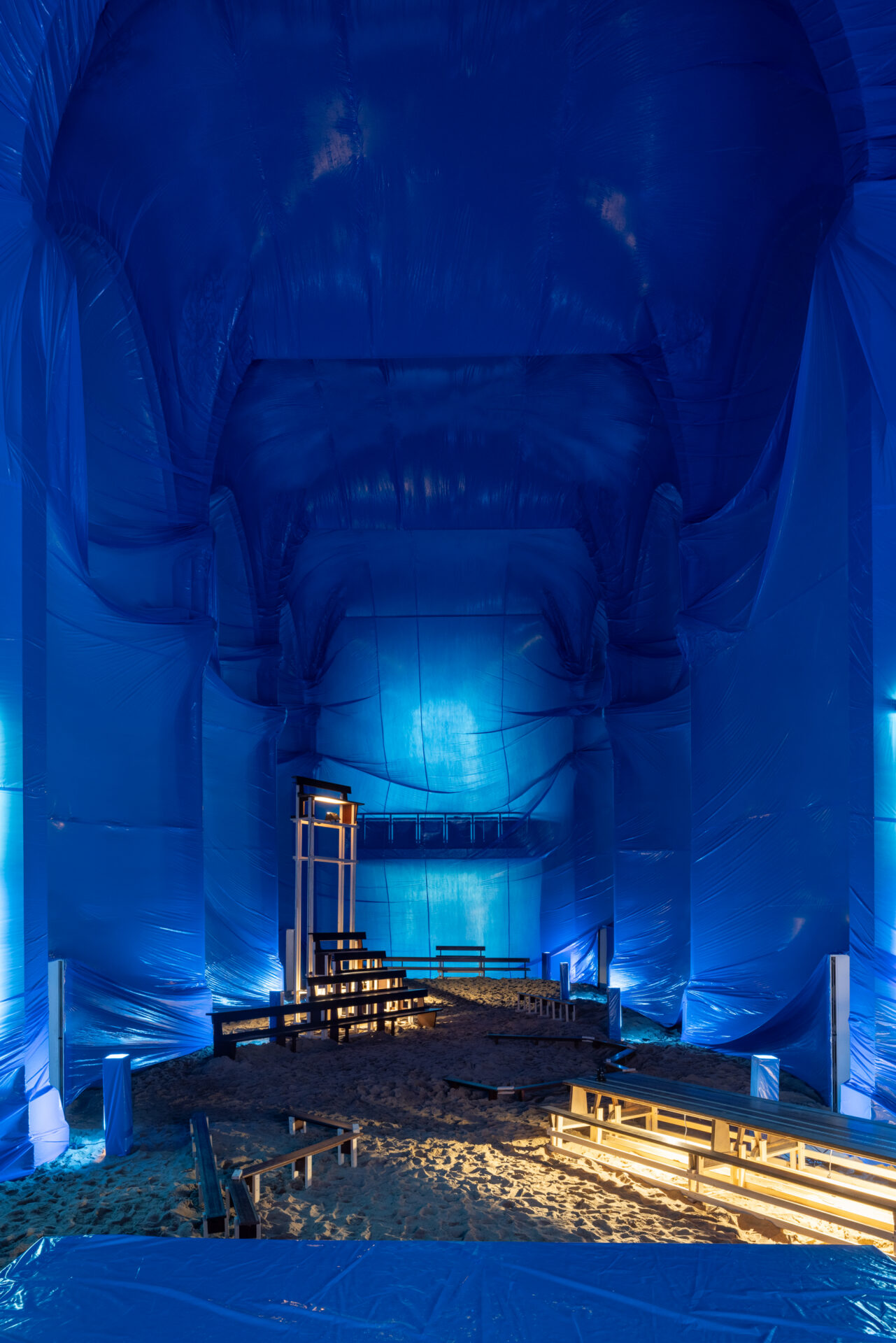
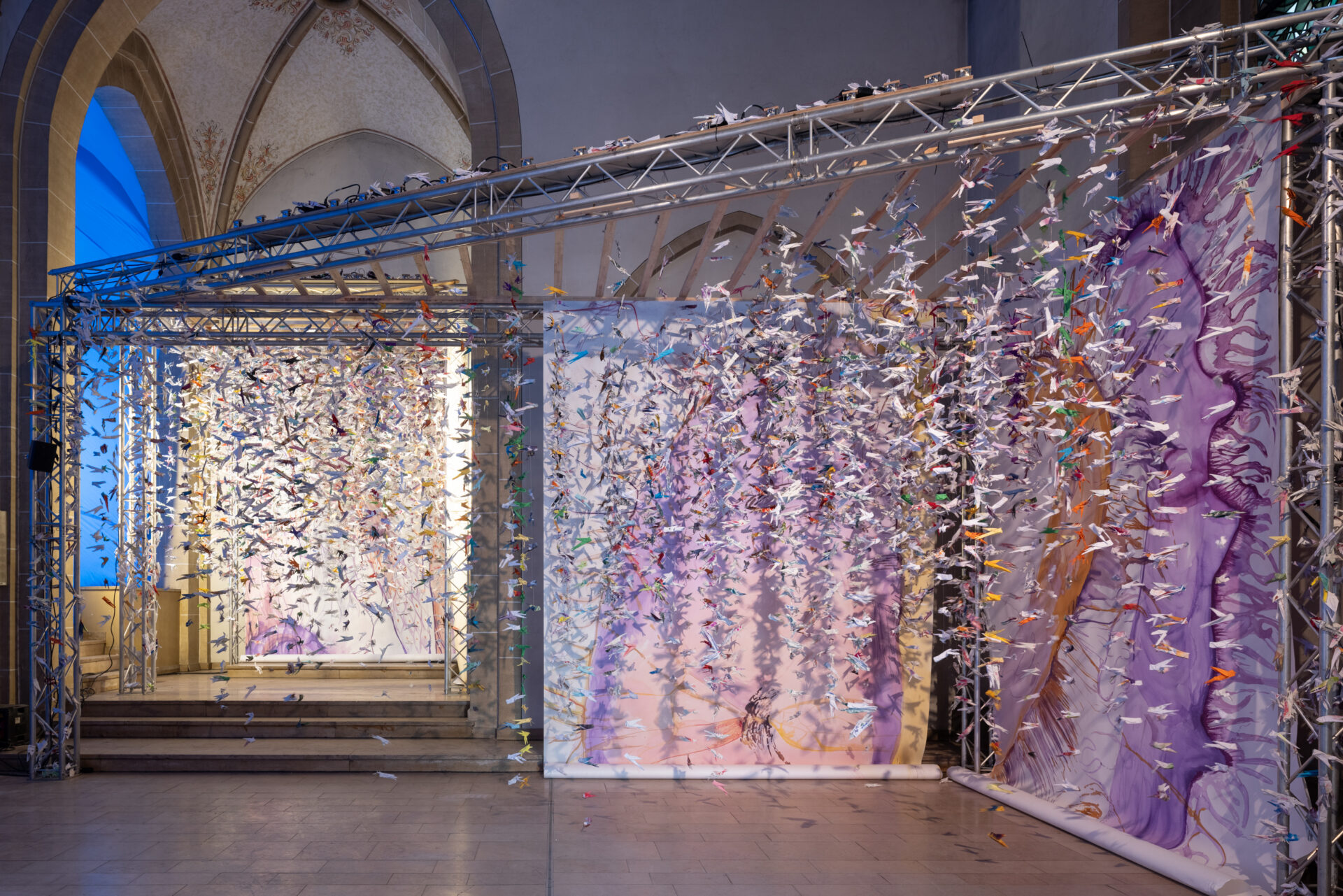
Besides St. Ludgerus, Bohigas is also the creative mediator of St. Josef in Gelsenkirchen, which is not a modernist church but features neo-Gothic and Classicist elements. It is monumentally altered by an inflated space created from blue plastic; Möglich Unvorhersehbar (Possibly Unpredictable) (2026) by Penique Productions. At the entrance the visitor is greeted with an outward bulging barrier. Once moving around it, they discover an entrance. I step on a thick layer of sand, and find inside the blue-tinted space a video work and constructions of former church pews. At first glance impressive, the inflatable structure ends up making me feel like any imposing church would have: detached, small, ominous. I seek help from a host and she explains that the space is meant to function as a community spot for people to meet, make their home-work, read.
I ask with some disbelief why anyone would want to hang out in a dark-ish sandpit without any idea of the outside. She confirms that it isn’t really used, nor practical. She grew up in this very area, Ückendorf in Gelsenkirchen, shaped by structural poverty and racial and political divide. She tells me that it is difficult to attract the people who live here. Manifesta puts in various efforts to reach the neighborhood with public programs and coffee and cake stands that happen here weekly. Before the official start of the biennale, the church housed a basketball court which was well used. It is hoped to return once Manifesta closes. But why did the basketball court not continue to stay when it worked so well?
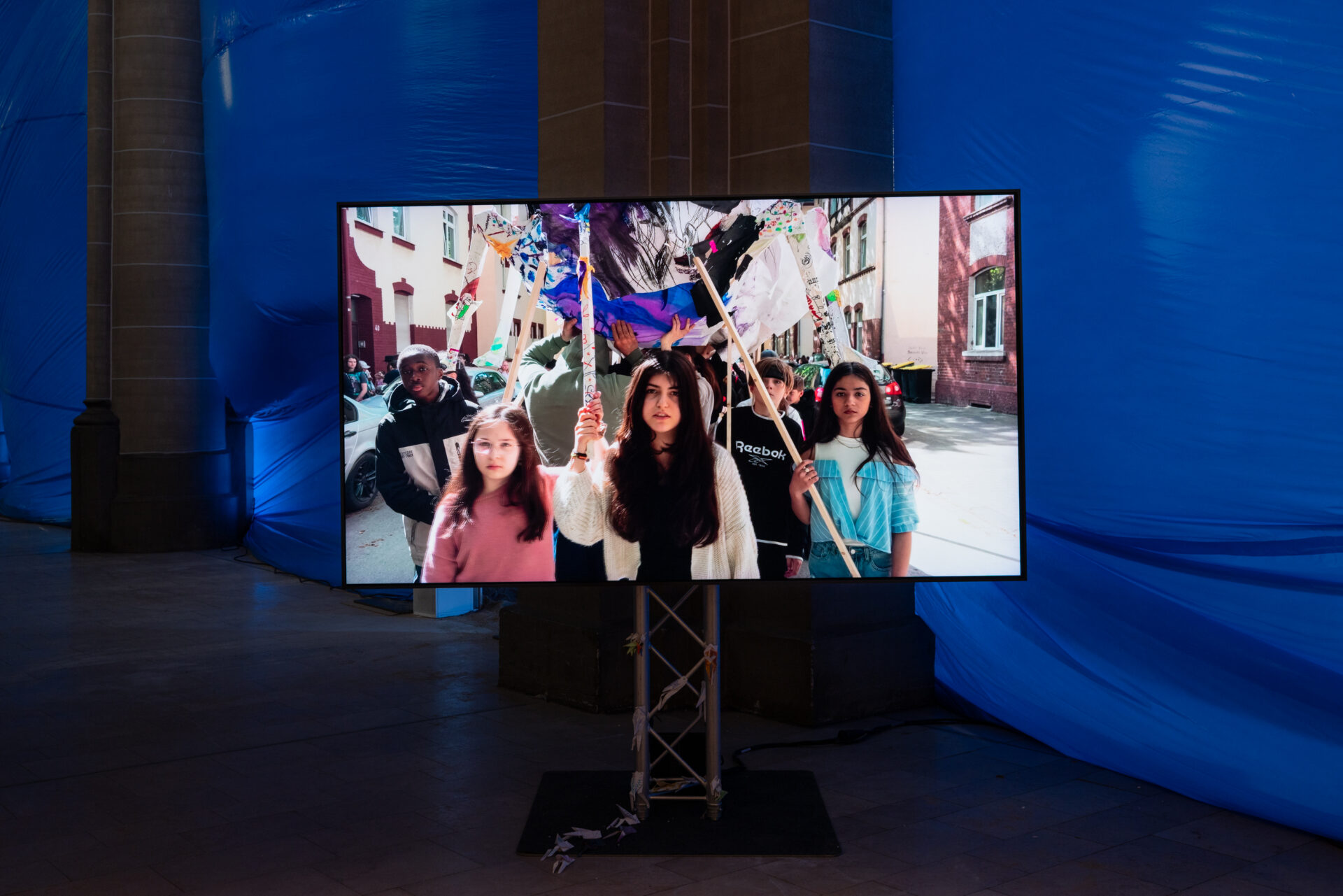
Moving outside the balloon, I find a locust made out of ragged pieces of paper, some drawn on through the recognisable scribbly fantasy of children, some plain color. Its legs are connected to pieces of wood and tell me that it can be moved. How to Carry a Locust (2026) is a collaboration of the artist Havîn Al-Sîndy and around 200 local students, and their teachers, commissioned as part of Schule, Nachbarschaft und Wir (School, Neighbourhood and Us), initiated by Manifesta’s Education and Mediation team. I am drawn further by the sound of singing coming from a screen in which I see a young girl holding a locust in her hand. She is moving around a landscape that I cannot pinpoint. Kulî (Locust) (2026) is a quiet and subtle work, but it unfolds as one of the more political pieces. The wall text tells me how it relates to Kurdish resistance and history: ‘a history of being watched, forced displacement, and the struggle for self-determination. At the same time, it opens onto present experiences in which war, dispossession, and survival are inscribed.’ To me it resonates as the first work that carefully mirrors Palestine’s right to exist. Seeing the rows of names of children below the wall text, I leave with some form of awe at all the connection that lies behind the making of the humble locust next to the blue inflatable.
Once outside I take a big breath of fresh air. A few boys play cards enthusiastically on the steps of the church, hopping from one step to the other, while the play seems to propel them further. I ask them if they have been inside. One proudly holds up his hand; the others promise that they will go later. Next to the church is a small Trinkhalle or kiosk as you see in so many German cities. Through a window you can get daily essentials, and obviously something ‘zu trinken’ (to drink). I expose myself as a big city person, or not from here, by wanting to pay by card for some of the candy inside plastic boxes showcased in the window. I have just enough cents on me to get two of my favourite licorice balls and keep on moving to the next location.
Using what is there
Many of the biennale artists seemed to have been looking into ways to relate to or oppose the church space. For many this was done by using or altering the inherent furniture like the organ, pews or altars. This is drawing from the historic example of ‘Trümmerfrauen’ (rubble women) who collected and cleaned the immense numbers of bricks and stones left-over from the destruction of World War 2. Artists salvaged, foraged and gathered old material in their spirit, to build anew from the crumbling structures of churches.
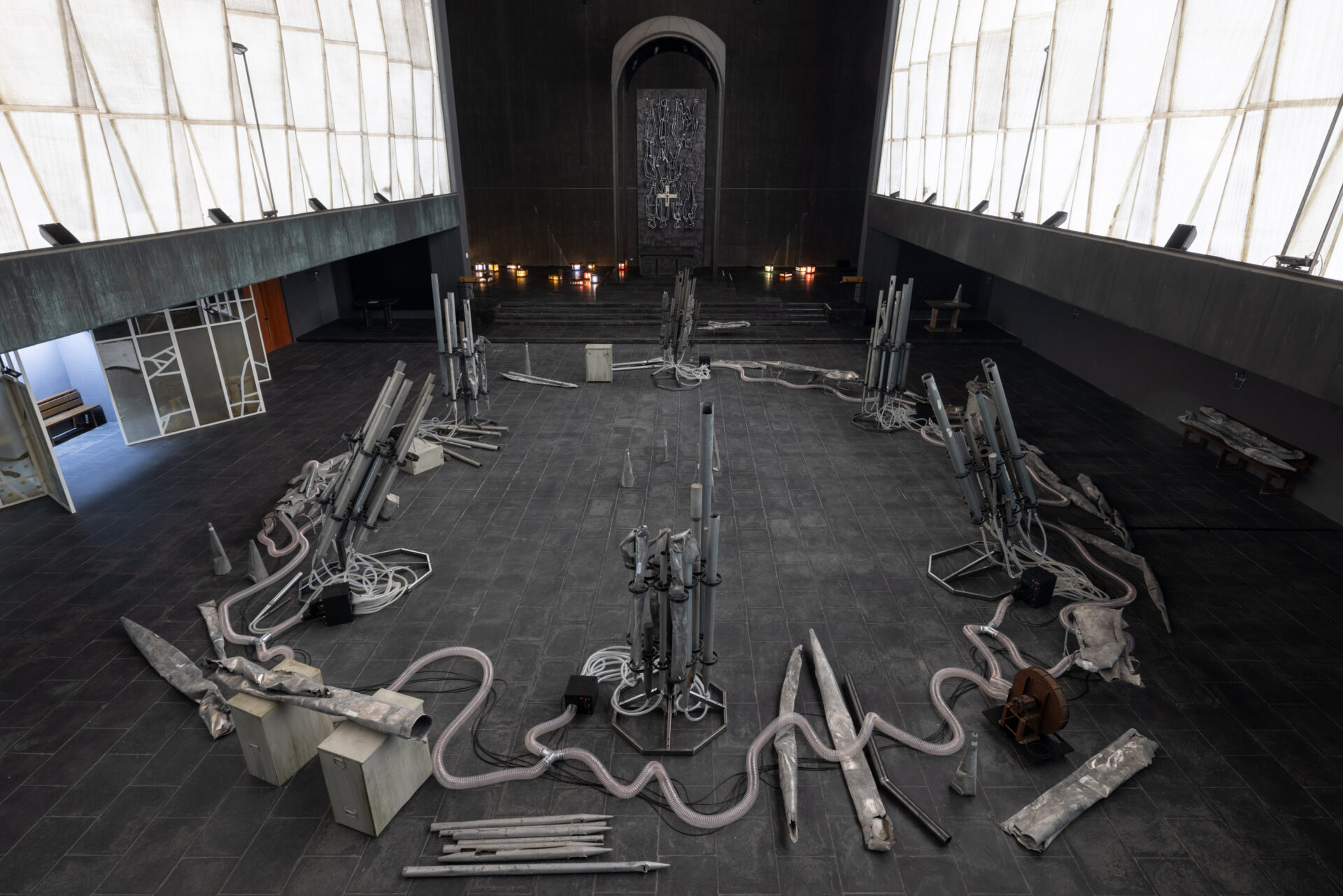
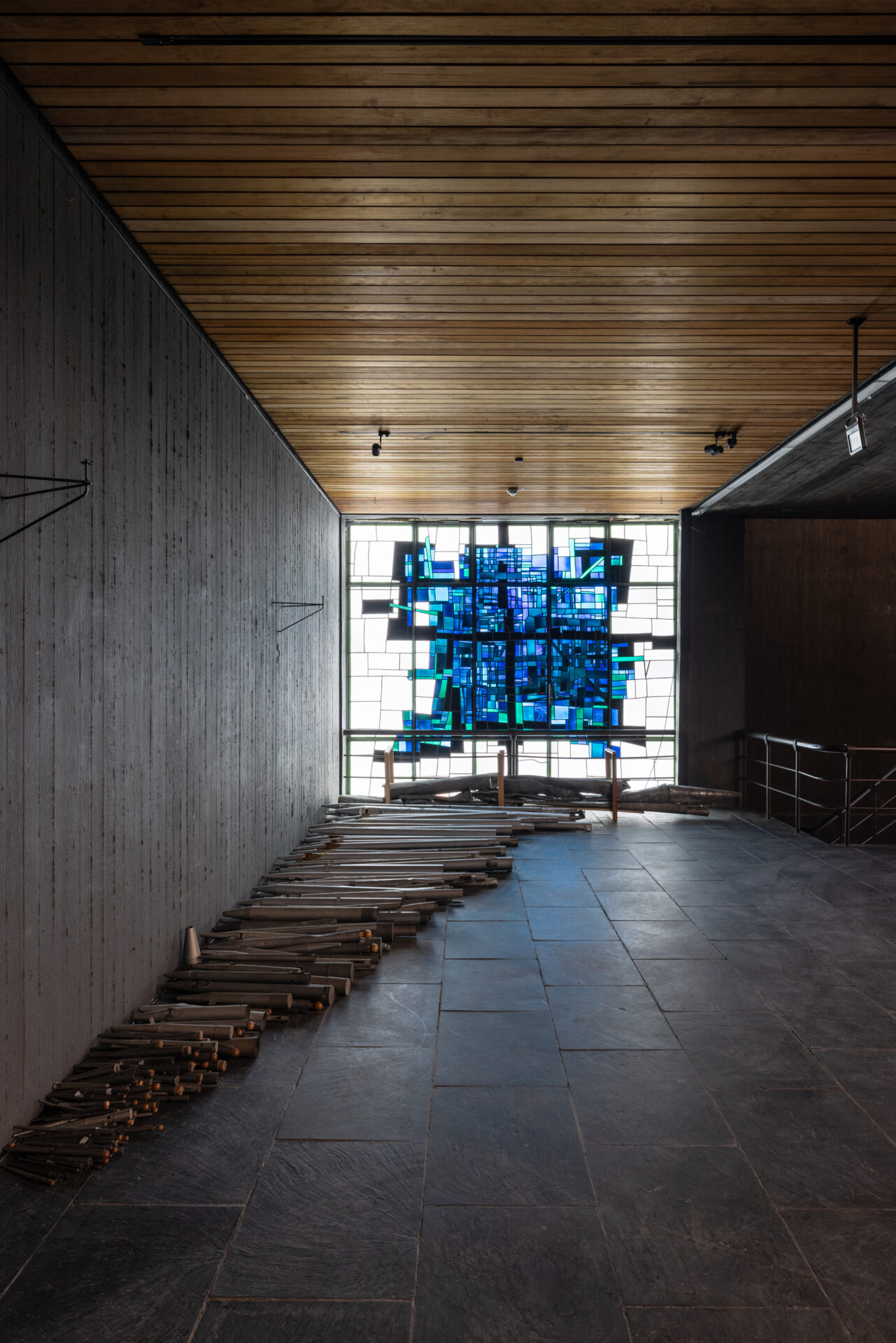
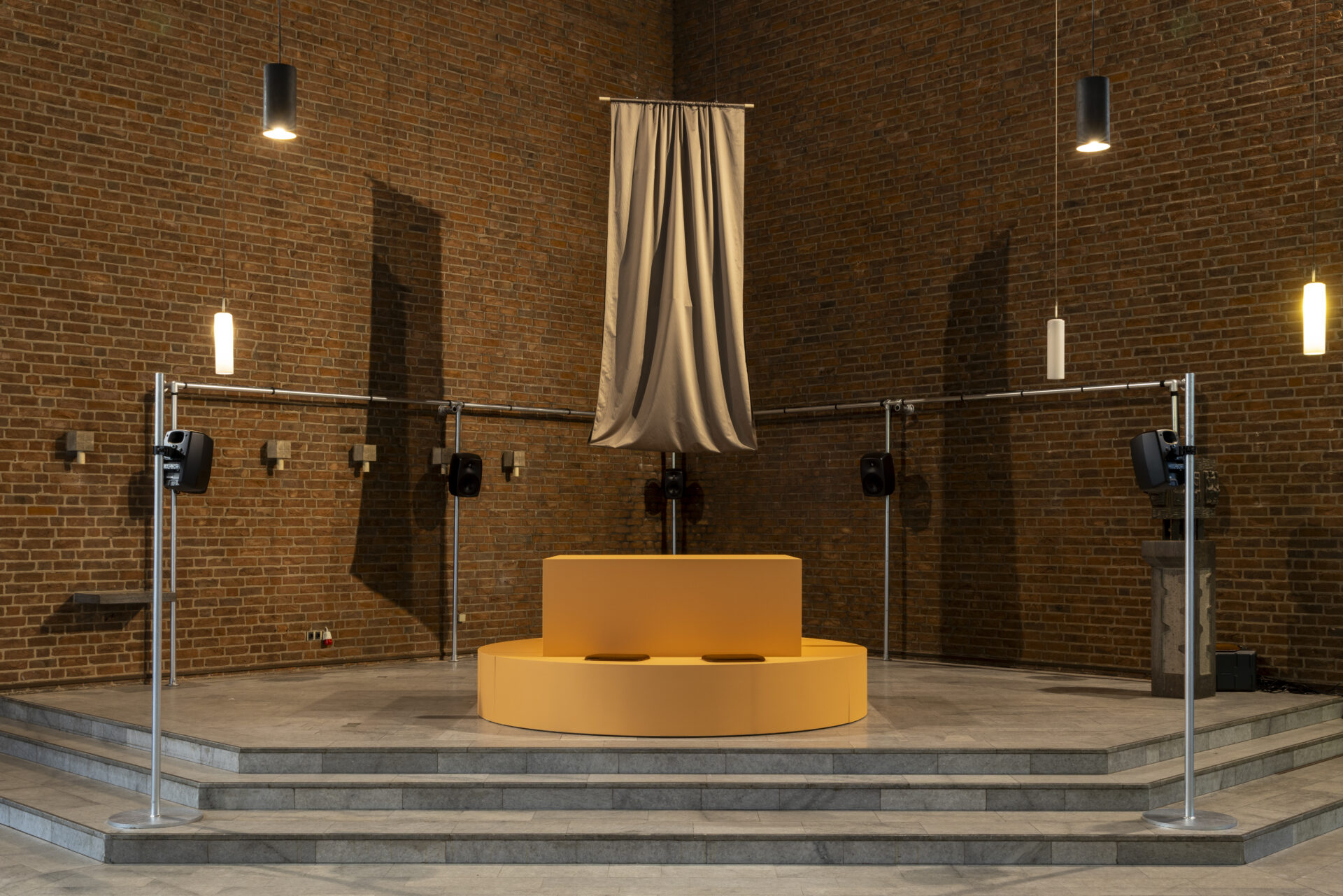
Abbas Zahedi responded to the broken organ of Kulturkirche Liebfrauen (Duisburg) by creating a deconstructed organ on the floor of the church. The imposing modernist church building is curated by Michael Kurtz and Henry Meyric-Hughes. The sound installation Ouranophobia 47051 (2026) is formed by disused pipes from across Europe. Its foundation consists of pipes from the organ of the destroyed St. Nicholas church in Kyiv. Many of the pipes are deformed; clustered upright, they look like missile systems.
The information board tells me that the installation should offer a space for grief, and for support groups to meet there. The installation is monumental and apocalyptic, a place to reckon with past and current disaster, but I wonder how to grieve amidst it.
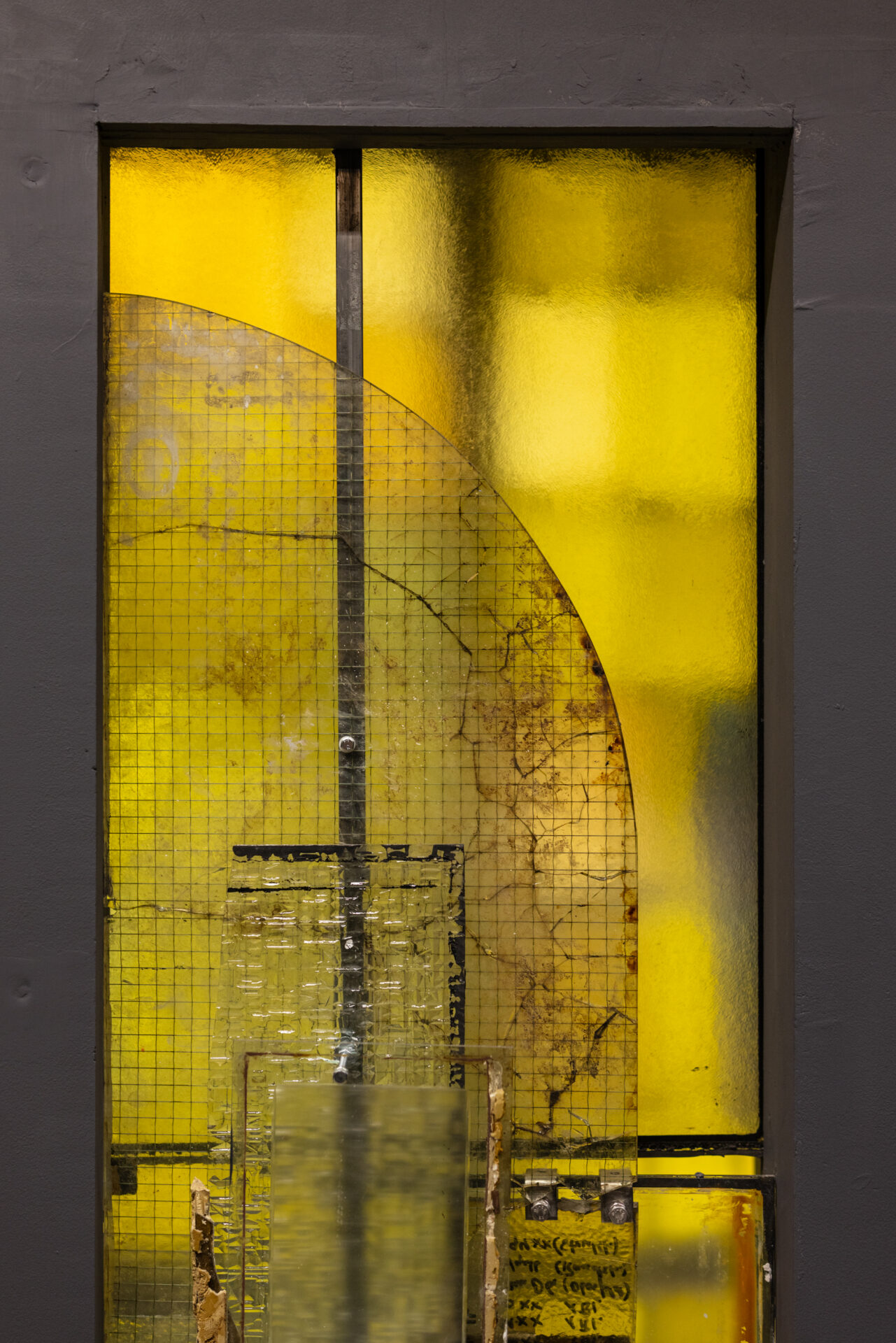
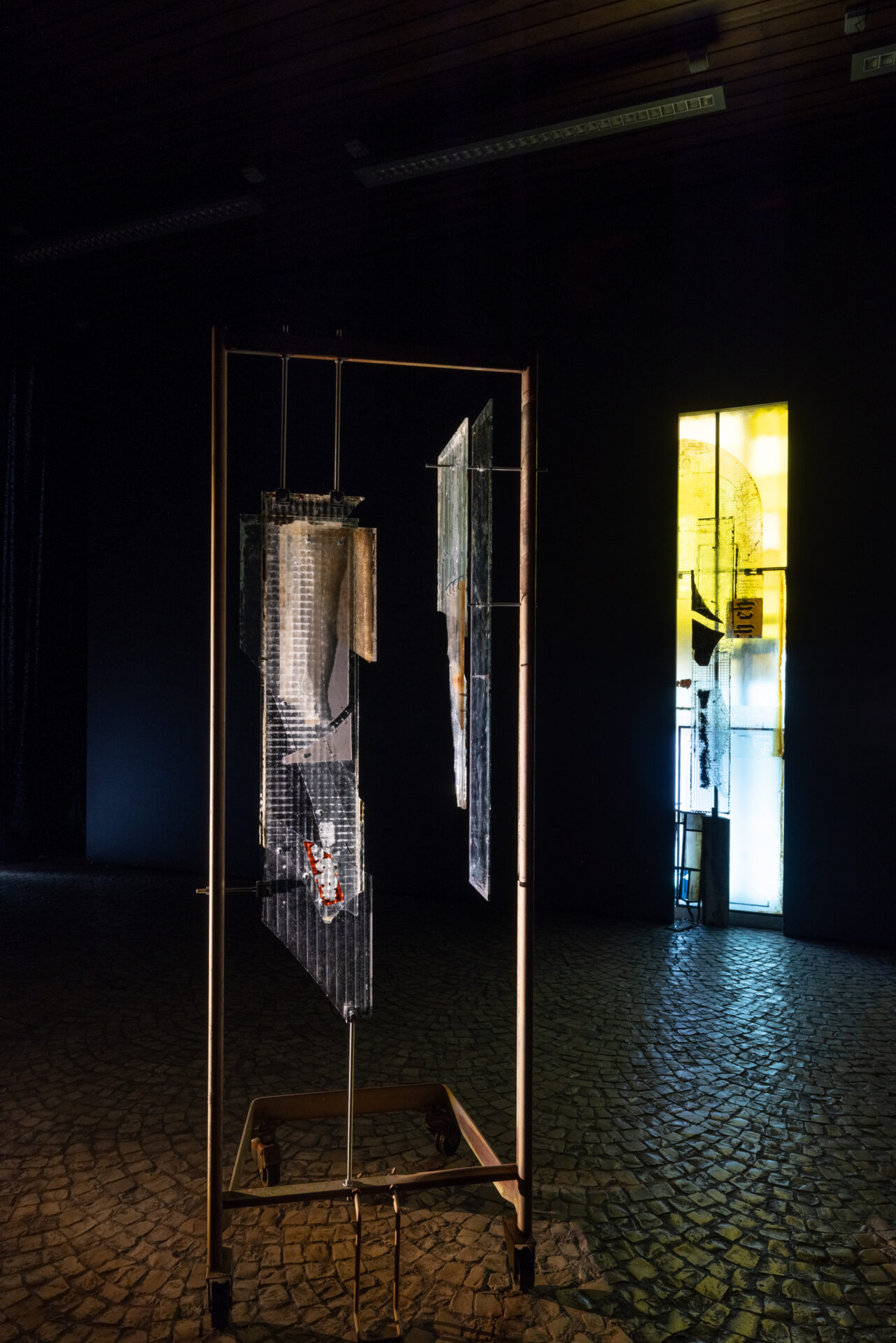
In a room slightly hidden from the rest, Athina Koumparouli brings together intimate traces in sculptures made of overlapping shards of glass. Their old-fashioned patterns and textures feel familiar. Koumparouli told me that she sourced local glass for All the views I can’t remember (2026), looking for domestic signs to counter what feels so intimidating in being inside this church.
Turkish-German history
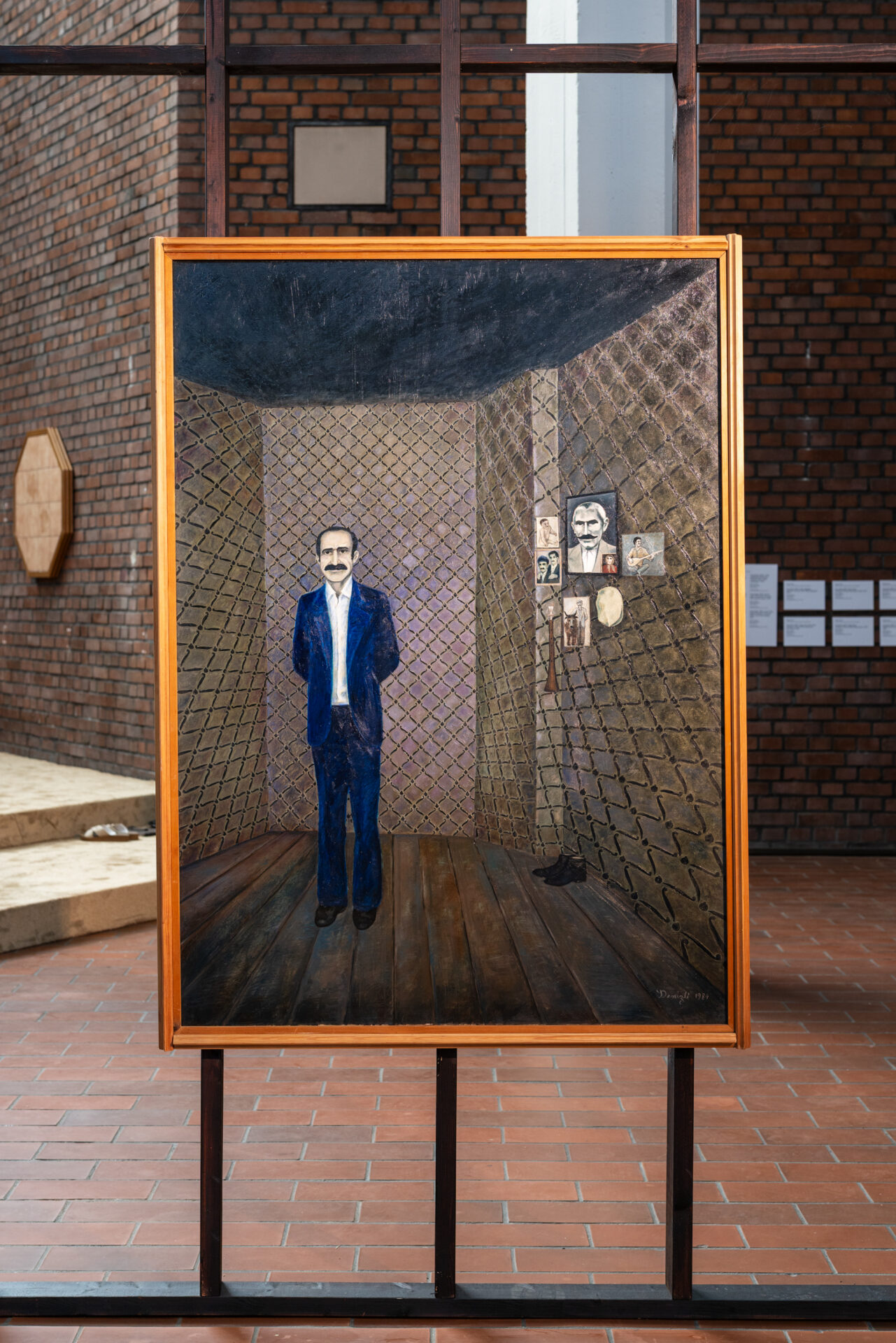
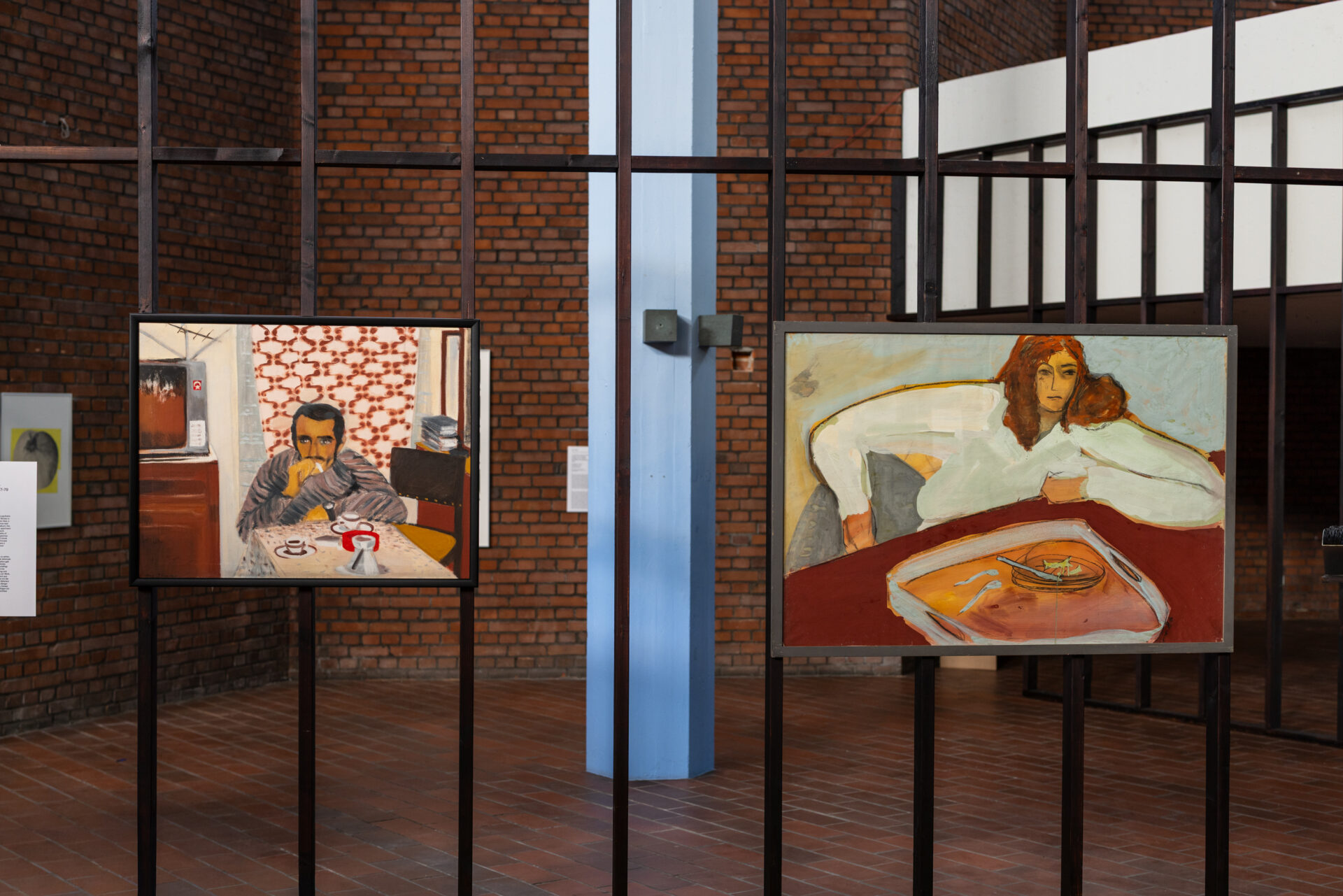
Most churches showcase a more or less classic exhibition, albeit in a place of former worship. But for Gürsoy Doğtaş the formality of curating takes on a deeper meaning. His three exhibitions focus on the introduction of art and culture of the so-called guest workers, with the majority migrating from Turkey due to a special agreement between the two countries. The churches have additional naming: a spatial and a personal signature. Additionally, the descriptions of the different art works often contain the details of the artists’ lives, such as how and where they worked, and how life affected them. Art isn’t made about the workers – it is made by them. The personal is deeply political for each and every one of the works.
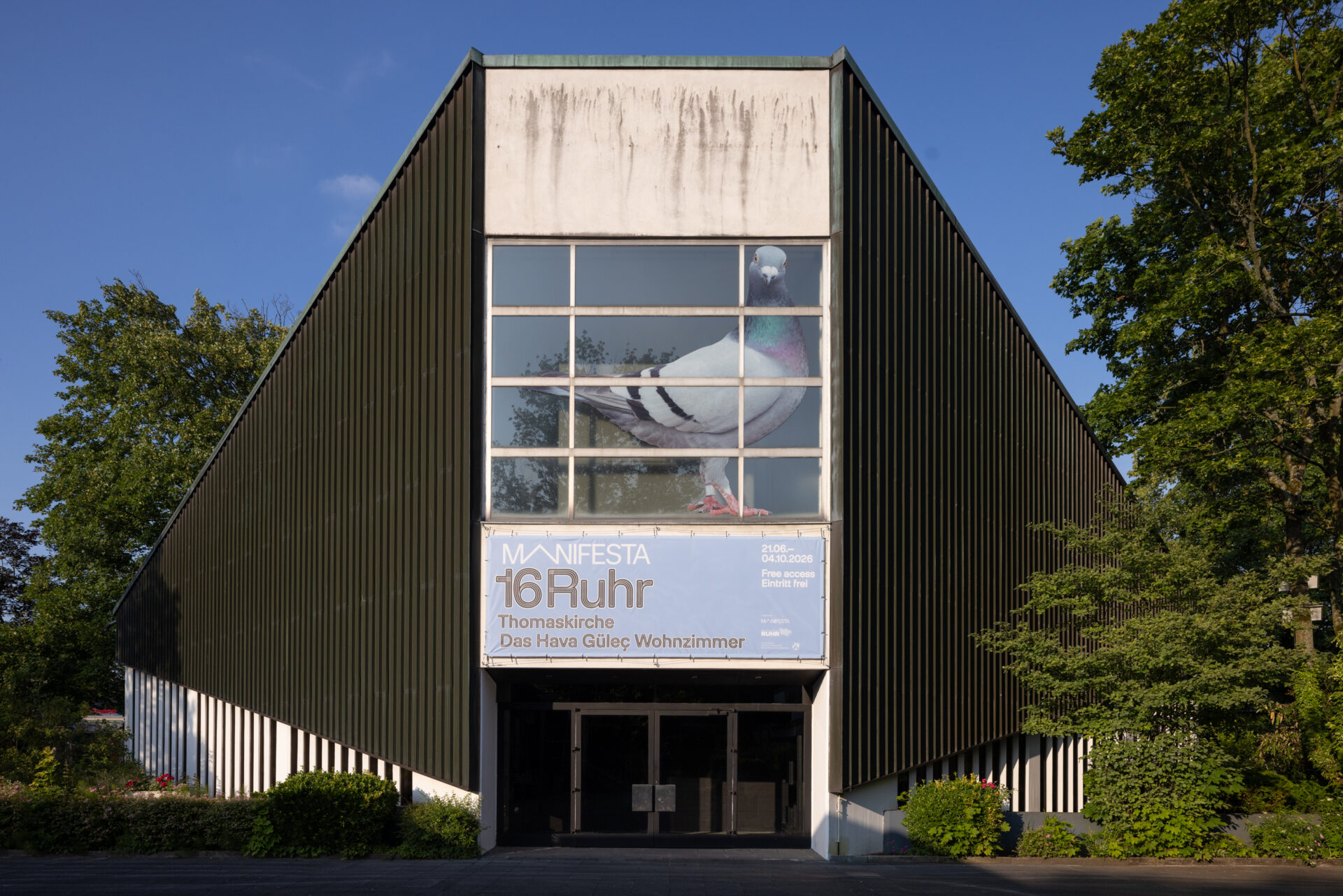
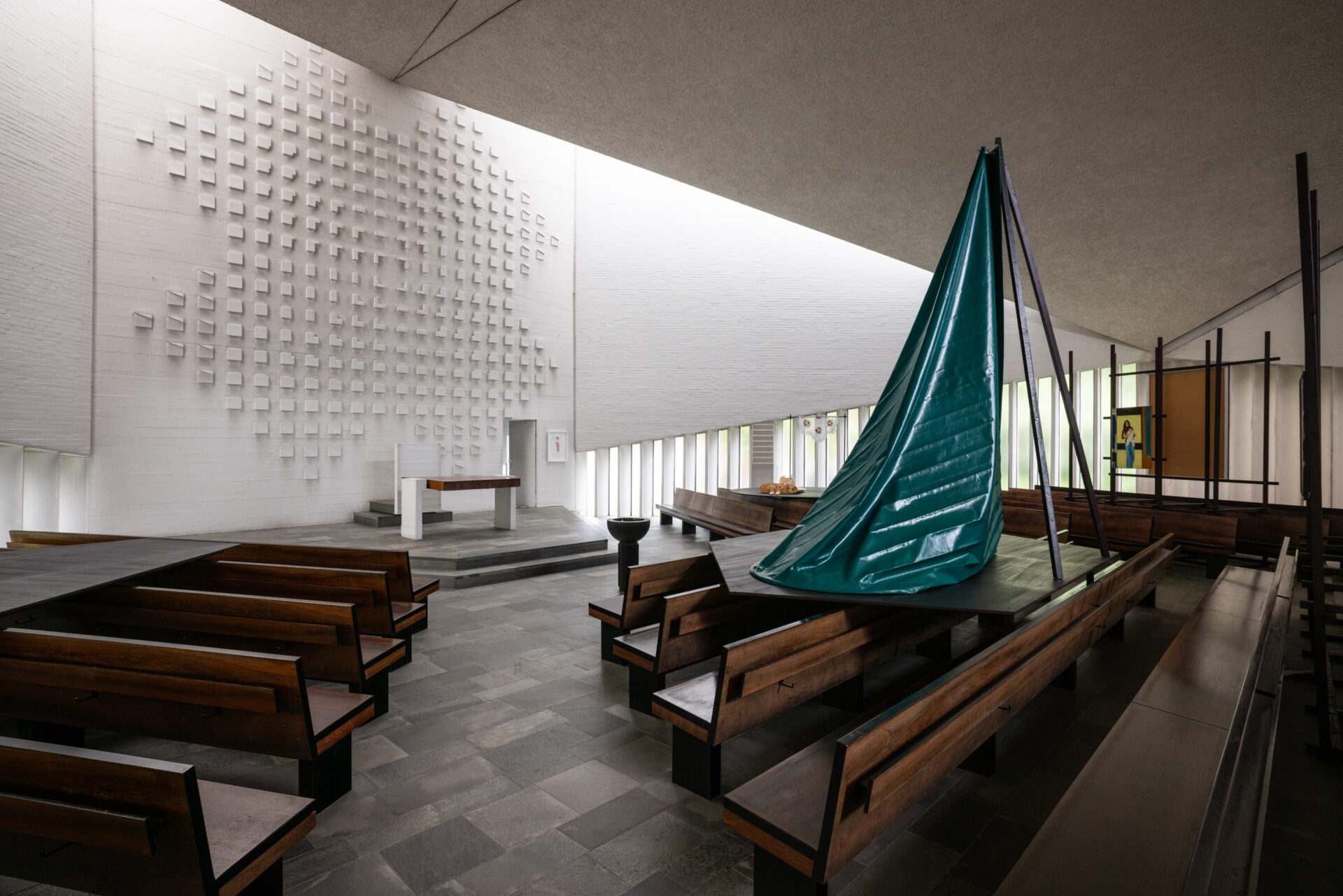
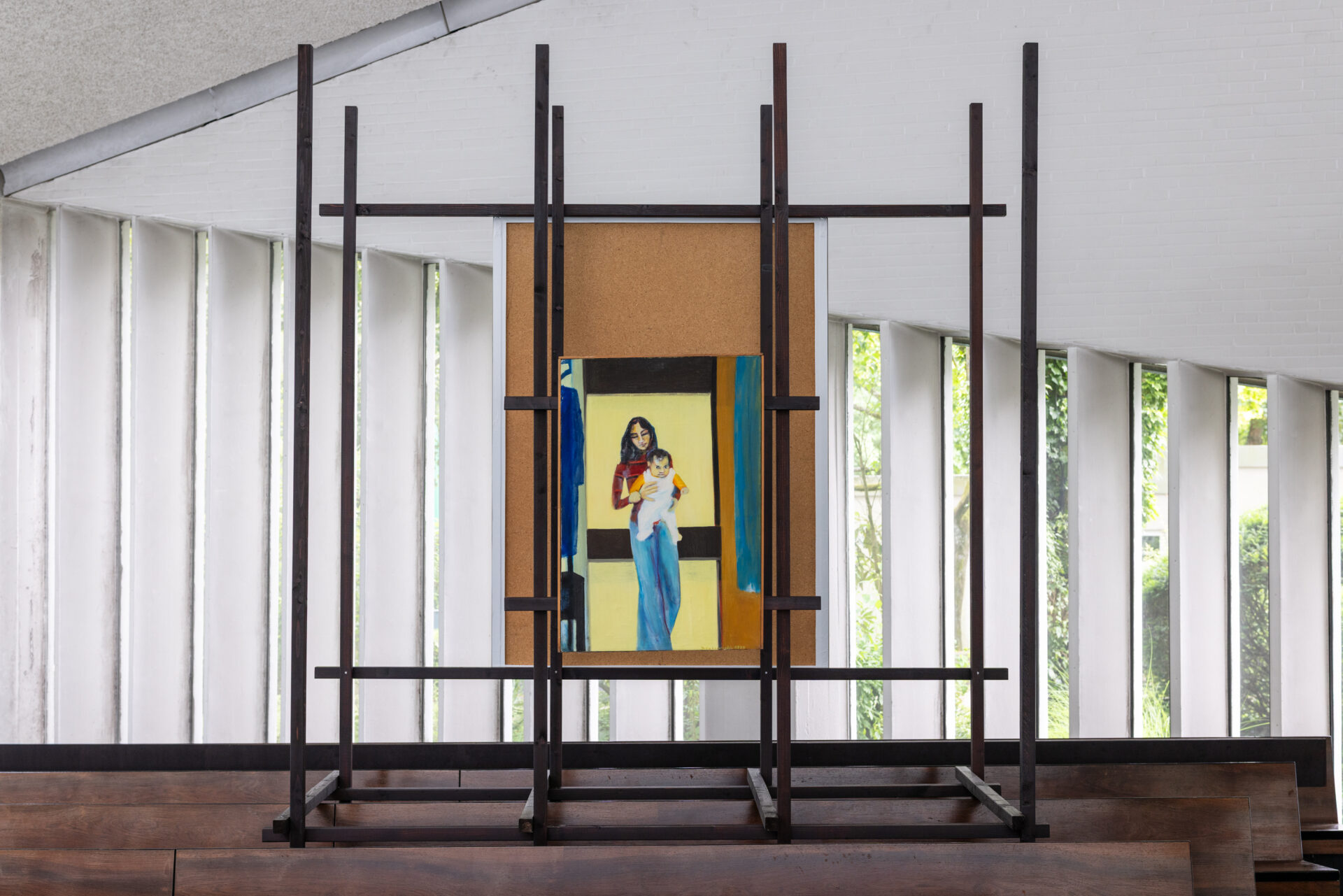
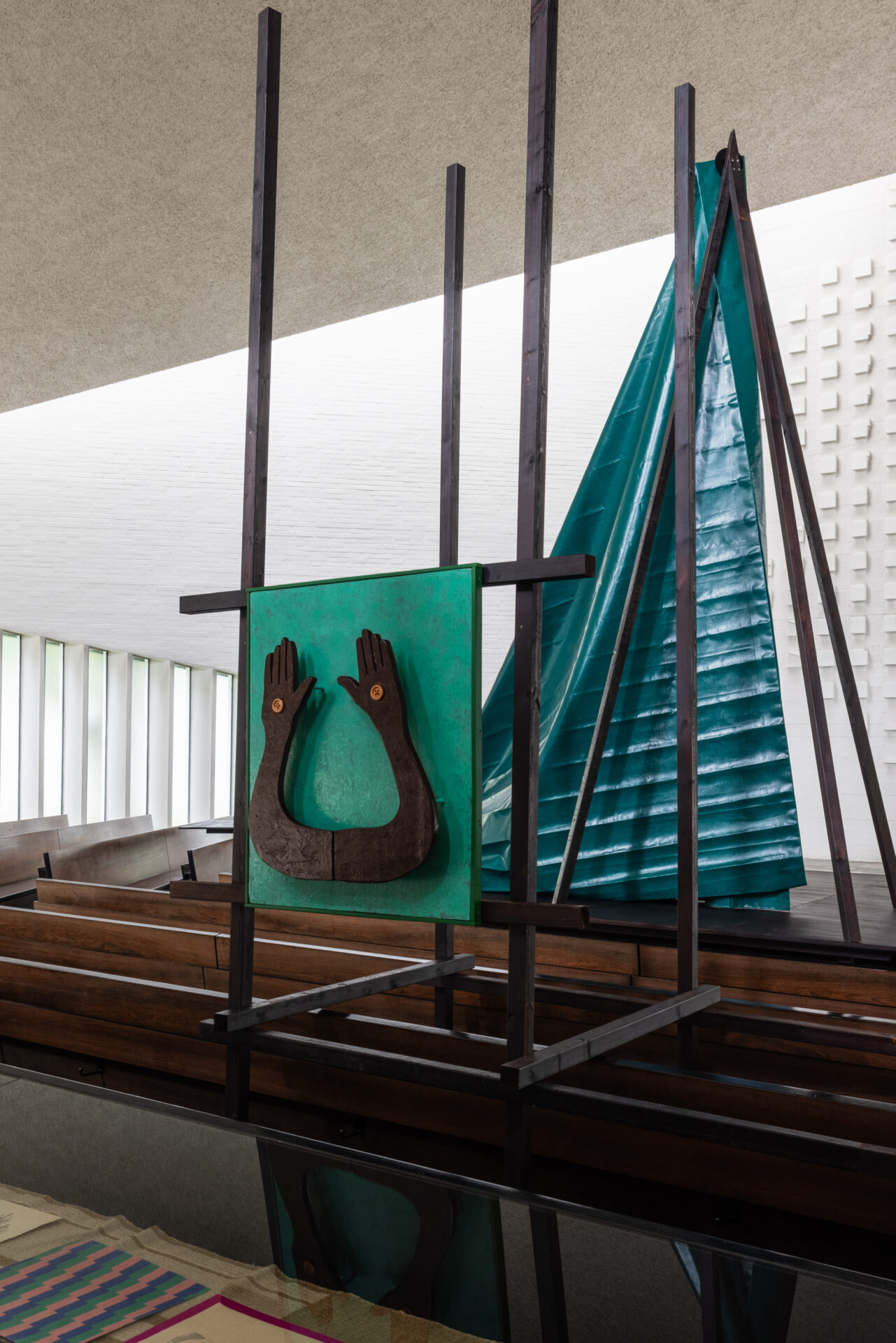
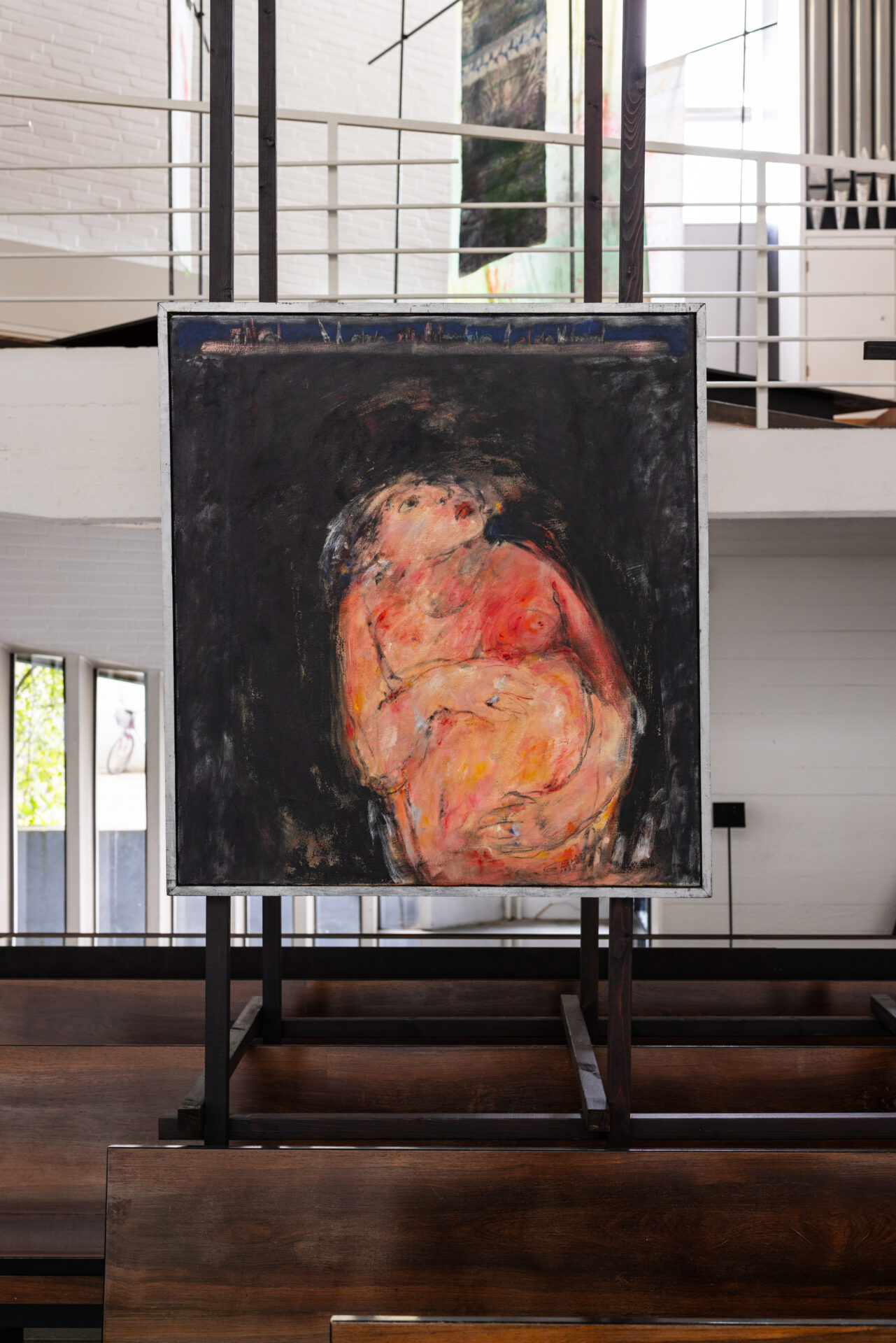
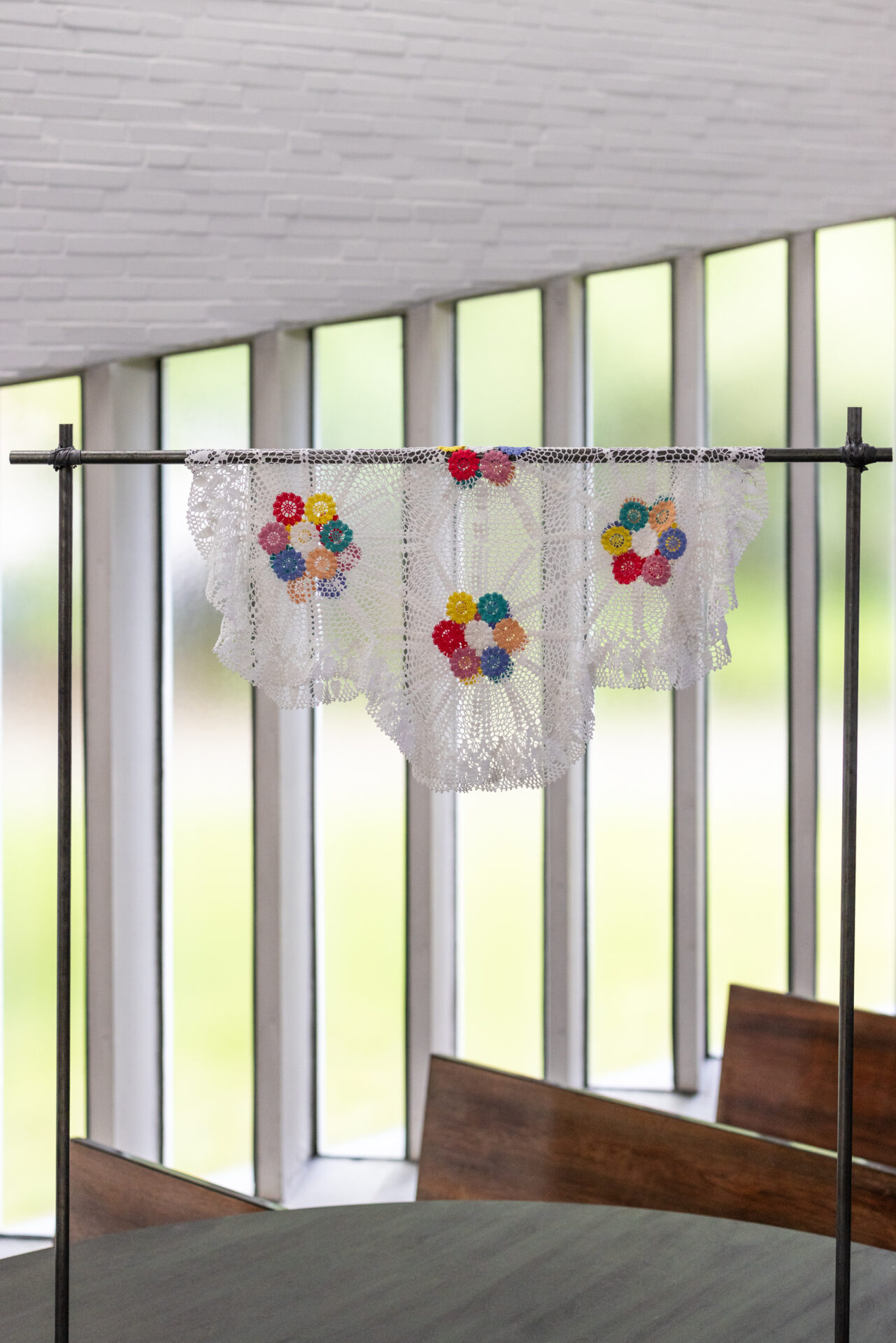
The Thomaskirche (Gelsenkirchen) is renamed as the Halva Güleç Living Room. Halva Güleç was a piece-rate worker, and caretaker of her family and neighbourhood community. Inside the impressive church, one of the most significant examples of post-war church architecture, a large monochrome wall relief sits behind the altar. The different presentations are built on top of the church pews that are under conservation protection. The architectural scenography has been designed skillfully by Bureau LADA for all three of Doğtaş’s propositions. Walking around, narrowly between the pews, I’m struck that what I find isn’t newly commissioned work, but a layer of art history I hadn’t known before. Paintings by Auzer Güler, wood-cuts by Mehmet Güler and textile works by Fatma Ceylan among many others, are orientated on wooden structures sitting on top of the angular benches. Display cases framed between them show textile works and some domestic objects, among them a hand-forged dough scraper and a handmade brush by Halva Güleç. I stand still in front of What Kind of Future (1988) by Serpil Yeter. A pregnant person is holding her belly, painted over with rough strokes. The body doesn’t seem grounded or centered but captured in a shaky moment. On top is a tiny skyline. I wonder if the person is underground – is she already buried or emerging?
Not inside the church but an adjacent building is a weaving workshop: The Weberei Kai School (2026) by Weberei Kai. It presents as an inviting space with material, looms and small woven pieces around. Weaver Catrin Loch tells me about their various projects, for example, a project with the nearby kindergarten, and weekly neighbourhood workshops. Many of these projects already go beyond the time-frame of the biennale, and so extend into the future of what the biennale wants to generate.
In and out
In another of Doğtaş’s presentations we are greeted with the sound of music. St. Anna in Gelsenkirchen is dedicated to the singer and central figure in diasporic music Hatay Engin and coined Music Hall. The triangular shaped space has impressive windows; a glasswork by Johannes Beck. There are two neighbourhood girls who come in and go out, and linger at the entrance the whole time. This movement seems to be their kind of play, and I ask how they like it here and they mostly just giggle. They point to paper works they have done as part of the public program. I exclaim: so your art is here too! And they move away with some more giggles.
Gelsenkirchen had the highest votes share for the extreme right in the local elections of 2025. During Manifesta's press tour we are invited to lunch with the SPD mayor of Gelsenkirchen. Not present, her vice mayor belonging to AfD. This July he was voted out of office after taking part in the racist public humiliation
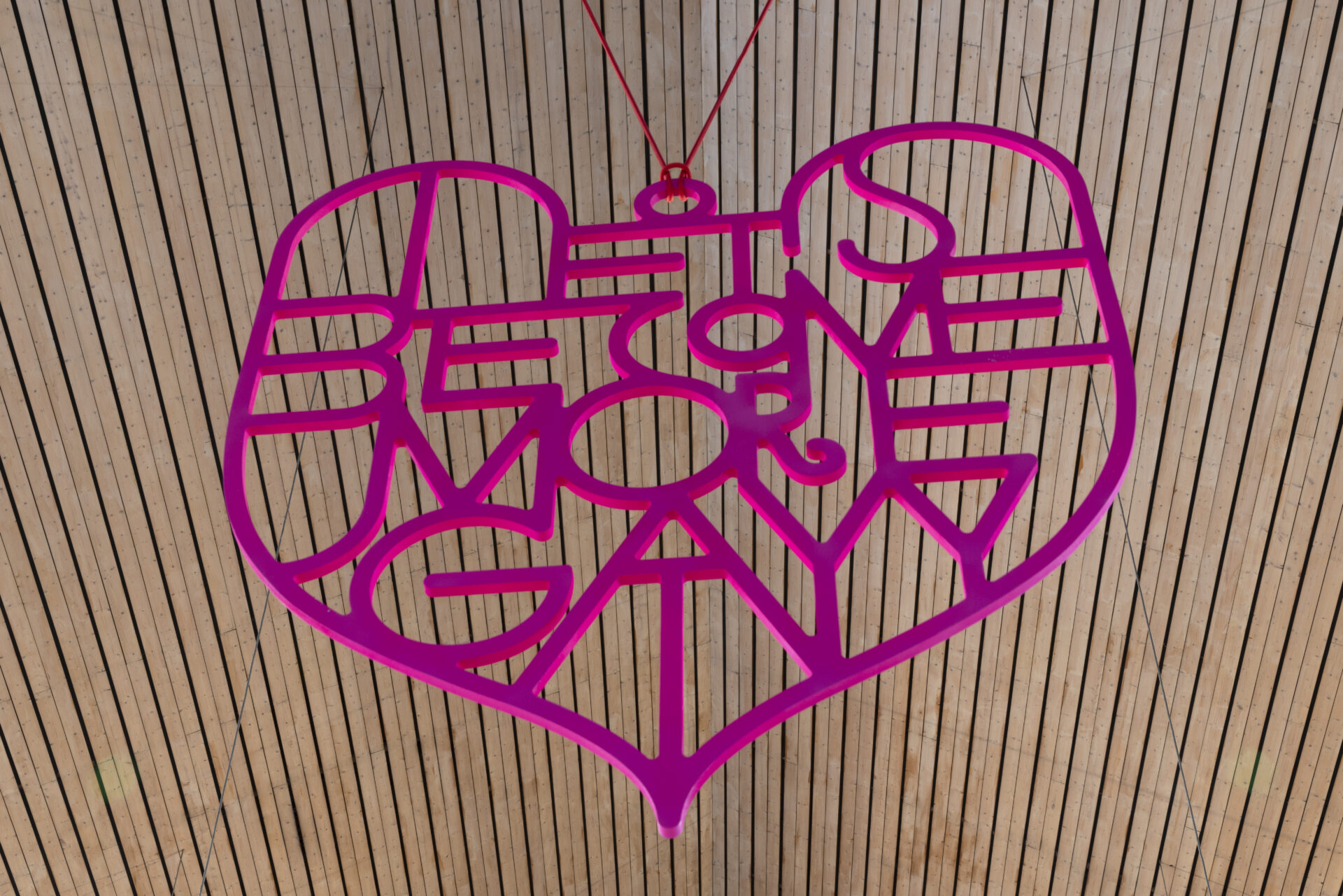
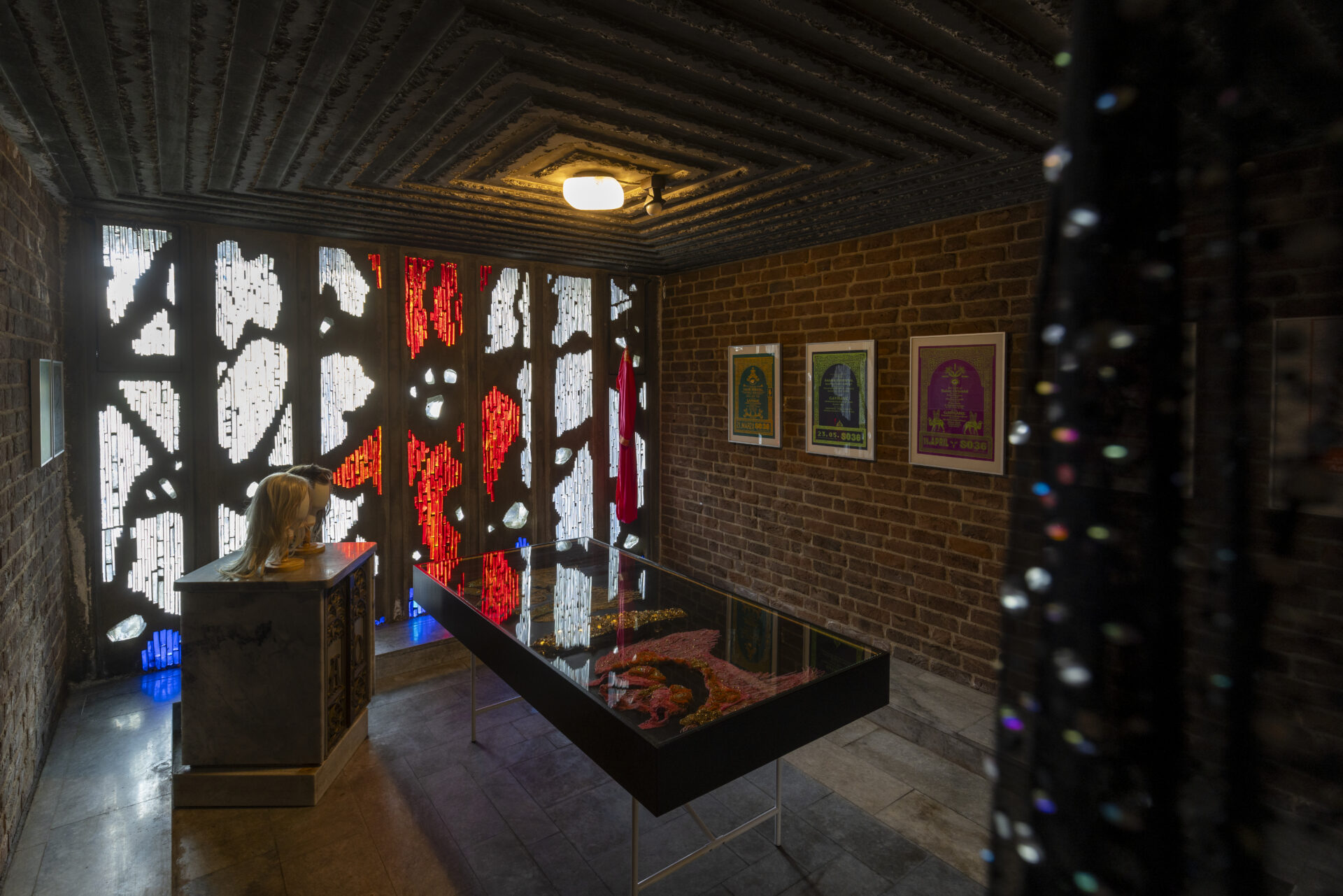
Inside, Complete Cypher Vol. I (2026) by Emre Abut is blasting hip-hop, R&B and Turkish music from the 1990s and early 2000s. I wiggle my body a bit while walking around. It is quite empty while I am there and it feels simultaneously strange to dance and not to dance. From the ceiling hangs a large sign. Like a very queer cross, it reads: LET’S BECOME MORE GAY. Ornament (2025) by Gašper Kunšič blesses us with this sign in decorative and cheerful contrast to the more sober modernist architecture of the church. The signage and the music move me further, towards The night as home (2026). Here we find documentation of ‘Gayhane’, a queer space and event series co-founded by Mesut-Sabuha Salaam for queer people of color in 1998.
Doğtaş presents us with exhibitions that do real community work by sharing with us important moments of migrant art and life experience. I leave feeling emotional. Many of the stories feel weighty and significant, as an important part of migrant and German history, and in how these stories extends into the present. Doğtaş’ third church is named after Tea garden and Ferdane Satır, who was known for her care and neighbourliness. Satır, her four children, her son-in-law and her grandson were killed during a racist arson attack in 1984.
Outside the joy of the music hall I again encounter rows of bleak-looking houses. There is a child smiling at me brightly and another man sitting on a chair. I ask them if they have visited the church but we don’t seem to share a language, so we are both a bit confused, and I move on. I later learn that in June this year members of the far-right party AfD forced people they perceived as Roma to clean these streets with brooms.[4] They filmed their appalling action and distributed the videos online. Historically, Ruhr has been the stronghold of the social-democratic SPD. This has changed with the decline of mining and the increase of joblessness and poverty. In recent years, the rise of AfD shows the deep division in the region. Gelsenkirchen had the highest votes share for the extreme right in the local elections of 2025. During Manifesta’s press tour we are invited to lunch with the SPD mayor of Gelsenkirchen. Not present, her vice mayor belonging to AfD. This July he was voted out of office after taking part in the racist public humiliation and sharing the video himself.[5]
Gathering outside
Any institution with certain forms of power, be it a church, or an art biennale, has many visible and invisible thresholds that need to be overcome. These thresholds do not only decide who feels welcome; they also gatekeep what kind of politics can be spoken here, or which wars and genocides can be named and which can’t. Manifesta positions itself firmly as a European biennale, concerned with its own European issues. But worldwide politics are an intrinsic part of working with the German government. Germany is the second-largest supplier of weapons to Israel. Working with German funding means that there are spoken and unspoken rules of what can be talked about. And to me it is such a shame that a biennale like Manifesta, which aims to think through social issues, works from that silencing. The opening event of Manifesta was hosted at Folkwang Museum where in 2023 Anaïs Duplan’s part of an exhibition devoted to Afrofuturism was cancelled due to his pro-Palestine social media posts.[6] I wear a Free Palestine button during the opening, curious about any response. But of course there was none with the press pass dangling from my neck. With it, I had already passed through a gate.
One host told me: Ruhr doesn't need Manifesta: there is already an existing infrastructure of community. Day-care centers, church groups, youth centers, and kiosks enliven neighbourhoods
One host told me: Ruhr doesn’t need Manifesta. By this she didn’t mean that people didn’t like the art that was presented. She pointed to the fact that Manifesta proposed to bring a transformation to them. But there is already an existing infrastructure of community. Day-care centers, church groups, youth centers, and kiosks enliven neighbourhoods. Most of the churches, especially the ones taken on by the intergenerational duos, appear like quite formal exhibition concepts, albeit in a defunct church. I see compelling art in a non-white-cube space, but I don’t find a new vision for the neighbourhood here. If Manifesta proposes speculative changes for a neighbourhood, why not give the people the large sum of money used for exhibitions, to let them fill the churches themselves? The church as exhibition venue is a frontier not easy to overcome for most people. This is especially for most that live in the biennale neighbourhoods, and to whom many institutional forms don’t offer a welcoming entrance. Manifesta intends to open its doors wide to everyone and while people do step in, it remains a question to me if the biennale can speak enough of the felt and social language of the neighbours for them to stay. To me, the strongest presentation is also the one that crosses the threshold instead of just widening it. While most churches open their doors without really changing what’s inside them, Doğtaş’s presentations let the neighbourhood’s own history become the exhibition, and thereby turns exhibition into community work.
So, what kind of future is being brought within Manifesta’s transformed churches? The answer depends on your relation and engagement with the region, to art, to politics. For me, this future unfolds outside the churches. By talking to people, observing children who find different uses of space, and in getting to know new neighbourhoods. Maybe that’s what Manifesta actually facilitated: not a finished urban vision with the temporary transformation of churches, but the discussion of what we still want to gather around, and how, with or without imposing structures left standing to hold us there.
Manifesta 16 Ruhr, several locations in Duisburg, Gelsenkirchen, Essen and NBochum, through Oct4. 2026 MORE INFO
[1] Michale Kurtz, Manifesta 16 Ruhr Creative Mediators’ Conceptual Essay, 2026, www.https://manifesta16.org https://m16-stack.fra1.cdn.digitaloceanspaces.com/Final-web_EN_Manifesta16_Annexe-1.pdf
[2] no author, 2026, https://www.it.nrw/ https://www.it.nrw/nrw-verfuegbares-einkommen-je-einwohnerin-und-einwohner-im-jahr-2023
[3] Hedwig Fijen, Speculating on the Civic Future of Europe’s Churches, p. 7, Urban Vision
[4] https://www.stiftung-ng.de/ueber-uns/aktuelles/news-detail/antiziganismus-und-menschenfeindlichkeit-gelsenkirchener-afd-laesst-migrantinnen-die-strasse-putzen
[5] https://www1.wdr.de/politik/politik-in-nrw/rat-entscheidet-abwahl-buergermeister-afd-emmerich-100.html
[6] Rhea Nayyar 15.11.2023 https://hyperallergic.com/german-museum-cancels-afrofuturism-show-over-curators-pro-palestine-posts/
Maike Hemmers
is an artist based in Rotterdam