Dancing with Ritual – Mounira Al Solh at Bonnefanten Museum
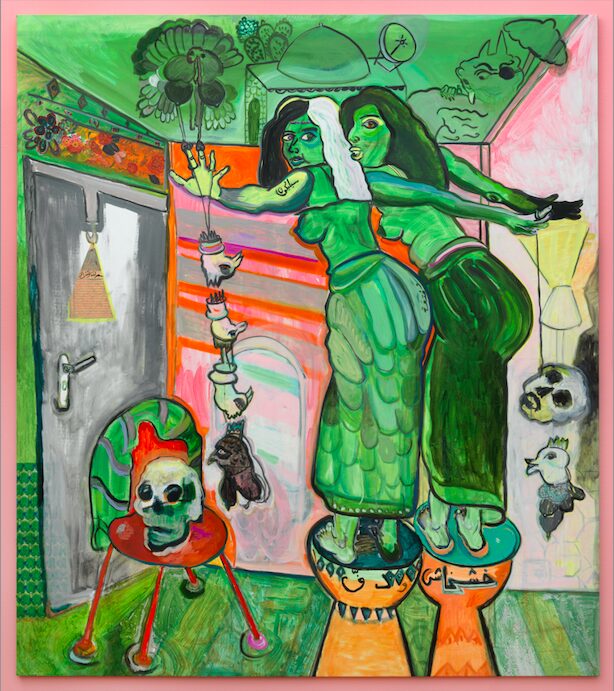
Two green-skinned bare-breasted women are perched on darbuka drums, gazing over their shoulders at the viewer. A jinn-like creature peeks lasciviously at them from the top right corner of the canvas. One figure has the word silicon, in Arabic, written across her arm. Bird heads and a skull dangle from her fingers. The whole painting is sensuous and vibrantly steeped in a tantalising energy: a “let’s dance!” girls’ night with sinister undertones. It is a fitting campaign image for A land as big as her skin, Lebanese-Dutch artist Mounira Al Solh’s largest solo exhibition to date in the Netherlands. Held at the Bonnefanten Museum in Maastricht, it is off-kilter, feminist, and deeply rooted in Arab music, dance, and the Arabic language. Nat Muller visits the exhibition.
Mounira Al Solh spends her time between Zutphen and Beirut, and over the past two decades has developed an interdisciplinary practice that spans video work, painting, drawing, publishing, embroidery and performance. Her work is colourful, playful and tongue-in-cheek, but trauma, loss, migration, and violence are never far away. Al Solh was born in 1978 in Beirut during the Lebanese Civil War (1975-1990) and came of age amid its violent aftermaths of political assassinations and consecutive wars in 2006 and 2008. More recently, economic collapse and the 4 August 2020 port explosion in Beirut was followed by the 2023-2024 war with Israel and a still volatile ceasefire. All this grief feeds into Al Solh’s oeuvre, yet she highlights life, its absurdities and pleasures, and the stories we tell each other of lived experience, of pain and love, to survive.
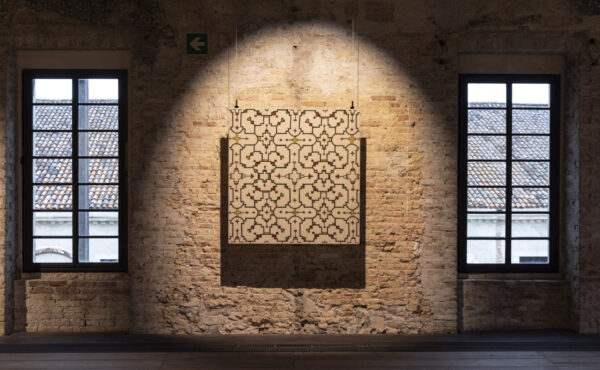
A land as big as her skin focuses primarily on the artist’s prolific recent output, which include her contribution to the Lebanese Pavilion for the 60th Venice Biennale (2024); her award-winning work for the 10th Artes Mundi Prize (2024); work made for the ABN AMRO Art Award (2023) exhibited at H’ART Museum; and a body of work focusing on music for Zeno X Gallery in Antwerp (2022). What ties these various presentations together at the Bonnefanten Museum is a concern with rituals, those that soothe, repair, defy, unite, retell, and renew. One example is A Dance with her Myth (2024), Al Solh’s project for the Lebanese Pavilion. Through video, paintings, ceramic masks, and a skeletal boat, Al Solh reinterprets the myth of the Phoenician princess Europa, daughter of the king of Tyre, who was approached by Zeus disguised as a white bull, then abducted to Crete and raped. A foundational figure in Greek mythology, Al Solh reminds us of the Phoenician origin of Europa, the seafaring forebears of the Lebanese.
The artist’s deep-dive in Phoenician history is a multi-pronged dance. Europa is not presented as a victim but as a woman with agency, who uses the white bull as her plaything. Still, the present interjects itself, as does the idea that belonging and group identity change across time, space and ideologies. In Lebanon these dangers have been meted out by decades of sectarian strife and divisions, as well as military intervention from its neighbours Syria and Israel. This caveat pierces through every counter-myth Al Solh proposes. Take a yellow-hued painting showing at its centre a reclined Europa balancing the decapitated and jarred bull’s head on her arms and legs, surrounded by motifs of Phoenician boats, but also of flags and missiles. Present-day Lebanon is never absent from the artist’s mind when ancient Phoenician cities like Beirut, Byblos, Sidon and Tyre continue to be bombed.
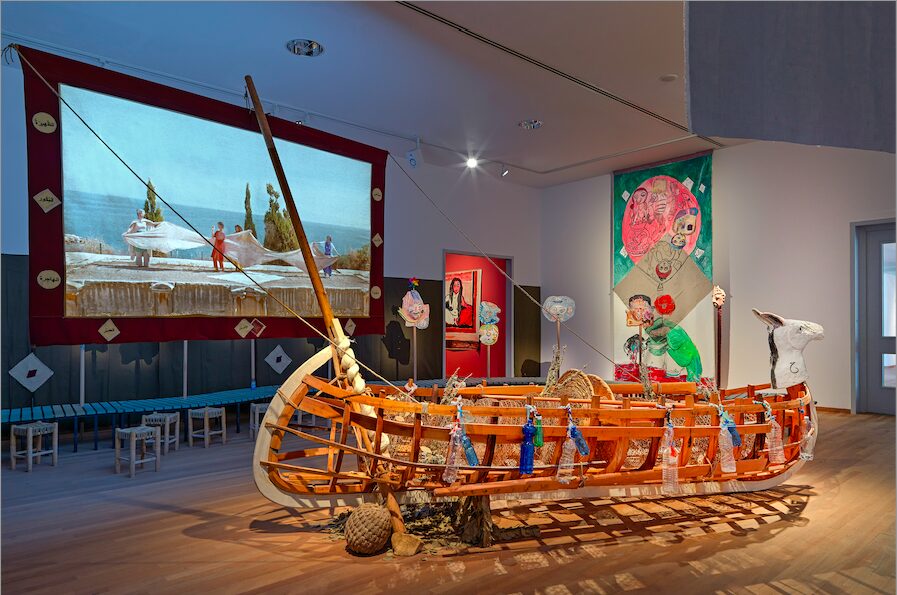
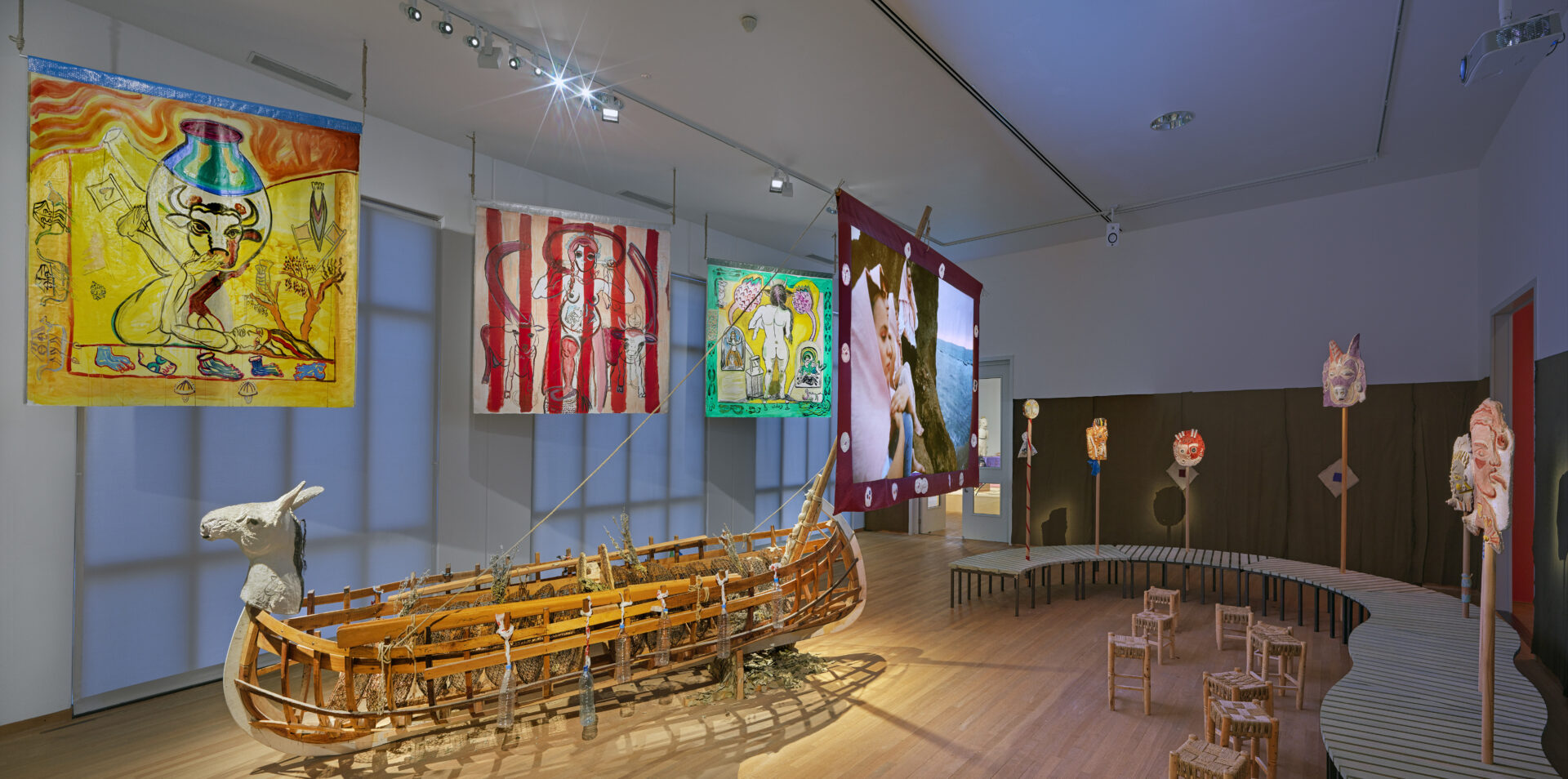
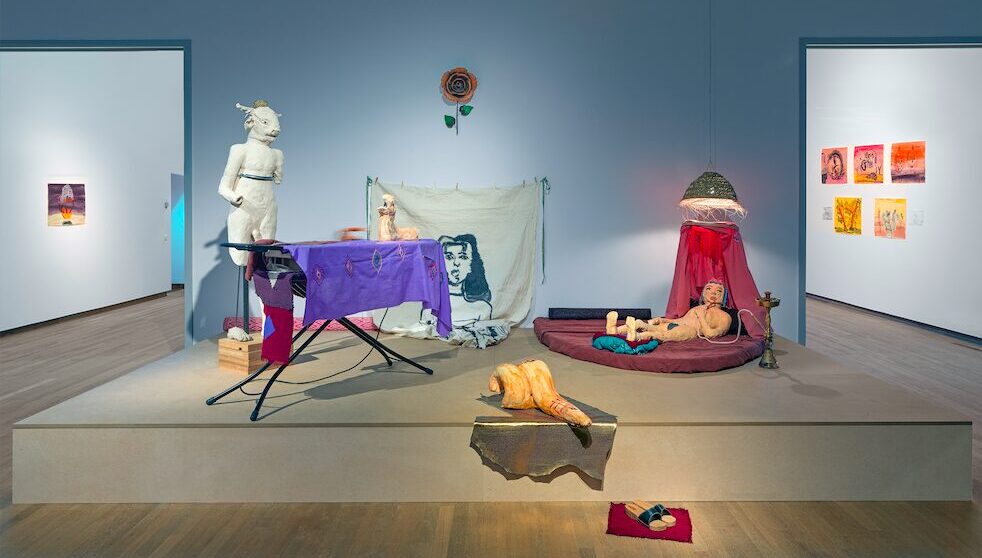
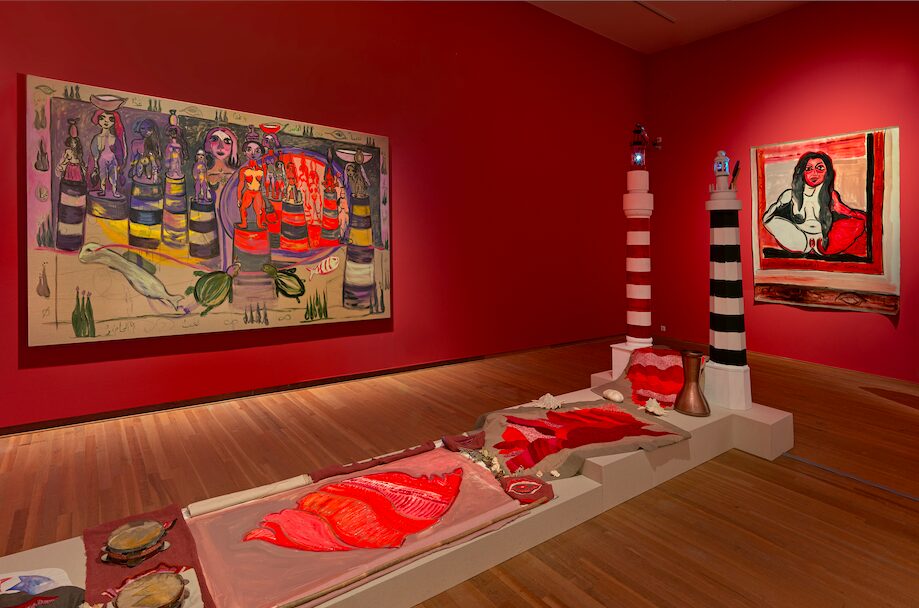
Myths are, in a way, ritualised stories. Narrated on repeat until they become familiar, part of a culture’s patina, regardless of their racial, gendered and political bias. Al Solh takes issue with this bias and with the misconception that these stories speak with a singular voice. She proffers other voices and demands they be heard by underlining the female, polyphonic, communal, and Eastern Mediterranean in her work. So too in the installation Elissa’s Room (2025), especially commissioned for this exhibition, in which the artist foregrounds the myth of the Phoenician princess Elissa (Dido in Greek and Roman mythology) who became the founding queen of Carthage in North Africa. Paintings and textiles filled with heroines, maritime motifs, fish, turtles, and seashells flow from lighthouses modelled on those on Beirut’s Corniche celebrate Elissa’s political prowess and cunning. But more often Al Solh’s re-evaluation of myth and history prizes the mundane and quotidian. Swapping the grand, patriarchal, extractivist, and imperial tendencies of mythology for a kitchen sink sensibility. Like Zeus ironing Europa’s scarf in the installation Europa’s Bedroom (2025) and in the video A Dance with Her Myth (2024) Al Solh substitutes a goat for the white bull, and beetroot, red onions and cabbages for murex sea snails, the main component for the prized Tyrian dye, the Phoenicians’ major export product.
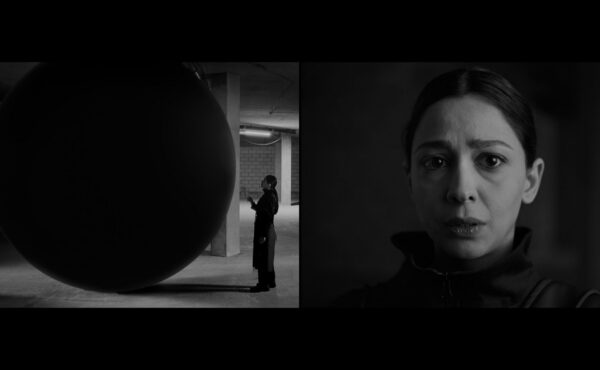
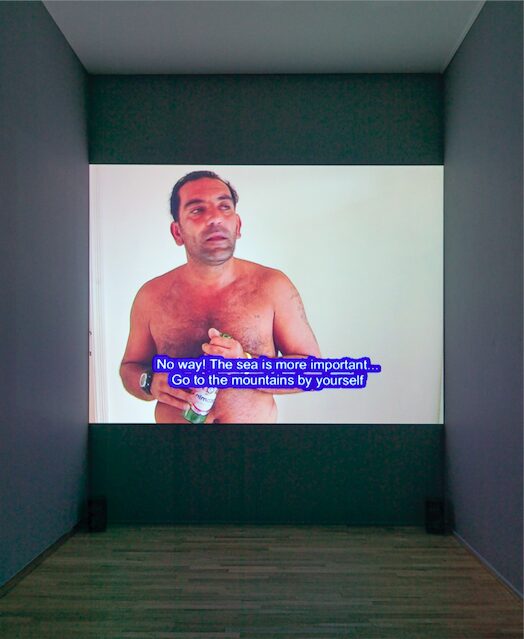
Al Solh’s older work is limited to three videos, À la santé des allies (2003-2019), The Sea is a Stereo: Paris without a Sea (2007-2008), and The Mute Tongue (2009-2010). They illustrate her broader concerns with ritual, language, narrative, the history and geo-politics of the pan-Arab region, and Lebanon in particular. In The Sea is a Stereo (2007-2008) she interviews a group of men who, come rain or shine, swim at Beirut’s Corniche, demonstrating ritual as a survival tactic. This motley crew of men, including the artist’s father, pontificate on swimming styles, sunbathing regimes, each other’s nicknames, and so on. It is a decidedly masculine space, which Al Solh breaks into by dubbing her subjects’ answers into her own voice, thereby muddling the exclusive nature of gendered spaces and the difference between interviewer and interviewee. In the context of Al Solh’s wider practice this film points to finding normalcy and routines in a city prone to political upheaval and violence. In addition, the subtext to this video is that the bathing rituals of these men at Beirut’s seaside are at risk from pollution and shrinking public space due to the privatisation of Beirut’s beaches and aggressive seafront real estate development.
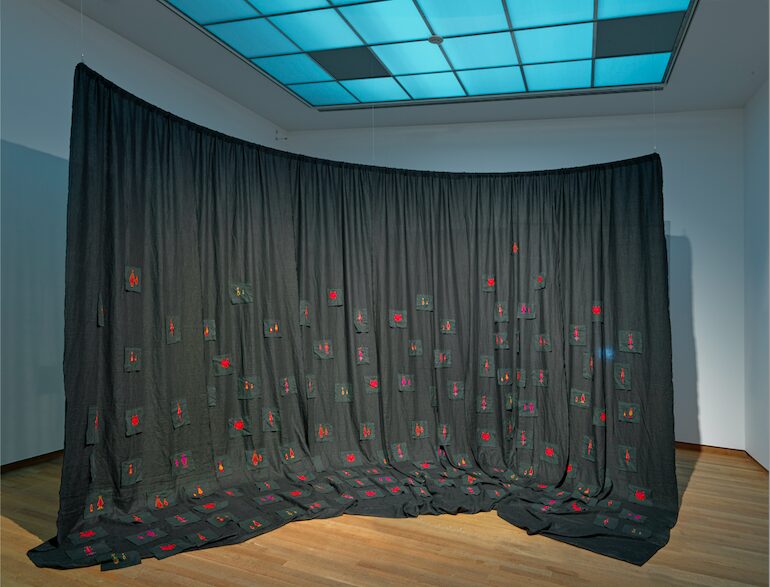
Ritual as a soothing practice is equally evident in the installation Nami Nami Noooom, Yalla Tnaam (2023), the words of a well-known Arabic lullaby sung across the region, which translate as ‘Sleep, Sleep, Sleeeep, Let’s Sleep’. At times of heavy bombing during the Civil War, Al Solh’s mother would allow her to rip holes in her pyjamas and then stitch them up again. The repetitive gesture of tear and repair would relax Al Solh. For Nami Nami Noooom the artist worked with groups of women in Lebanon and the Netherlands, many from migrant backgrounds, and asked them to bring in their own nightclothes. Instead of mending the holes, here they meticulously embroider around the tears. It resembles a needlework version of Japanese kintsugi in which cracks in pottery are embellished to embrace breakage and imperfection. Presence, absence, loss, connection, and shared experience play off each other. Suspended high across the Bonnefanten’s staircase, it is the first work visitors encounter. Originally commissioned for the ABN AMRO Art Prize, at H’ART Museum the work was hung at eyesight, visitors could stroke the materials, walk through it, experience their tactility, and the intimate and communal aspect of the project. This is lost at the Bonnefanten. Here the work becomes monumental, a war memorial of sorts. It somewhat diminishes Al Solh’s proclivity for proximity, the accessible, and the inclusionary. The artist’s long relation with needlework as a means of fabricating, storytelling, and mending can also be seen in the project Red Cypress Textile (2025). Produced in collaboration with Inaash, a Lebanese association supporting Palestinian women through tatreez (traditional Palestinian embroidery), a piece of black fabric is delicately dotted with cypress tree embroideries, a motif symbolising steadfastness, resilience, and mourning. Given the unprecedented destruction of Palestinian life since 7 October 2023, it delivers one of the most arresting moments for contemplation in the exhibition. The work quietly reads like a burial shroud.
In the context of Al Solh’s wider practice this film points to finding normalcy and routines in a city prone to political upheaval and violence.
Still, A land as big as her skin is full of levity. Al Solh, ever the trickster, remains on mission: challenging authority, disrupting norms, and bringing people together. The exhibition shows that witnessing, growing up in, and living with trauma and violent conflict need not reduce survivors to passive victims. In Al Solh’s case it instils a zest for life and an embrace of the frivolous. One anecdotal video, Falling (2025), holds the key to much of Al Solh’s approach to ritual and broaching difficult topics. Shown on a TV monitor, we see the artist sporting a fake moustache and wearing a man’s suit in a kneeling position, repeatedly falling face down on her bed. Is this the fall of patriarchy? A devotional gesture? Lebanon as a failed state? The spinelessness of the international community amid the genocide in Gaza? A mere exercise in gravity? A resurrection of the painter Bassam Ramlawi: Al Solh’s male alter ego created in the 2010s? All of it, none of it? It is performative, absurd, all-encompassing meaningful and meaningless altogether, all at once.
A land as big as her skin is on show at Bonnefanten Museum in Maastricht until the 11th of January 2026.
Nat Muller
is a curator, writer, and researcher based in Amsterdam.