Imagination is liberation: Nigerian Modernism at London’s Tate Modern
The Tate Modern’s new mammoth exhibition Nigerian Modernism: Art and Independence celebrates the rise of modern art across Nigeria’s great multiethnic state. Displaying more than 250 artworks from across the region’s separate ethnic groupings, spanning a plethora of mediums including painting, sculpture, textile, charcoal on paper, wood and ceramics. This exhibition shines a light on the works and accomplishments of Nigerian artists working during the beginnings of Britain’s indirect colonial rule and continues into the decade following Nigeria’s national independence in 1960.
Nigerian Modernism spans eight rooms that trace the developments of Nigeria’s modern art scene, documenting the plurality of works, styles and movements that emerged as the country shifted culturally, politically and socially. Local cultures, faith and religious traditions spread across the former region’s wide array of ethnic groupings hugely shaped artists’ approaches to their practices. Across the country artists were heavily inspired by not only African but Pan African and European art forms. Nigeria witnessed a rise in the emergence of artistic schools and literary clubs as spaces that were carved out to celebrate, centre and explore the intersections of poetry, art and performance. Pivotal to this was a brutal colonialism, mass civil war and the fight for sovereignty feeding and shaping artistic innovation. What becomes immediately clear in the exhibition is how Nigeria’s colonial past ultimately gave rise to a new era of political consciousness, and consequently these artists were seeking to define but also to create and reclaim a new African vision of Modernism. They were seeking liberation.
Spanning such a great length of time, and a huge geographic location, this exhibition was no easy feat. It’s ambitious in its curatorial approach. In an attempt to map it, the rooms follow a chronological and thematic order; it begins with Modernity, then, wading through to the euphoric pulse of independence, we are confronted by the impacts of the Biafran War, we see a proud a return to and reclamation of culture and tradition, before reflectively concluding on changed and globalised Nigerian identities, spiritualities and diaspora.
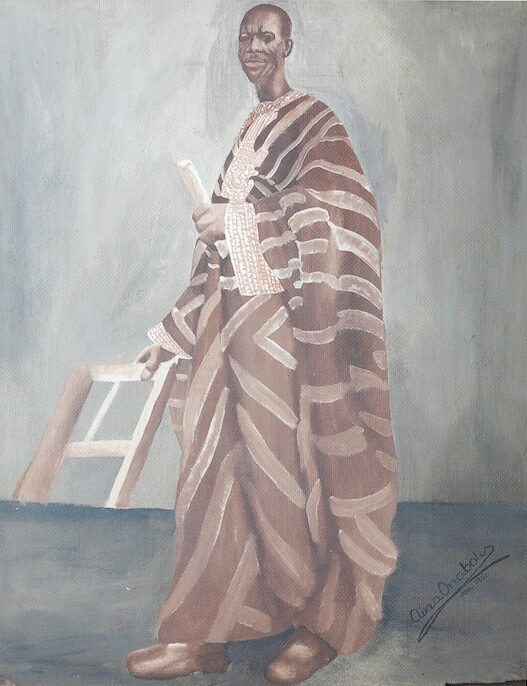
The exhibition opens with the works of Aina Onabolu and Akinola Lasekan. Delicate and detailed European and academy-style portraits capture Nigeria’s early to mid-20th Century respected upper class, from Sisi Nurse (1922), a portrait of Charlotte ‘Sisi Eko’ Olajumoke Obasa who fought for Nigerian women to have access to nursing as a profession, to an elder Yoruba woman, titled Iya Agba (1958) meaning grandmother. This portraiture, which highlights and heralds the region’s esteemed education and academia, activism, and cultural respect, demonstrates the painters’ deep respect for their subjects, honouring these important figures whilst challenging colonial notions of Blackness and the African experience.
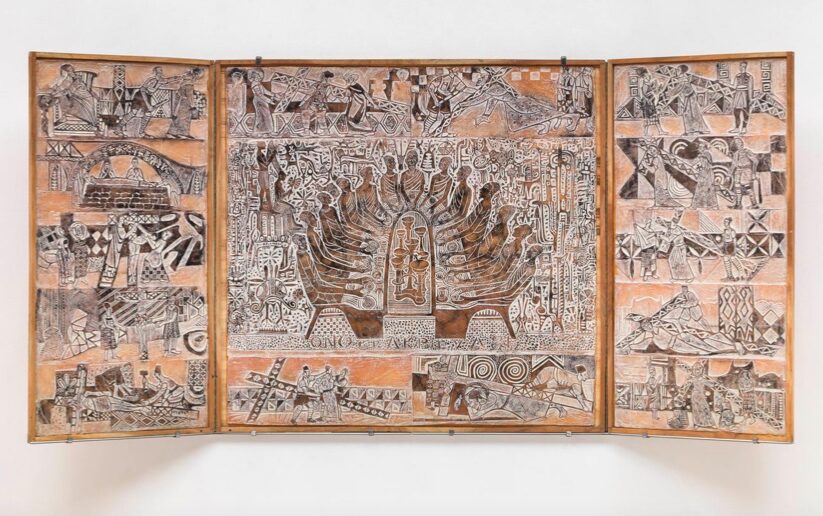
The works hang in stark contrast to others in the space. Wooden door panels and a lintel expertly carved and painted by Olowe of Ise depict the Ogoga, King of Ikere, and his wife receiving Captain William Ambrose, the British officer for Ondo province. The officer, who is being carried in on a sedan chair by soldiers, is followed by porters holding his belongings – most likely items collected as tax from locals. They are accompanied by shackled prisoners or slaves. Next, are photographs of Oba Ovonramwen, King of Benin, shown captured by the British forces following the brutal invasion of Benin City in 1897 and on his way into exile. Ovonramwen is shackled on board a British boat, with two uniformed Hausa soldiers standing as guards beside him. His eyes valiantly look directly into the camera. He feels almost magnetic, bathed in a flowing white robe. You can’t help but feel overcome with his resignation, his pain, his sadness and his rage upon taking in his surroundings and what is actually happening. Such feelings strike again in the chilling recognition of Jonathon Adagogo Green’s complicit photographs of this scene. It is a stark reminder of the callous nature of Britain’s colonial project.
Finally, viewers are returned to Akinola Lasekan, who painted beautiful, vibrant and eclectic scenes documenting Yoruba mythology. His artworks span deities, acrobatic dancers and fellow artist Justus D Akeredolu cloaked in an ase-oke cloth. Here, realistic paintings bring life to the region’s rich tradition of oral histories. Together, these works point to the ways in which modernist sensibilities were already at play across colonised Nigeria.
This first room sets up the emotional and visual journey of the rest of the exhibition. It tells a complex political and social history and the painful shadows it casts, all whilst exposing the role of artistic expression across the region’s battle for freedom and resistance.
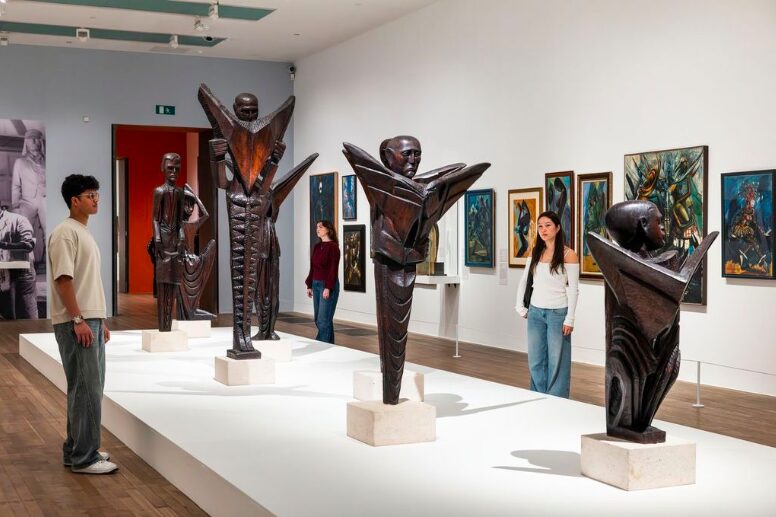
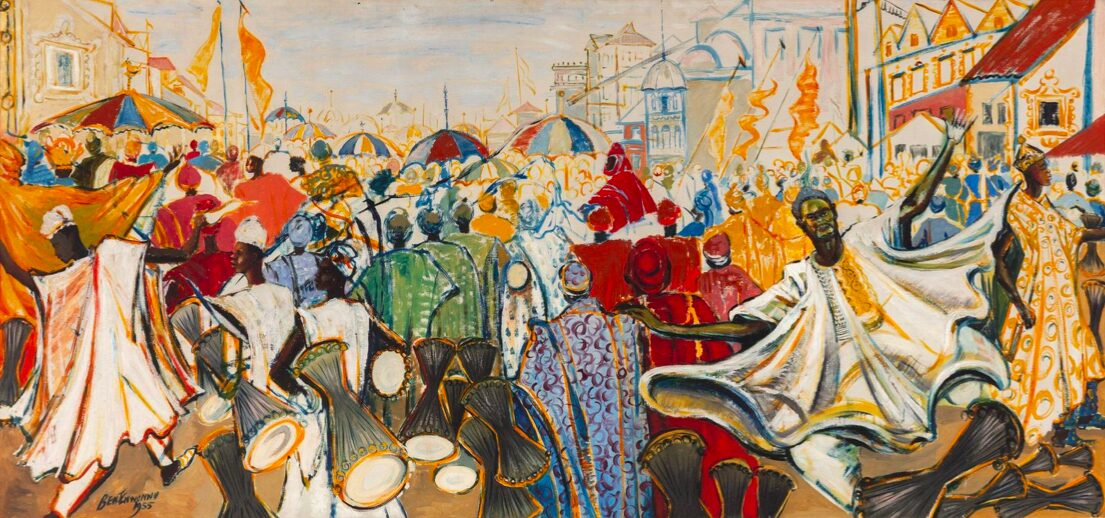
Room Two envelops us in the world and works of Ben Enwonwu and the rich cosmologies and worlds he explored, conjured and built as he developed a pioneering and inspirational visual language for Nigerian modern art. The room is adorned with Enwonwu’s artworks which encompass and merge both his training in Igbo sculpture inherited from his father and his knowledge of masquerade together with European artistic traditions. Widely regarded as one of the most accomplished artists equally in painting as in sculpture in the region’s cultural history, it immediately becomes clear how and why he was the first African modernist to gain international recognition. In Road to Siloko (1943), viewers are greeted by Enwonwu’s honouring of Onitsha cosmology with a water colour painting depicting a shrine in a forest grove. Like many of his earlier works, here he also pictures a carved pillar, symbolic of the shrines traditional sculptors like his father often retreated to when focusing their creative energies on carving. Throughout the room, viewers are transported between this sort of colourful landscape art and portraiture thoughtfully exposing how Enwonwu experimented with a variety of themes and styles.
In conversation with each other throughout the room are symbolic images of African dancers, Igbo deities, cultural rituals, ideological values, and masquerade performers – works of varying sizes and forms, densely populating the four walls and central piece of the space. Enwonwu’s striking interpretations of Igbo feminine power reveres the Black Mother symbolism central to Négritude. Black female bodies with elongated forms, such as in Black Culture (1986), are presented with beauty, grace and tenderness but also a clear, potent inner strength. He was working towards a revitalisation and reclamation of the African creative force and was successful in achieving it. Standing tall and centre stage in the gallery space are seven ebony wood carved figures, five of whom are reading broadsheet newspapers, their heights and expressions vary. The more you look at them, the more their newspapers appear to metamorphose into wings. Commissioned by the Daily Mirror for their new headquarters in 1960, Enwonwu said ‘I tried … to represent the wings of the Daily Mirror, flying news all over the world.’ It was made in the same year that Nigeria gained independence. The compelling sculptures, particularly in hindsight point to another meaning – that of Nigerians soaring, aka rising, is common in his work. Like his contemporaries Enwonwu is expanding the canon to be more inclusive, here we see how the imagination became a site for liberation. His practice is emblematic of a national optimism that became intrinsic to the very essence of much of the work coming out of Nigeria during this time. Work came to signify freedom. He served as a reminder and inspiration of this perspective both then and now.
Room Five, Eko, in honour of Lagos’ precolonial name, is a tribute to Nigeria’s buzzing most populous city and with it we see the continuation of the evolving sense of cultural pride. Prior to Independence, the city experienced a rapid period of urbanisation. People from across the country travelled to the city in search of new opportunities and economic prosperity making it a hub of internal migration. Such civic change gave rise to a new generation of sculpture artists who engaged with and advanced Pan-African approaches to modernist sculpture. As important archives, various copies of the leading publication Nigeria Magazine which championed contemporary art and literature are laid out, detailing the evolving spirit and artistic development of Nigeria’s art scene. Throughout the room the sounds of Highlife, the sonic beating pulse of Nigeria can be heard, giving sensorial context to the space but sculptures such as Adboola Folarin’s standing terracotta piece command it, as they call on varying mythologies and Yoruba culture. Beautiful wood sculptures with elongated fluid forms by Okpu Eze such as The Adanma Masquerade (1989) pay tribute to cherished Igbo masquerade traditions in which men performed choreographed, feminine dances. A common thread throughout the exhibition are artists engaging with themes of identity and the self in relation to their own ethnicities, and traditions – as they clearly attempt to synthesise their own experiences with this newly formed understanding of nationhood.
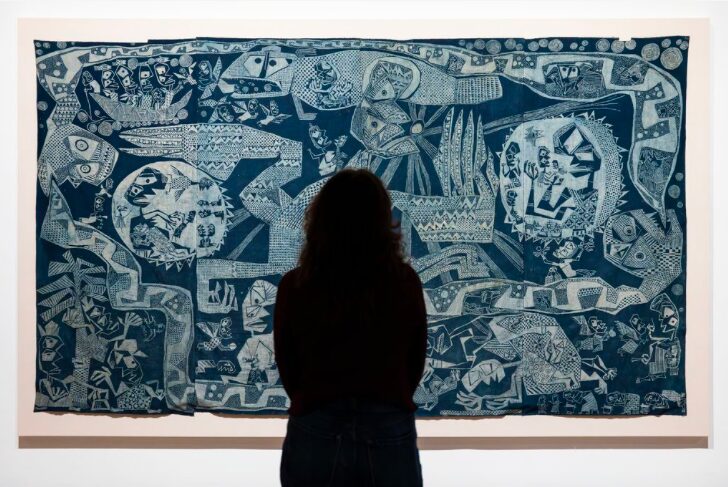
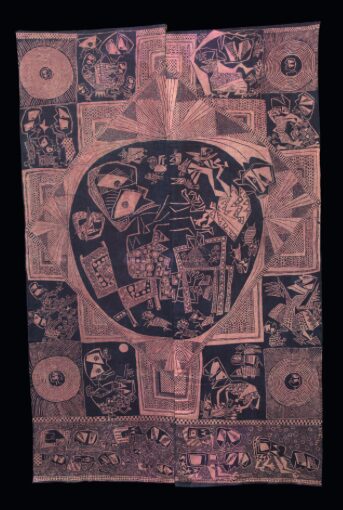
In equal measure, folkloric motifs strongly run throughout the exhibition. The sixth room subtitled Forest of a Thousand Spirits celebrates the works of a group of artists and local craftspeople who became known as the New Sacred Art Movement. Brought together by Austrian-born artist and Yoruba high priestess Susanne Wenger, they set out to help restore the main shrine to Osun in the Osun-Osogbo Sacred Groves. These groves are located just outside the city of Osogbo along the Osun River in south-western Nigeria. Susanne Wenger’s tapestry Mythos Odùdwà (1963) is huge, stunning and intricately detailed with Adire textile which tells the Yoruba creation story of Odudua the mythical ancestor who shaped the earth. Wenger avoided realistic representation in favour of forms that express spiritual power and inner meaning, inspired by Yoruba traditions.
Similarly, Room Seven, dedicated to Festival of the Gods: The Oshogbo School is filled with works from a series of art workshops hosted by Duro Ladipo in 1962. The Woman with Four Breasts by Asiru Olafunde (1960s) is a large captivating aluminum panel portraying a Yoruba tale of a four-breasted princess who later turns into a river. Each line and detail is carefully and innovatively hammered into the material from behind to evocatively capture the scenes from the Yoruba oral tale. Other paintings honour the Yoruba Orishas, offerings made in adherence by their devout followers. Two beautiful and experimental linocuts illustrating The Orisha Iya Ewe and Egungun Dancers (1962) by Jacob Afolabi celebrate the fantastical creatures associated with Yoruba folktales and popular fiction of the time.
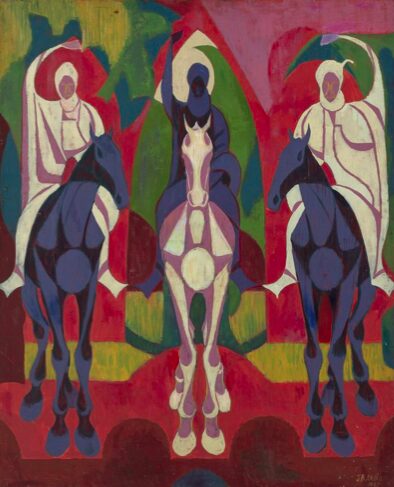
The exhibition at times feels dense and a lot to take in, but the quantity of works throughout offer a real sense of the significance and potent intention driving the collective vision of artists across the newly formed Nigeria. Tribal and ethnic divisions were a horrific legacy of colonialism and the Nigerian civil war, however, so too was the building of a budding network of artists and cultural thinkers who innovatively sought to capture a national identity. It feels like a great honour to be able to see and experience such work and Nigeria’s cultural trajectory archived in one space. The show clearly indicates the restless and relentless emotion of artists who were channeling their hunger for true freedom through their creative pursuits. The curatorial approach to how the artworks are in dialogue with each other successfully bears witness to this. Whilst overwhelming, perhaps there was no other way for the curators to showcase the scale and depth of works being produced. It is also simply indicative of the restless and relentless drive of the artists.
Nigerian Modernism is on show until the 10th of May at Tate Modern in London.
Francesca Rechere
is a writer, filmmaker and cultural producer