‘once upon a time, not a long time ago’ – In conversation with Hala Elkoussy
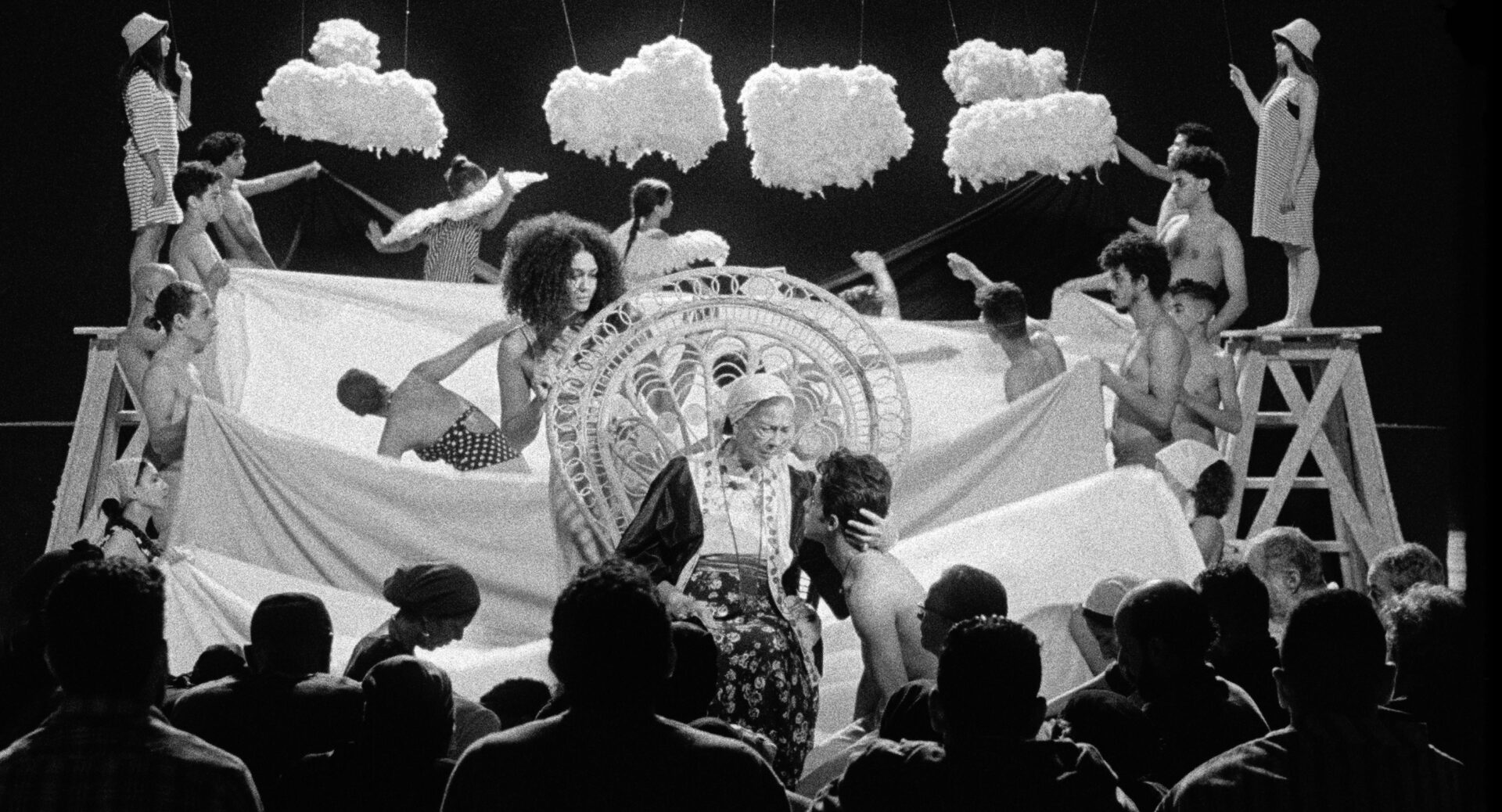
Hala Elkoussy’s latest feature film East of Noon will be released in theatres (coming days screenings at Eye and a Q&A with Hala at Louis Hartloper) across the Netherlands starting in November 2025. Set in a placeless and timeless desert enclave, East of Noon is a shimmering and energetic portrayal of authoritarianism’s theatricality and narrative contortions.
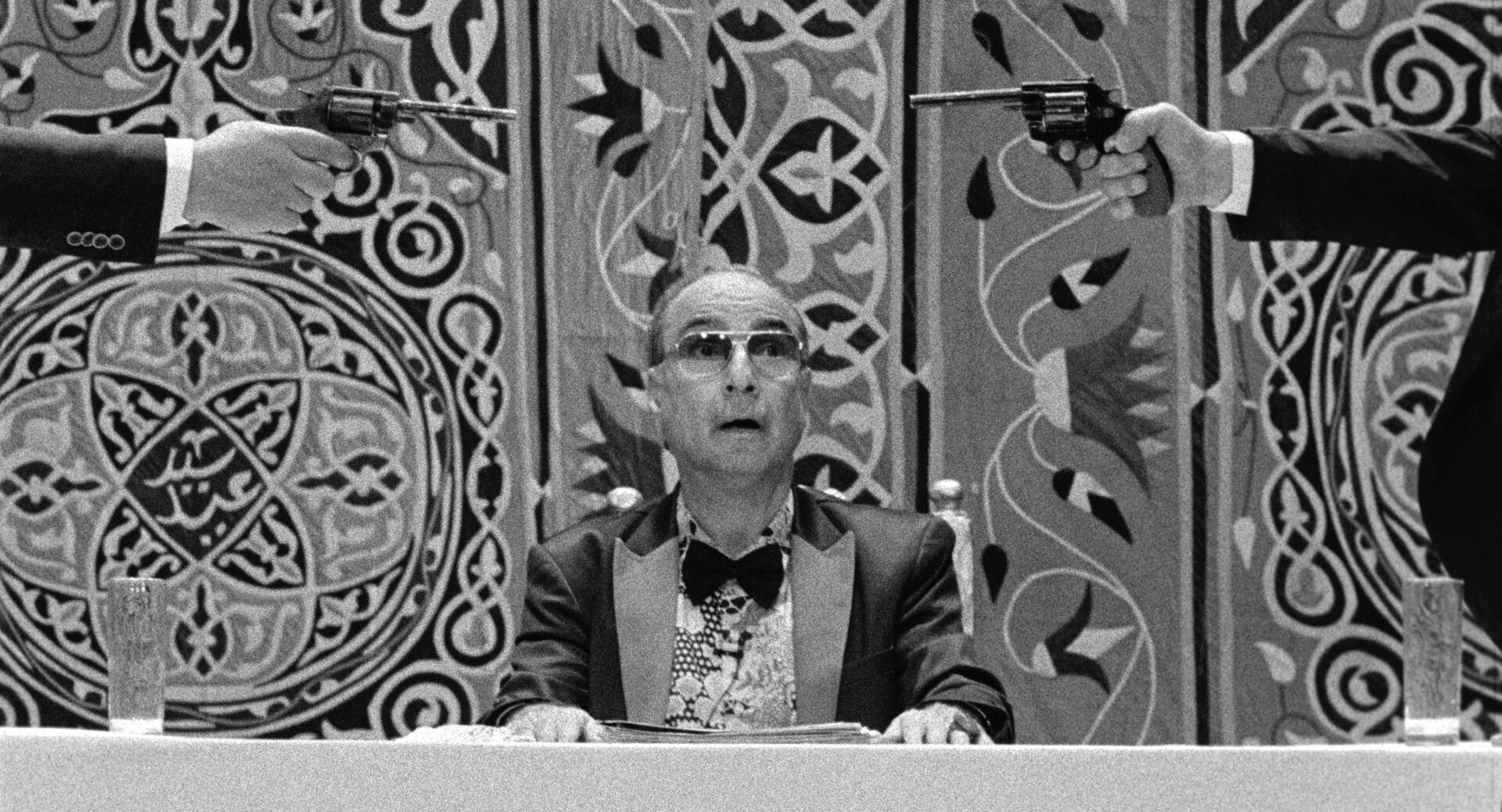
The story follows the young and idealistic Abdo, whose freedom and imagination are constrained by an older generation, including his grandmother Galala, a collector and keeper of stories, and Shawky, a campy despot, whose theatre productions force a captive audience — laughing or gasping on cue — to re-enact an already-engrained acquiescence. Abdo’s visions of a different future are a palliative escapism but remain an image of hope and emancipation. The sea, at whose marshy shores the film begins, is a parable of endings and beginnings, an experiment in a storytelling that is recursive and disruptively determined. What stories do we tell to help us survive? How do we interrupt what has already been written?
Thema's
During the Q & A at the premiere of East of Noon at the Eye in September, you said something that really struck me and stuck with me: in a world of rising authoritarianism and unspeakable violence, perhaps the most ethical thing to do as an artist or a filmmaker is to make nothing. Could you elaborate on the ethical position or the ethics of making work today?
‘It’s a lingering thought that I’ve had for a couple of years now, that was already spurred by a project by Maurizio Cattelan (Oblomov Foundation, 1992), in which he raised prize money for any artist who was willing to not work for a year. Nobody took him up on it, but that idea has been quite intriguing; this notion that we don’t do this for the money, we do this for something else that is much bigger. The idea to stop working is catastrophic — it’s the worst thing that could come to the mind of an artist, that you would be stopped from making work. At the moment, I’m researching all kinds of artists who were incarcerated. They are writing on rolling paper and toilet paper and having artwork, art supplies, smuggled into the prison; they are doing all sorts of impossible things just to continue to work. There’s an impulse to produce. On the other hand, looking at this current climate where freedom of expression is being eroded at a pace we never imagined, it becomes a thought to ponder: would not making art be a more effective kind of resistance given that art has become completely mainstream? There’s always this kind of usurping that happens. On the other hand, how much do artists as a collective contribute through their desire to continue to work? Artists seem to be contributing to a cycle that’s eating them up; that’s eating their effectiveness up. I think art should be proposing an alternative vision for the future. Or at least considering how to do so.’
East of Noon seems like a kind of proposal for this alternative vision for the future and is structured like a fable or an allegory. How did the film come into being, especially in a context where the ethical imperative might be to not make a film?
The inspiration for a work is always the spark of an image — there’s a lucid kind of image that I see. In this case, I saw an image of an old woman sitting in an armchair on a raft in the open sea. Around her domestic objects of varying sizes were floating. This image triggered the script of East of Noon, but also several other pieces of writing. I’m also interested in stories and how they are relayed: passing on a story from one person to the other. What gets kept; what gets left out? What happens to the story when it gets retold? What makes a contemporary story mythical? There was a conversation that influenced me quite a lot when I was working on the script for this film, which is a conversation between John Berger and Susan Sontag about storytelling (“To Tell A Story,” 1983). There’s one notion that John Berger put forward, that it’s the end of a story that makes a story and somehow that ending spurs us to tell it — if there was no special ending, then whatever happened before wouldn’t be of interest to tell. This idea connects completely to the tradition of the stories of One Thousand and One Nights, which I have been reading since I was a child. I was nine years old, when I read all of them — the censored version, of course. This notion of entering into a cycle of one story leading into another in an endless fashion that has always been there and, this structure I also mirrored in my short films and also to an extent in East of Noon. There’s a story within a story.
'Artists seem to be contributing to a cycle that’s eating them up; that’s eating their effectiveness up'
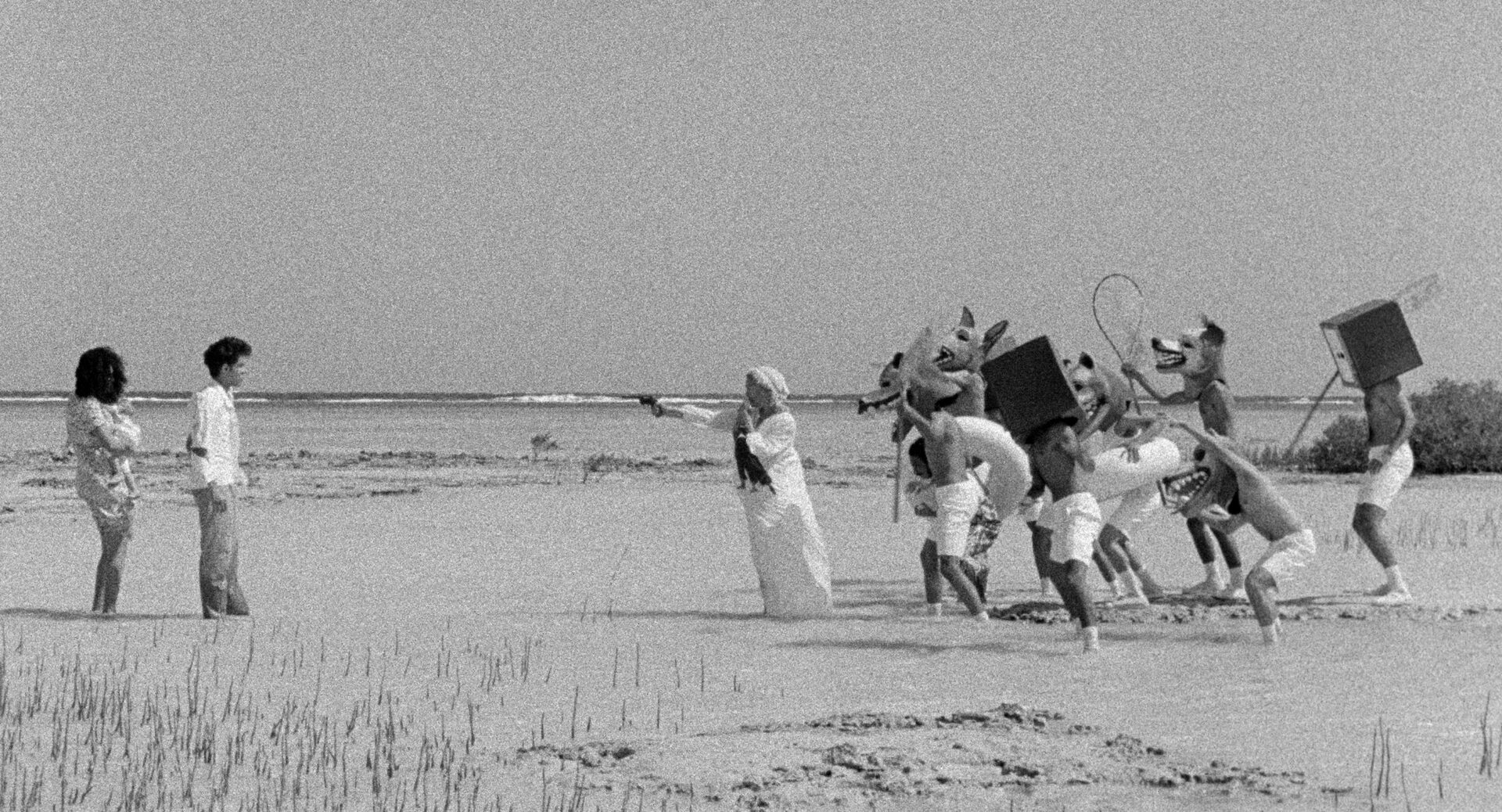
When I rewatched East of Noon, I noticed this mirroring or spiral story structure. The film starts with Abdo, the young protagonist, being carried along the shore by his parents, who we won’t see again outside of this scene. The beginning of the story is also a kind of end; the inciting incident is also the moral of the story, told to us in voiceover, ‘Once upon a time, there were frightened people. They were so frightened their imagination escaped.’ So, there’s a recognizable, even universal, structure that East of Noon, even as it defies a linear or wholly graspable narrative.
‘In Arabic it says, something like ‘once upon a time, not a long time ago,’ which is difficult to translate; it’s difficult to imagine. This line posits that even though it’s ‘once upon a time,’ the story isn’t ancient. There’s always an inherent impossibility with ‘once upon a time’ because it kind of asks you to go somewhere you can’t access. I’m interested in a notion put forward by the German archaeologist and Egyptologist Jan Assmann on collective memory and how through passing on stories and histories, a culture also preserves itself. With East of Noon, I wanted to look more at these notions, and at the dissection of storytelling: what are the components of a story and more than anything, what is the value of telling stories. It’s also something that’s said in the film, ‘every story has a hero.’ Sometimes the hero wins, but not always, and even if the hero doesn’t win, then their story has still been written. That goes back to John Berger. That even the attempt to tell the story is heroic. This is something of great value today. That somehow, it’s not all hopeless and somehow, we’re just here to continue to try to thrive.’
This attempt to thrive or the struggle to thrive is also reflected in the actual materiality of the film. You shot the majority of the film black and white 16mm, but two times, there are brief interruptions of 35mm colour. There’s a kind of freedom or magic that breaks through the story in these moments: they’re dreamlike, but then again so is the grainy and haziness of the black and white. This transition between desaturation and colour is also a recurring narrative strand, and plays with the function of magical realism. How do you see magical realism as a narrative or formal structure in the film?
‘This is something I’ve been playing with throughout my practice. Very early on, I would take a photograph of a lone person — a wide shot of a single person in different parts of the city, and they were made up as a kind of reenactment to fit their environment. Nothing in this scene would be outwardly different or strange: somebody would be sitting in a café for a drink, for instance. They all looked very normal. But there was something about this existence in this space that was a bit hyperreal because you couldn’t imagine a big city like Cairo where these moments might exist. But they do exist. And I think at that point I was already starting to think that everything around us, if we would look at it in a certain way, has a hyperreal quality. It’s not necessarily the thing in itself, it’s more that it takes you or your disposition to see something magical in it, or something that’s not normal. If we’re in a rush, then we don’t see it. In my mind, this idea of magical realism has to do with taking the time to look. And once we do, then mundanity ceases to be mundane. It could be that even small gestures acquire a different weight. Another thing I’ve always been interested in is escapism, which you would tend to go toward when there’s a certain situation that is hopeless — there’s a notion of imagining an alternative where there is none. I’m interested in that alternative mixed with reality in a seamless way.’
Can you talk about the construction of the space or enclave, SHARQ12, where the film takes place. There are elements of the location — its arrangement of highly decorated and detailed indoor spaces and the kind of vast almost abstract industrialised exterior space — that are reminiscent of a film set. It can be everywhere and it’s nowhere at the same time.
‘When I first started thinking about the story, I wanted it to take place in this enclave. But I couldn’t imagine possibilities for what it could be. One thing that was important was that the place was dry so that there would be a contrast between the enclave and the sea. When we were scouting, we found this disused factory — a furniture factory on the outskirts of Cairo. The industrial backdrop added another dimension to the story because Egypt, like a lot of countries ridding themselves of colonialism in the 1950s and ‘60s, had this big industrial dream and went through a process of heavy state-owned industrialization. But that all collapsed in the ‘80s and most of these factories went into disuse and are now sold for land. This particular factory is 400 metres from the Nile, so destroying it and building high rises with a view is way more profitable than doing something else. It’s waiting for demotion.’
'Theatre has always been part of my work'
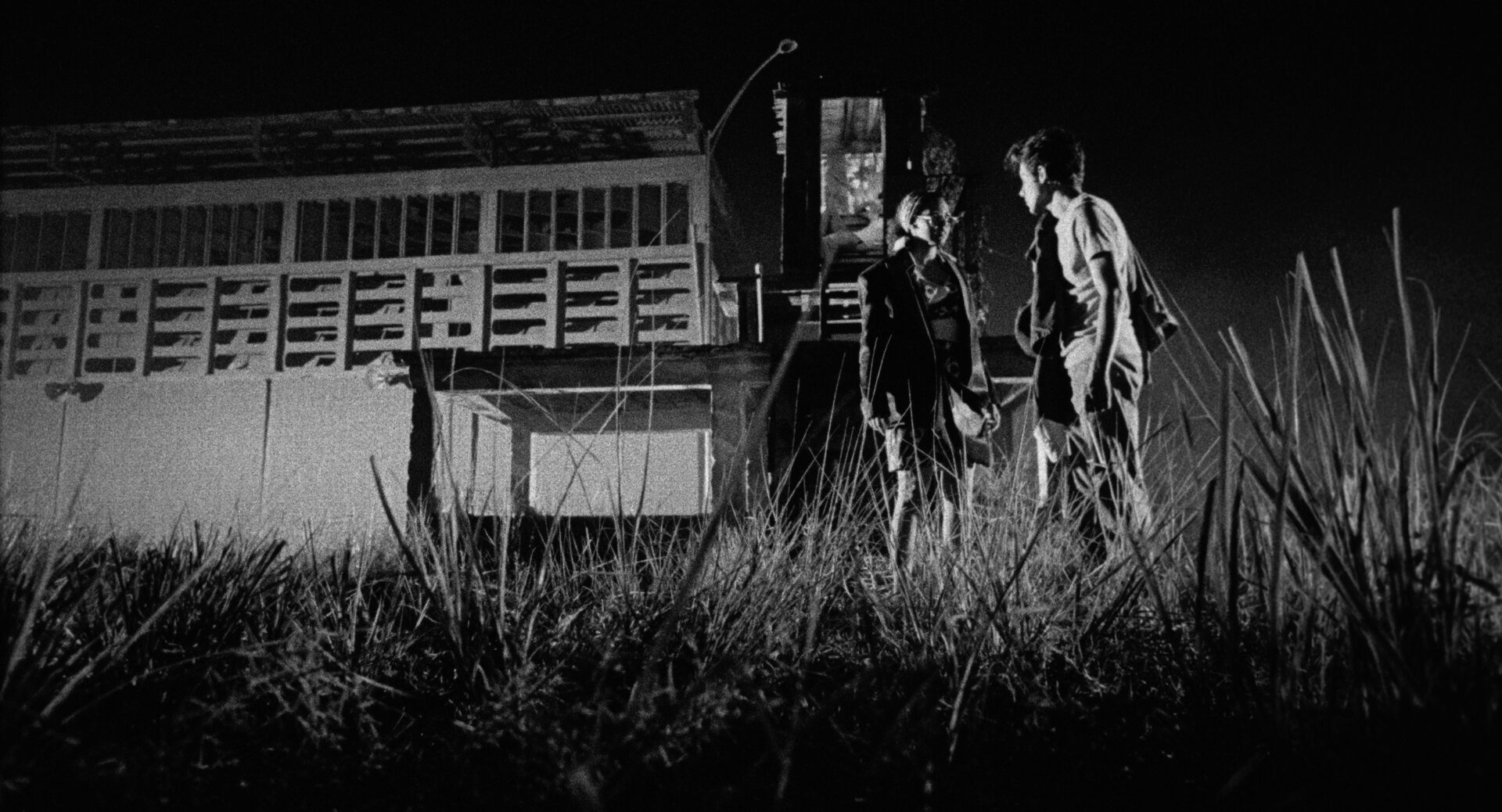
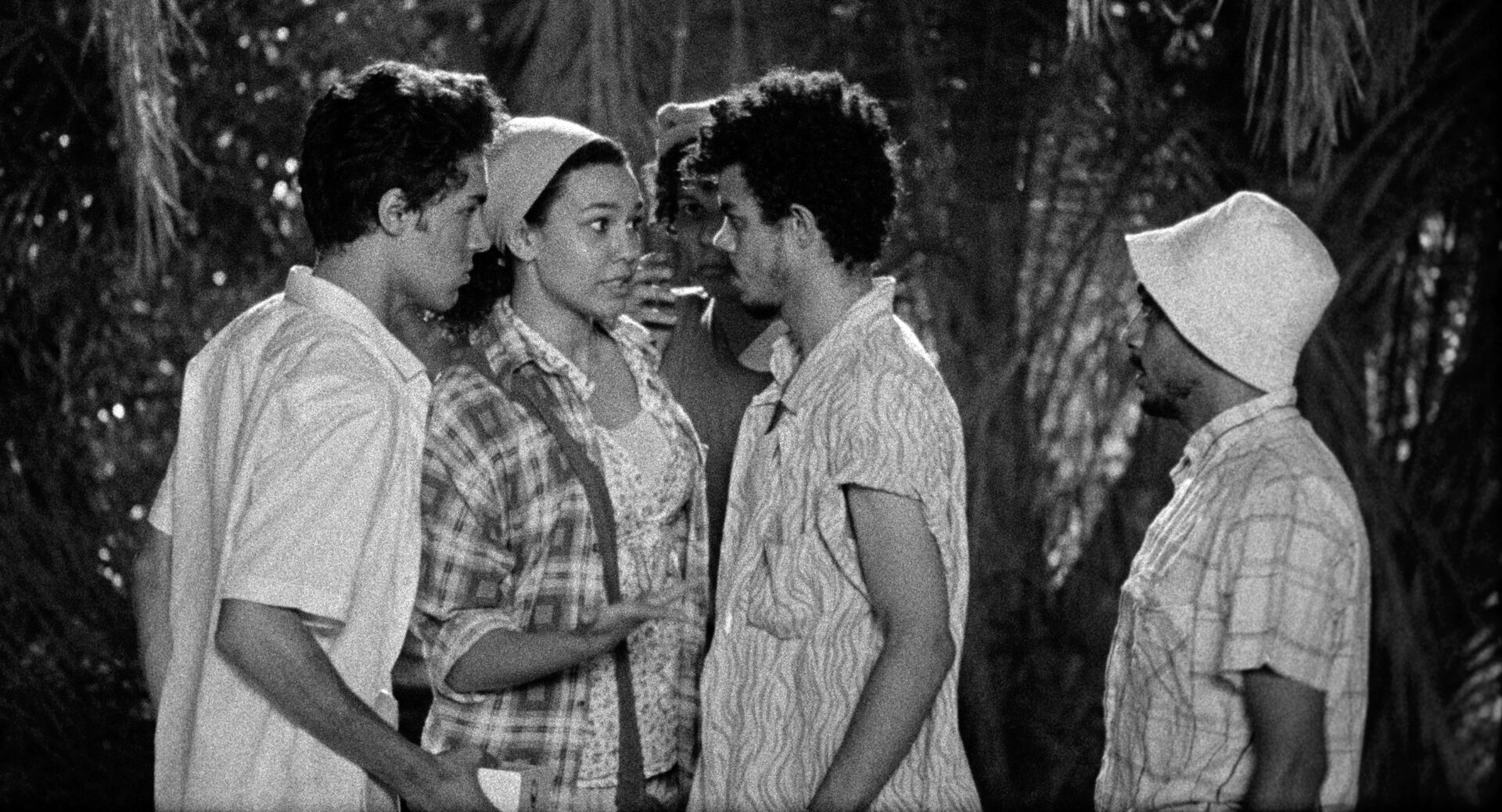
There are a lot of different modes of theatricality in the film: there are frenetic scenes in which the camera moves around crowds of people (at the market or in the penultimate scene of a chaotic dig for treasure buried with the dead). There’s also the despot Shawky, who presents a kind of vaudeville-style production with dancing and music, ‘a showman’s show’ he calls them. Is the theatrical a way of displaying artifice or the movement between reality and fantasy?
‘There was something I became aware of very early on making films. When audiences are watching something different from their own world, they often assume what they’re watching is real, even if it can’t be verified by their own experiences. This is a quite Western-centric way of looking at the world. The theatre has always been part of my work. I showed my first short film in a large biennial years ago, and there were 100 extras in the film. It was constructed around actors, it was very theatrical and part of it actually took place on a stage, and there were voiceover and music, but not one of those extras spoke. But the curator was treating the work as if it was some kind of documentary. This was kind of baffling to the young me. How should something look to not to be taken as real? What is the value in treating art as news? And so, the theatre has always been part of my work. There are almost always theatre curtains in my work. The idea that there’s a show that’s been put on for your benefit, instead of perhaps this awareness of complex layers to human experience.’
Amidst the drama and theatricality of the enclave, there is also focus on collecting (especially objects and their stories). There is something that seems slower or perhaps a way of encountering the past.
‘Yes, every object is not just an object. And this brings us back to the idea of contemplation or stopping to look at something as an experience. I’m mainly a collector of photographs. I did not set out to create an archive, but I have a kind of archive now. Within a single image there’s all this history preserved. The collector collects in the hope that by preserving these objects they would somehow be of value later. I’m collecting these photographs because I feel these images have value; it’s maybe not visible to the state or to anyone else, so I’m keeping them for now. The artist is doing something similar with ideas: I’m making a film about storytelling because I believe that storytelling is important, and maybe it’s an idea that I want to carry forward to the future. Both the artist and collector resist oblivion; they’re connected.’
East of Noon received De Verbeelding (a collaborative project between Mondriaan Fonds and Film Fonds) in 2023
On the 27th and 28th of October there are screenings of East of Noon at EYE Museum.
On the 29th of October there is a screening and a Q&A with Elkoussy at Louis Hardloper Complex in Utrecht
Annie Goodner