The bag and the spear – reflections on Ursula K. Le Guin’s The Carrier Bag Theory of Fiction
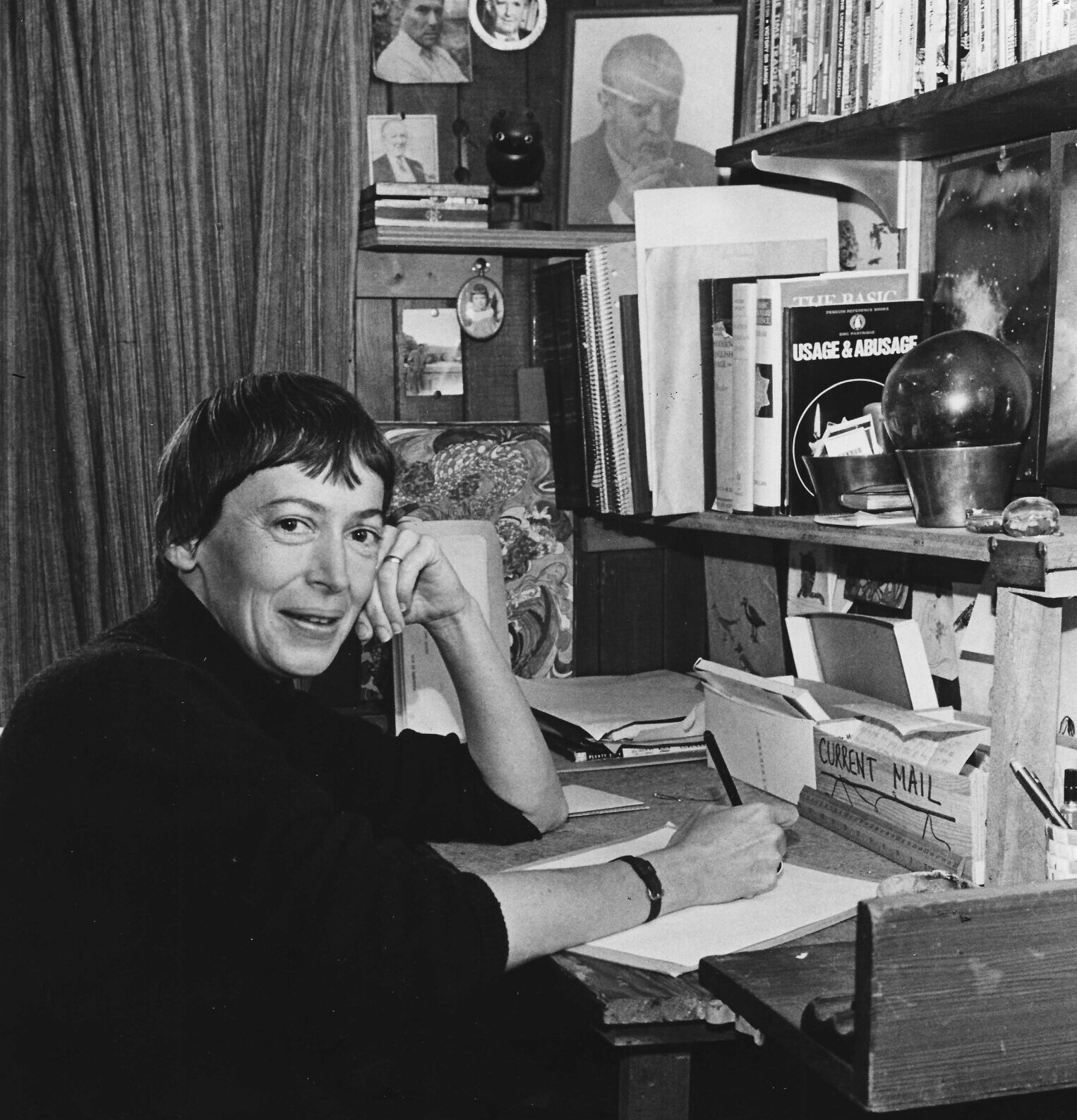
Ursula K. Le Guin is a renowned American author. While primarily known as a writer of speculative and science fiction, Le Guin’s prolific body of work includes poetry, collections of essays, short stories and children’s literature. Especially her essay The Carrier Bag Theory of Fiction has regained popularity the past few years. Hannah Fleishman asks why this is the case through a critical reflection of the text.
Having recently completed an MFA myself and having spent time teaching fine art students, Le Guin is a name that comes up again and again. Mainly her essay The Carrier Bag Theory of Fiction published in 1986 has regained popularity these past few years. My own thesis cited this text as one of its main sources. I have been curious about Le Guin’s popularity amongst young creative people especially within educational environments. Are we just feeding our peers and students the same things over and over again solidifying the already all-powerful echo chamber? Or is there something fundamentally current and urgent about Le Guin’s writings, something that speaks strongly to our moment and to young people in particular?
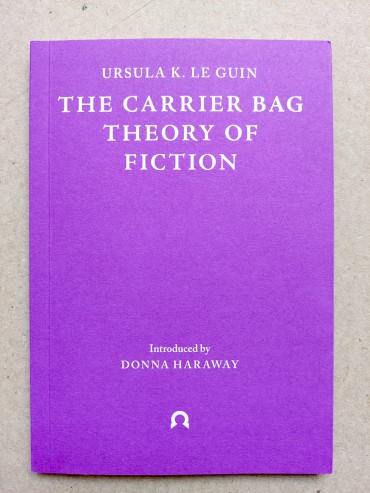
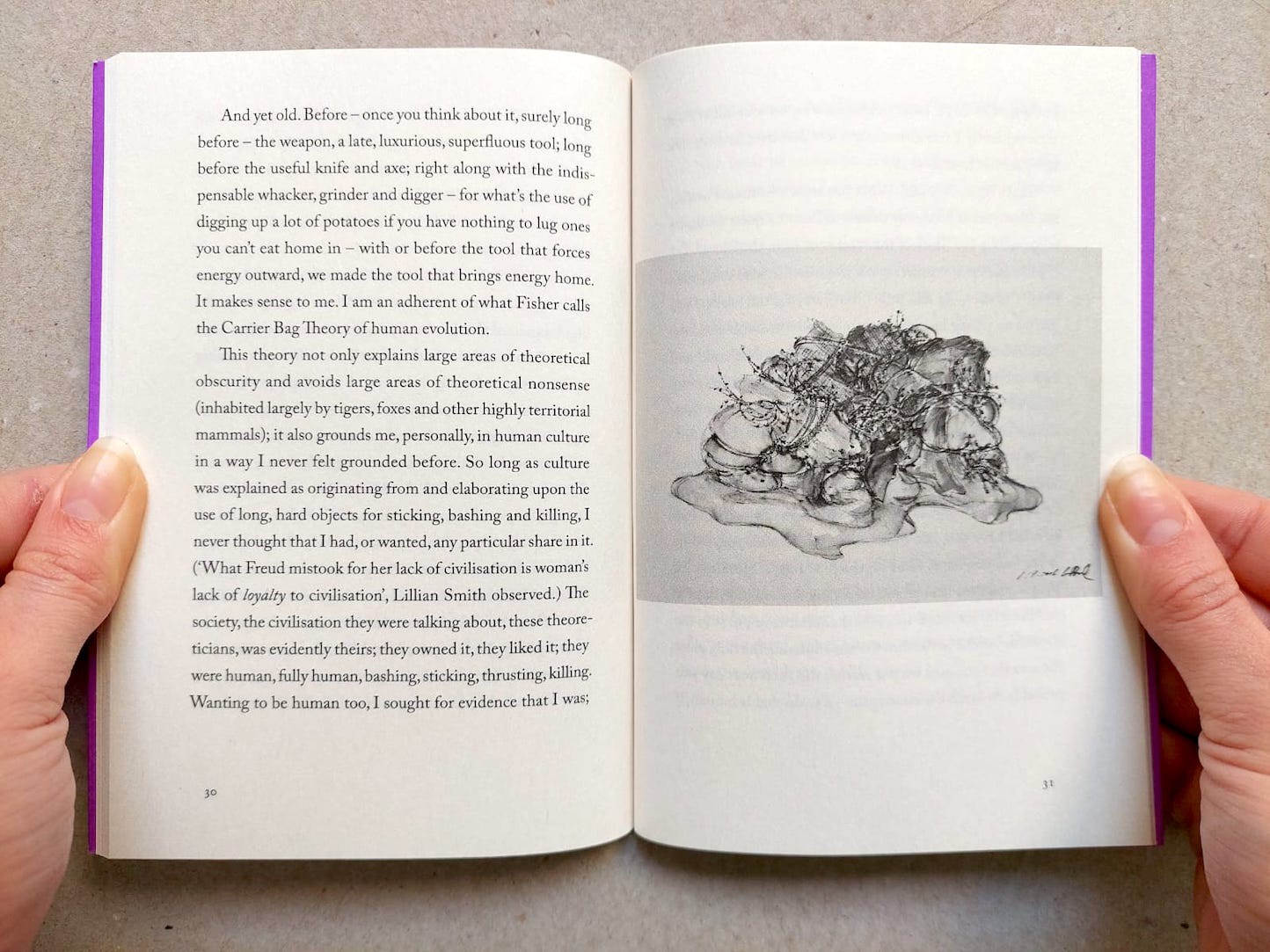
In The Carrier Bag Theory of Fiction Le Guin suggests that the first human made object was not in fact the spear but rather the bag. She states that ‘[B]efore the tool that forces energy outward, we made the tool that brings energy home.’ If the spear existed there must have been a containing object that proceeded it in order to collect gathered resources and hunted animals. Le Guin’s argument reinscribes something vital in our understanding of the development of human culture. It moves away from the basis of human culture being grounded in a bashing, probing, killing object. The essay goes on to relate this thinking to the formation of stories and the expectation for what she describes as a killer story: ‘So the Hero has decreed through his mouthpieces the Lawgivers, first, that the proper shape of the narrative is that of the arrow or spear, starting here and going straight there and THOK! hitting its mark (which drops dead).’ This suggests that conflict is at the core of narrative. She goes on to propose that the apt shape of the story is in fact that of a bag or container: ‘a book holds words, words hold things.’ Within the model of the bag the story is not defined by a violent and singular narrative arc that rises with tension and ends in neat resolve. The bag fails to ultimately cohere into one long linear line of argument. Different objects in the bag (or aspects of the story) clash up against each other in good ways and in difficult ways. This can also be applied to the realm of research (another type of story). Our understanding of research has its basis in the scientific method: an outcome-based form of experimentation which simply goes about asking questions and then answering them. The scientific method wants the arrow/spear. It wants research that starts here and goes there, definitively and with sharp precision. Scientific research claims to have caught something.
When setting out to write my own master’s thesis I found it challenging to relate my approach to this research model. My form of research was defined by a reaching for things, not a grabbing. It was defined by a piling up of instants and a placing together to create meaning. In this sense the model of the bag was one of my driving rationales.
However, having sat with Le Guin’s thinking for a while now I feel the need to give space to particular nuances missing from her text. Le Guin foregrounds the violence of the spear initially as the first supposed human-made object and then later as the core of conventional narrative form. She writes about the formation of humanity based on the understanding of the spear as the first cultural object: ‘So long as culture was explained as originating from and elaborating upon the use of long, hard objects for sticking, bashing, and killing, I never thought that I had, or wanted, any particular share in it.’ She goes on to say however: ‘If it is a human thing to do to put something you want, because it’s useful, edible, or beautiful, into a bag, or a basket,(….) and then take it home with you, home being another, larger kind of pouch or bag, a container for people … if to do that is human, if that’s what it takes, then I am a human being after all. Fully, freely, gladly, for the first time.’
When I first read this, I was overwhelmed by the poignancy of Le Guin’s words and perhaps felt that I too could place myself in this understanding of what it meant to be human. However, the more I thought about it, the more something did not feel right. I felt a large and painful oversight. I can broadly articulate this oversight as the historical violence of the bag. I mention this not as an encouragement to disregard the concept of the container but to regard the gap in this discourse that I feel sticks out like a sore thumb.
The act of collecting as a general concept cannot, in my opinion, be separated from the history of colonial collecting. Collecting or rather looting objects during the colonial period was a form of significant structural violence. Imperial military forces would seize objects or specimens from countries they were colonising. This collection would range from cultural objects, religious artefacts, artworks and would extend to the seizing of indigenous people for their bodies to be displayed and studied in human zoos. The acquisition of these objects, this material, these bodies had a multitude of effects. To begin with, the collecting of live people, or even human remains is a devastating dehumanisation and objectification, viewing certain people not as humans at all but as sites of difference that can be manipulated, poked and prodded for the sake of the Empire’s curiosity. The collection of other material objects worked as a cultural eraser, removing a sense of identity from colonised subjects. Further the process of acquisition was a way to impose cultural superiority. Collecting is not a neutral action. As anthropologist Pieter ter Keurs has stated: ‘All collecting, certainly in the context of colonialism, is political. The very act of taking can be seen as a structural form of violence.’ With this in mind, I question Le Guin’s uncritical approach to the symbol of the bag. It is also an object/symbol with links to a violent history.
The act of collecting as a general concept cannot, in my opinion, be separated from the history of colonial collecting.
Do not get me wrong, I think there is much to learn from Le Guin and this essay in particular. But in the same breath I think there is much to learn from unpacking the popularity of it. There seems to be a current obsession with fixed models of understanding. For, while the object of the spear and the bag do indeed differ greatly, they remain as singular fixed objects onto which an immense amount of meaning is placed. Perhaps we like these models because they promise a sense of stability, a sense of steadiness amidst uncertainty. They both have the same function, tying quite a neat summative knot. The spear proposes a type of anchor: a clean, linear narrative with a definitive purpose and focus on progression. According to Le Guin, the bag, offers another: a spacious, gathering form with a focus on inclusivity that seems to at first resist the violence and individualism of the spear. But if we turn to the model of the bag too uncritically or too completely, we may find ourselves re-enacting the same desire for definitive ‘truth’ that has too commonly shaped Western philosophies. We risk running into similar issues that come with a need for certainty and fixed models. Further, to regard the bag as an uncomplicated alternative to the spear is to disregard its connection to histories of extraction. The bag has been a tool not only of sustenance but also of plunder. It is therefore vital to understand the bag as a complex model with both significance and limitations, in order to not condense complex histories into singular narratives that promise explanative simplicity. The spear pierces; the bag collects; but both options ultimately become conceptual shortcuts.
The spear pierces; the bag collects; but both options ultimately become conceptual shortcuts.
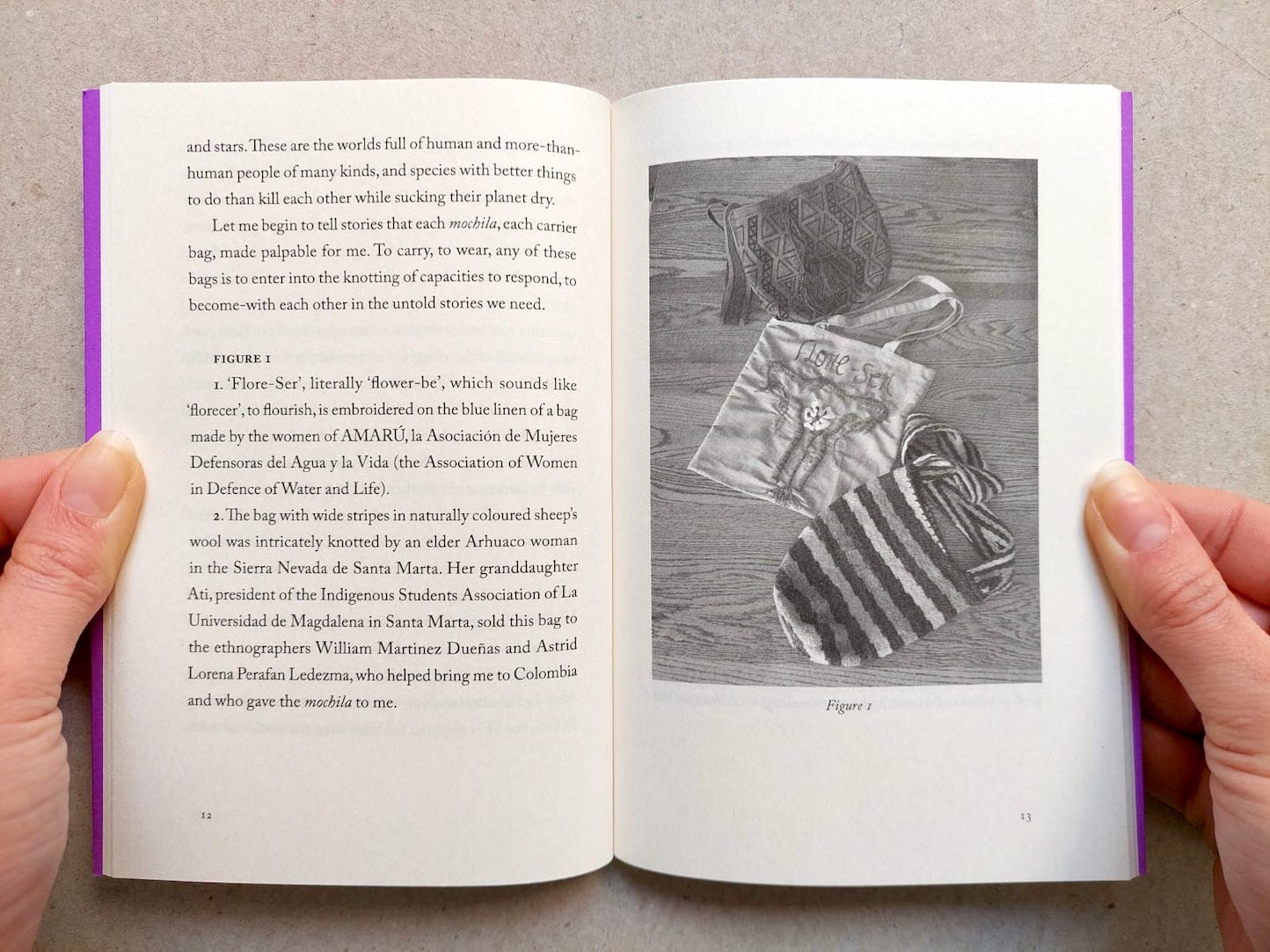
Perhaps It is exactly this simplicity that draws young creative people to The Carrier Bag Theory of Fiction. In a moment defined by precarity as well as institutional fatigue, Le Guin offers an alternative model that feels both ethically and emotionally mitigating. However, the model of the bag offers only a fleeting sense of reprieve, leaving intact the very structures that continue to condition how we understand and interpret the world. Within the art world specifically, artists often take on the role of creating otherwise, seeking ways to imagine, make, and think beyond conventional structures. In this way I can understand why authors like Le Guin become prevalent now with a focus on speculative fiction and critical world building. I can further understand why the image of the bag becomes so desirable. At first glance it posits itself as a counter object, as a way to push against and imagine anew. And I would agree with this if it was understood as a springboard off of which to start imagining instead of another fixed model. This brings forward the question of what it means to truly inhabit an ‘otherwise’. I do not think that artists turning to speculative fiction or similar conceptual frameworks are looking in the wrong place but too often, the story is concluded too soon, and the potential of these approaches is prematurely settled.
I think one of the harder tasks in the current moment is to have to lean into ambiguity and inhabit the grey spaces between things. In this grey space stories resist neat resolution and objects are not used as monolithic, impenetrable symbols. I do acknowledge the difficulty here. Ambiguity offers no stable ground, there is no relieved exhale associated with a clear outcome or at least a way forward. Instead, it demands a willingness to embrace contradiction and uncertainty and, further, to interrogate the allure of concise explanatory frameworks. However, if we follow along this path, I think it is important to ensure that we are not using this approach as an explanation out of action. Ambiguity does not mean inaction or stillness, or laziness for that matter. That is one of many lies constructed under the modernist paradigm. Perhaps the laziness is rather prescribing familiar recognizable forms to the space of ambiguity in an attempt to quickly understand it instead of sitting with its tensions. Samuel Beckett writes in his novel Watt published in 1953 that ‘the only way one can speak of nothing is to speak of it as though it were something, just as the only way one can speak of God is to speak of him as though he were a man.’ The question then arises: how can we treat ambiguity as something generative without trying to define it?
Hannah Fleishman
is an artist, based in Amsterdam