Beyond Filling in the Gaps – Practicing Freedom and Refusal at Metro54
Last change to visit Practicing Freedom and Refusal at Metro54. Rebeka Erdélyi sees several examples of artists refusing to follow the main narrative.
Practising history also means taking responsibility for what it excludes. Rather than approaching history as something fixed or complete, the works in the exhibition Practicing Freedom and Refusal at Metro54 draw attention to the gaps, the silences and the power structures that determine what is remembered. The exhibition explores different ways of storytelling – through materials, bodies, personal histories and myths – and asks questions about how we construct (personal) histories, what is omitted from them, and whether these approaches can actually fill those gaps.
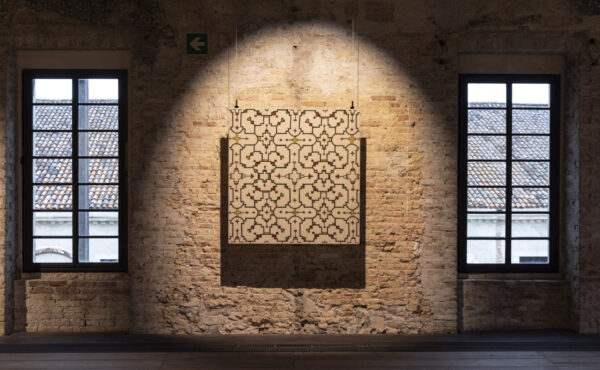
The use of alternative forms to tell stories is first explored in Adeju Thomson’s Queering the Archive. The work consists of a video, a large photographic still and an installation of objects – props from the video – hung on the wall and placed on the floor. The project is based on Thomson’s ongoing research project Post Adire, which examines Adire, a Yoruba textile dyeing technique, and reinterprets it as a contemporary visual language. Here, clothing is presented not merely as a functional or aesthetic object, but as an alternative system of knowledge. This challenges the rigid gender frameworks imposed by colonialism, and through this collection, the artist refocuses attention on forms of fluidity and spiritual significance that were already present in pre-colonial contexts but have since been overwritten. Since clothing is experienced through the body, designed to be worn and seen, it creates a more direct and embodied way of remembering. For me, this already points to how storytelling works in the exhibition, through material practices and personal, lived experiences.
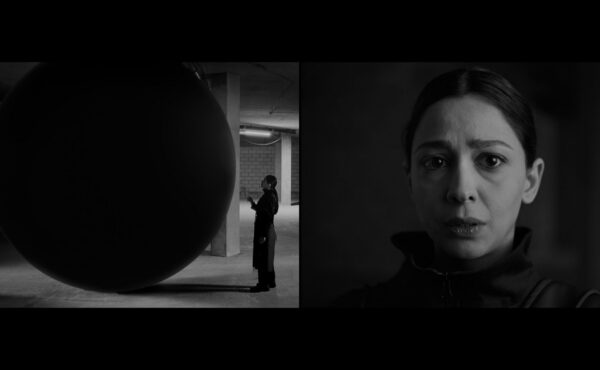
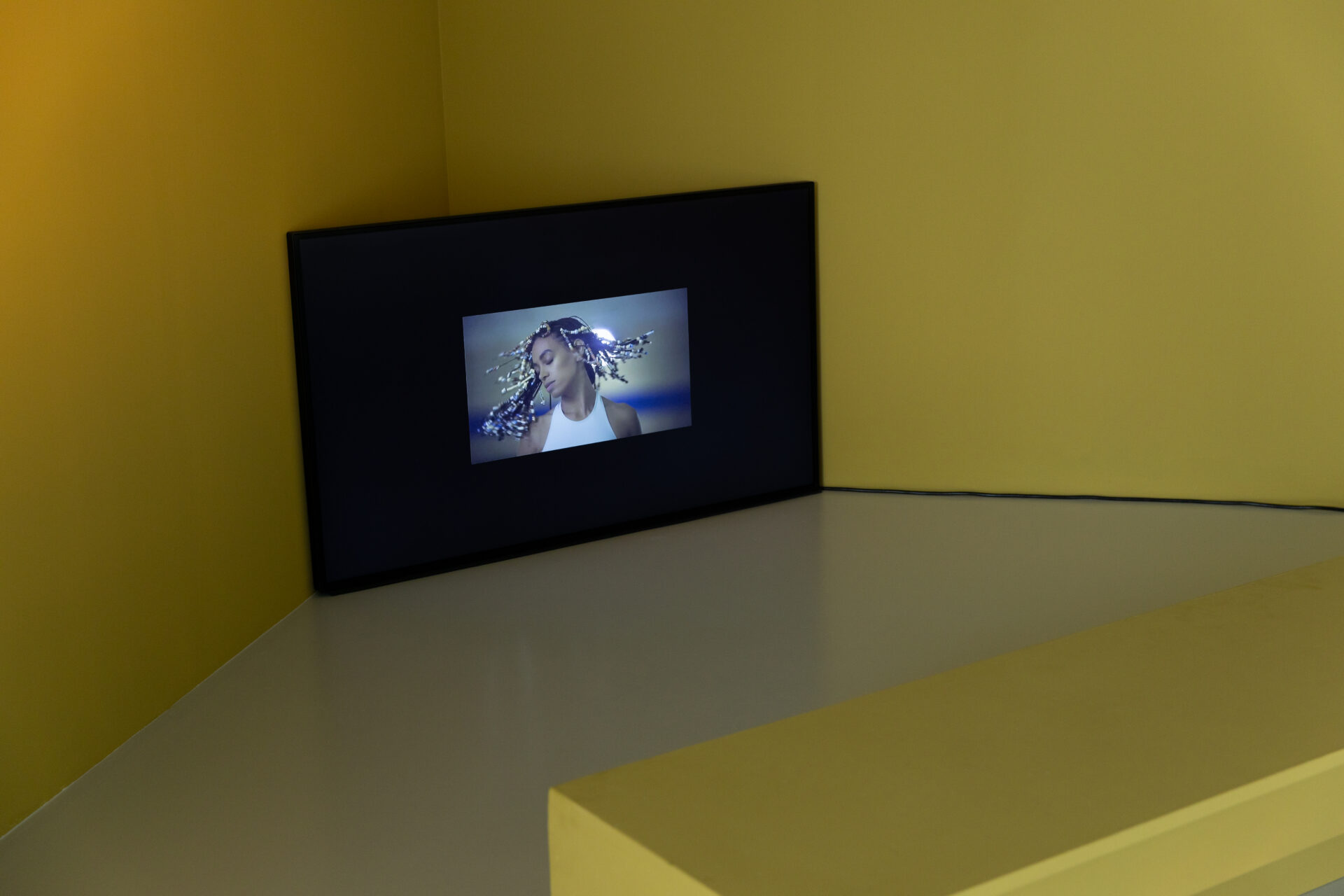
While Thomson approaches storytelling through textile and fashion, Christian Nyampeta shifts his focus to personal histories. Director’s Note is a film that layers migration, cultural encounters and the construction of belonging. The work begins with the artist’s own experience of applying for an artist visa and moving to the United States, using this as a starting point to think about how personal biographies connect to larger histories of cultural exchange and memory. Through video fragments, references and excerpts from writers and cultural workers, Nyampeta shows how Black cultural histories also formed him as a boy in Rwanda, creating an image of the American Dream that is far from the exclusive post-Trumpian reality he is now facing as an immigrant living there. But the attraction is still there.
Entering the second room of the exhibition space, Helena Uambembe’s Long Long Long Ago is presenting a six minute, single-channel film that unfolds a myth. The narrator in the video introduces two brothers who are nearly identical in strength, emotion and behavior. These two brothers constantly compare themselves to each other, which leads to a lot of conflict (neglecting that this is harmful to the other creatures coexisting with them). Their confrontations ultimately lead to a crack in the land, a crack that grows until it separates the ground entirely, dividing not only the landscape, but the brothers themselves.
Visually, the work incorporates shadow and light cinematography, with flat black figures moving across a white background. Rather than simply recounting an origin story, this work points to how such narratives are shaped by forces that exceed individual control. What appears as a personal conflict between two figures begins to echo larger histories of division (of land, borders, and migration) where separation is not neutral, but produced through systems of power. In this sense, the film suggests that these origin stories are not fixed, but constructed and (re)shaped, often at the expense of those who are smaller or less visible within them.
To me, refusal comes through in these works in different ways: in resisting overwritten histories, in moving away from dominant systems of knowledge and communication, and in insisting on other forms of remembering




In the same room are three installations by Masimba Hwati. Pfukwa 1-3, too, draws on a narrative, but approaches it through sound, returning to sensory forms of remembering and alternative modes of communication. Pfukwa references a haunting force, something that lingers and keeps returning, drawn from the Chidzimbahwe language. Two of the works are mounted on the wall, built around curved horns and arrows, that are bound together and decorated with bells, a metal can and skateboard wheels. The third installation stands independently, combining a helmet with horns and a trumpet-like base, with a crest positioned behind it. The combination of everyday sounds with signals of alert creates a sense of ongoing awareness, as if something might happen, pointing to pfukwa as that returning force. Sound, with its expanded communicative layers, is further explored in AYO’s installation A Score for Atat’s Homestead and its accompanying sound performances.
To me, refusal comes through in these works in different ways: in resisting overwritten histories, in moving away from dominant systems of knowledge and communication, and in insisting on other forms of remembering – through textile, sound, and embodied, personal experience. It also appears in the attention to personal detail, and in questioning how even these personal stories can be shaped, edited, and flattened. At the same time, the works turn to origin stories, myths, and other cosmologies that are often absent from dominant ways of learning and remembering. The exhibition is dense with references, not all of which are immediately accessible. What ultimately holds it together for me, however, is this shared attention to personal and lived histories. Rather than simply rewriting or adding to dominant narratives, the works suggest that attending to historical erasure also means rethinking how stories are told and remembered. In this sense, refusal is not only about opposition, but about creating space, a space in which other forms of memory and knowledge can exist.
Rebeka Erdélyi
is an Amsterdam-based art historian and curator whose current research focuses on post-socialist memory, nostalgia, and the (re)positioning of Central and Eastern European art in an international context.