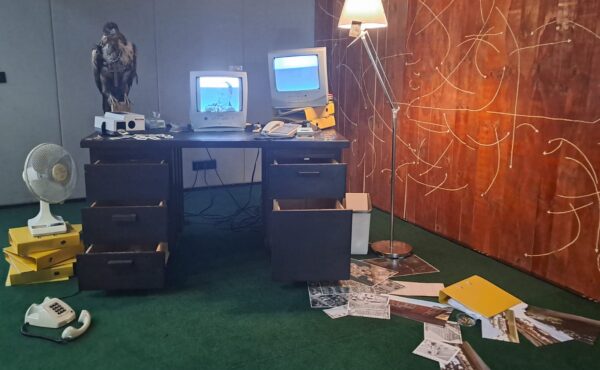
Unfinished Stories – Sandberg Instituut – Graduation Show 2025
This year, the seven departments of Sandberg have partnered with venues across Amsterdam to host their graduation shows. The decentralised format encourages visitors to move not only between spaces, but also between perspectives, approaches, and artistic mediums. Rebeka Erdélyi visits the Fine Art, Design and Artificial Times locations, where many of the works embrace conceptual openness: scattered, provisional, and entangled.
Constellations of Return, the graduation show of the Fine Art Department, is hosted at Bradwolff Projects. The exhibition explores memory, the dynamics of remembering and forgetting, traces of personal and collective histories, and alternative ways of narration. As the department’s director writes in the exhibition leaflet: ‘these artists lean into confusion, contradiction, softness and speculation. They create spaces where transformation is slow and layered; where art is not a product, but an ongoing act of return.’
Marta Crespí Campomar’s work is grounded in themes of memory, family, and the invisible labour that shapes our built environments. Inspired by a sentence she found in a 1997 magazine at her great-grandmother’s house; ‘I no longer want to be cured from this emotive nostalgia,’ she reflects on her grandfather, a craftsman whose work, like that of many others, went uncredited. Everyday materials that look like leftover construction elements: a found stone, a cement block, a glass object, are scattered near the entrance of the gallery. Instead of being part of a structure, these objects themselves become the focus. By placing them in a new setting and combining them with text, Crespí points to the people behind these materials (workers, like her grandfather) whose labour is everywhere but rarely acknowledged.
Exploring absence through material form is also present in Clara Deltort’s installation, The Husk, presented just outside of Bradwolff Projects. The dome-like installation, built from bamboo and yellow glass tiles, deals with the grief of her dog, Eiros,. The structure was first intended to be a shelter for dogs, but later became a shared space for both dogs and humans. When lying inside, visitors can look through the yellow glass, a colour that is both perceivable for dogs and humans. It becomes a space where again memory is carried by materials, not through traditional storytelling.
Clara Ketter’s work Modular Torpor is made up of different structural installations. Inside a red metal frame, black modular objects seem to be mid-assembly. Nearby, on the floor, a folded black object (possibly resembling an animal’s head) and a disc marked with a dog’s paw print, add to this sense of fragmented identity and memory. Similarly to other works in this exhibition this piece also asks: how do we remember, construct, and share stories? What can we learn from what the fragmented or incomplete?


I also visit the Design department’s graduation show, A Summer Sneeze, held at Dokzaal. The exhibition brings together a wide range of themes and mediums, with many works being site-specific and interactive.
Jingran He’s site-specific work, Pretty home, if ever, hand over the key is installed in the back corner of the gallery. The floor is marked with outlines of floorplans from the different homes she and her family have lived in. Additionally, there is a small book, described as a ‘graphic memoir’ that contains drawings, each representing a memory. Visitors are invited to use the book as a guiding tool, as they walk through this memory map. Jingran highlights the importance of personal histories, that take place within bigger historical shifts, especially in relation to urban development in China. By inviting us, visitors, to read, move, and connect memories to space, her personal story turns into something physical and shared.
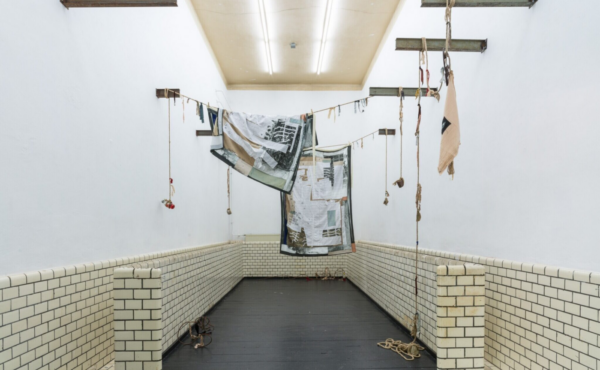
Continuing with the theme of collaboration, Sara Nygård’s ♪doo yoo…VIL-ken doh?[lahff—OH-kay, kej—ter] SÅ!!!…think? the UTH-er way [LAHFF—till-BAH-kah, SUM-mer will—ING] UN-der?…COME!♫ explores questions of collective authorship. The installation, hanging from ceiling to floor, is seemingly unfinished, with balls of yarn and knitting needles placed at the bottom. The accompanying audio piece brings together Sandberg Design students and singers from the Swedish Festivities Choir. Through a collaborative process combining knitting and voicing, conducted by Nygård, the work shifts the focus away from fixed outcomes to collaboration. It raises questions about authorship: how much of this work is shaped by the students and choir members? Who holds control over the result, and does it matter?
The graduation show of the two year temporary master’s program, Artificial Times, titled Zero (yeah) is held at De Thomas church in Amsterdam Zuid. Students in this department explore how art intersects with music and computation. The space creates an unexpected atmosphere, and I appreciated how the artists really made use of it in their presentations. Giada La Gala’s time-based installation, Reality comes in waves, directly reacts to its surroundings. The structure is made of thirteen sensors that notice light changes. If somebody moves around it, the sensors pick up the shifting light and shadows. The responses are especially present during scheduled performative activations, though they remain unpredictable.


What stood out across the shows was how materials became tools for storytelling, often fragmented, open-ended, and deeply personal. Many works felt unfinished on purpose, creating space for the viewer to enter. I found myself thinking about how memory is shaped not only by what we recall, but also by how objects, bodies, and spaces participate in that process. The projects did not offer clear conclusions, but stayed with the questions.
Finally as bonus some impressions from Studio for Immediate Spaces at Marineterrein. Lisa van Heyden shows an turned around inside out air conditioning system that blows fresh cold air out in the open the warmer the tent inside is; Ionna Mitza appropriates construction materials in as obstructive as poetical constructions, Cara Mayer reflects on waste as a corrupt business system in reference to a train that is on a weekly base transporting 900 tonnes of Roman waste to Amsterdam.


OOK DIT JAAR PRESENTEREN WE WEER EEN GRADUATION SPECIAL MET PORTRETTEN VAN 70 AFSTUDEERDERS BIJ METROPOLIS M NUMMER 4 – AUGUSTUS-SEPTEMBER. ALS JE JE VOOR AUGUSTUS ABONNEERT STUREN WE JE HEM GRATIS TOE. MAIL [email protected]
Sandberg graduation show takes places from the 11th until the 16th of June.
Rebeka Erdélyi
is an Amsterdam-based art historian and curator whose current research focuses on post-socialist memory, nostalgia, and the (re)positioning of Central and Eastern European art in an international context.