Rebellious women – Lily Bunney on Girls Peeing on Cars
To what extent do digital experiences shape Gen Z as a generation? In Girls Peeing on Cars, Lily Bunney transforms her online discoveries and viral icons into visually provocative works of art, constructed from a web of pixel dots. Nadeche Remst talks to Bunney about the shared experiences of their generation, and the search for identity and community.
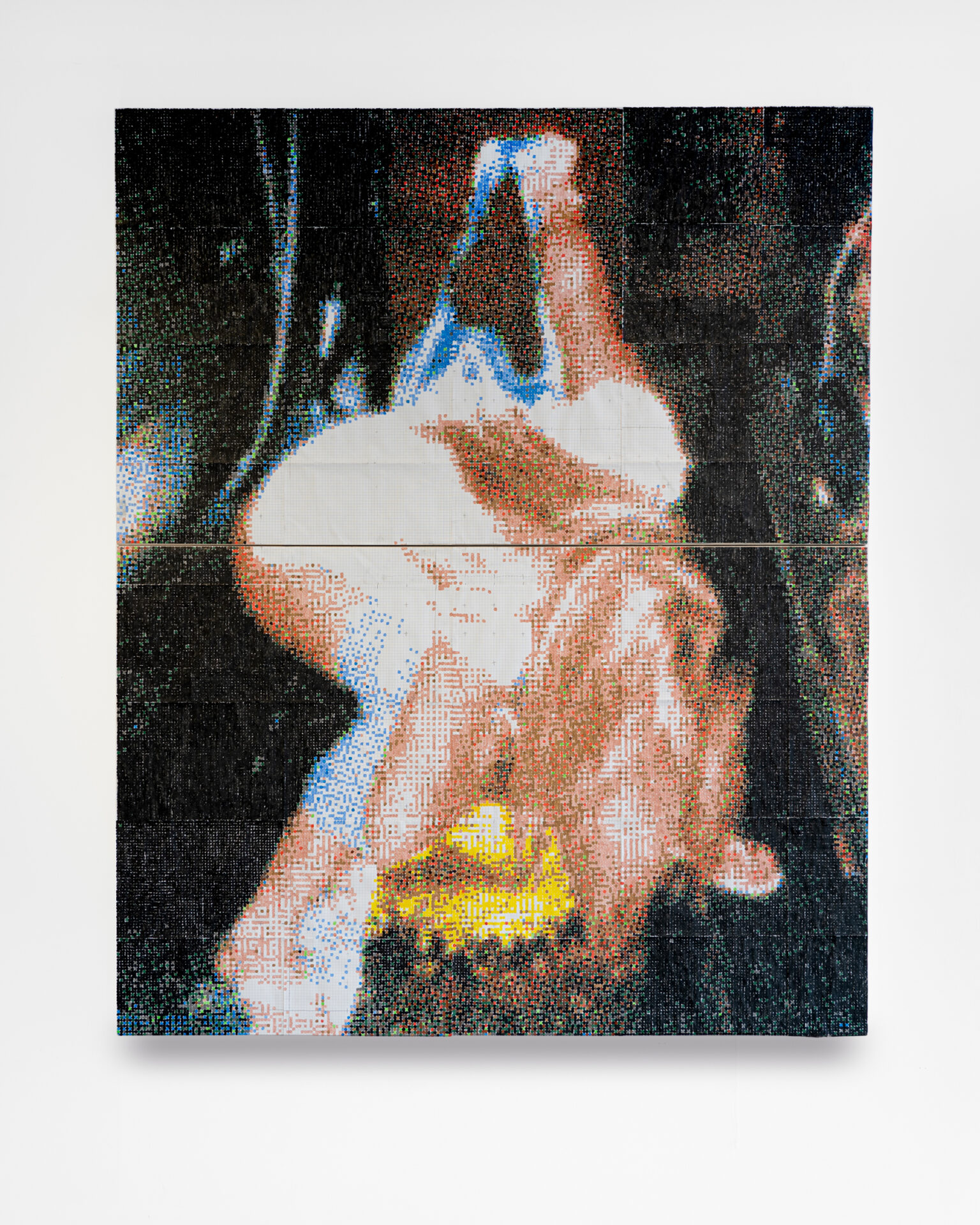
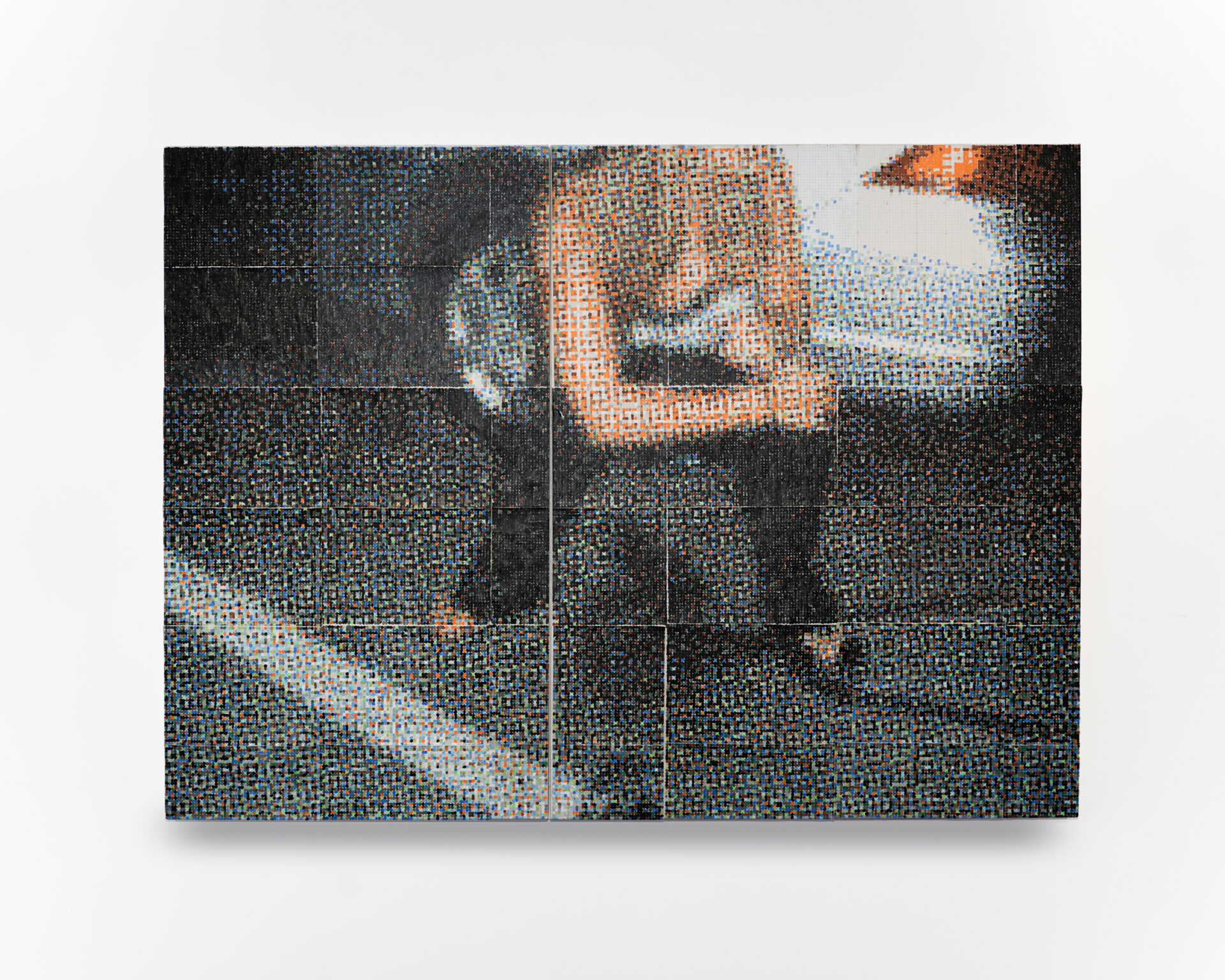
I spend a lot of time online, probably more than I would like to admit. The algorithm selects according to your preferences, but sometimes you also discover something unexpectedly new, something that sticks with you. That’s how I stumbled upon the work of Lily Bunney (@lily_bunney_) on Instagram, via Guts Gallery, a young gallery in London’s Hackney district. Her works, made up of thousands of dots reminiscent of pixels on a screen, reference images she found online. One of her pointillist works immediately stands out: an image of internet icon Julia Fox, Julia Fox (Lady Godiva) (2024), where the bottom of her body has been replaced by the legs of a Barbie doll balancing on a toy horse.
The reference to Lady Godiva, a countess who, according to legend, rode naked on a horse as a protest, evokes images of a woman consciously displaying herself, which here has been translated into a digital and artificial aesthetic. Julia Fox is a phenomenon that fits perfectly into the algorithm-driven world of online culture. Those who don’t know her may remember the viral clip in which she appears on a red carpet with drained black make-up and nonchalantly explains to a reporter: ‘I did it myself.’
‘I find it interesting how the internet has now become a kind of reality unto itself’, Bunney says when we speak via Zoom. We share experiences about what it means to belong to our generation, mid-to-late twenties. During our conversation, it immediately emerges how, because of the pandemic, much of our lives took place online and how that has shaped our generation. Bunney graduated in Fine Art from Central Saint Martins in 2020, a strange time to graduate. While other generations may experience it differently, for her there is no clear separation between online and offline. ‘I think my work is heavily inspired by what I see online. I once heard someone say in a podcast that the internet has now become a reality in itself, and that spoke to me a lot. It feels like it’s all happening on the same level in my life.’
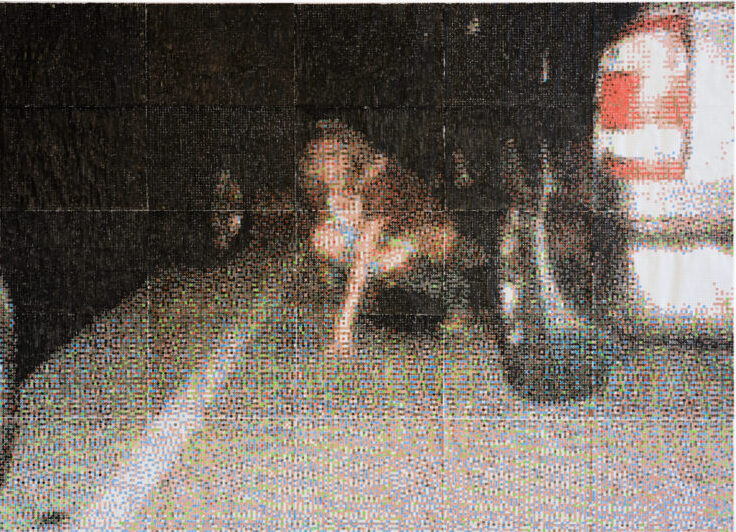
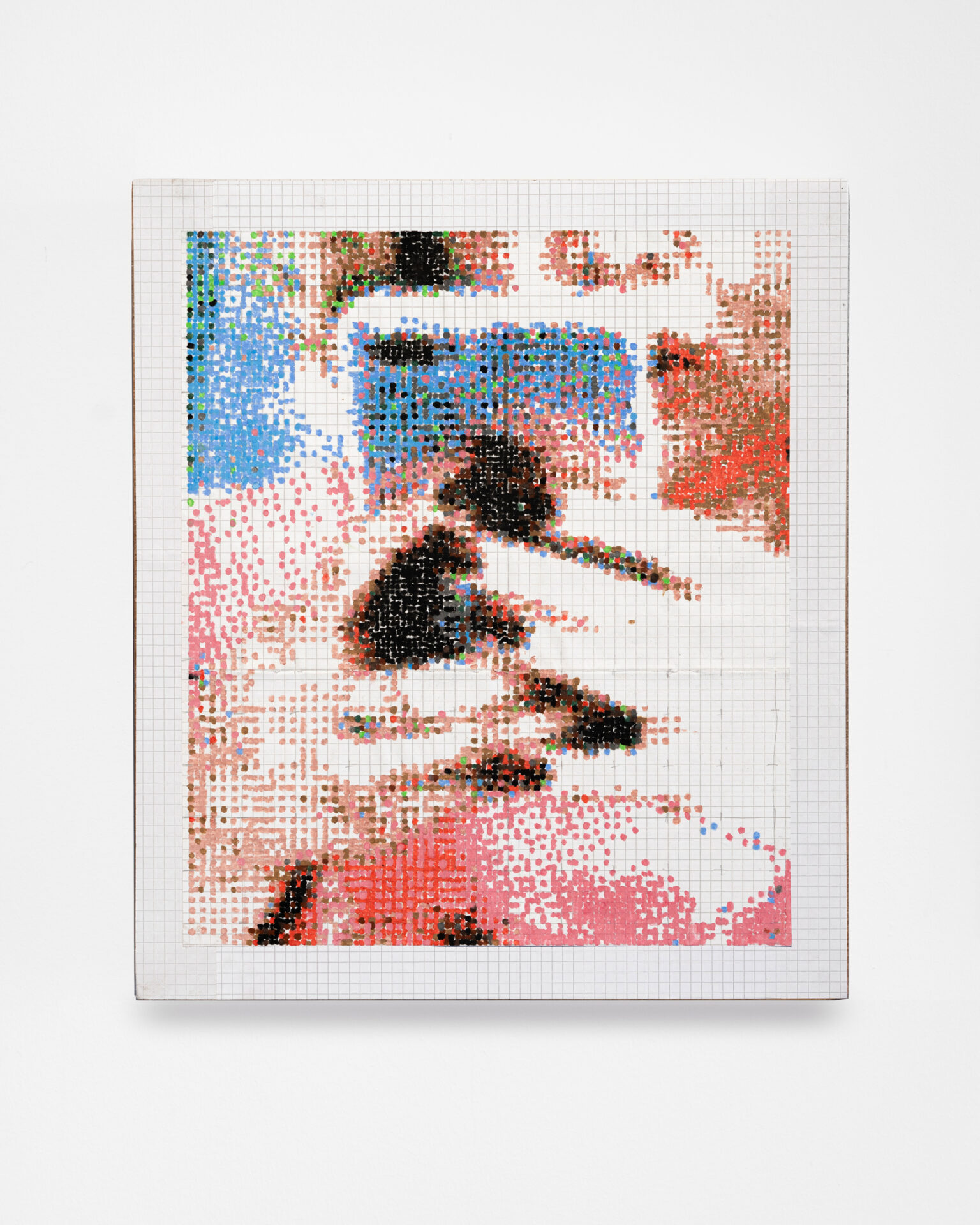
Her comment reminded me of last summer, when everyone was talking about the hype of brat summer. On my screen appeared videos of young people who seemed to want to claim summer as a form of rebellion, an ode to imperfection and following your own rules. This spirit of unconventional freedom and self-expression was also reflected in Charli xcx’s song 360, in which she referenced Julia Fox with the lyrics: I’m everywhere, I’m so Julia. I found that same provocative energy in Bunney’s exhibition at Guts Gallery, Girls Peeing on Cars: young women crouching on the ground wildly urinating between two cars. Bunney talks about the inspiration behind the work: ‘I remember being at a party and having to go outside to pee behind a car. My friends shielded me, and it was a brief moment, but it stuck with me because it made me feel like I could trust people. That was initially why I wanted to make this work.’ She found images of women urinating behind cars on a now-deleted X account. ‘Those images appealed to me because they are a mix of humour, community, voyeurism and vulgarity; things that are also reflected in my work.’
Bunney is referring to Sophy Rickett’s 1994 series Pissing Women, in which the artist photographed herself and her friends, dressed in business suits, as they pissed on the streets of London. The photographs challenge social conventions by showing something women usually perform discreetly, now performatively and in public. Pissing Women was created at a time that marked a transition into a new digital age, when the early and unregulated days of the internet were about to break through. ‘The work was not shown at the time, however, but some 20 years later, it was published by Climax Books’, Bunney explains.
In her own series, such as Girls Peeing on Cars #6 (I like to think they’re all peeing on the same BMW), Bunney translates this radical energy into a contemporary context. She adds a layer of abstraction with her signature pointillist technique, where distancing is literally necessary to understand the full image. Yet she notes that not everyone interprets her work the same way. At the opening of the exhibition, for example, a visitor asked her if she did not find the work embarrassing. ‘I found it fascinating that he saw it as shameful, while it doesn’t feel like that to me at all. On the contrary, it is about playfulness, trust and community’, she says.
Humour and community
Bunney draws inspiration from her own experiences in her search for community as a queer person and as a twenty-something in London. ‘It’s not just about making a statement’, she stresses, ‘but I focus more on a community structure, on how we live together.’ For her, this is specific to our generation: seeking connection in friendships rather than family. ‘For me, friendship feels not only like a refuge, but also a way to understand myself better and give my work meaning. It is a mutual dynamic of giving and receiving.’
One of the most personal works is the series Birthday Dinner, in which she captures intimate moments with her friends. The work Birthday Dinner #3 (With all of you I’m never lonely – It’s a miracle come) shows her friends holding each other’s hands. These scenes highlight the crucial role of friendship in creating community, especially in a generation that is increasingly abandoning traditional family ties. This ‘generational thing’, as she calls it herself, is also evident in her interest in the ways online platforms express girl-culture. At the same time, she criticises the superficiality of representations of ‘femininity’, such as the emphasis on appearance that often prevails.
In Girl Online: A User Manual (2022), Joanna Walsh explores this ambiguity of the phenomenon of girl-culture: a construct that balances between strength and vulnerability. Walsh explains how young women redefine themselves through digital personas. The girl online is both a creator and an object, a curator of her own image and at the same time a consumer of the expectations others have of her, Walsh argues. This tension between autonomy and self-representation corresponds strongly to themes in Bunney’s work. Although this can also be problematic; think of children who are massively influenced by influencers who share ‘skincare routines’ while being paid by a major brand.
Bunney also plays with the idea that these online personas become a kind of ‘acquaintances’ of yours, and thus influence you as well. ‘I found it interesting how Julia Fox is both an internet phenomenon – with her podcast, apartment tour, and the online discussions about it – and someone who can be unexpectedly personable and inspiring. It creates an interaction: you see someone online, get inspired, and that then affects your daily life in ways you don’t always expect. That kind of dynamic, that constant bouncing back of ideas and images, inspires my work.’ Yet she is selective in her choice of images. ‘I don’t want to just use familiar images that everyone has already seen, because that can get boring. I try to find a middle ground where the images are both recognisable and visually challenging.’
Pixels
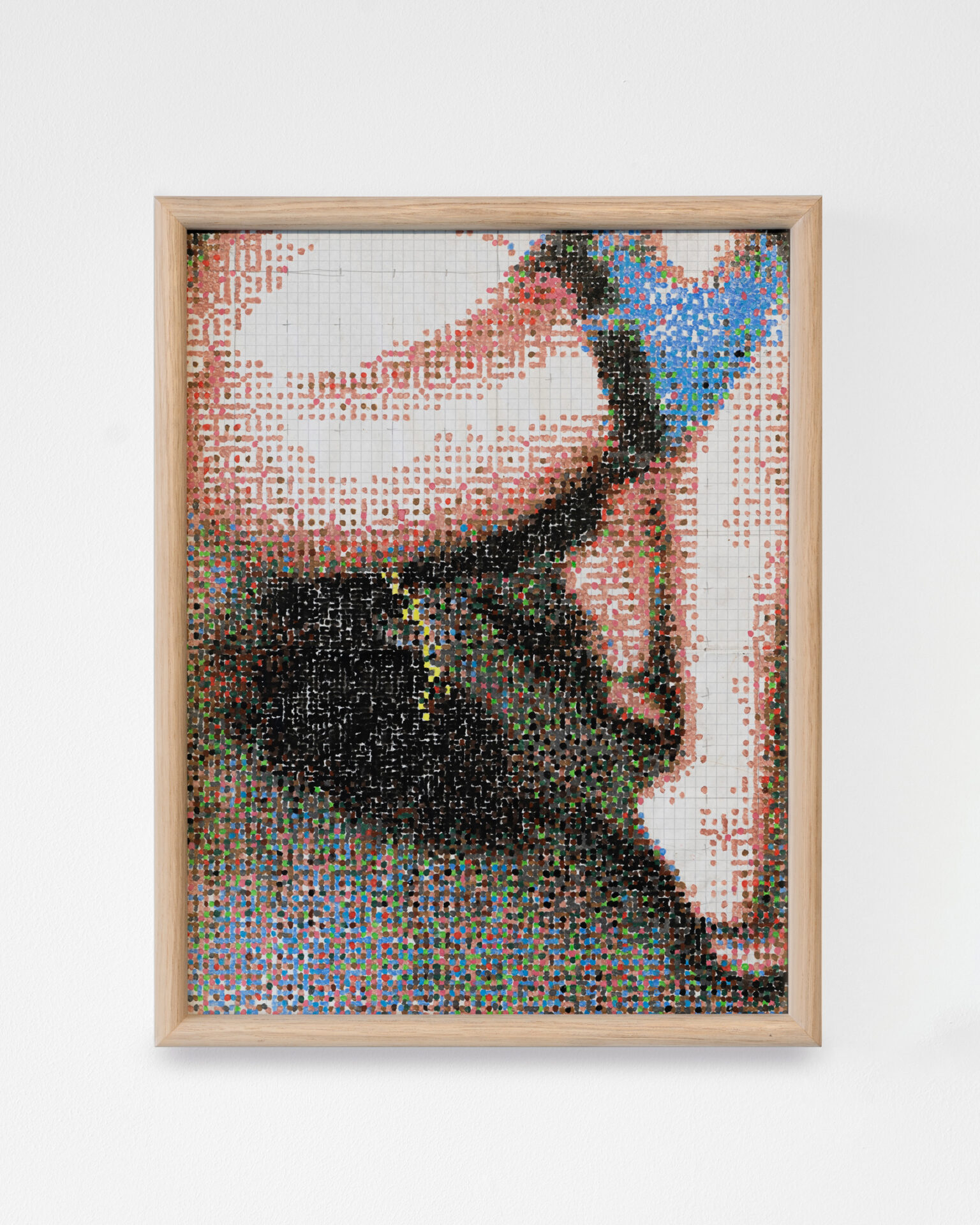
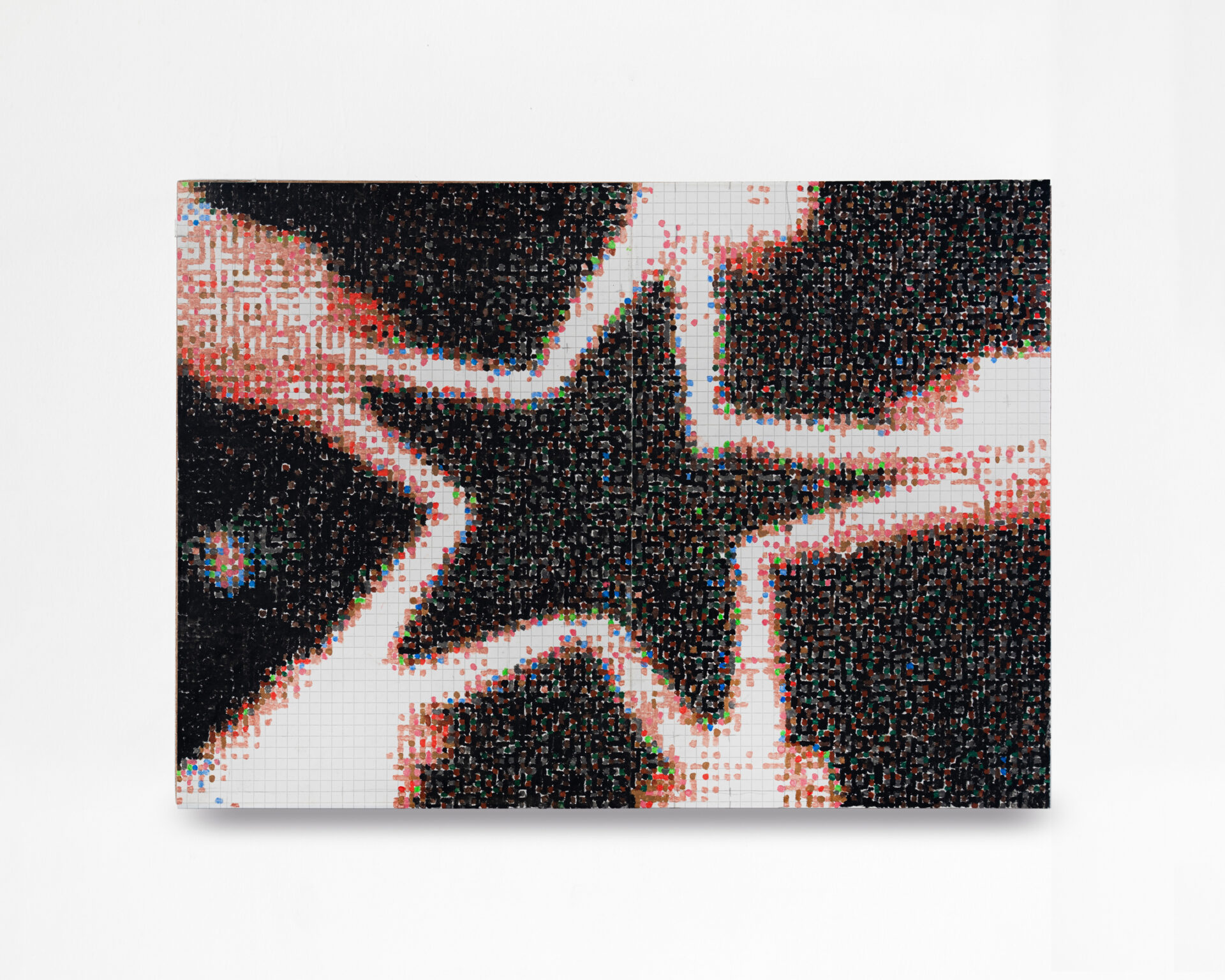
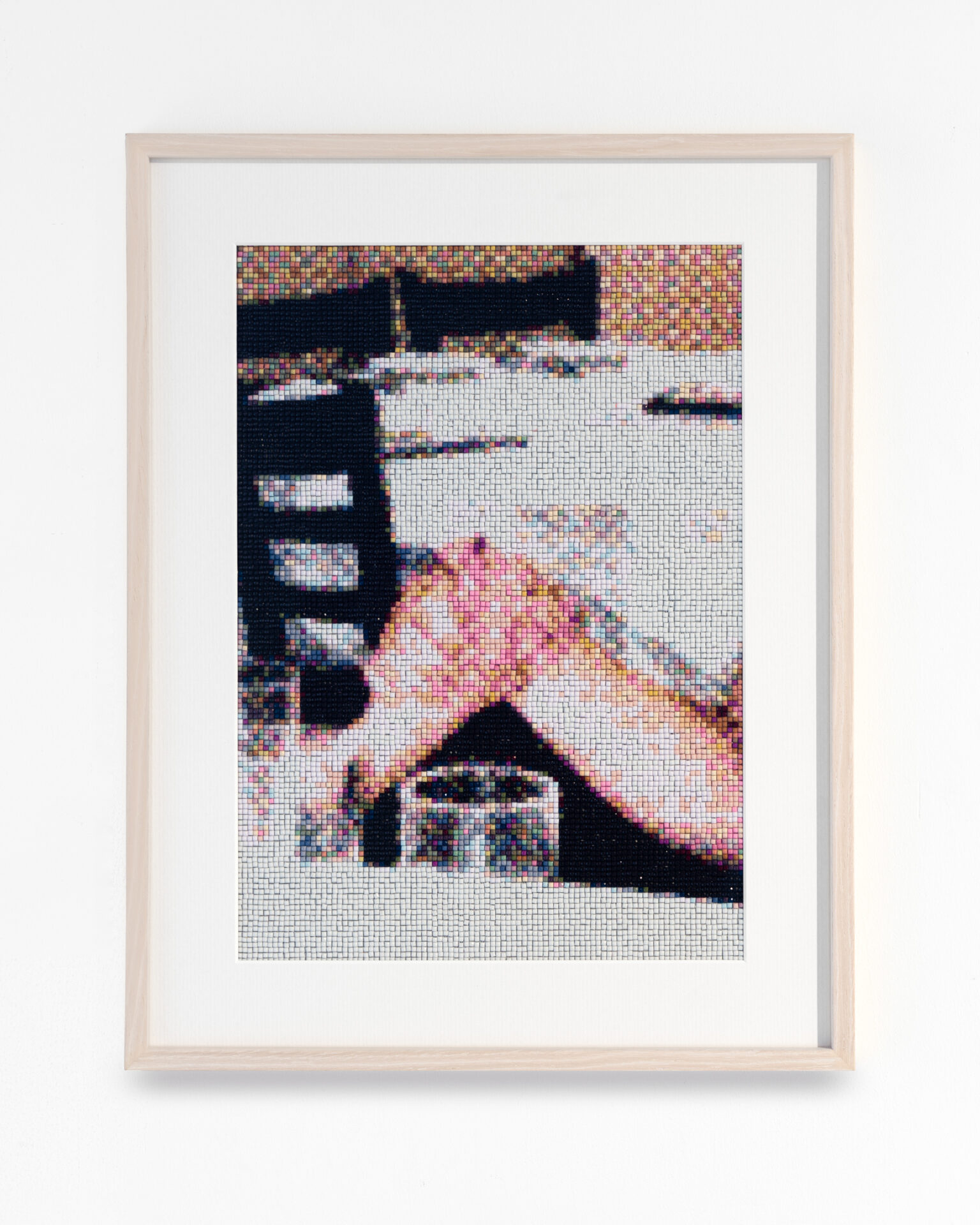
Due to the density and placement of the dots, her works often become fully legible only when viewed at a smaller size or digitally, on a screen. This not only emphasises the intertwining of her work with the online world, but also symbolises the importance of the digital in understanding contemporary reality. Bunney’s work invites the viewer to explore this relationship: if you want to understand this work, look at your phone – and vice versa. Its physical presentation in a gallery offers a completely different, more abstract experience, in which the intensive creative process asserts itself.
Unlike the ephemerality of the platforms from which the photographs she selects come, her working process is an intensive one that requires enormous patience: the number of dots per work can consist of 50,000 dots, depending on size and complexity. Each work is created from a combination of found images and her own photographs, which she converts pixel by pixel into complex patterns, similar to both a knitting or crochet pattern and early computer graphics. ‘The process of my work is very structured. I work on graph paper left over from my side job as a maths teacher. Each dot is planned, drawn out with pencil, and then filled in with watercolour or oil paint. It’s an intensive process that can take months, but I find it soothing.’
Bunney talks about how people of different generations react differently to her work. ‘During one of my first exhibitions, I had an interesting encounter with an older man who was carrying a Polaroid camera. He took a picture of my work and said, “Now I see the work as it was meant to be.” But children also see the power of her work, as Bunney recounts: ‘While finishing a work outside the gallery, a six-year-old girl walked by with her mother. She looked at my work and shouted, “Look, mum, they’re making pixel art! You put little dots and then an image appears.” That spontaneity is exactly what I strive for: a sense of recognition and surprise, whether you experience it digitally or physically.’
When I ask her who she would like to collaborate with in the future, if anything is possible, Bunney replies enthusiastically: ‘I admire the work of artists like Charlotte Edey, who makes beautiful embroidered tapestries. Her attention to detail and her process inspire me greatly. I also think it would be interesting to collaborate with Cindy Sherman, her work thematically matches my own interests in self-representation. Or a collaboration with fashion brand Chopova Lowena: ‘Their aesthetic is unique and representative of online culture; it would be great to create something for them.’ She adds, smiling, ‘And maybe Julia Fox. The work is partly meant as a wink, but it would be surreal if she ever noticed my work. The idea that someone I “know” online and have pictured, would actually see my work feels unreal.’
Lily Bunney’s work is on show in the group exhibition Good Eye Projects at Saatchi Gallery in London until the 1st of March
The Dutch version can be read HERE
Nadeche Remst
is an art historian and critic, and managing editor of Metropolis M