Frustrating the Infrastructure – The Venice Biennale 2026 Strike
Alina Lupu reports from the 24 hours strike announced by ANGA and supported by participants from many pavilions and participating artists from the central show In Minor Keys.
How do you visualise a strike? Let alone an art strike? A strike, unlike a protest, is a refusal: an interruption, a withdrawal, a disruption of the norm. It frustrates the regular flow of work and exposes the systems that depend on full participation. At the Venice Biennale, during its press and VIP previews, where future shows are hunted and negotiated, where spectacle dominates, not just in the pavilions and side venues, but overall, and where culture is organised through national representation, a strike does not simply halt labour, instead it exposes the machinery of the nation-state itself.
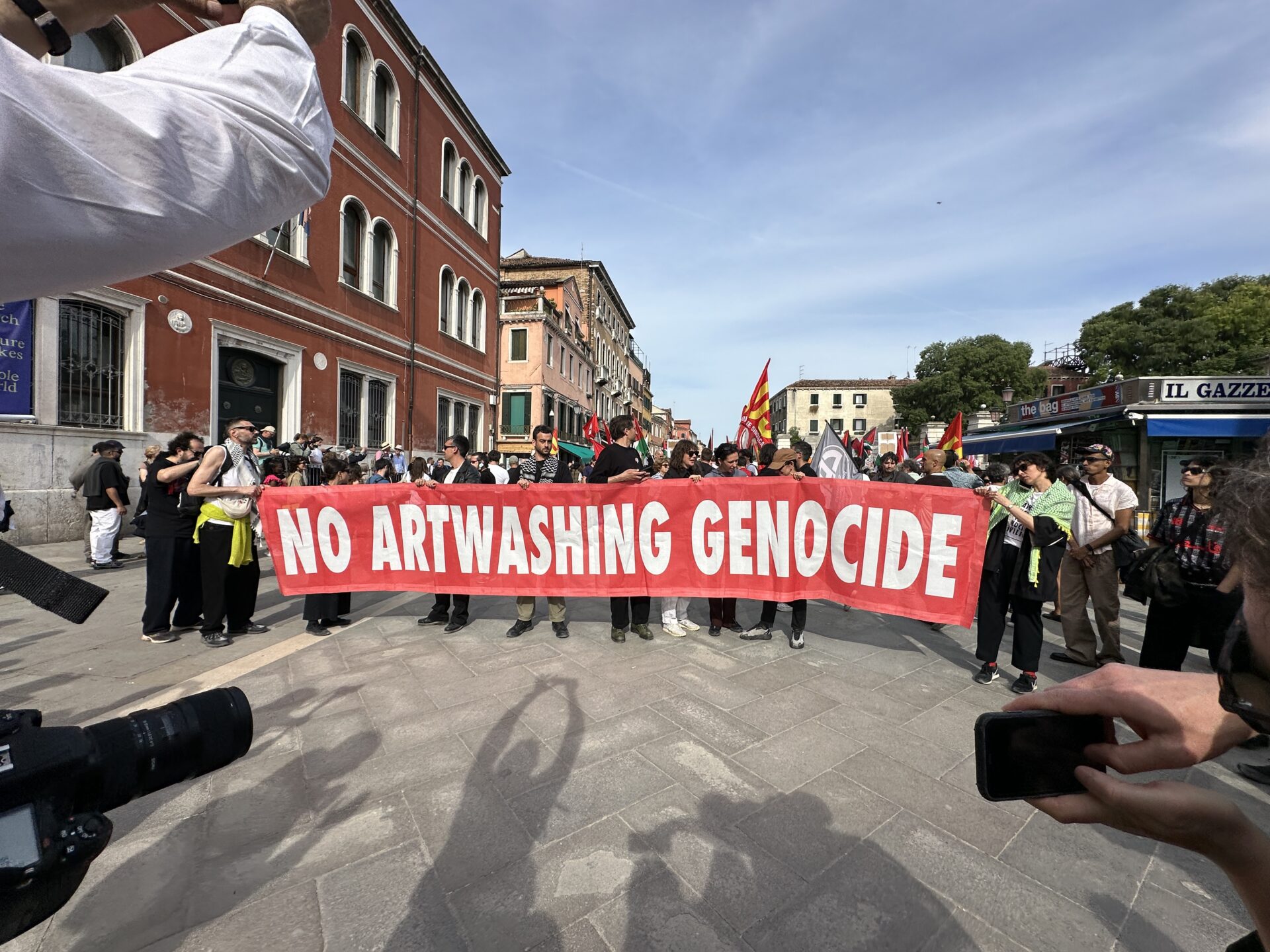


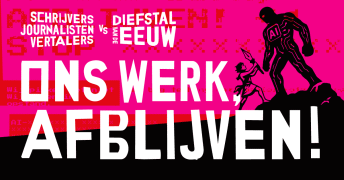
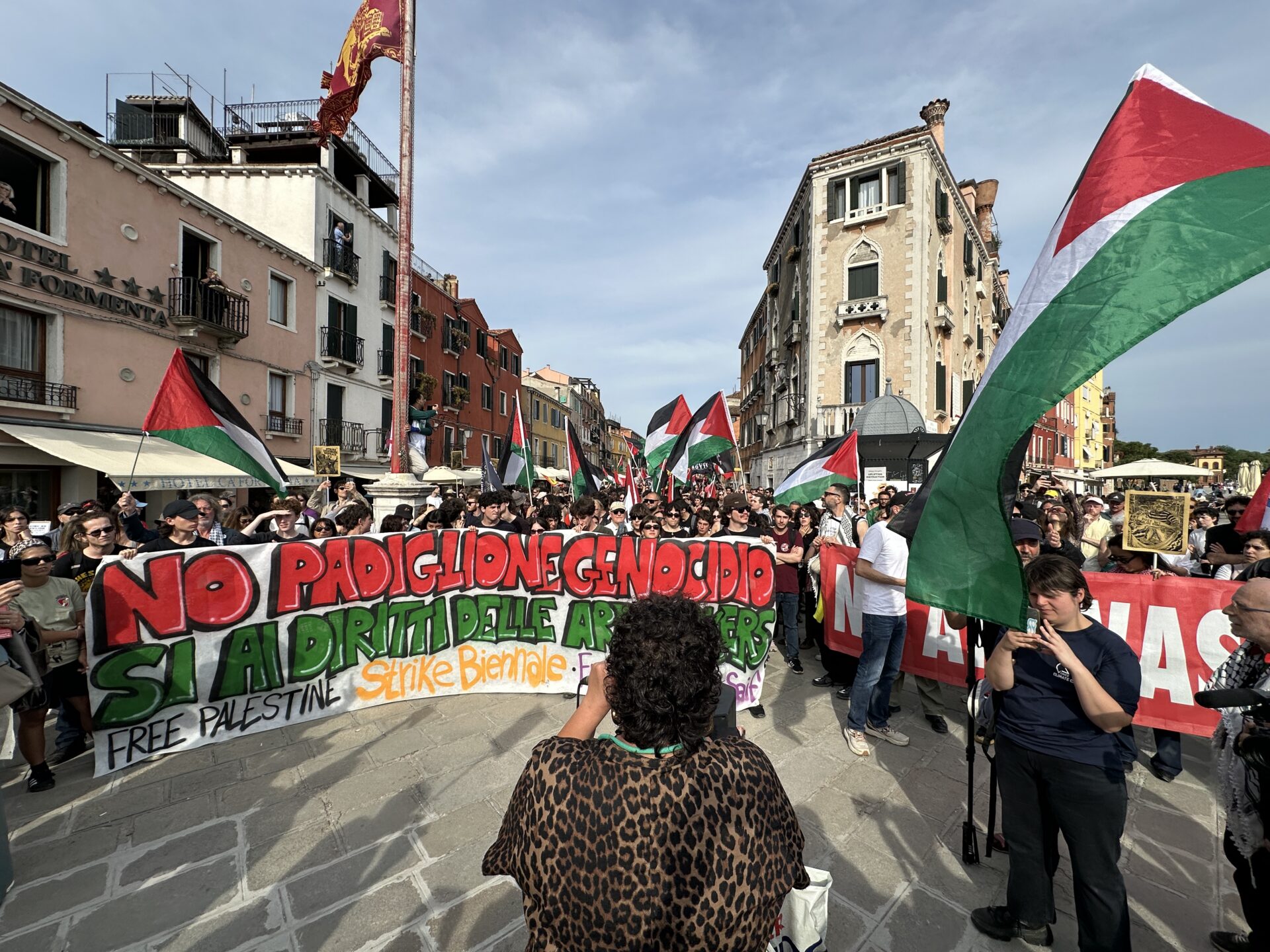
On May 8, 2026, the Art Not Genocide Alliance (ANGA), together with Italian unions and the collective Biennalocene, organised a 24-hour strike across the Venice Biennale in solidarity with Palestine and against the inclusion of the Israeli Pavilion. The action rejected what organisers described as the normalisation of Israel’s presence within international cultural space during the ongoing genocide in Gaza, while also linking this refusal to the precarious labour conditions underpinning the Biennale itself.
The strike unfolded through absences, closures, delayed openings, barricaded entrances, interventions inside exhibitions, and collective refusals to work. Artists altered works, hung Palestinian flags, distributed protest material, and joined the march through Venice that culminated outside the Arsenale in violent clashes with police. It became the first large-scale strike action at the Venice Biennale since 1968, a reminder that history, artistic or otherwise, is far from over.
At the centre of the action was also a defence of labour rights, an issue of increased urgency for precarious cultural workers worldwide. In a press release issued the evening before the strike, the Biennale claimed that “any announced forms of strike action do not involve the institution’s staff or organisation.” Organisers responded that the strike proclamation explicitly included the Fondazione La Biennale di Venezia, meaning employees of the Foundation and all workers directly contracted by it had the constitutional right to abstain from work and join the strike under Article 40 of the Italian Constitution.
ANGA and the striking unions argued that the Biennale’s communication was misleading and intimidating: an attempt to discourage participation through fear of retaliation, while many workers did not want their labour instrumentalised to normalise genocide and apartheid policies carried out by Israel in Palestine. The strike therefore functioned not only as an act of solidarity, but also as a confrontation with the conditions of cultural labour itself: precarity, institutional pressure, and the political management of participation.

By acting through the national pavilion system, the strike revealed how nation-states negotiate, stall, align themselves, publicise decisions, support one another, or refuse solidarity altogether. The Biennale became not simply an exhibition space, but a live demonstration of cultural diplomacy, institutional complicity, and the politics of visibility, an accelerated version of history unfolding over three preview days before the public could even enter.
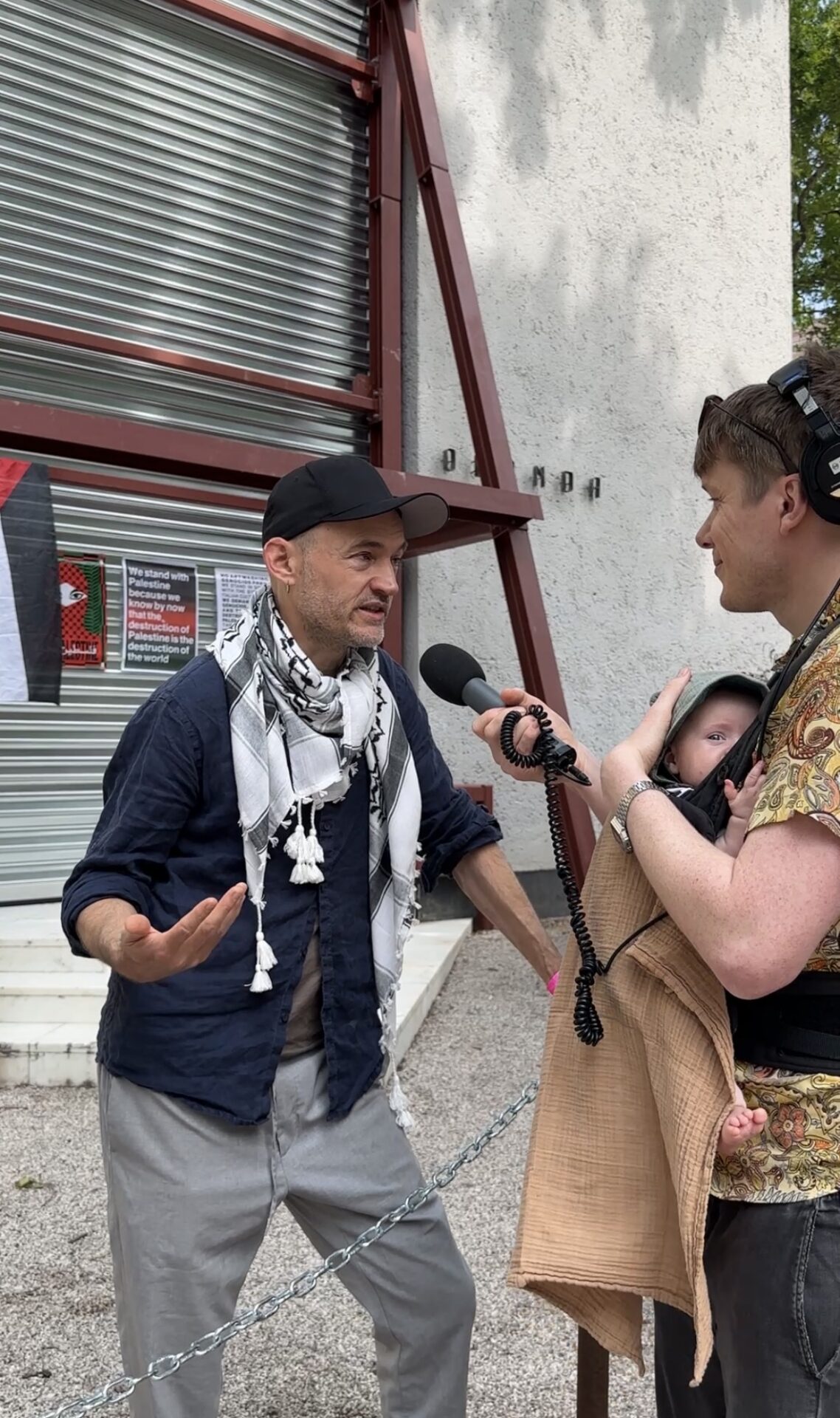
The breadth of striking strategies made this especially visible. The Netherlands used the mechanisms of the work itself: the barricading of the pavilion behind a shutter that remained closed throughout May 8. The artist, Dries Verhoeven, curator Rieke Vos, and performers answered questions throughout the day while ANGA strike posters were taped across the shutter, alongside notices for the later protest.


Great Britain closed in the morning, but reopened after replacing striking workers, in violation of the strike.
Austria, one of the most sought-after pavilions, shut down entirely. Performers quietly camped beside the pavilion among a barrage of posters, refusing press statements or photographs. From the audience came the remark: “It has politicised itself to death.”
Belgium closed fully, chains wrapped around the doors, with elements of Miet Warlop’s work rearranged, stacked at the entrance: STOP reverberated in writing.


By acting through the national pavilion system, the strike revealed how nation-states negotiate, stall, align themselves, publicise decisions, support one another, or refuse solidarity altogether
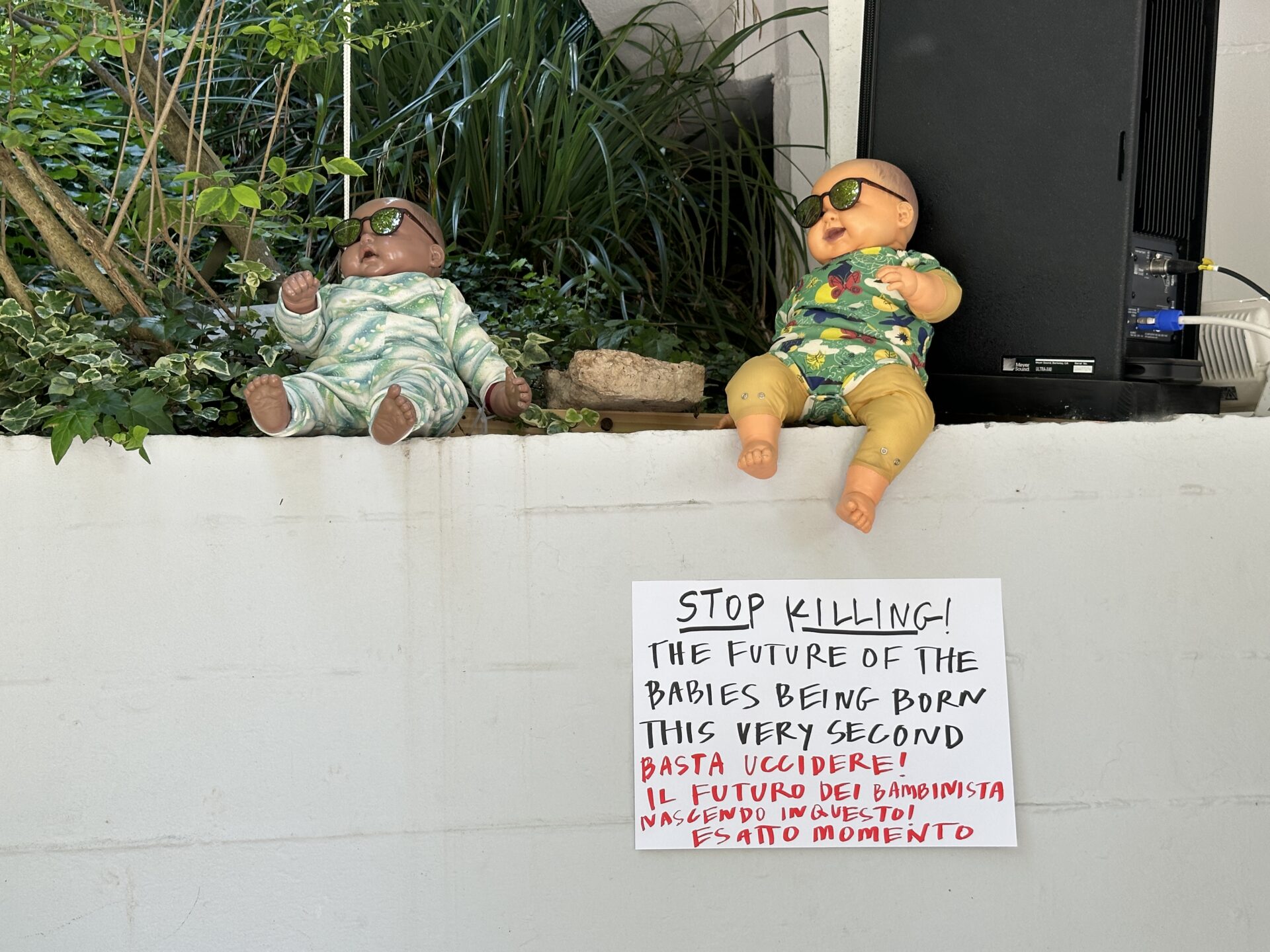


Japan initially taped strike posters across ropes blocking entry, but later shifted strategy. Artist Ei Arakawa-Nash decided to remove the “performing” babies from the installation, declaring that they themselves were now on strike in solidarity with Palestine.
South Korea closed its doors and installed posters under the curatorial support of Binna Choi.
The Czech and Slovak Pavilion shut for one hour, with curator Peter Sit and artist Jakub Jansa standing outside taking questions.
France closed with a sign announcing a strike by the artistic team.
Spain encountered internal resistance and shut down three separate times throughout the day, each previous time being reopened forcefully.


Romania closed at 4pm, connecting the crises in Ukraine and Palestine through statements by participating artists Anca Benera and Arnold Estefán, alongside curators Corina Oprea and Diana Marincu.
Poland issued “an expression of solidarity with communities affected by war and violence,” clearly referencing Ukraine while avoiding any direct mention of Palestine, under the signatures of artists Bogna Burska, Daniel Kotowski, Ewa Chomicka, and Jolanta Woszczenko.


Ukraine chose not to close, arguing that doing so would detract from its own ongoing struggle.
Egypt closed and later reopened.
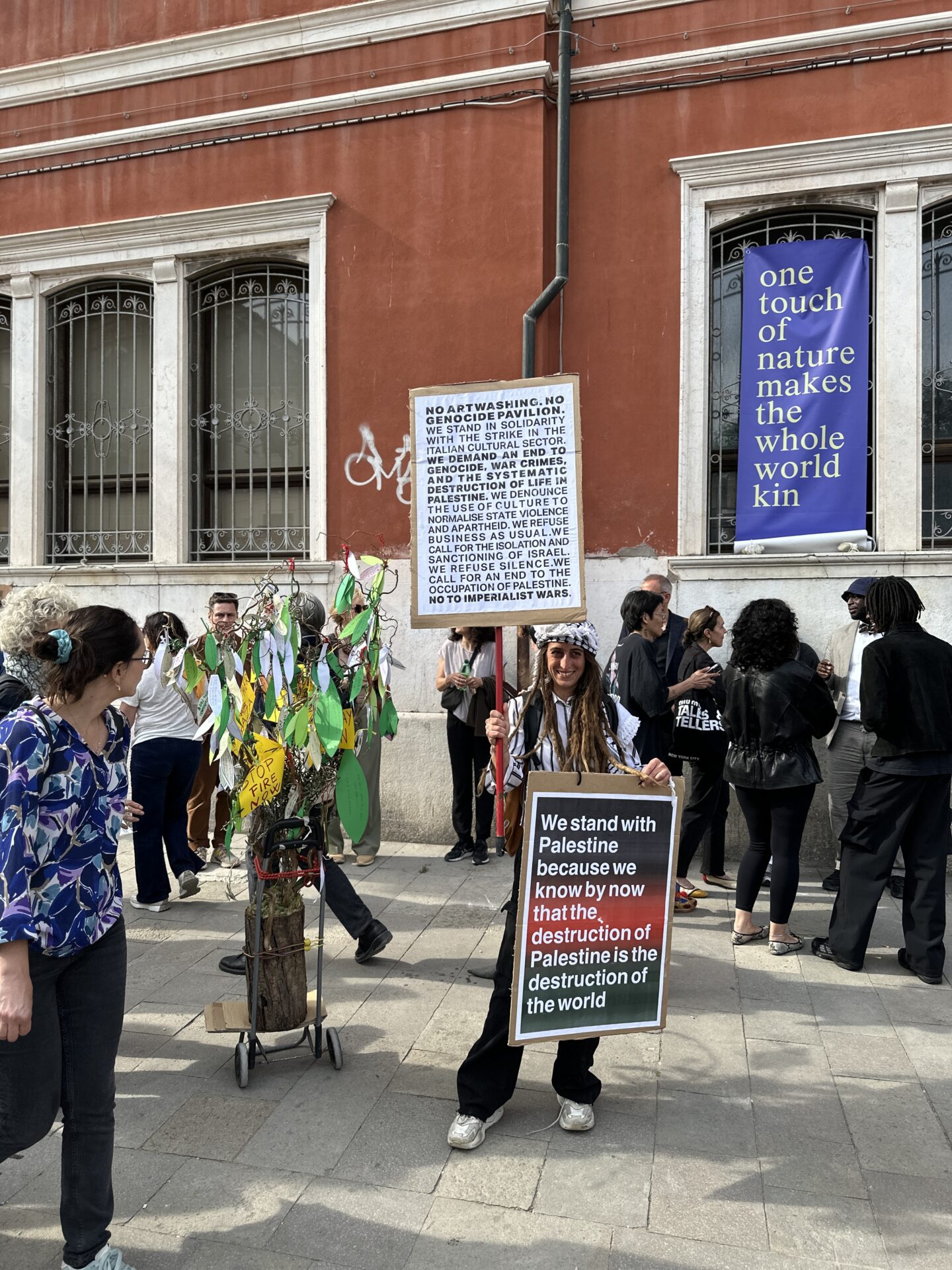
Switzerland simply announced: “The Pavilion of Switzerland cannot open due to lack of personnel. The nominated team have decided to turn off their work.” Outside, one of the strike posters, laid down in gravel, read: “We stand with Palestine because we know by now that the destruction of Palestine is the destruction of the world.”
In the Arsenale, the Irish Pavilion turned off its lights but couldn’t close its doors due to these being a security exit. Italy remained open, but performers went on strike, reading on the grass outside. Lebanon and Turkey also joined the action. Elsewhere, Iceland displayed strike posters, Catalonia, Cyprus, and artists within the “Minor Keys” exhibition scattered posters throughout their works.


In total, around 27 pavilions, adding up to roughly a third of the Biennale, participated in a coordinated, layered action throughout the day, supported by ANGA, Biennalocene, Sale Docks, and labour organisations Mi Riconosci, ADL Cobas, and USB.
What began as a dispersed and often quiet series of gestures, or loud, frustrated attempts to close, transformed into a collective force around 16:30, when a protest gathered outside the Giardini, on Via Garibaldi, and marched toward the Arsenale, accumulating speeches and thousands of participants in solidarity along the way.
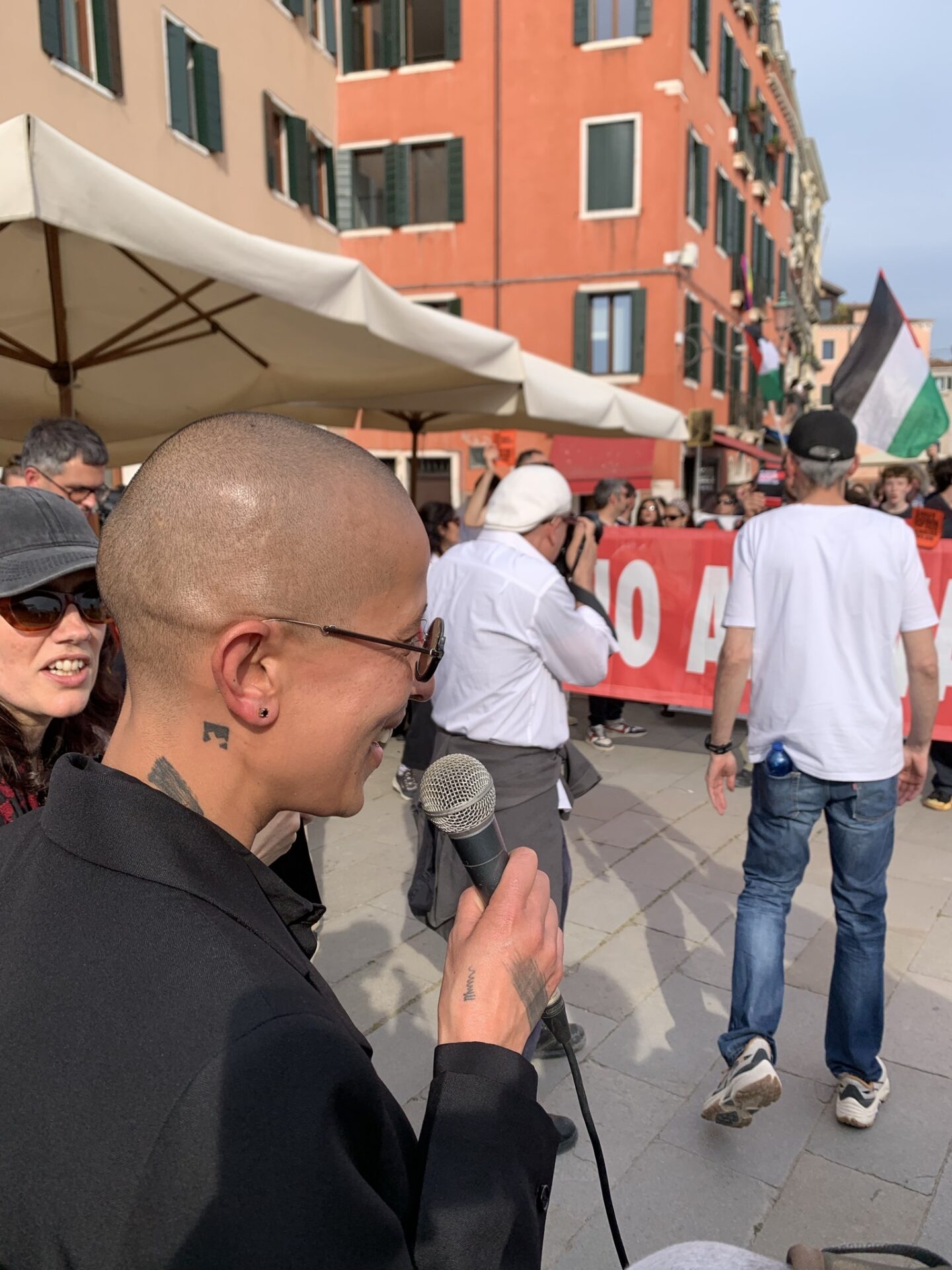
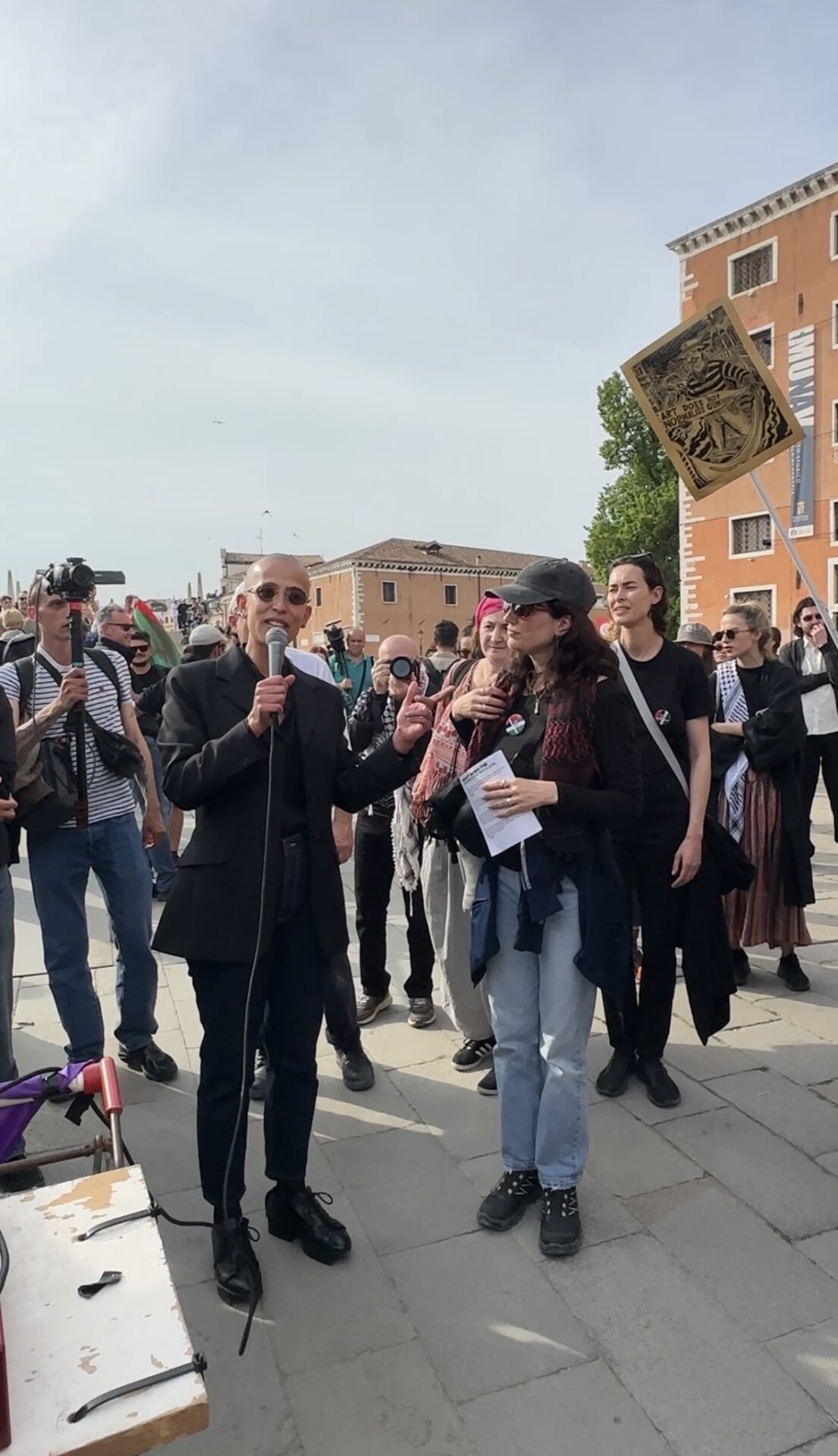
Towards the protest’s end, Gabrielle Goliath took the mic. The South African artist who had her pavilion pulled from the art manifestation by her Department of Sport, Arts and Culture, earlier in the year, and was told she “will not grieve Palestinian life”, had in the meantime set up an off-venue in Chiesa di Sant’Antonin. Her work, Elegy, was made available. But she reminded those present, alongside the Biennale Foundation that she comes from a country that was once barred from the Biennale, and of the need for the foundation to find its moral and political compass.
METROPOLIS M KAN NIET ZONDER JE STEUN
Trouwe lezers vormen het fundament van Metropolis M. Wij kunnen niet zonder je steun. Je kunt ons steunen door een jaarabonnement af te sluiten. Het eerste jaar krijg je 40% korting. Een regulier jaarabonnement kost 58 euro. Er zijn ook kortingsabonnementen. Studenten/65plussers/CJP-ers/Personen met een minimuminkomen en PLATFORM BK-leden betalen slechts 36 euro voor hun jaarabonnement. Op DEZE PAGINA lees je meer over de verschillende abonnementssoorten en kun je je direct aanmelden.
BIJ VOORBAAT DANK!
Alina Lupu
was born and raised in Romania and works as a writer and post-conceptual artist in Amsterdam, The Netherlands. In her works, she looks at the role of the image and performative actions when it comes to standing in solidarity through protest against capitalist hegemony and precarity.