Should I Stay or Should I Go? – NDSM International Conference: Don’t Worry, It’s (Only) Temporary
At the two-day international conference Don’t Worry, It’s (Only) Temporary, curators, directors, artists and other art professionals discuss the temporality of public art. Kaylie J. Stuart attends the first day and notices how the conference itself becomes the most interesting object of discussion: conferring seems absent from the conference, in the same way that the public is often absent in public art.
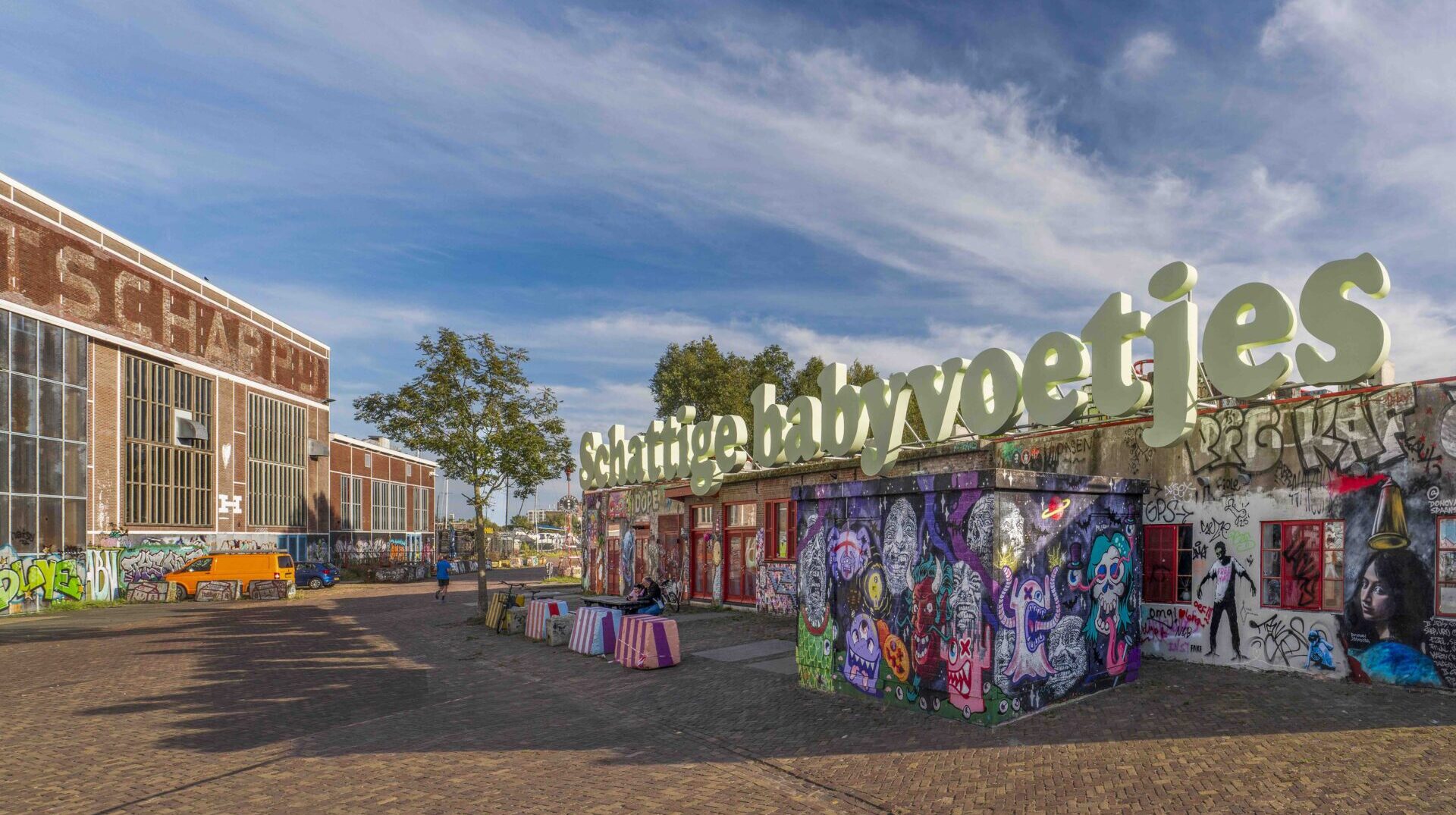
On a crisp November morning, I step off the ferry to the NDSM terrain, across the water from Amsterdam. Graffitied concrete, rusting metal, shipping containers turned into studios and cafés: the remnants of a once-prolific shipyard now pulsing with artists and micro-businesses. Artworks and cranes puncture the skyline. The colourful mismatch is distracting in the best possible way but makes finding the conference venue all the harder.
Eventually, I arrive at a temporary set-up above a restaurant. A brown room with neat rows of chairs. I order coffee, watch the ferry drift away. The event’s title repeats in my mind — Don’t worry, it’s (only) temporary. Should I, in fact, be worried?
The two-day conference explores art projects in public space, focusing on temporality, sustainability, interaction, archiving, and afterlife. Curators of biennials and triennials, directors of platforms and institutions, artists, and architects discuss how public works move through time. The aim: to ‘re-imagine engagement, resources, materiality.’ In other words: how to future-proof the temporary. Yet, despite the engaging moderation by Saskia van Stein, director of the International Architecture Biennale Rotterdam (NL), the set-up itself feels underimagined. Whilst NDSM has a reputation for openness—its vast space, focus on public engagement, and clear support of artists, the event seems to compress that spirit into a narrow format. The conversations feel condensed, more PowerPoint than public dialogue.
The first day is loosely divided into three parts. The opening panel offers historical and conceptual perspectives on public art’s duration, archiving, and afterlife. This gradually morphs into a curator and director-heavy discussions on engagement temporality, sharing the challenges and responsibilities that shape collaboration. As the day goes on, the presentation pace increases, leaving less space for artists and architects to voice their own views on site specificity and the role of the artwork in public space or to propose new ways of seeing.
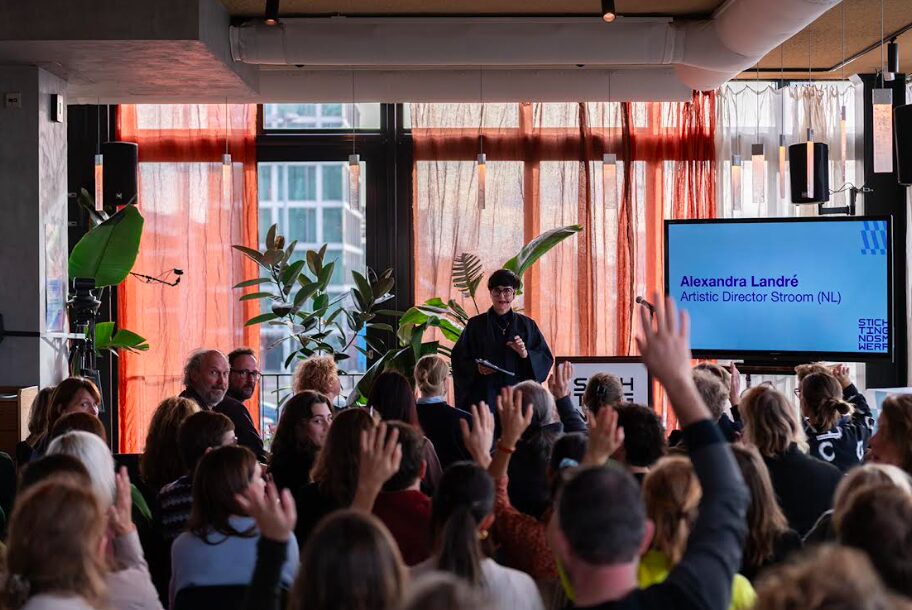
Alexandra Landré however, director of STROOM (NL), speaks with poetic intelligence—rigorous, informed, and quietly assured. She invites us to imagine looking back from the year 2119, asking what traces we might leave behind. Referencing the work of Suzanne Lacy, shared stories of labour and care, Landré evokes an ecology of social connection, questioning how multi-species collaborations might help us to remember together. I feel it is one of the only talks at the conference where a radically different temporality is invited. Her presentation, symbolic rather than directive, offers no clear path back to the present. Yet perhaps that is the point—to remind us that meaning endures not as an object to be fixed, but as a relationship that moves through time. Sometimes, wandering is necessary.
Alastair Upton, director of the Folkestone Triennial (UK), then shifts the register, presenting art-led regeneration as civic salvation. Across his four terms stretching (2014 to date), he describes the triennial’s blend of permanent and temporary works, its success captured in a string of adjectives: ‘Lovely, fantastic, amazing.’ Using well-known artists, he said, was a shortcut to visibility, a strategy that had worked. But it all felt somewhat misplaced when he said: ‘I genuinely believe that a lot of the people in Folkestone don’t know a lot of the stuff is art.’ When I ask him about responsibility, what duty the Triennial owes to those who live among its works, and the gentrification risk of a two-tier economy. The response voices a defence couched in social-uplift language. Education, opportunity, engagement: a familiar triad of regeneration rhetoric. He notes that The Sunday Times had named Folkestone ‘the best place to live’—a line that sits uneasily alongside efforts to drive local economy. My local knowledge was deflected; the discomfort softened by a rhetoric of inclusion.
Upton states that ‘their experience is 100% valid, sometimes they (the locals) think the artwork is shit… then they love it.’ This may sound generous, but it dissolves structural critique into personal validation — a soft landing where friction should be. Performing responsibility is not the same as taking accountability; one gestures toward care, the other carries its weight. In that moment, the panel became its own case study in the politics of public art — an ethical mirror held up to the very systems it claimed to reflect, and perhaps to protect.
On the topic of gentrification, the moderator paraphrases and re-propositions my question as ‘the semantics of the money’: how to produce a narrative of public value that can coexist with economic hardship. It’s the paradox of culture-led growth: public art must justify itself in the language of welfare while depending on the economics of development. Upton admits that ‘We can do nothing if we step outside the neoliberal context. We have to live in the world we live in.’ A bold affirmation, an acceptance of complicity as inevitability, naming the trap but using it as permission to continue.
I had done my research. In Folkestone, the 2025 Triennial coincides with the sharpest rent rises in Kent, the UK and a widening gap between cultural prestige and local welfare. Amid the fanfare of public-art commissions, the numbers tell a simpler story: culture here functions as place-branding and is not broad-based benefit.
Irritated by my questioning, Upton came to find me during the coffee break; on the assumption I’d ordered a flat white I was accused of gentrification myself. The irony wasn’t lost on me: it’s easier to blame a coffee than confront the structures that turn seaside towns into investment portfolios. After his righteous monologue about accepting that we are all part of the problem, he promptly left the building, returning to Folkstone, making the ‘conferring’ part of this conference impossible.
When Marianne Wagner, curator of the LWL-Museum für Kunst und Kultur (DE), shares the lyrical refrain from The Clash’s Should I Stay or Should I Go? a reciprocal reflection on the temporality of public artworks, the room laughs. That’s the question public work negotiates when engaging communities.
She speaks through Oscar Tuazon’s, Burn the Formwork (2017), a public fire sculpture gifted to the municipality and built on land marked for redevelopment within five years of installation. It has now stood for eight. When the time comes, regeneration will not build with or around it; the work will be removed.
We however never reach the next refrain of the Clash song: It’s always tease, tease, tease / You’re happy when I’m on my knees / One day it’s fine, and next it’s black/ so if you want me off your back… But the clash is clear: The story shifts depending on who’s listening—and who’s funding. If we’re truly talking about publics, maybe the question isn’t about staying or going at all. It’s about commitment: dialogue, showing up, sticking around, finding ways to exist in proximity rather than tearing down and starting again.
The afternoon turns to the practicalities of ‘collaboration’. Speakers included Ulrika Flink and Helene Rix Runting (Bruges Triennial, BE), who speak holistically about public art—valuing its afterlife and the relationships that endure long after the exhibition ends. It is refreshing to hear their commitment to sustaining support beyond the visible, long after the show leaves town. Claudia Linder, speaking for the Stadscuratorium Amsterdam,(NL) reframes permanence as stewardship—art not as an object to own, but as a relationship to remain in dialogue with.
This last part of the conference feels rushed—just as different speakers and artists begin to make interesting connections: Lily van der Stokker (NL) reaffirms the role of a mediator in her practice. Holly Hendry (UK), whose presentation stunned the room into a low rumble of appreciation, connects with Alice Walters (COLAB, UK). These examples feel grounded and alive—the practices finally begin to speak to one another.
If we’re truly talking about publics, maybe the question isn’t about staying or going at all. It’s about commitment: dialogue, showing up, sticking around, finding ways to exist in proximity rather than tearing down and starting again.
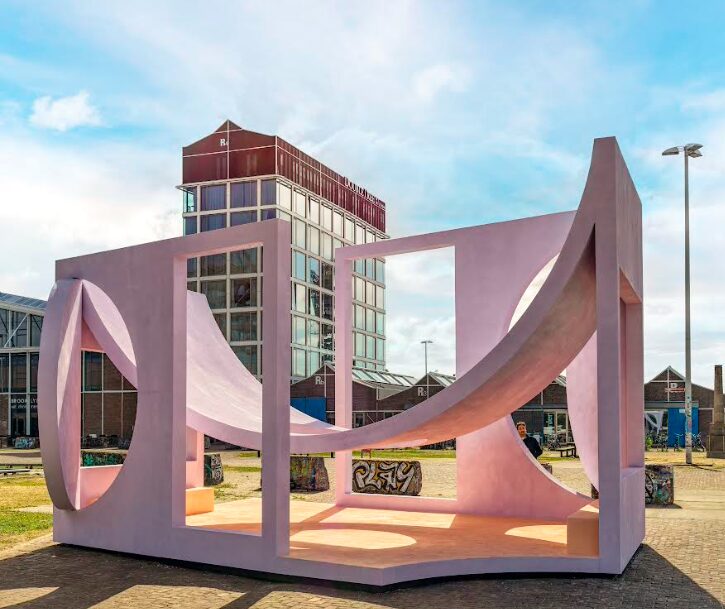
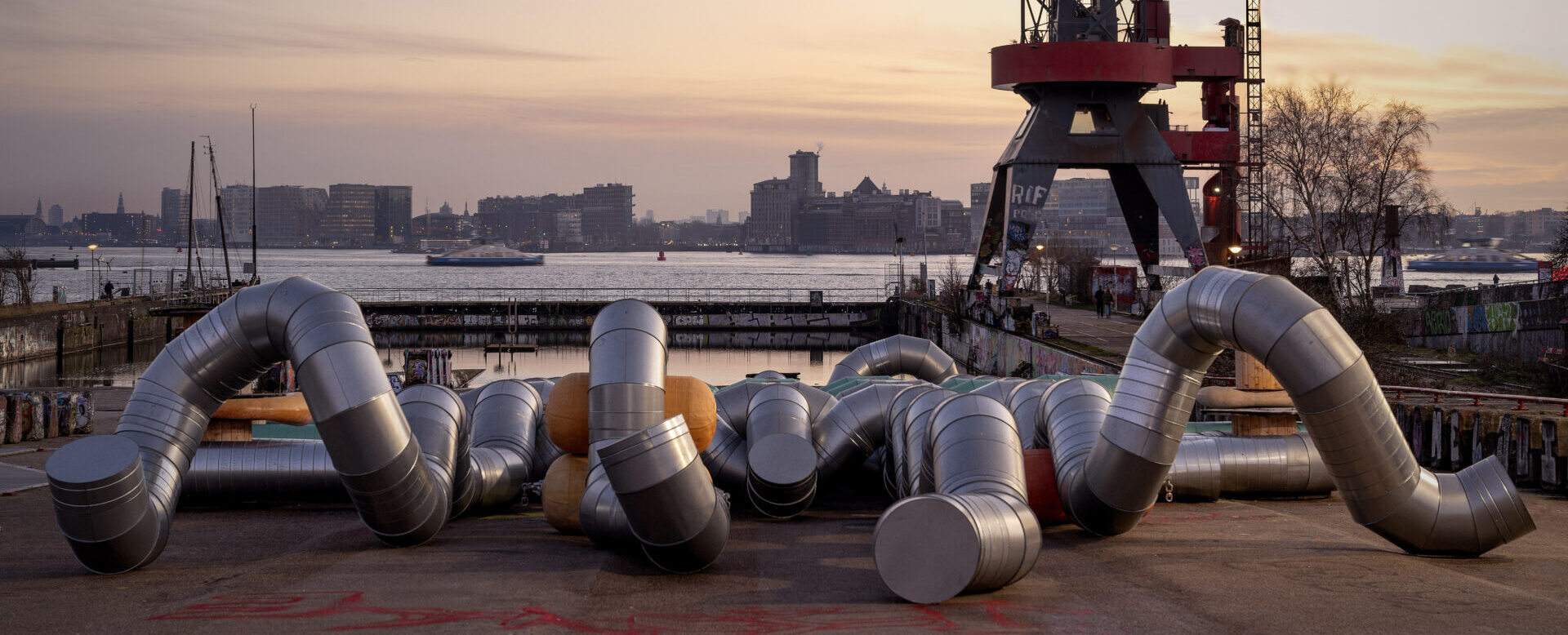
At the end, NDSM showcases their resident and commissioned artists. This final part feels like a return to what had been missing all day: the live pulse between public space, art, and real life. It reminds us that these conversations aren’t abstract—they’re embodied, material, happening. Two of the program’s unexpected gems are Bart Houwers (NL), who recently completed a residency and is planning a temporary commission, and Afaina de Jong (NL), whose Kinship Library can still be explored in its final days. Both De Jong and Houwers seem to understand what much of the day circled but never reached: interconnectedness and temporality are not just curatorial themes but conditions of living. I left wanting the artists to have shaped more of the structure itself.
If there is urgency to reimagining space, why do we keep inviting the same structure to shape it? For a decade, the same disciplines and vocabularies have danced around the same conference handbag—as if repetition itself were proof of innovation. The practices that already understand this—performance, dance, social practice, walking, sound, temporary architecture, urban intervention, even gaming—work in rhythms of impermanence. They appear, shift, dissolve, leaving not monuments, but moments, memories, traces of togetherness.
The public part of the conference failed to truly reimagine. Maybe that happens on day two—reserved for collaboration and practical strategy—but that’s closed door, by invitation only.
What struck me was how nobody really talked about funding, the all-important financial part, yet when support is brief, so is safety. When institutions learn to translate impermanence as progress, maybe we should worry, because temporary then becomes the condition of everyone involved—a shared precarity disguised as progress.
I sit, listen, we go on, conference-style, drinking coffee, living on borrowed time, rehearsing PowerPoint flexibility as survival—the most familiar public performance of all.
I wonder why permanence became the dirty word of the day. Cue the Clash guitar. I should go now.
The conference Don’t Worry, It’s (Only) Temporary took place on the 6th and 7th of November. The program on the 7th of November was by invitation only.
Kaylie J. Stuart
is kunstenaar en schrijver