‘Sustainability in and of itself is an empty signifier’ – in conversation with Jeff Diamanti and Colin Sterling on sustainability, art and heritage
What roles can art and heritage play in navigating the current ecological crises? This question is central to research projects PITCH (Petroculture’s Intersections with Cultural Heritage) and JUST ART, which address the topics of energy transitions and climate justice. Ruby de Vos sits down with Jeff Diamanti and Colin Sterling to talk about sustainability, art’s responsibility toward ecological questions, and ’the field’ as a site of research.
When we were asked by Metropolis M to discuss sustainability, art, and heritage, I immediately got stuck on that first word: sustainability. It’s a term that has been used and abused a lot, but that at the same time feels inescapable. When I started working at the lectorate Art & Sustainability at Hanze/Academy Minerva, that felt like a moment where I really had to reckon with the term. When sustainability is part and parcel of my immediate context of work, how do I work with this concept? So, I’m curious to extend that question to you: what does sustainability mean to you, and how do you position yourself in relation to it?
Jeff and I taught a course called “Rethinking Sustainability through Arts and Culture,” and I also coordinate a degree program with a major titled “Reimagining Sustainability.” I think these two course titles or pedagogical framings of rethinking and reimagining give a sense of how we approach it. Sustainability has clearly become an organising principle for a lot of debates and discussions that are currently happening within the academy, as well as more broadly through policy and societal transformations. In so doing it has become a point of contestation across lots of different spheres. For that reason, I don’t think I could use the term without a preceding propositional concept such as rethinking or reimagining (weak as these are).
Sustainability is a profoundly imprecise concept. It is also a relatively new concept, as I think Colin and I rediscovered when we were preparing that course a few years ago. It emerged in the 1970s where it referred to the capacity of a given energy infrastructure to be reproduced or sustained based on a baseline demographic range. Now, of course, we talk about it in all kinds of ways, using it as a catch-all term for a set of norms most colloquially associated with environmentalism. So that is why we often begin our inquiries of classes with the kind of claim that there is no such thing as sustainability, that it has become a kind of neoliberal mandate to allow for a set of institutional and economic imperatives to feel as though they are inherently progressive. We need propositions, such as reimagining or rethinking, because sustainability in and of itself is an empty signifier.
One of the common critiques of the term is the question, what exactly is it that is sustained through the work that is performed in the name of sustainability? Often that turns out to be fundamental inequality and oppressive power relations. Yet given the persistence of the concept, I also wonder if sustainability can at all be reclaimed? In The Activist Humanist (2023), literary scholar Caroline Levine attempts to reclaim sustainability, drawing on Indigenous philosopher Kyle Powys Whyte’s notion of ‘collective continuance’. In particular Levine considers sustainability as the work that is necessary to keep life going, and makes visible the repetitive care work of labour and maintenance that goes into it. I find this emphasis on long-term temporality, care, and collectivity quite helpful as a way to reconfigure the term and its imagination of futurity. There is something that is attractive about her pragmatic approach to reclaim this contested, but sticky notion of sustainability.
I quite like that kind of contribution to critical thought today. I think we’re in severe shortage of it. It speaks to a utopian presence in contemporary thought, which I think we need to show up for. I’m saying this, of course, on the brink of what really feels like the horrifying prelude to the coming years of conflict. Against this current moment, sustainability feels very much like a concept that was born in the 70s and died in the late 2010s. But as sustainability doesn’t name the basic motivational infrastructure of states or of capitalist civic accord anymore (i.e. to sustain the status quo), maybe now is the moment to do something more propositional with sustainability.
Against the backdrop of so many conflicts, sustainability can certainly seem like a privileged concept to be wrestling with. In some sense it has always been this way. I think many people in the Global South would say, why the fuck are you talking about sustainability? It has been imposed on them in so many ways in recent decades. And yet now Levine and others are suggesting it is exactly the infrastructures, world systems and cosmologies of such communities that we should be paying attention to. This is not an easy contradiction to overcome.
Beyond Representation
One thing that we share across our different research practices is an interest in how this reimagining of sustainability takes shape across different realms, which includes the level of art and heritage, but also very much the material and the infrastructural conditions that underlie them. You are both working together on the project PITCH, which explores heritage, petroculture, and the energy transition. How do those elements come together in that project?
PITCH came about in response to a call from the EU asking for projects that would look at how heritage can ‘help citizens face change with confidence.’ We proposed the energy transition as one significant change that is currently being negotiated by communities, with heritage then functioning as a kind of tool to understand or navigate this shift. If heritage has come to be a way of thinking about our relation to time and to historical consciousness, how then might it help people face fast-moving aspects of the energy transition?
The project looks at how certain heritage practices emerged in relation to previous transitions (from coal to oil, for example) and how heritage processes might help people rethink the current energy transition. This is not only an abstract question: the energy transition is materially visible as you move through so many landscapes today; people see it in their homes; feel it in the way they power things; view it on the horizon in the shape of huge wind farms. This can be both reassuring or unsettling. The strange thing is that there are very few cultural structures to explain what is going on in relation to such systems. That is where PITCH comes in, at least in a small way.
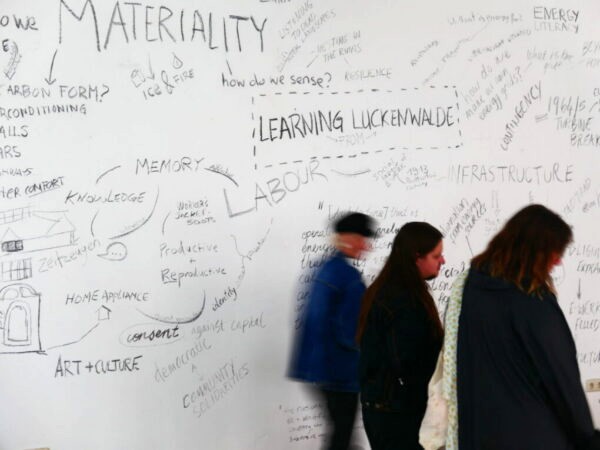
Throughout the project, we collaborate closely with cultural institutions that are materially, conceptually, and economically embedded in the messiness of energy transition. Colin and I collaborate with E-WERK Luckenwalde, a former coal powered energy plant in Brandenburg, just south of Berlin. E-WERK has repurposed and reactivated this energy infrastructure in a variety of ways. They run a contemporary art programme, but they also produce energy through carbon-neutral and renewable technologies and sell that energy through a cooperative infrastructure that distributes power across Germany. In doing so they supply hundreds of houses with energy, called Kunststrom or ‘art current’. E-WERK moves beyond a representational paradigm of petroculture and heritage insofar as they actively repurpose this power plant to rethink what it means to inherit such systems.
‘E-WERK moves beyond a representational paradigm of petroculture and heritage insofar as they actively repurpose this power plant to rethink what it means to inherit such systems.'

We tend to talk a lot about artists’ supposed responsibility to address ecological questions not only on the level of content but also in the process of making. What do you think it means for institutions, such as E-WERK, to move beyond that representational paradigm?
On one level it boils down to some pretty basic questions such as reducing carbon emissions, reducing waste, reducing material excess. I would not be dismissive of that; I think it is really important to reckon with some pretty wasteful practices in the art and heritage field. More generally, a lot of people working in heritage are currently asking what it actually means to conserve stuff. Why do we invest so much energy in storing and caring for certain things or places in very particular conditions? I am curious about how asking this question ties into a broader shift in mindsets around the relationship between people and their environments, mediated through cultural systems. This is why E-WERK is such a good case study to think with: they are actively modelling new socio-environmental relations through cultural praxis and energy infrastructures, at scale.
Feeling Stupid in the Field
What I find very interesting about E-WERK is the way in which the art institution quite literally comes home to people through the provision of energy to their homes. We increasingly see this kind of entanglement between social, artistic, and infrastructural dimensions in ecological art and research. Both PITCH, as well as JUST ART, the project on climate justice and artistic research in which Colin and I work together, really emphasize these connections to and collaborations with citizens through art. Obviously, how such projects are conducted and take shape matters greatly (both in what they mean for participants as well as how we think about art). How do you view these developments?
In my more cynical moments, I would certainly be worried about the extent to which projects like JUST ART or PITCH, and there are of course many others, essentially help states outsource important work they should be doing. But then I also think, if this work can be delegated to anyone, let it be to these critical fields that are encouraging alternative literacies, and not just propagating or replicating normative frameworks.
‘if this work can be delegated to anyone, let it be to these critical fields that are encouraging alternative literacies, and not just propagating or replicating normative frameworks.'
One of the affordances of these public, participatory models is that, whatever kind of artistic or curatorial practices we are talking about, new kinds of knowledge or literacy are getting crafted collectively. To me, that is an interesting place to begin the work of thinking about where energy comes from and to increase the organizational capacity of the art world. I think there is currently a primacy of triangulating the home, the field, and the museum or institutional space, and thinking about them as in an ongoing relation that brings with them new set of practices, norms, and affordances that are distinct from previous examples of this kind of work. I’m thinking about residency models I’ve been supporting like FieldARTS or the NICA course I teach on ‘Field Theory’ that put artists and researchers in dialogue with port workers, marine scientists, and the more than human communities that make meaning of the logistical spaces where energy as commodity is still moving around in barges and pipelines. But there are also clear efforts by organizations like Framer Framed and Sonic Acts to bring audiences and field-researchers into collaborative relation in spaces overlaid with environmental and economic neglect. Or the group exhibition shadow circuits at MaMA in Rotterdam where the curator and artists are including a field visit to the port of Rotterdam as part of the program. Something important happens to the questions we ask about art, critical inquiry, and literacy when we ground our concerns in and with the field.
You bring up the field, and I would say that this shift towards the field is really a key dimension of ecological art and research practices. Perhaps more so than other sites of research, it seems to invite the attempt to decentre anthropocentric worldviews and to create space for other forms of knowledge creation that include the sensory and the relational. What does this move facilitate for you?
When you immerse collectively in the field, you are suddenly aware that the kinds of distinctions that you are trained to recognize are insufficient. What is a subject and what is an object in the field? How do you make historical demarcations in a field that is lively and lived and remembers its own historicity in the grammar of matter? Who gets access and on what terms is often determined by labour conditions, imperial propriety, and custom, and none of these care much about the normative criticalities that we bring from the humanities. I think it can be very overwhelming and beautiful, it can also be troubling, frustrating, if not boring. Either way, there’s an inevitable contamination of your habitus that is really important to show up for.
I totally agree with you. But I also think the capacity that some of us have to wrestle with these signals and affects and to make sense of them and then to act on them, and to change accordingly, is wildly uneven. Never do I feel more stupid than when I am in the field.
I think it is important to take that seriously. Because we are within a certain kind of Western pedagogical model, we expect the object to release its information very quickly. And the field will persistently resist that demand, and that resistance is part of its alterity. I think what you are describing is a very ethical experience to have; there is good reason that many of the contemporary arguments for environmental ethics begin and end with the concept of alterity.
But there is a level at which the capacity to even begin to understand expressions of alterity is limited. It needs time, but it also needs something else. I think that something else is an interesting place for art to come in.
‘Never do I feel more stupid than when I am in the field.'

Looking ahead
Both PITCH and JUST ART are long-term projects. What kind of challenges and possibilities do you envision for these research projects in the coming years?
Today, topics such as the energy transition, climate justice, and climate change are deeply contested political spaces where the right is claiming and very often winning ground. We only have to look at the intersection of culture wars rhetoric and climate denialism. It’s a political tactic that exploits some very real anxieties and insecurities about the economy, energy, and people’s capacity to actually live a good life, or what they see as a good life. Critical heritage and critical art practices need to address these issues as well, otherwise we’re not going to help people confront the fundamental challenges of contemporary society. You’ve got to offer an alternative.
I think you are right. I do believe shifting the discourse of sustainability much more explicitly towards multispecies climate justice can be very generative, as a lot of artistic practices have done over the last years. In that way, the (neo)colonial power structures and ideologies that underlie both climate change and biodiversity loss, as well as the energy transition and climate adaptation, are placed at the centre of the conversation. But while that ideally opens the door for a sense of ecological interconnection and collectivity, it is easy to see how such ways of thinking are also being co-opted. So, I think working at that knot, if you will, feels quite urgent.
I think this is a conjunctural moment for us to participate in conversations about whether or not the forms of life that preceded this moment were actually very good, or if we can come up with better ways of living. I think there was a lot of individual security and privilege for a certain group of people in late modernity, but even for them it was pretty depressing and unfulfilling. I think we can do way better, you know? Late neoliberalism was shit; what a terrible project. Let’s be done with it, let’s do something else.
METROPOLIS M KAN NIET ZONDER JE STEUN
Trouwe lezers vormen het fundament van Metropolis M. Wij kunnen niet zonder je steun. Je kunt ons steunen door een jaarabonnement af te sluiten. Het eerste jaar krijg je 40% korting. Een regulier jaarabonnement kost 58 euro. Er zijn ook kortingsabonnementen. Studenten/65plussers/CJP-ers/Personen met een minimuminkomen en PLATFORM BK-leden betalen slechts 36 euro voor hun jaarabonnement. Op DEZE PAGINA lees je meer over de verschillende abonnementssoorten en kun je je direct aanmelden.
BIJ VOORBAAT DANK!
More information about PITCH: HERE
More information about JUST ART: HERE
On the 10th of April, Jeff Diamanti will accompany a visit to the Rotterdam harbour as part of the group exhibition shadow circuits at MaMA and the Political Ecologies: Supply Chain Criticism group of the University of Amsterdam
Jeff Diamanti is Professor of Global History of Sustainable Development at the Vrije Universiteit Amsterdam (by special appointment) and is Associate Professor of Philosophy and Cultural Analysis at the University of Amsterdam.
Colin Sterling is Assistant Professor of Heritage, Museums and the Environment at the University of Amsterdam
Ruby de Vos
is senior researcher materials & art at Hanze/Academy Minerva in Groningen.