A Call to Witness – Dala Nasser at KM21
The Lebanese artist Dala Nasser presents her first solo exhibition in the Netherlands, Cemetery of Martyrs, curated by Yasmijn Jarram, at KM21 in The Hague. First shown at Nottingham Contemporary, the exhibition has been reconfigured for KM21, where Nasser’s large-scale installation transforms the space into a symbolic cemetery. Elâ Atakan visits the exhibition.
The sky is pale blue when I’m visiting KM21, offering a kind of happiness that makes it seem as though all is well with the world. A video shown just before the entrance to Dala Nasser’s exhibition seems to have been recorded on just such a day. On a white sheet dappled with shadows cast by what resembles an olive tree, a hand calmly uses charcoal to take a rubbing from the stone beneath it. The scraping sound and the shifting shadows of its branches create a strange sense of peace.
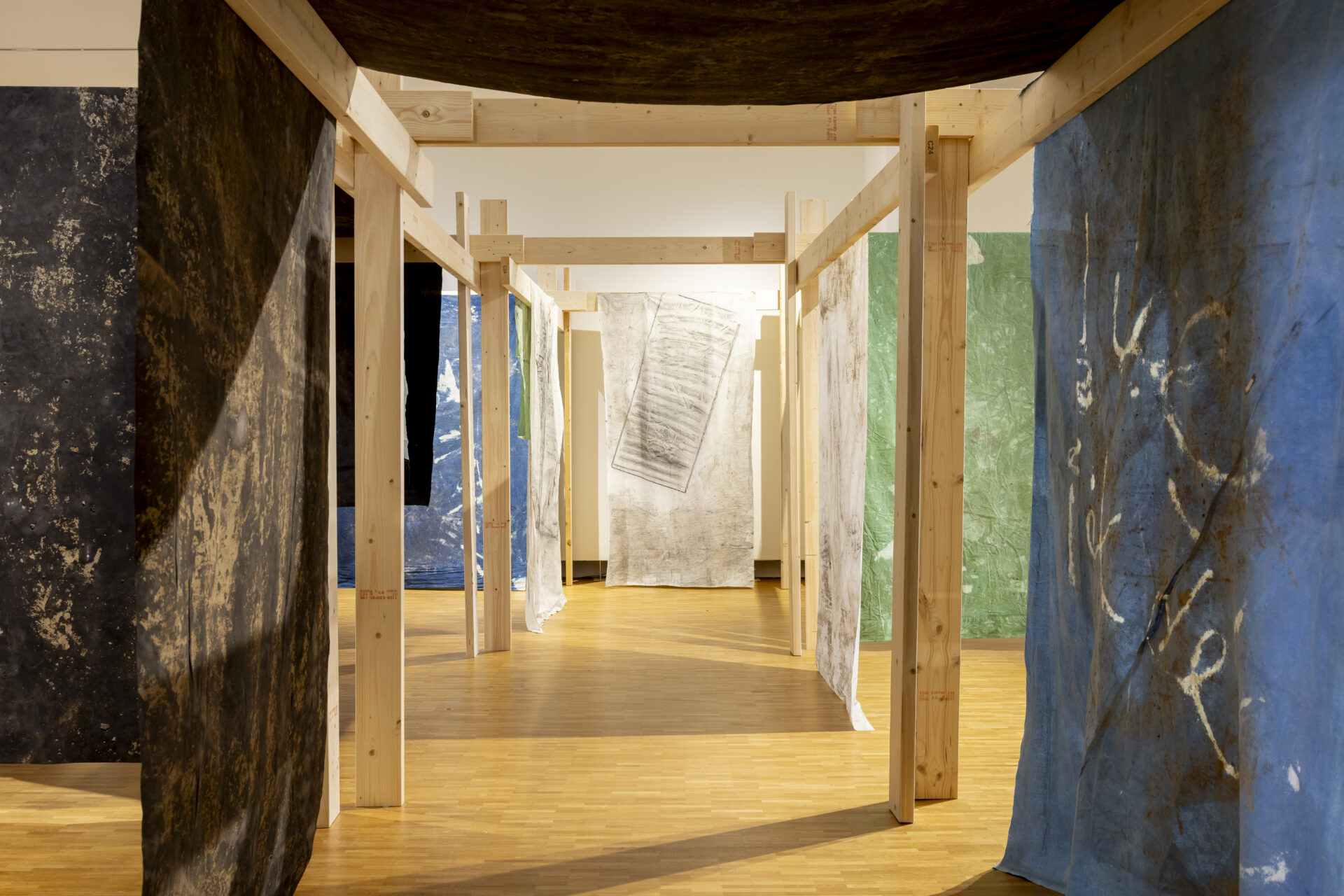
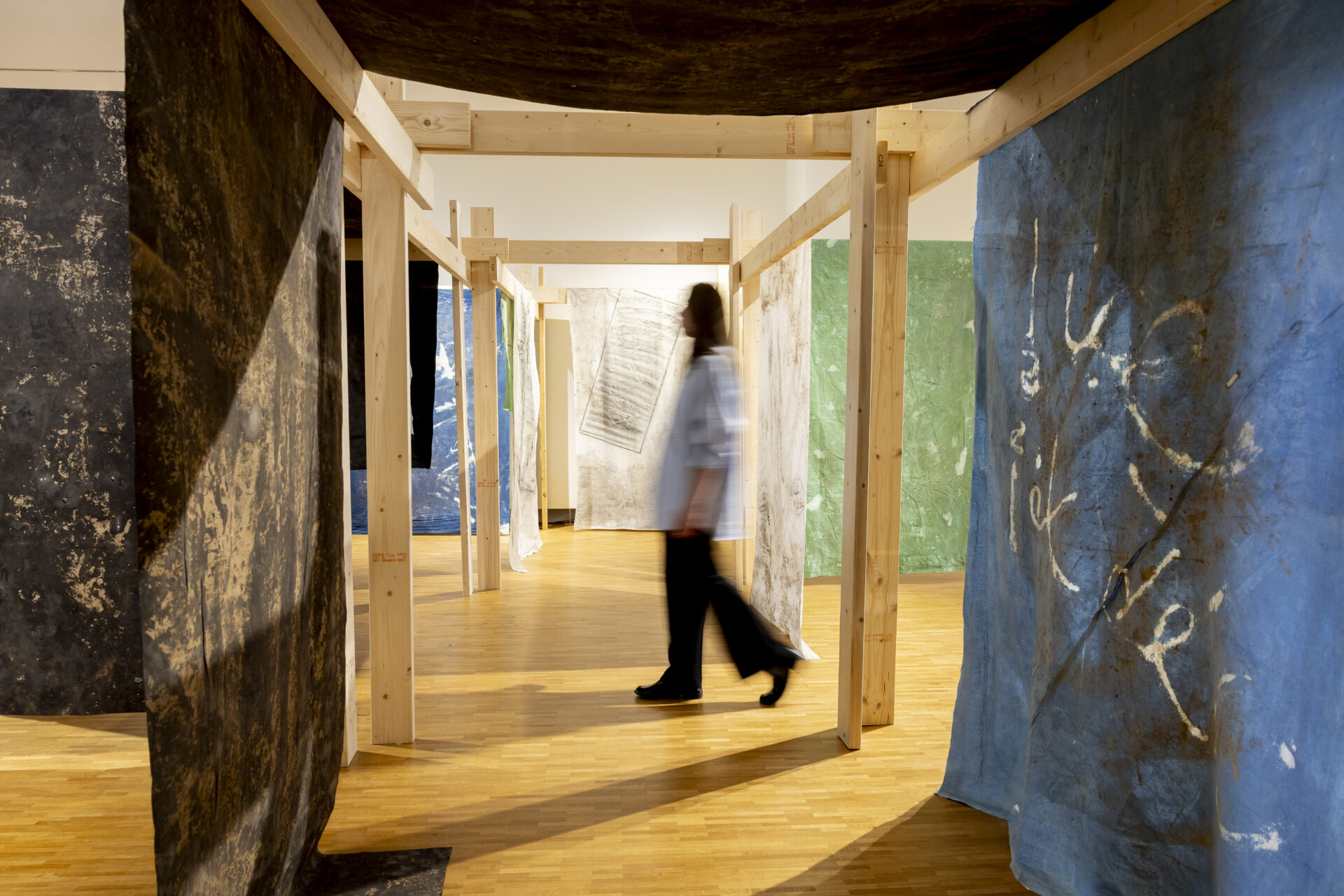
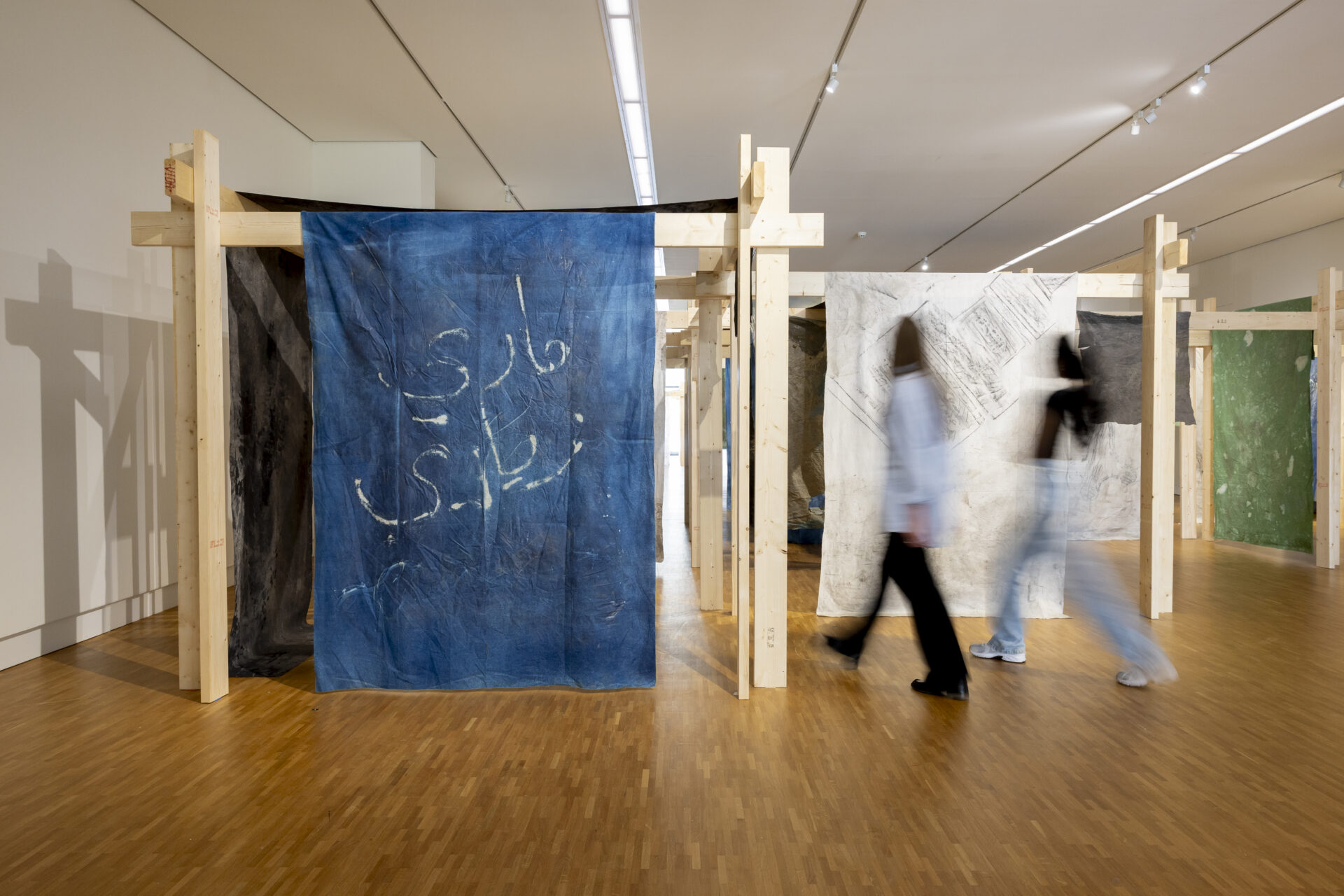
After the brightness outside, entering Cemetery of Martyrs feels like crossing a threshold into the physical reality of death. It is as though I have entered an abandoned world: a labyrinthine cemetery enclosed by hanging fabrics, worn and stained with soil, that recall burial shrouds. The fabrics form narrow passages, giving the sense of moving among graves. Each hanging sheet seems to hold a single life within this crowd. The darkness feels new, as if everything had only just happened.
The word martyr in the title forms a bridge between the exhibition’s visible and invisible dimensions. The lives of 43 cultural figures represented and mourned in the space, recounted in the accompanying biographical booklet, reveal a depth that is not immediately apparent in the space. The English word “martyr” derives from the Ancient Greek martys, meaning “witness”. In Arabic, shahid means both witness and martyr. Nasser’s title also refers to the real Cemetery of the Martyrs of the Revolution near Beirut. The lives and intellectual journeys of these figures, who came from different places and lived in different periods, intersect in Beirut but extend far beyond it. Nasser draws these 43 lives and deaths, otherwise dispersed among different cemeteries, countries and historical narratives.
Thema's
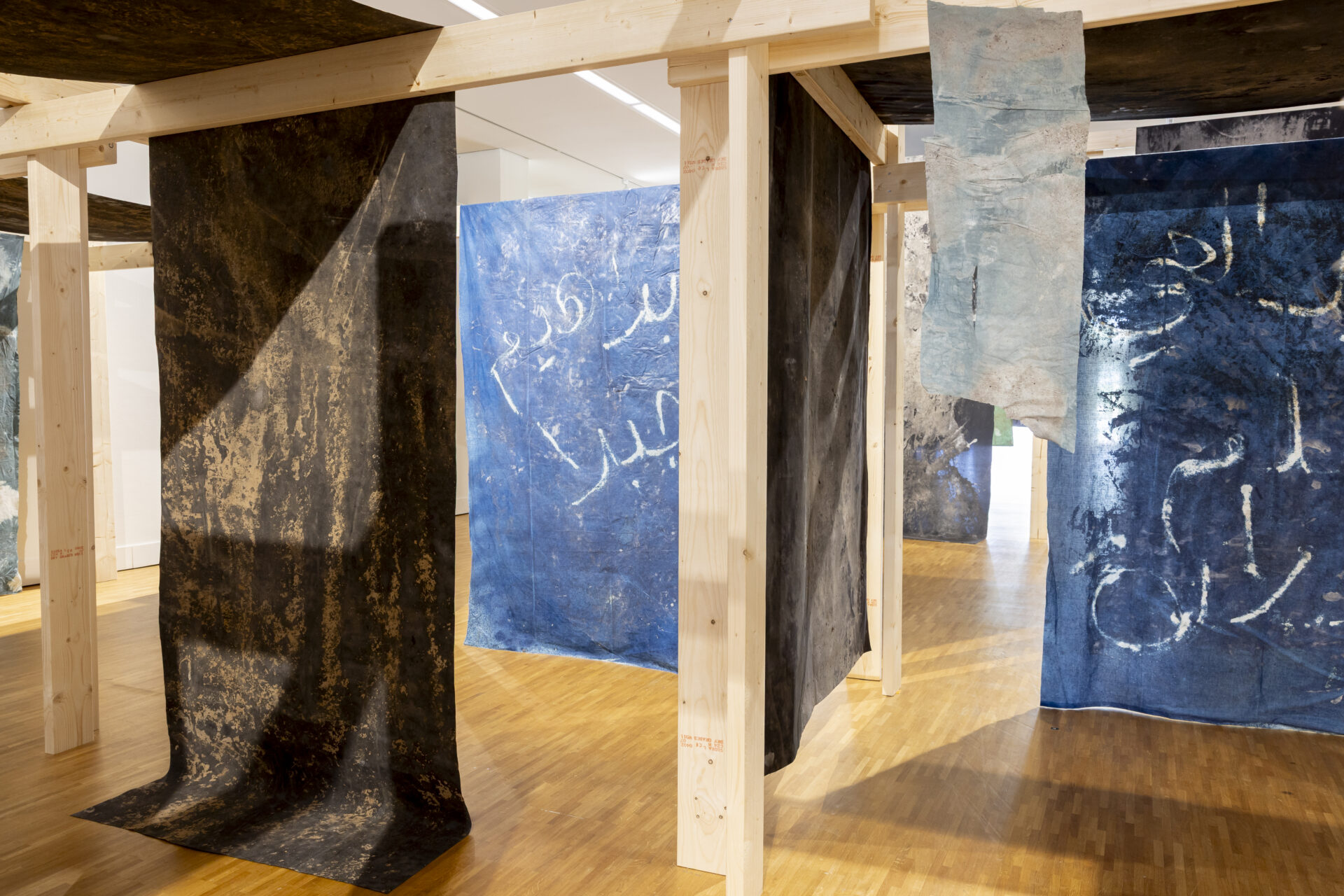
In the exhibition, this act of witnessing extends from names and biographies into the material itself. Nasser laid her own used bedsheets and those of people close to her over gravestones, transferring their surfaces onto the fabric with charcoal. Through this technique, known as frottage, the fabrics do not depict the graves so much as record their physical contact with them. The choice of bedsheets takes on another meaning here. Fabric swaddles us at birth; throughout life, it accompanies sleep, illness and desire, and in death it can become a shroud. As the surfaces of the gravestones pass onto the sheets, traces of soil, mud and charcoal mingle with the movements of the artist’s body. For graves that had disappeared or could no longer be located, Nasser uses cyanotypes. She wrote their names in Arabic with sand on fabric and exposes it to sunlight, producing blue cyanotype sheets on which the names remain as traces. In this way, even when there is no gravestone to leave a physical trace on the fabric, each person is given a material presence within the installation. The fabric moves beyond being a metaphor for death and itself becomes a form of testimony.
The architecture of the installation makes this reversal physically tangible. Burial normally moves downwards; Nasser reverses this movement, suspending the graves above our heads and raising them beyond our reach. The weight of stone gives way to the lightness of fabric, and the fixed grave becomes a surface that moves. A trace that would otherwise remain buried and gradually disappear is elevated within the exhibition, acquiring visibility as well as a form of honour.
The sounds accompanying the exhibition prevent this ceremonial space from becoming detached from everyday life. Recorded in eight cemeteries across Lebanon, the sounds of birds, motorbikes, the surrounding hum and the scrape of charcoal over fabric and stone remind us that life continues around death.
Burial normally moves downwards; Nasser reverses this movement, suspending the graves above our heads and raising them beyond our reach.
The exhibition changes again when one begins to read. One after another, the lives gathered in the accompanying biographical booklet, which Nasser compiled together with art historian Nadi Abusaada, researcher and translator Rayyan Abdelkhalek, and poet Chbib Al Amin, reveal a cultural history that is continually extended and interrupted. The oldest figures on the list come from the Nahda, a period beginning in the second half of the nineteenth century when Arabic literature, publishing, translation and education were undergoing a profound transformation. Meaning “awakening” or “renaissance” in Arabic, the Nahda carried a promise of a new future that took shape in the schools these figures founded, the newspapers they published, the books they translated and the relationships they formed. As the biographies progress, however, this hope passes through the changing borders that followed the dissolution of the Ottoman Empire, the Nakba and the wars and exiles that followed. People leave their homes, move to other cities and continue to write in other languages; some are killed, while the graves of others disappear. The booklet registers these historical ruptures at the scale of individual lives. What connects these figures is their continued creative and intellectual work through such ruptures, and the testimony their work bears to the times in which they lived.
What I find particularly compelling about Cemetery of Martyrs is that, although the exhibition initially presents itself through the language of mourning and remembrance, the extensive research behind it opens onto a much broader historical inquiry. Nasser constructs an intellectual and cultural genealogy across almost a century and a half. This is where the exhibition moves beyond memorialisation: the cemetery becomes a way of tracing a cultural history, revealing connections between lives that had otherwise remained dispersed across different periods, countries and historical narratives.
The friendships, loves, families and everyday details included in the biographies bring these historical figures closer, lending an unexpected warmth to the installation’s cold and heavy atmosphere. Alongside internationally recognised figures from different generations, such as Khalil Gibran and Etel Adnan, the list brings together many other important cultural figures from across the region. Among them is May Ziadeh, a Palestinian writer, critic and feminist who was among the leading intellectuals of the Nahda. Nasser recounts how Ziadeh hosted a literary salon in Cairo that brought together many of the period’s most important writers and thinkers. Later in life, she was falsely declared insane and confined to a psychiatric institution, losing her freedom, her money and her civil rights. When she died, none of the intellectuals she had welcomed into her salon attended her funeral. Eighty-five years later, Nasser’s exhibition restores her to the intellectual community to which she belonged and gives her a new place within collective memory.
On leaving Cemetery of Martyrs, the darkness felt upon entering does not disappear completely, but its meaning changes. By then, the experience of moving through the exhibition has come to resemble an act of paying one’s respects. Nasser does not try to bring these people back to life; she builds a shared archive from the traces they left behind and restores them to a place in cultural memory. This returns us to the oldest meaning of the word “martyr”: if they were witnesses to their own times, by the end of the exhibition visitors have become witnesses to their lives.
Cemetery of Martyrs is on show until the 11th of October at KM21
Elâ Atakan
is a curator and writer based in Amsterdam, working on contemporary art with a research-based approach