Circular Connection – ⌀ [dia] at Stroom Den Haag
How can the body function as a testing laboratory? Ana María Gómez López’s first solo exhibition in the Netherlands — hosted by Stroom Den Haag — offers different answers to this question: Gómez López tries to grow a pearl in her mouth and sprout a seed in her eye. Delia Toppi visits the exhibition in The Hague, rich in metaphors and symbolic connections.
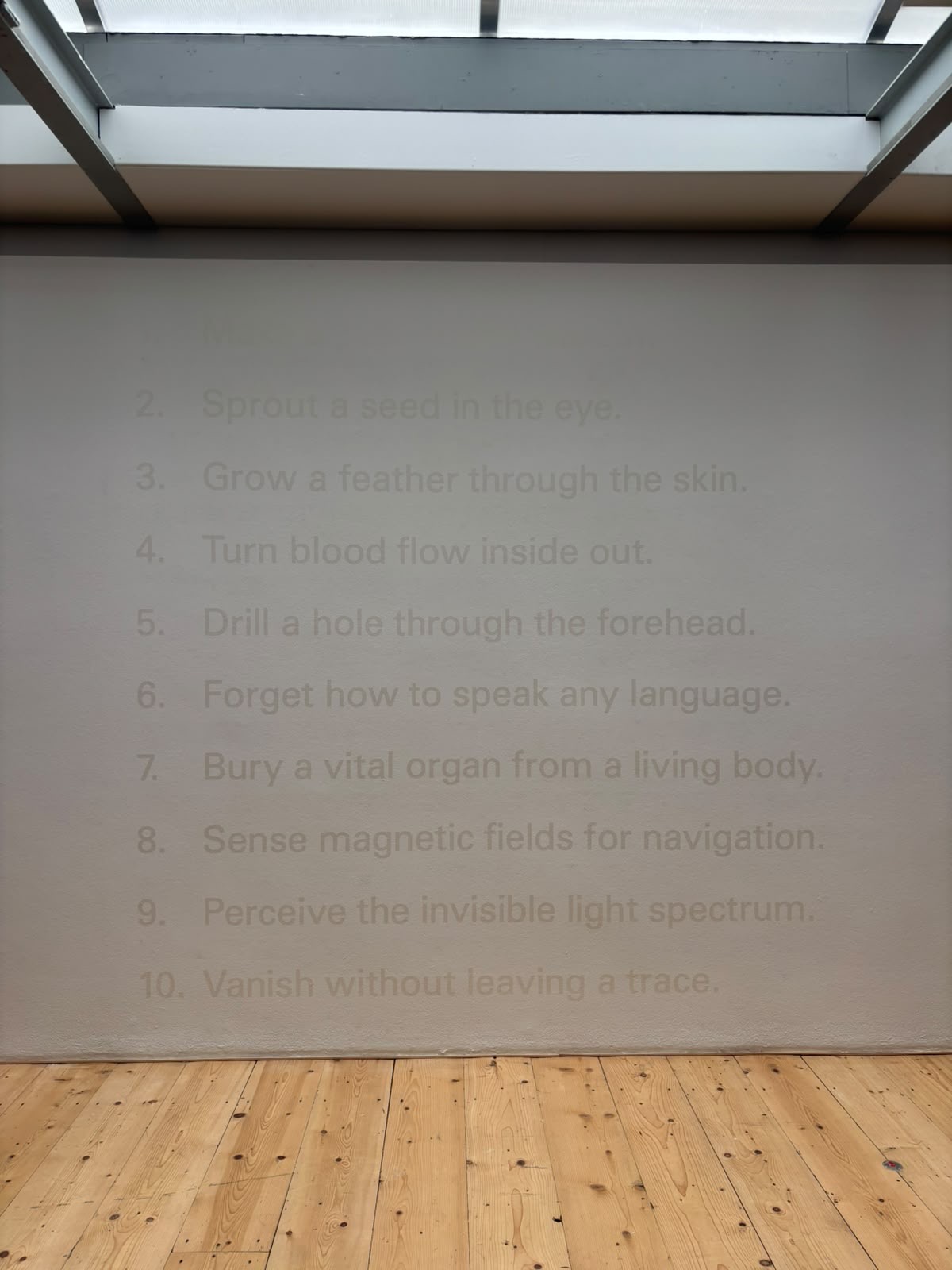
The exhibition is structured around ten statements, displayed in light silver tones across the surface of an entire wall, barely visible upon entering. Fragments of the texts emerge and disappear depending on the light, urging to shift one’s position to decipher the entire message:
Make a pearl in the mouth / Sprout a seed in the eye / Grow a feather through the skin / Turn blood flow inside out / Drill a hole through the forehead / Forget how to speak any language / Bury a vital organ from a living body / Sense magnetic fields for navigation / Perceive the invisible light spectrum / Vanish without leaving a trace.
This process of partial discovery is further instrumentalised as a curatorial strategy by Gómez López through the organisation of the exhibition space into separate yet interconnected clusters, each marked by a diacritical or standard letter that indicates the recommended viewing itinerary. For an exhibition of such multidimensionality, this strategy is both necessary and effective; it physically guides me through the space and organises the exhibition around interrelated themes, rather than confining it to the individual experiments alone.
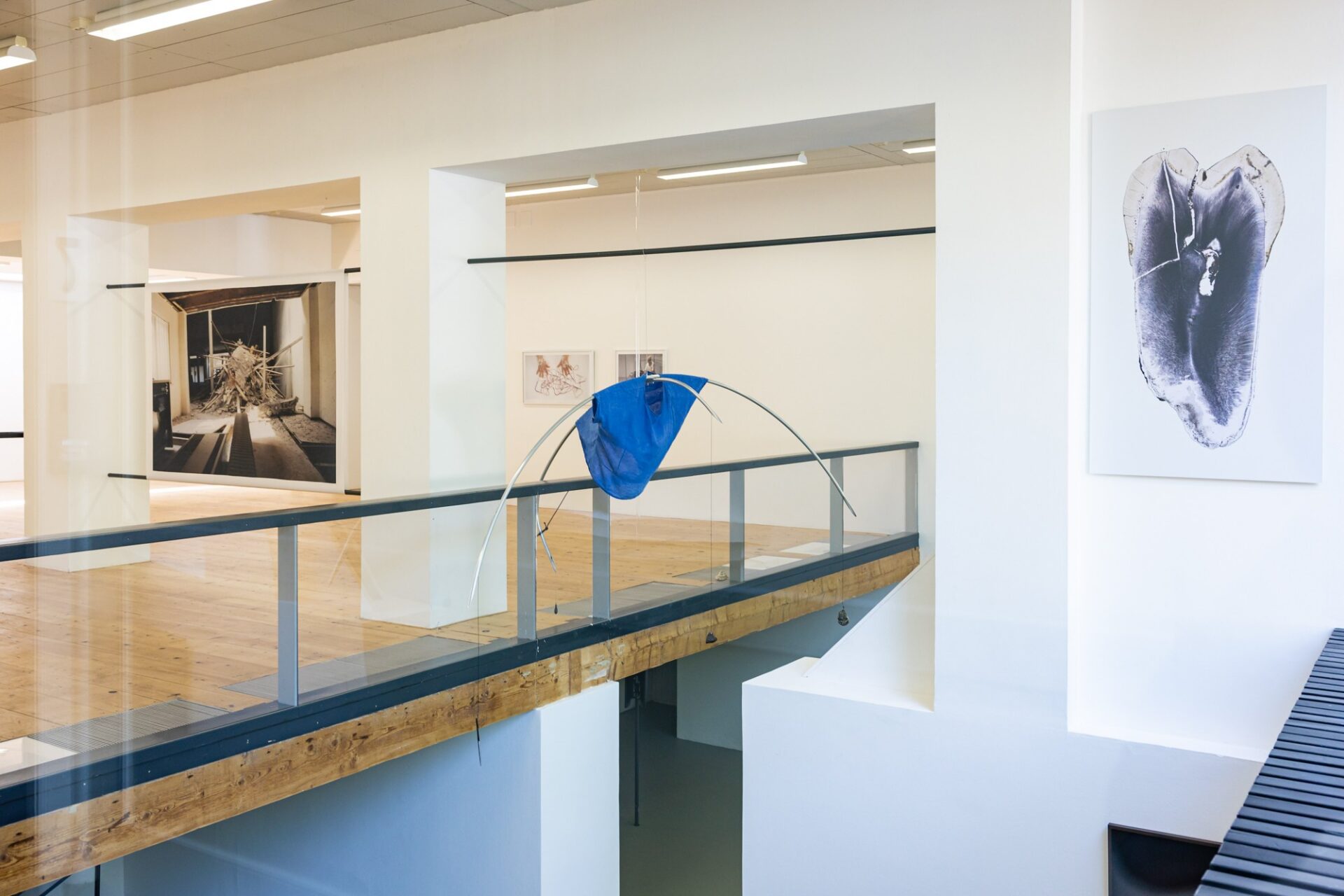
Across two floors, Gómez López constructs an artistic context in which ideas, spontaneous associations and intuitive connections are formed through a constellation of archival materials, objects and photographs that reference historical examples and the work of other researchers alongside her own. The exhibition is organised into distinct thematic chapters, each focused on one of the ten projects outlined above and guided by a research question, such as ‘can the human body become a site of mineral formation, mirroring geological or cosmic processes?’ related to the pearl-growing experiment, or ‘what additional kinds of encounters can take place between human physiology and vegetal growth?’ referring to the practice of ocular germination. Nevertheless, each section remains connected to the others and prompts mutual dialogue and a fluid understanding of reality. While most examples originate from realised experiments, some remain speculative and question the perceived limits of the human body. I encountered these hypothetical scenarios through bird feathers and tracking devices, which imagine human skin as a site for the growth of animal-like anatomical features and the possibility of humans acquiring birds’ natural perception of the Earth’s magnetic field for navigation.
While most examples originate from realised experiments, some remain speculative and question the perceived limits of the human body.
At the same time, this process of classification into sections introduces a tension between the natural world and the human need to categorise it, an impulse entangled with histories of violence and colonialism. This underlying tension lingers throughout the exhibition as a trace, up to one of the final works of the exhibition: an enamel sign concealed beneath the stairs leading back to the entrance states A METEORITE IS THE ORIGIN OF A TAXONOMIC ALPHABET.
Among the first works encountered in the exhibition are those related to Gómez López’s attempt to grow an artificial pearl using her own mouth as a site of biological experimentation. The upper and lower jaws function as the two shells of a mollusc, while the tongue acts as the internal tissue. A micro-meteorite is constantly rolled by the tongue in the hope that through this circular movement, saliva and accumulation of artificial iridescent nacre, it will develop into a pearl. Instead of presenting the entire photographic or video documentation of the experiment, she adopts a more relational strategy that features selected sonic and photographic fragments from her attempt, external images, objects and artefacts that refer to the process of pearl formation from diverse cultural and historical perspectives.
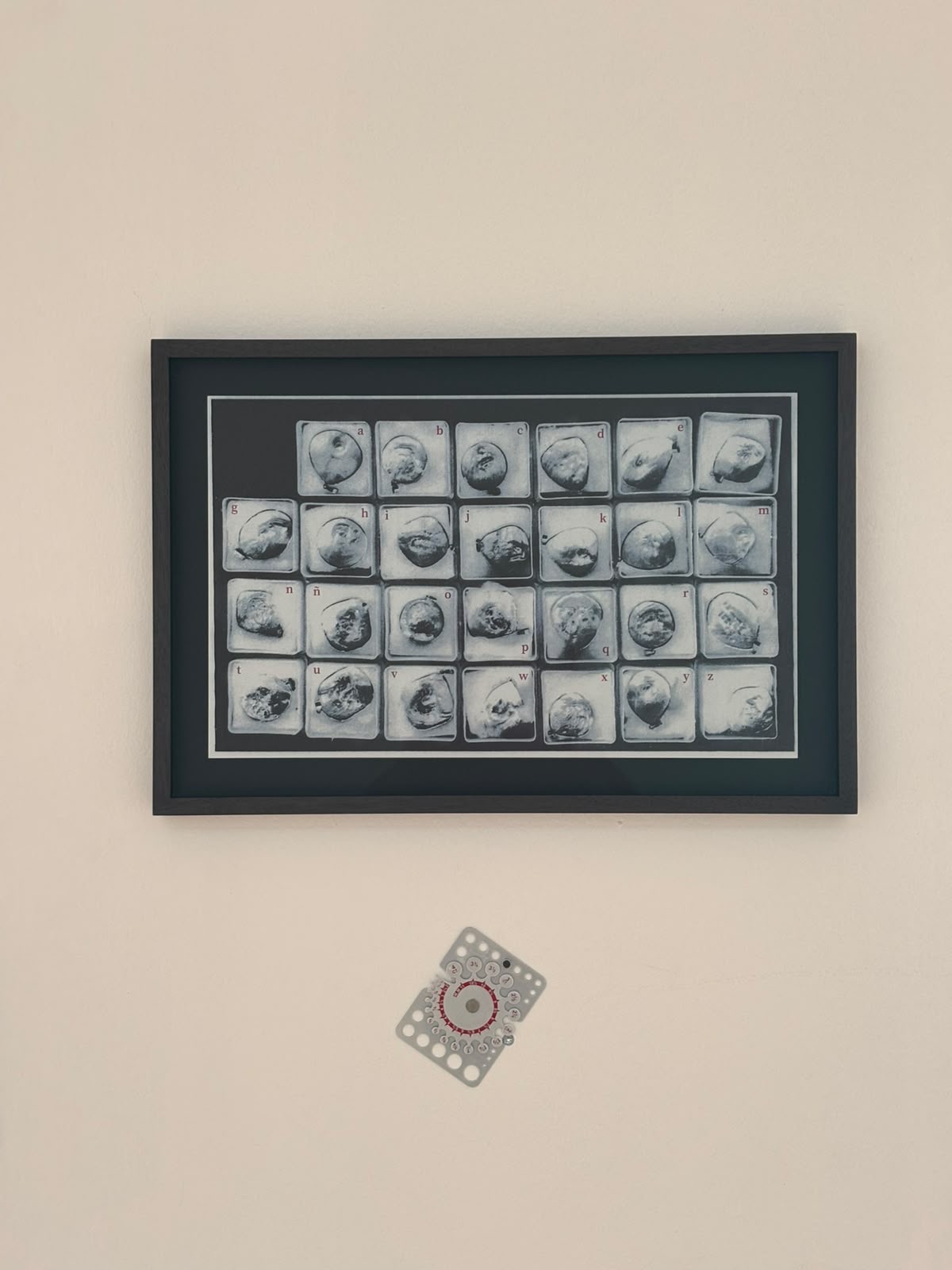
The pearl first appears in cluster ð as a silkscreen print of pearl blisters from the present-day border region between Colombia and Venezuela and, directly beneath it, a gauge used to measure pearl carat and diameter. Together, these works introduce the commodification of natural materials, evoking the intertwined histories of extraction, colonial trade and systems of valuation where economic, political and ecological realities merge into one another. Nearby, an engraving of the Pearl Islands in Panama further reinforces these associations, referring to the violent conquest of Indigenous populations and the forced harvesting of some of the world’s richest natural pearls.
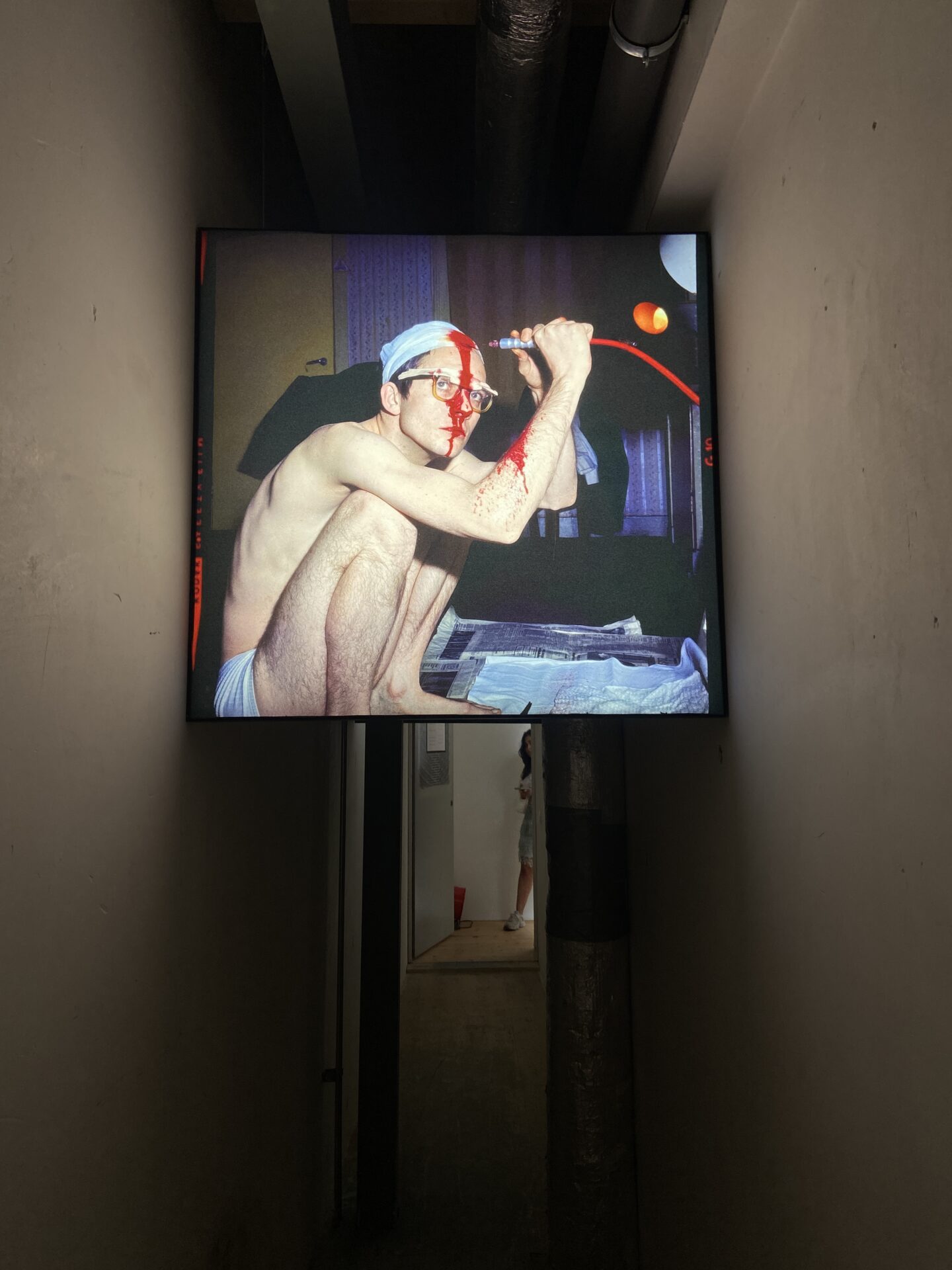
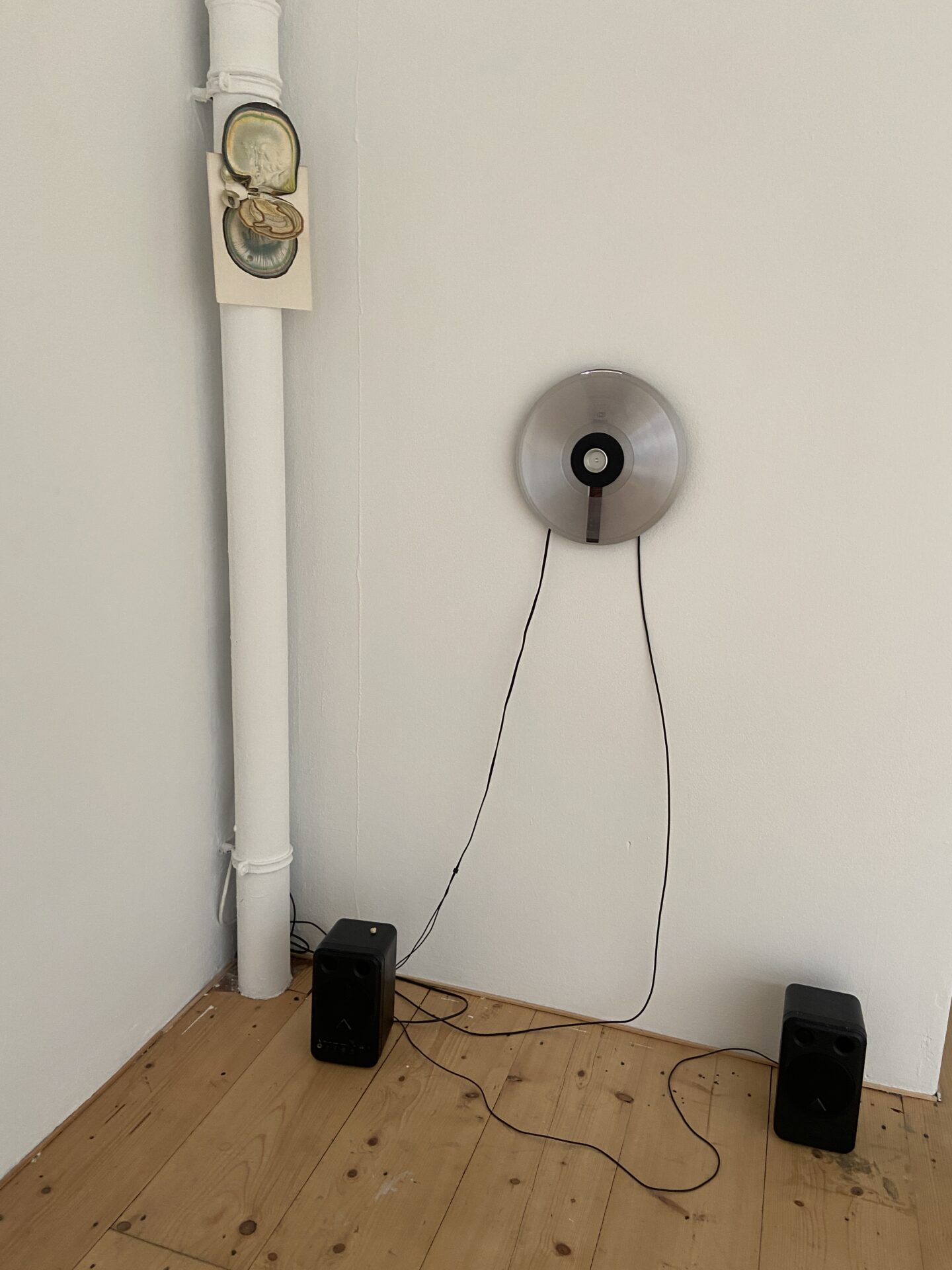
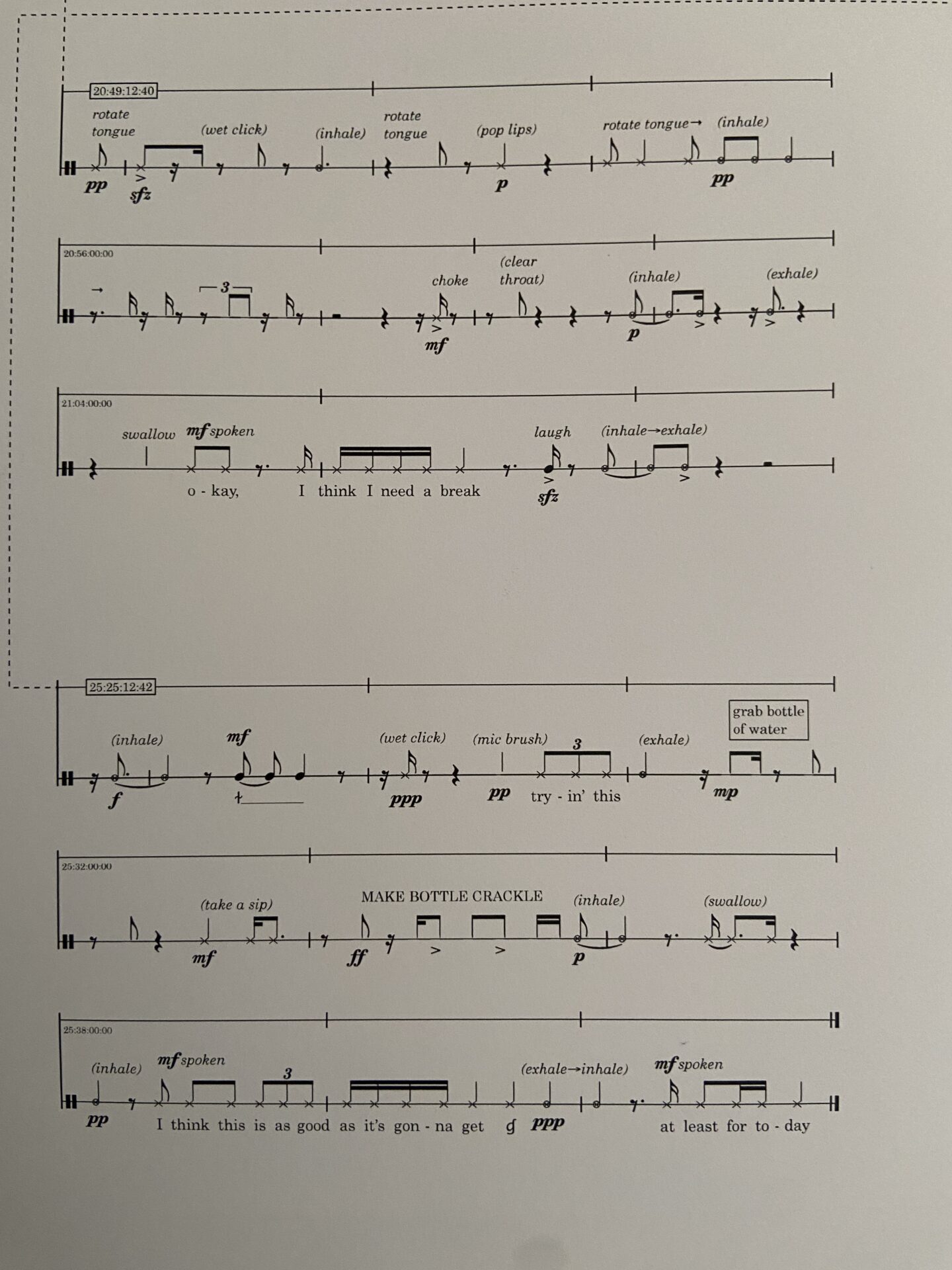
Continuing along the path predetermined by the artist, I encounter the first material trace of Gómez López’s pearl-growing attempt. The artist presents this experiment visually through a double-exposure lithograph of her mouth and sonically, with Lingua Lamina consisting of a vinyl connected to two speakers, playing a recording of the sounds made by the artist while shaping the pearl in her mouth. Nearby, on a door leading into a passage where two photographs of Bart Huges’ trepanation experiments hang beneath the ceiling, the musical transcript of the sound made throughout the pearl-growing experiment is displayed. Here, the second objective of the experiment is revealed: language is introduced as an instrument of production rather than solely aimed at communication. In parallel with Huges’ attempts to expand his mental capacities by drilling a hole in his skull, Gómez López uses her body as a tool and as a testing ground.
The scarcity of documentation available reveals that the experiment’s outcome is only of secondary importance. Instead, what truly matters is the creation of unexpected relationships and questions between what we know, what we believe to know and what remains unknown in a continuous process of interrogation. Human imagination becomes the central core around which the exhibition is structured. Gómez López allows the body to explore non-normative ways of acting or thinking as resistance strategies rather than restricting it to a fixed function.
The spatial structure of the exhibition mirrors its central interests. It develops circularly, with staircases positioned at each end of the space and opens onto two interconnected levels that remain simultaneously visible from multiple spatial points, allowing further dialogue and exchange between the objects. These spatial conditions become particularly evocative as the circle, implying rotation and circularity, acquires a specific role in the exhibition. Beyond the circular movement of the tongue in the pearl-growing experiment, circularity recurs many times throughout the exhibition: in Bart Huges’ trepanation experiment, in the autologous transfusion work, which reimagines blood circulation by moving blood outside and back into the body using only basic clinical tools, as well as through actual and photographed micro-meteorites. Additionally, the exhibition’s title, ⌀ [dia]—meaning diameter— refers to an opening and passage, evident for example in the corridor containing Huges’ photographs and, metaphorically, to the act of exchange between two realities, in the attempt to find a common truth in between.
Gómez López allows the body to explore non-normative ways of acting or thinking as resistance strategies rather than restricting it to a fixed function.
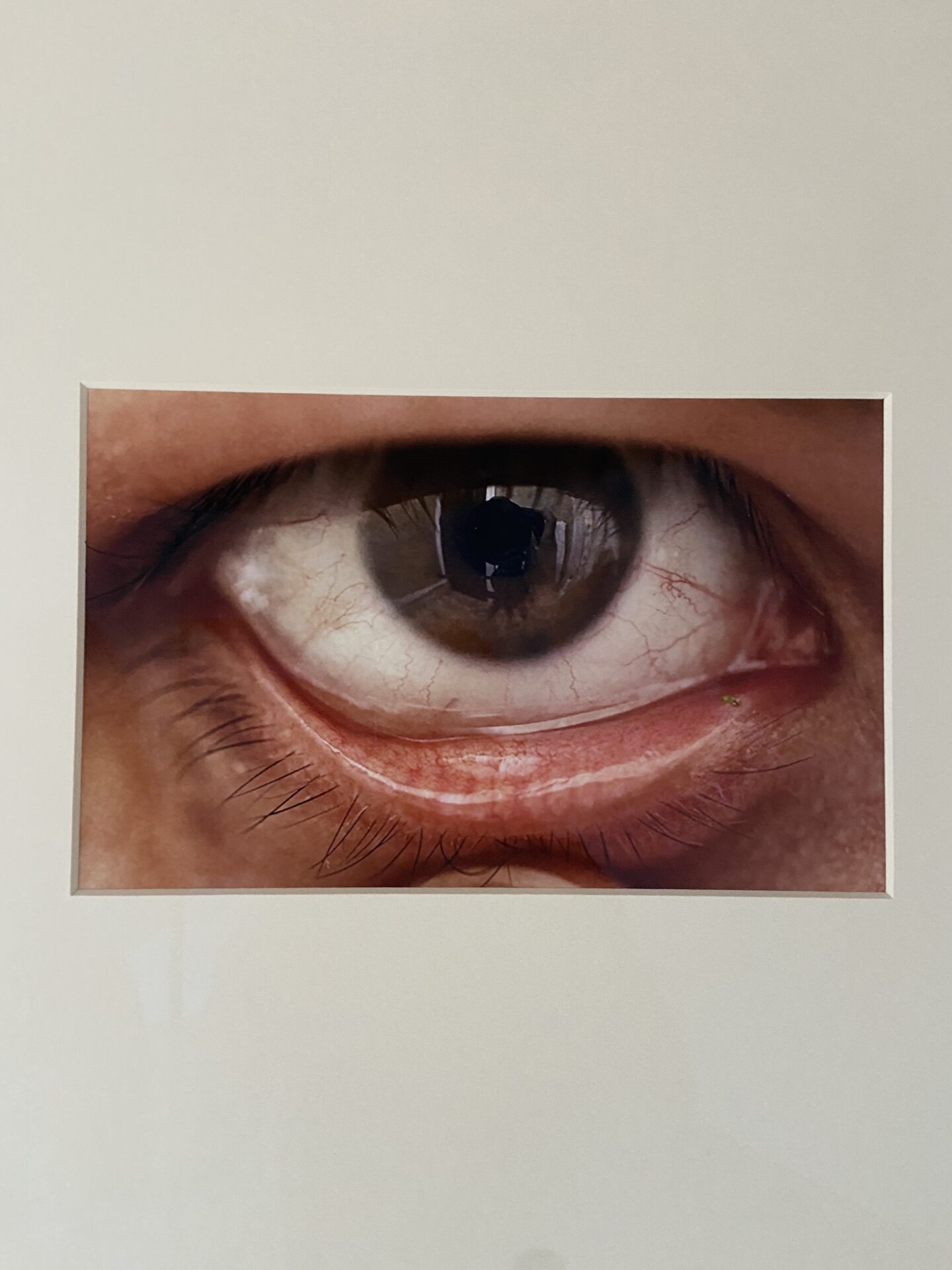
The desire for relationality becomes even clearer in Gómez López’s only successful experiment to date. In the lower level of the exhibition, the artist presents her productive attempt to grow a seed within her own eye. The cluster brings together the medical and practical instruments used during the experiment, an instruction manual in twelve languages for ocular germination, a photograph of a sprout emerging from the artist’s tear duct and microscopic photographs of both the seed and a tear. To achieve this result, the artist inserted a seed into a silicone prosthesis designed to hold lacrimal fluid and then placed it in her tear duct. She then lay face up on a table below a window and, after two weeks of tear irrigation and sun exposure, a miniature sprout emerged from her eye. As with the pearl-growing experiment, this experiment reconfigures the conventional function of a bodily organ, suggesting an alternative role of the eye beyond the seeing function.
Gómez López proposes the body as a site through which the world can be continuously reimagined. Through hypothetical or realised self-experiments, her work disrupts established truths and limitations of the body through processes of interchange and relationality. With an exhibition that acquires the form of a mosaic made of incomplete, imperfect yet interconnected pieces, Gómez López reminds us how it is exactly such fragmentation which creates a more productive and truthful understanding of the world. In this context, failure becomes inseparable from success: what matters is the constant experimentation that challenges fixed ways of existing and becomes a form of resistance.
⌀ [dia] was on show form the 29th of May until the 26th of July at Stroom
Delia Toppi
is an Italian art historian based in Utrecht, specialising in contemporary artistic practices