Following rootlets through the soil – Milena Bonilla at Ellen de Bruijne Projects
After a year of workshops with If I Can’t Dance, Milena Bonilla presents her first solo exhibition at Ellen de Bruijne Projects, where she continues her research into herbalism and botany. Notes on Soils, Light and Gravity dwells around plants and their past, presents and futures. A special focus is given to Rosa Luxemburg, who, besides her revolutionary practice, was also an amateur botanist. After attending some of Bonilla’s workshops, Nina Djekić visits the exhibition.
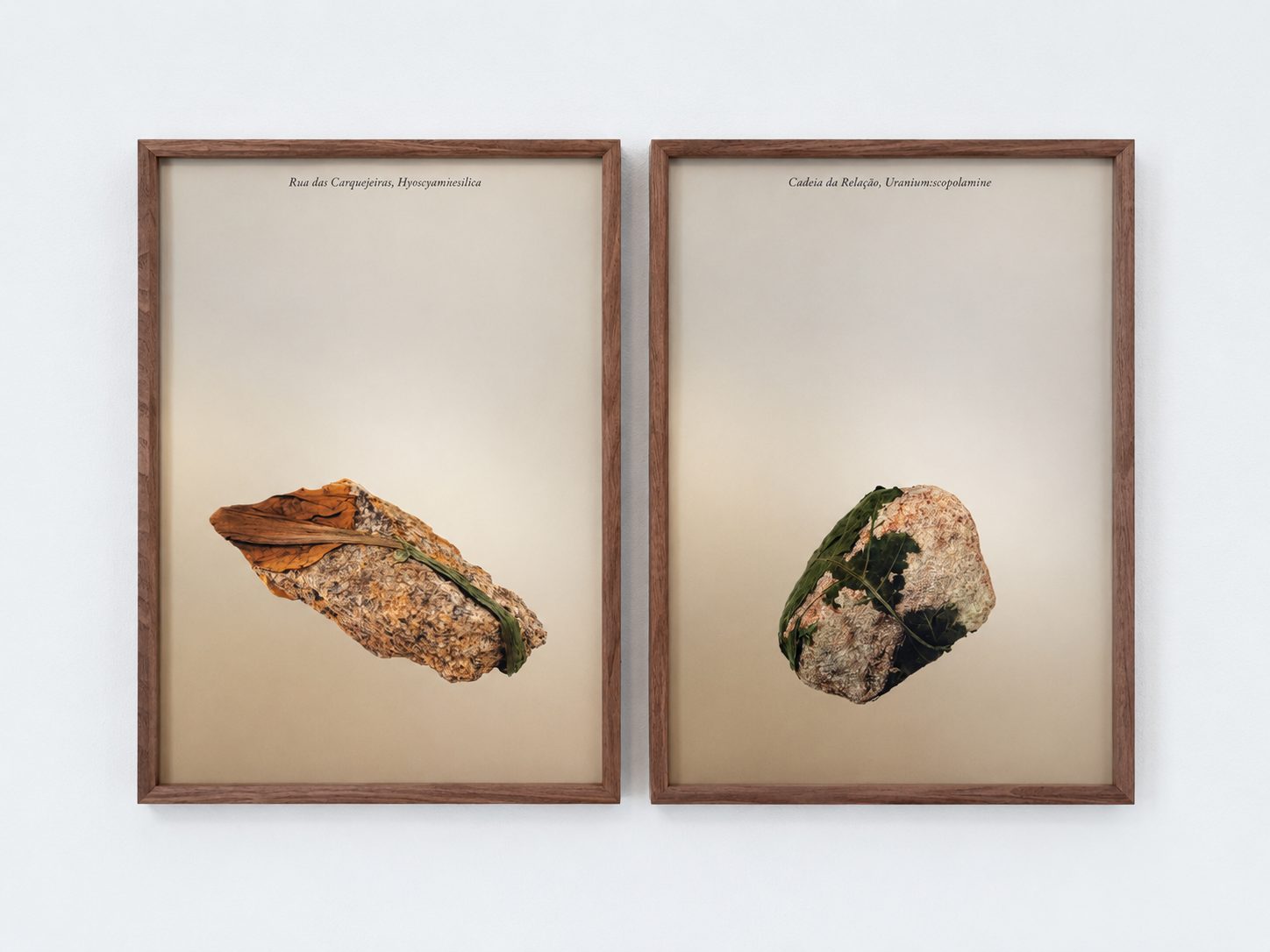
At the entrance of the exhibition Notes on Soils, Light and Gravity I am met by a series of photographic prints of rocks tightly wrapped up in dried up leaves and flowers. In one of the prints a purple funnel-shaped bloom, reminiscing a megaphone, presses against a granite-coloured rock like a skin-tight shroud. I guess it must be either a type of burgmansia or datura, both powerful alkaloids, which are also called Angel’s or Devil’s Trumpet respectively. An apt way to begin.
Each of the prints presents a rock found at different historical sites – from Colombia to Germany, all marked by (or monuments to) the history of colonialism and capitalism. These rocks, each in their own bespoke vegetal skin, possess a rebellious energy. As if embodying a latent force with a power to break through the hardened status quo. At the same time, they appear like peaceful offerings to the spirits tied to those places. As doorkeepers they guide us with a spirit of resistance, companionship and alliance. Perhaps they are amulets for those willing to momentarily let go of the present attempting to learn how to reshape it.
In the exhibition text I read that the portrayed plants are amongst the ‘Master Plants’; sacred vegetal teachers in the indigenous practices of the Abya Yala (the Americas). In Bonilla’s work and practice, informed by various herbalist (as well as decolonial and socialist) traditions, plants appear as powerful beings with intentions. They speak through the visceral; they teach resilience and adaptation through affect and seem to sprout where their lessons are needed.
At the top of each print, a line informs us about the location where the rock was collected and a name the artist coined for each presented subject, merging the plant and the mineral, pointing at a collaborative dynamic between the two realms: Crystal Palace, Lysergicquartz; Bundesministerium der Verteidigung, Ironnicotine or Cadeia da Relacão, Uraniumscopolamin.
This entanglement is also explored in the workshops Bonilla lead in collaboration with If I Can’t Dance in the year leading up to the exhibition. Titled ‘Ferals and Ruderals, A history through the cracks’, it unravelled over multiple sessions and walks around the WG terrain in Amsterdam, where If I Can’t Dance is situated in the building of what once was the women’s clinic of the Wilhemina hospital: A hospital designated for the city’s disenfranchised and those determined unfit for society. In the seventeenth century it was designed as the buitengasthuis, where plague victims were brought to by boat from the city and the surroundings. An island outside the city walls, obscured behind rows of large walnut trees, also to combat the foul smell.
The workshops focused on ruderals; plants that are among the first to repopulate an area where the ground has been disturbed. Bonilla lead us on a walk around the area, encountering it through the lens of the weeds (St. John’s wort, nettle, red bistort) that grow in the sidewalk cracks, unregulated. We walked across the Overtoom. A watercress poking from a narrow patch of soil at a side of a building alerts us that we are crossing a threshold. This is where a canal once marked the line between the living and the doomed. We also take notice of the elm and maple trees that replaced the walnuts, still growing in orderly grids.
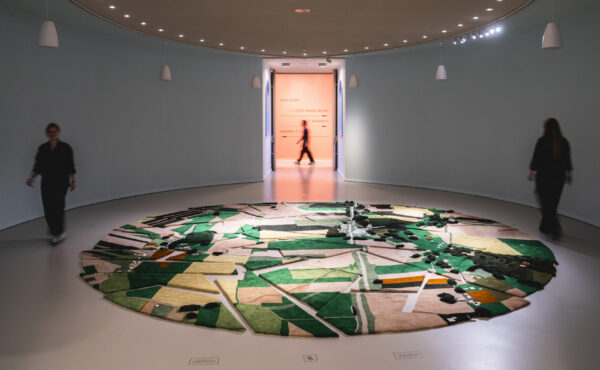
In one of the workshops, we are encouraged to spend time with a plant that attracts our attention, observing its cues, shapes, colours and smell. We listen and observe to interpret and imagine their backstory. We make notes, sketch and conspire. In the exhibition, a series of drawings that sprawl across a composition of pages as if taken out of a sketchbook, reminds me of this process. Systems of roots unfurl, like seen in cross section with ground horizon at eye-level. Some of the rootlets reach far down towards my feet, towards the earth’s core. Upon a closer observation the drawings reveal to be a kind of organic mind maps, in which many timeliness and dimensions are drawn out like annotations to ever growing histories of entanglements.
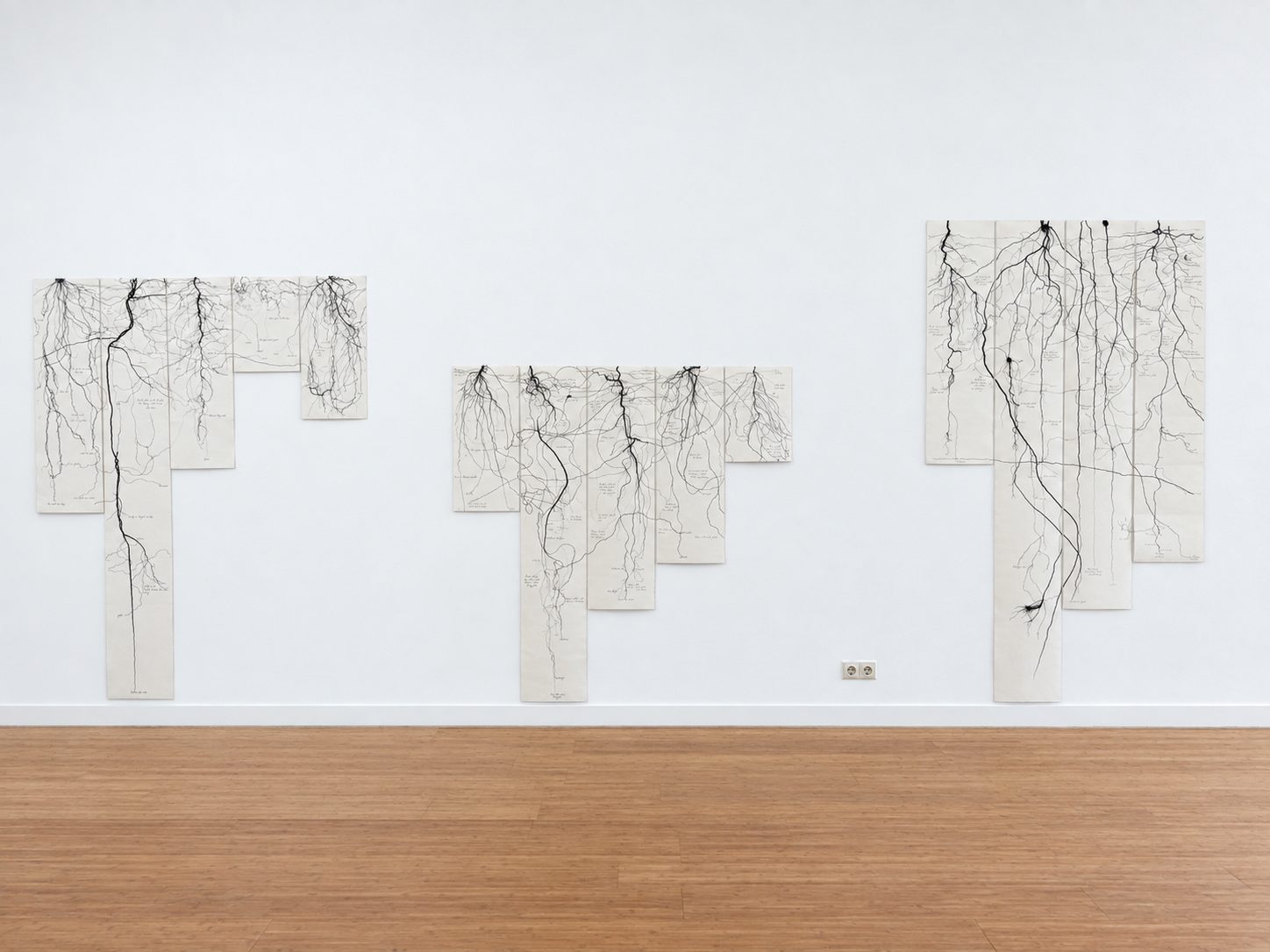
One of the drawing clusters, titled Sketching for Gardening series (ii) (2026) speaks of the buitengasthuis, through the rootlets of mugwort (Artemisia Vulgaris), a common medicinal plant of the era. Key words and poetic notes scribbled in between this labyrinthine network point at the many subjectivities contributing to the history of the place – the company, the grid, the nurse, the witch, the mineral, the soil, the seed. Bonilla exposes connections between the logics of extraction, confinement and psychiatry on one hand and companionship, care and resilience (of bodies, thought and spirit) on the other.
I read through a collection of short texts accompanying the drawings. In an oracle-like manner they elaborate on the events and transformations that informed the work. Allowing them to non-linearly unwind through time: 1912, 1805, 1905… The construction of the palm house, a monumental greenhouse in Hortus Amsterdam. The transformation of the buitengasthuis into an asylum. A plan to convert one of its buildings into an ethnographic museum.
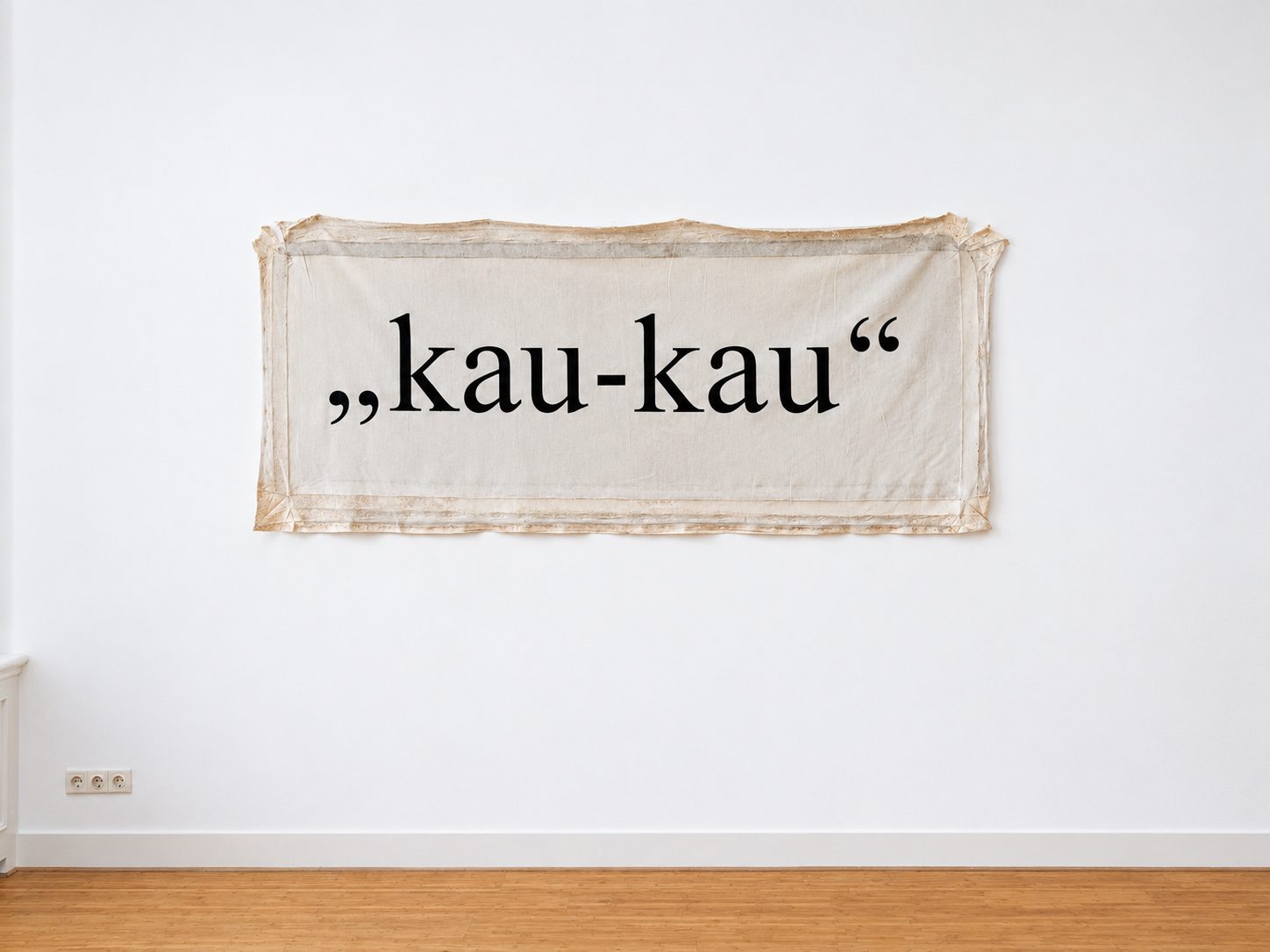
Following the inky horizon, I reach the other end of the gallery. By the window looking out towards the canal and the trees that line it, I am faced with a canvas banner painted over with loud black letters. Kau-Kau. They announce the section of the exhibition centred around Rosa Luxemburg, a revolutionary but also an amateur botanist.
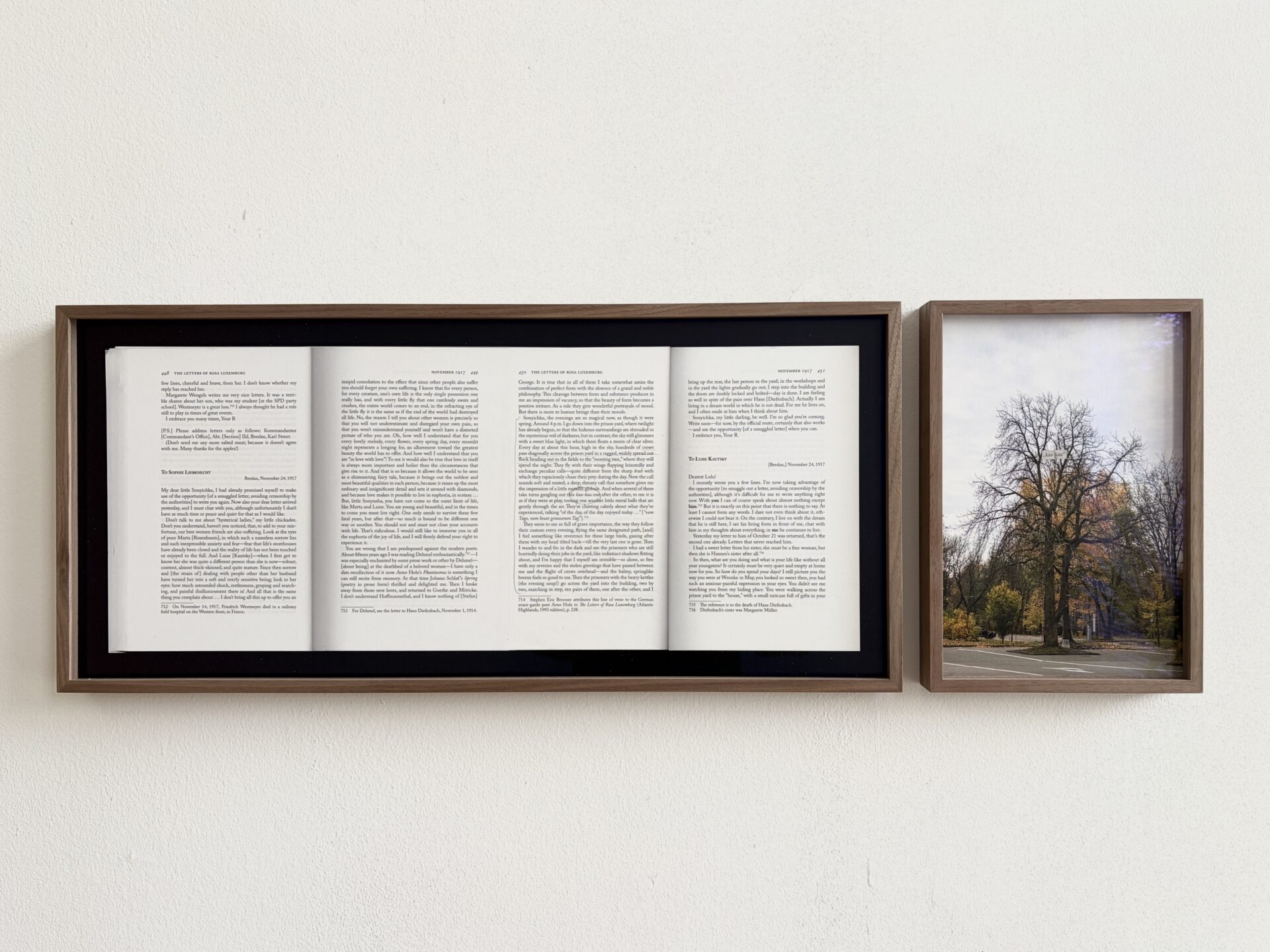
Titled Letter To a Roosting Tree (2025) the banner was previously mounted on a large horse chestnut tree in Ujazdowski park in Warsaw. That tree is seen on a photograph accompanying the banner. Hanging next to it is a print of an excerpt from Rosa Luxemburg’s letter she successfully smuggled out of prison via a resistance network. At the centre of one of the pages the same word is encircled: Kau-Kau. It echoes between the banner, the image and the letter. In the intimate letter to her friend, Luxemburg is describing a daily occurrence in late afternoon when twilight begins to set in the prison yard and ‘hundreds of crows pass diagonally across’ towards the ‘roosting tree’. Listening in to the conversation of the crows, she revels in this moment of ‘stolen greetings’ exchanged under a patch of an exposed sky.
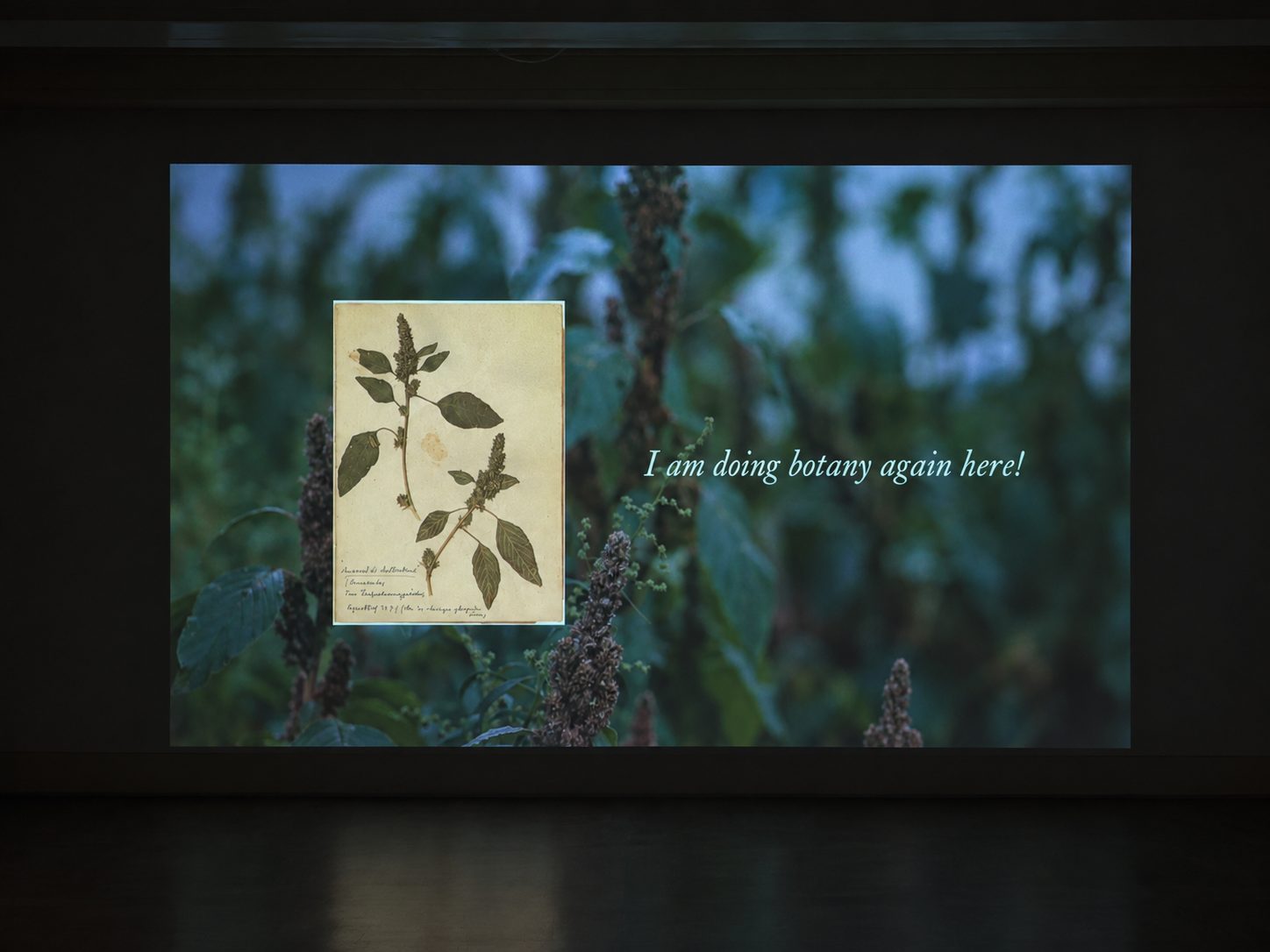
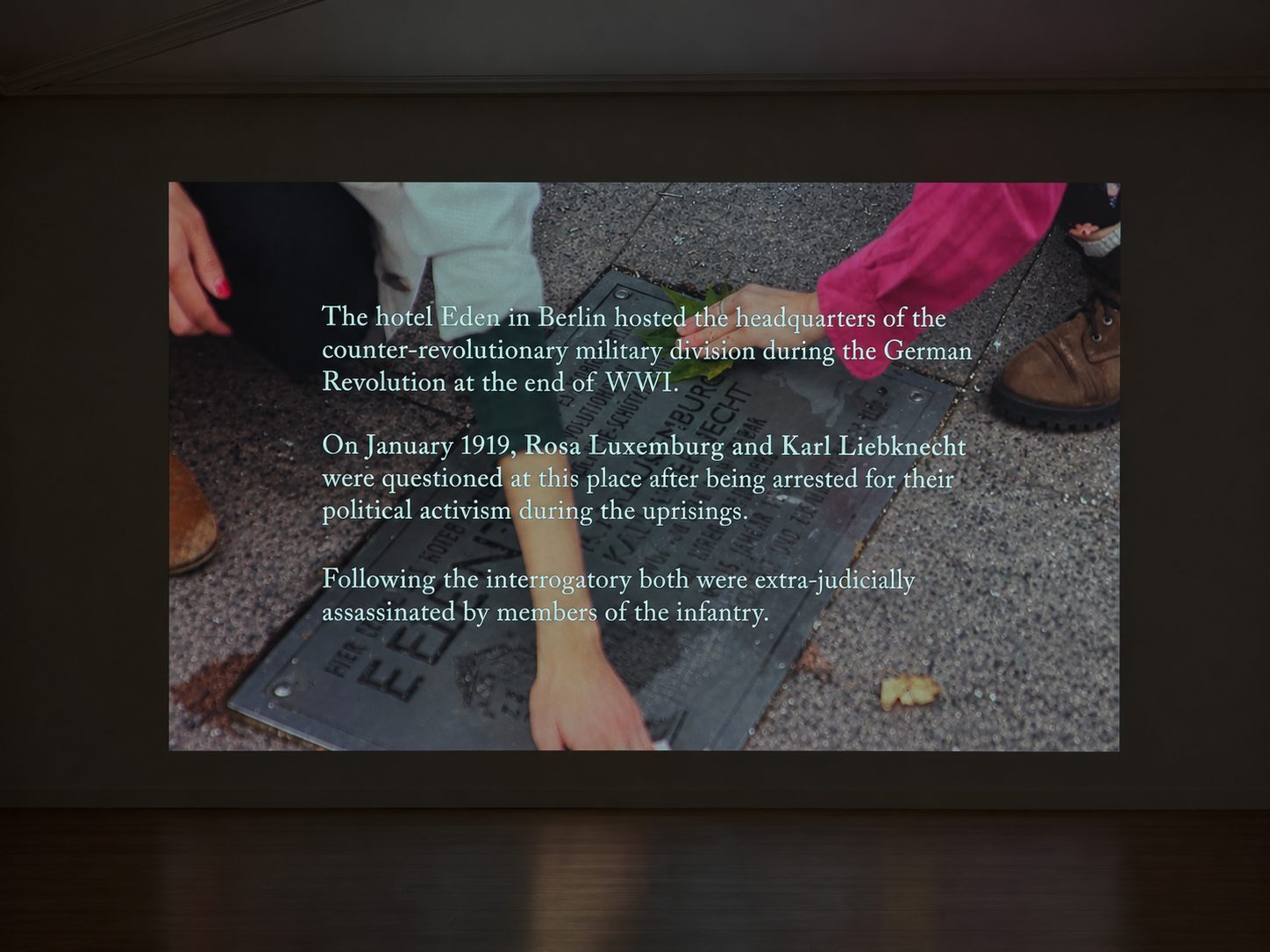
The final work in the exhibition, is presented in the back space of the gallery. The video series I am Life and Life is Beautiful (2020-2022) explores the conjunction of herbalist philosophy and political strive and resilience through the life of Rosa Luxemburg. Each of the three videos in the series is set in a different location in Berlin, following the path of the radical socialist from her questioning at Eden Hotel to her violent death at Landwehr Canal, concluding at her eventual grave site at The Memorial of the Socialists at Friedrichfeld Cemetary. The videos feature pages from Luxemburg’s own herbarium, for which she passionately collected plants between 1913-1918, also through her incarcerations in Poland and Germany. Some were sent to her by friends.
As if inspired by Luxemburg’s vitalist curiosity and critical enquiry, the work unfolds through a conversation between the artist and Berlin based herbalist and dancer Shelley Etkin. Following the herbalist methodology, they develop connections between plants’ apparent qualities (shape of the leaves, bitterness…), their medicinal properties and bodily affects. The conversation flows as if by association to speak of systemic imbalances and political agency. Indirectly entering into dialogue with the narration on Rosa Luxemburg’s work, her political organising and the historical events around the time of her death in 1919 that unfolds in the captions.
Bonilla’s work takes poetic leaps and on occasions lead us down dream-like paths, not shying away from dark places: Like following rootlets through the darkness of the soil, by trusting the sensation between one’s fingers. As a natural storyteller, her works have the capacity to thread vulnerable connections into poetic webs that amplify resonances between experiences, ontologies and knowledge traditions. In spirit of Luxemburg’s fight for borderless solidarity, Bonilla lets them sprout across different geographies and contexts.
Notes on Soils, Light and Gravity is on show until the 17th of October at Ellen de Bruijne Projects
Nina Djekić
is an artist and choreographer whose work revolves around notions of movement and embodiment as entangled with language.