The Immorality of Immortality and other Digital Dilemmas – CODE 2024 at IMPAKT
At CODE 2024 at IMPAKT themes such as the right to be forgotten, the use of AI in image creation, and the tensions between personal identity and public perception are modern, massive, and imminent. During the exhibition at IMPAKT Julija Zagurskyte examines how unnatural certain technological developments can feel and how important digital rights are.
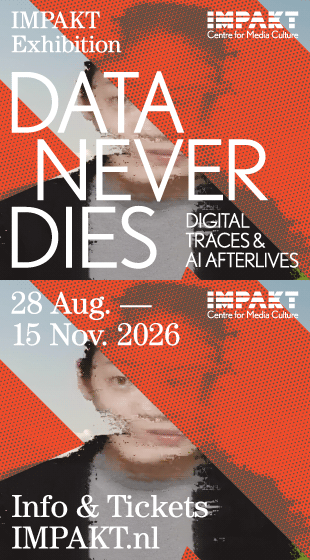
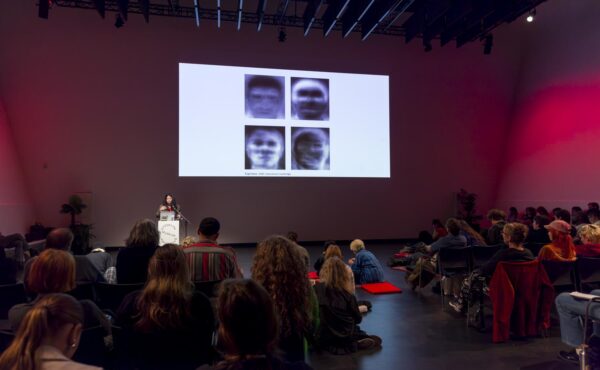
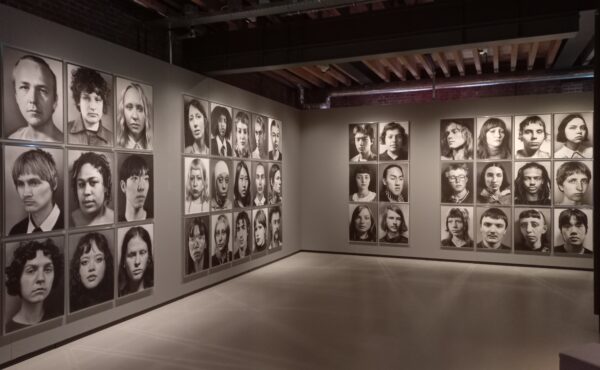
IMPAKT is an organisation based in Utrecht, aiming to present critical and creative perspectives on media culture and the arts. They explore social, political, and technological trends, as well as dominant perceptions in society. It is no surprise then, that here, the dark developments of artificial intelligence and tech monopolies come to light. From the 30th of August to the 13th of October, IMPAKT is hosting the CODE 2024: Deep Nudes and Digital Oblivion exhibition. CODE is an initiative that seeks to ensure politicians, policymakers, and general audiences fully understand the urgent digital challenges of our time. The 15 participants, from 11 different nationalities, consist of artists, designers, researchers, activists, and tech industry workers who collaborated for this year’s CODE 2024, illustrating the fact that these themes transcend borders and cultures.
In the entrance of IMPAKT stands a clear fishbowl filled with fortune cookies. I grab one and walk into the large, illuminated room behind a heavy curtain. It seems the small silver package in one’s pocket is the only indication that you were somewhere else before you were here. The windowless, industrial space is at once eerie yet bright. Projections are scattered on the walls, an inexplicable blob towards the middle sits on a lapis carpet, and large, black-clothed boxes promise video installations.
And seemingly out of nowhere: posters of cowboys greet visitors on the back wall. A piece interestingly called TOYBOI, another CODE 2024 project by Emily Hsiang-Yun Huang, Claudia Oliveira, Gema FB Martín, and Lotte Louise de Jong, interrogates patriarchal structures in deep nude technology. The team explains that deep nudes can be made using ‘undressing tools’. On the web, a picture or video can be uploaded by anyone, most often without the consent of the subject, and nearly always of a woman. Then, this program ‘undresses’ them presumably using the same technology like those in AI image generators. On the exhibition wall of the IMPAKT Centre, it is nude cowboys that are seemingly scantily dressed and compromised. The Marlboro man advert has come back, but this time, with the use of deep nude technologies, he is naked. But none of these indecently dressed men’s genitals looks “normal”. Instead, where one would expect genitals, a failed image has been generated, making it obvious that the program lacks enough data points to generate convincing anatomy because it primarily wants to portray a vulva. These algorithms are only as good as the data they have, and if it mostly saw vulvas, it will generate ‘something’ of the sort. Unlike the real world, there is no binary standard in generators. But much like the real world – there is most certainly bias.


Deep nudes are not a new phenomenon. High-profile celebrities like Taylor Swift have been victims of such scandals since the technology began circulating the dark corners of the internet. It doesn’t stop there. In March of this year, the UK newspaper The Guardian reported that over 4,000 celebrities have fallen victim to this evil.[1] It has now started infiltrating schools and affecting young women everywhere. Yes, it is an issue of depravity, but it is also an issue of gender inequality. The TOYBOI website [2] notes that it is women who are most vulnerable to these attacks on their image, and they are the ones who bear the brunt of the pain. When the TOYBOI project uses the messy and mangled depiction of manhood to sell lighters or postcards with these images, it feels like retribution. Alas, only time will tell whether this is an effective way to address the problem.
Moving towards the centre of the room, something soft and white blooms around a short fountain spouting water. Unlike the Trevi Fountain in Rome however, the sculptures in the middle are small, and instead of emulating gods in stone, plastic security cameras litter the beam which rises above the bubbles. Water flows from its centre and disappears into the ring of bubbles which sits like a cloud atop the round lapis carpet on the floor. The playfulness of the piece makes up for its smallness. This fountain and project produced by Aleksandra Naydenova, Amber Macintyre, Cyan D’Anjou, Dorijn Boogaard and Kurina Sohn is called META:MORPHOSIS (2024) and is accompanied by a light purple zine. Inside is a piece of soap paper. On the ground next to the bubbles are simple instructions. Guests are encouraged to write down what they want to be removed and forgotten from the internet and place it in the fountain. This will then presumably feed the fountain and create more bubbles. Surprisingly, my wish came out of nowhere. The soap paper, which left my hand read: “Any trace of my personhood in the digital space.” It washed away, or more accurately, transformed into the mass of effervescent bubbles gently floating just above the ground. This simple act led to a disturbing realisation about the “nature of the digital space” – its total unnaturalness. In an exhibition addressing themes like ‘being forgotten’, I can’t help but think what would happen if I were to stop existing. How my memory would stay in the digital by way of “footprints” and pictures. But nature is cyclical: things have to die, to change, to sustain life. “Forever” is a horror story told to children, previously taking the shape of vampires and zombies.


CODE 2024 is the fourth year of this initiative to address large digital concerns at the IMPAKT Centre. Alongside the four projects from 2024 were some others from previous years. One that especially stood out was the DSMA Unlimited (2022) project, which proposed the humorous business model of selling parts of European legislation intended to regulate digital services.
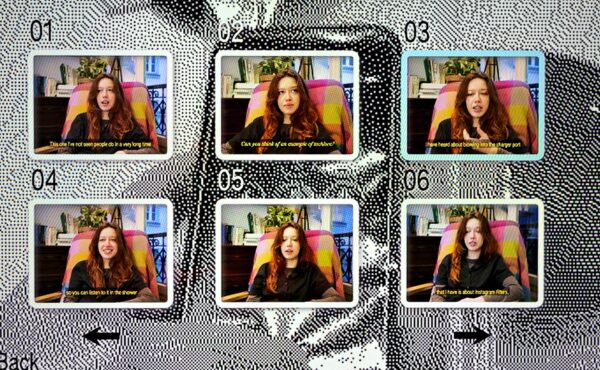
Another standout project was clickedy.click (2023); an interactive work/social experiment that gives users a deeper sense of how all their information – down to the movements of their mouse – can be tracked. It’s presented in the attractive and pastel format of a dating platform, effectively driving home the idea that a lot can be garnered from seemingly useless information like (how you click and hover over a button). Admittedly, it’s a fun experience to be categorised based on something as innate as how you take up space on your screen. To meet someone this way is even exciting. Equally horrifying, however, is the reminder that categorisations of people types by large institutions has not always stayed benign throughout history and I wonder, even now, whether I really should have submitted my email into the database of the project.

The CODE 2024 exhibition addresses many issues. Although not every work was as relevant or original, the experience leaves a refreshing, almost relieving sensation. The issues stemming from the digital world have hit us fast, but here guests are encouraged to slow down and think about topics which were previously outside traditional conversation. These are issues people were afraid to discuss, fearing they didn’t know enough to have an opinion. In this room a slow understanding begins to form – one does not need to be an expert in coding or AI to know they wouldn’t want a stranger making deep nudes of them. Something like the right to be forgotten feels innately right, because change is a quality bestowed upon us by nature. So, with a mind full of questions, anecdotes and some hope, one exits through thick curtains.
I crack open the fortune cookie from before and it says: “Update your values everytime you update your phone.” One can’t help but agree to these terms.
Julija Zagurskytė