The Need for Alternative Futures – Taking Root Among the Stars at W139
How various artists offer hope in times of despair and chaos. Katia Krupennikova visits the exhibition Taking Root Among the Stars at W139 and explores the significance of the alternative futures it presents
In times of despair, how can visual art respond with a proposition of hope? In Octavia E. Butler’s post-apocalyptic dystopian novel Parable of the Sower (1993), the year 2024 is marked by the devastating effects of climate change, rampant corruption, and radical social inequalities. The story follows an African American teenager named Lauren Olamina, burdened with hyper-empathy—a condition that causes her to feel the physical pain and emotions of others as if they were her own. As President Donner grants unlimited power to corporations, Lauren imagines a new religion called Earthseed. Her teachings are encapsulated in the Earthseed verse: “All that you touch You Change. All that you Change Changes you. The only lasting truth is Change. God is Change.” This philosophy emphasises resilience and adaptability, echoing the biblical Parable of the Sower in its focus on spreading ideas persistently and finding fertile ground where they can take root. Like the sower scattering seeds on different soils, Lauren urges her followers to plant the teachings of Earthseed in diverse contexts until they find the “good soil” where hope can flourish.
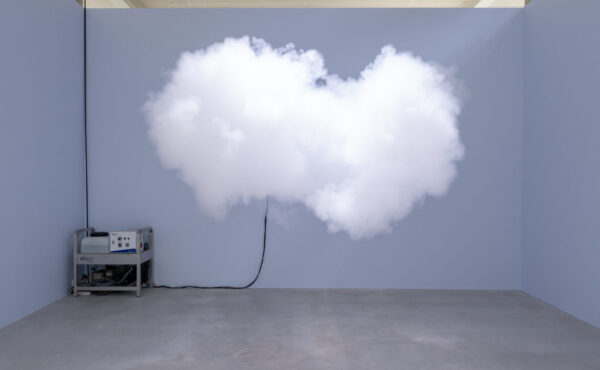
Opened in 2024, the exhibition Taking Root Among the Stars at W139, initiated by artists Müge Yılmaz and Anna Hoetjes, reimagines the universe as a space where diverse forms of knowledge can evolve. The exhibition space impresses with its sharp visual strength, where every shadow falls at the right place, and every piece starts the web of conversations with other works and the audiences, it offers a speculative of realm propositions for non-linear thinking.
The artists in the show draw inspiration from feminist, trans, queer, and decolonial perspectives, as well as science fiction as a method of “speculative worldbuilding.” Through this lens, the exhibition imagines alternative perspectives, methods, and visions of social and political realms. Many of the works are organised as community spaces – universes, or planets that propose shelter, reflection, regrouping, and rest. These “planets” are not hermetically sealed or bounded but exist as open, relational, and borderless entities, ready to “become-with” their human and non-humans neighbours and inhabitants.
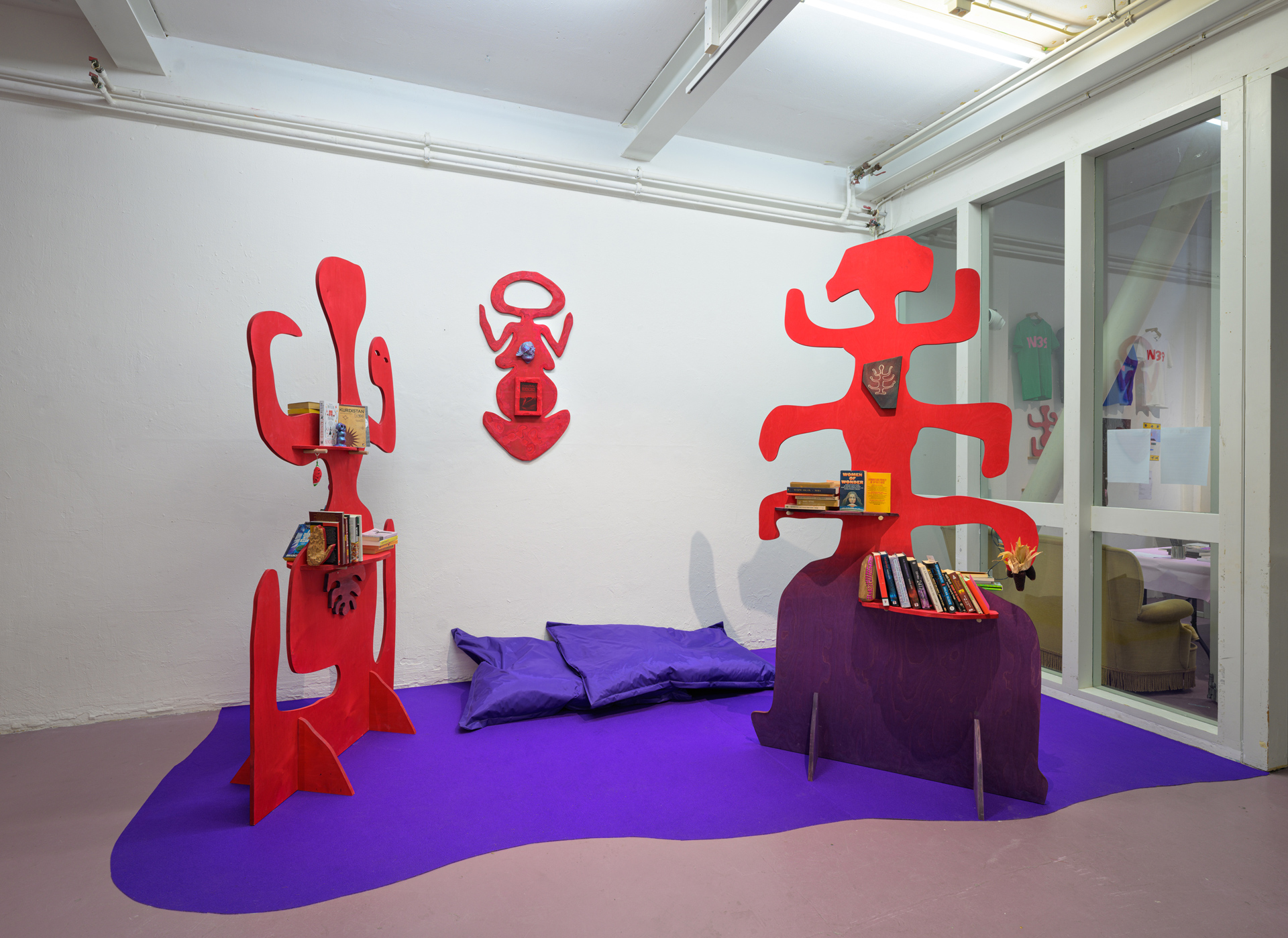


At the entrance to the exhibition, Müge Yılmaz’s social space, The Adventures of Umay Ixa Kayakızı (2022), invites visitors to explore a feminist science fiction library of 250 texts by female, trans, and non-binary writers. Collected by the fictional character Umay Ixa Kayakızı, this library offers a spot for reflection and contextualisation of the exhibition.
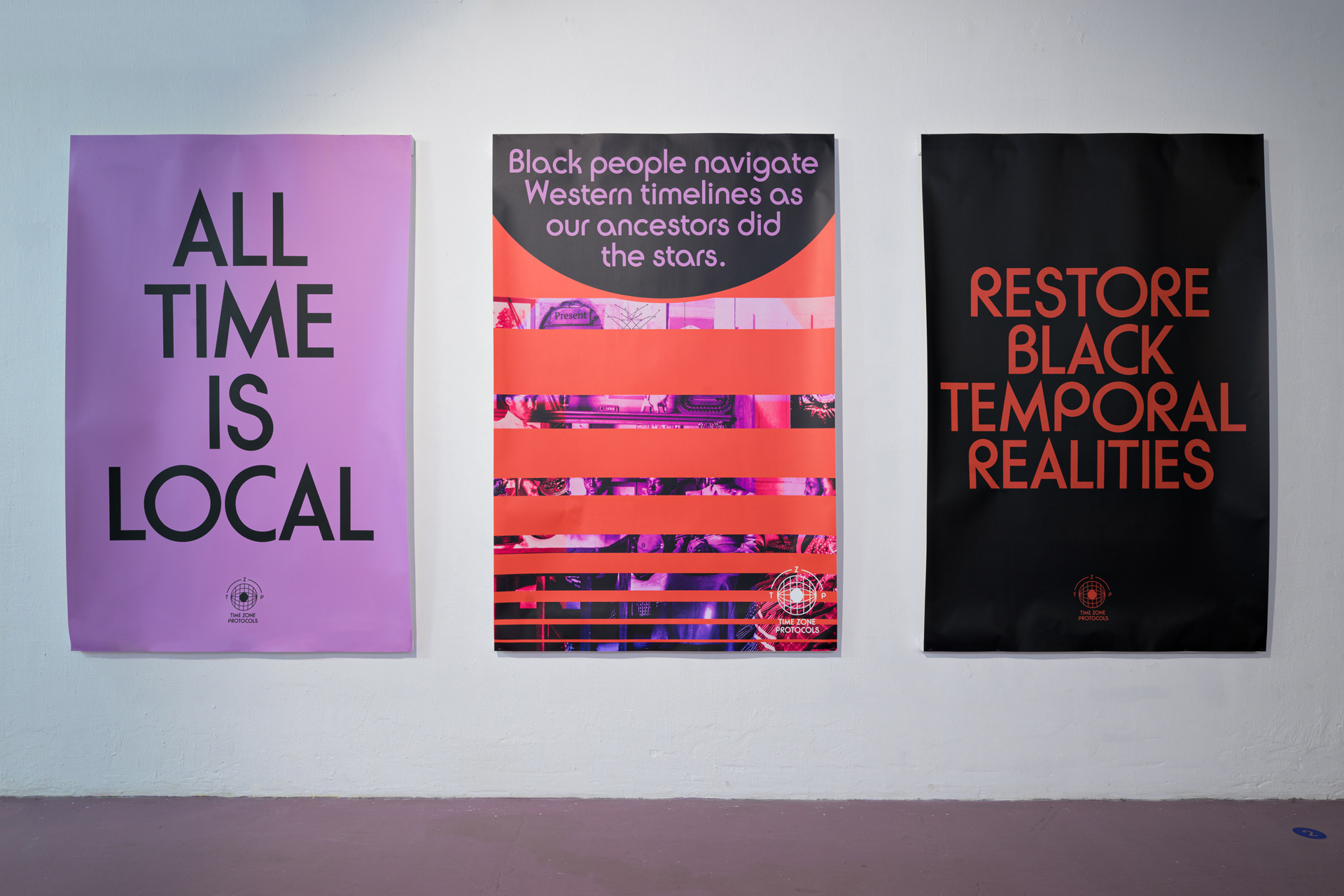
A few steps further, Black Quantum Futurism’s installation Time Zone Protocols (2024) presents a map of existing written and unwritten agreements regarding how time is measured and compared. It includes the “Protocol Proceedings” developed at the 1884 International Prime Meridian Conference, where Greenwich, London, was established as the world’s base for timekeeping. This map questions the ownership of time and proposes reclaiming it as a resource and tool for resilience. The installation also includes blank papers, inviting participants to respond to urgent questions about time and its perception. Above the map, a neon word “time” flashes every three seconds, alluding to the speed of light in a vacuum (300,000 km/s).


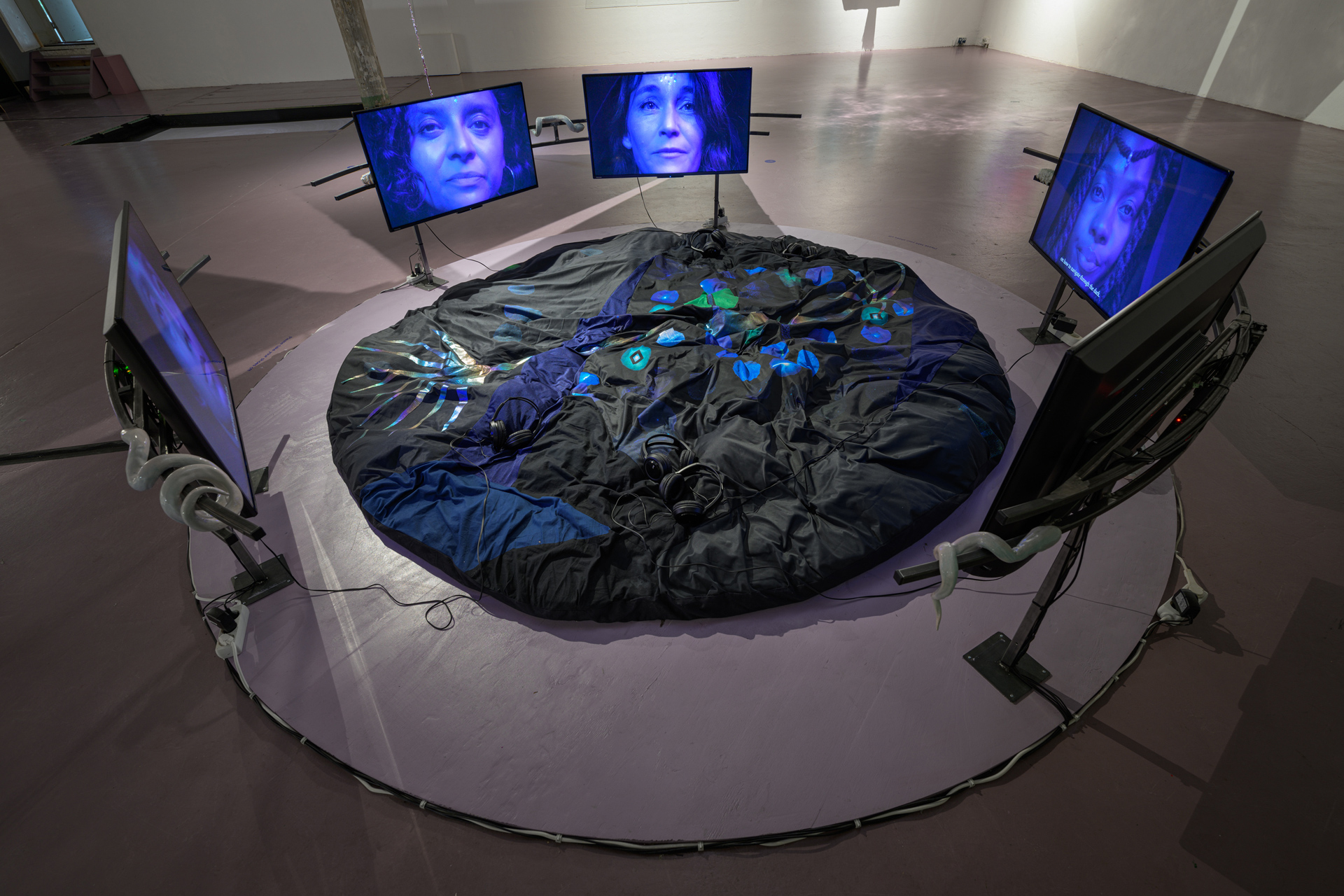
In the central space, Anna Hoetjes’ installation, The Armpit of a Giant – or the Juice of a Beetle (2024), immediately commands attention. This large circular textile and video installation is set in a post-apocalyptic moment where “Seven Siblings,” representing “the seven stars of the Pleiades Constellation—one of the most ancient star clusters known to humanity—gather in an old observatory” to discuss what knowledge can be passed on to future generations. The “siblings” are portrayed by individuals from diverse disciplines, including astronomy, poetry, theater, activism, biology, and music, weaving together a richly layered narrative.
In the right corner, Maartje Folkeringa’s sculptures, part of the series Afleiding als Aanleiding (Distraction as a Cause) (2024), evoke alternative realities and worlds. Drawing inspiration from such writers as Octavia E. Butler, Lee Bontecou, and Jennifer Higgie, the sculptures reference the cosmos, hidden frequencies, and the infinitely unknown. Next to them, delicate glass shelves hold spatial experiments, material and color studies, and imaginative sketches that captivate with their fragility, vivid textures, and dreamlike forms.

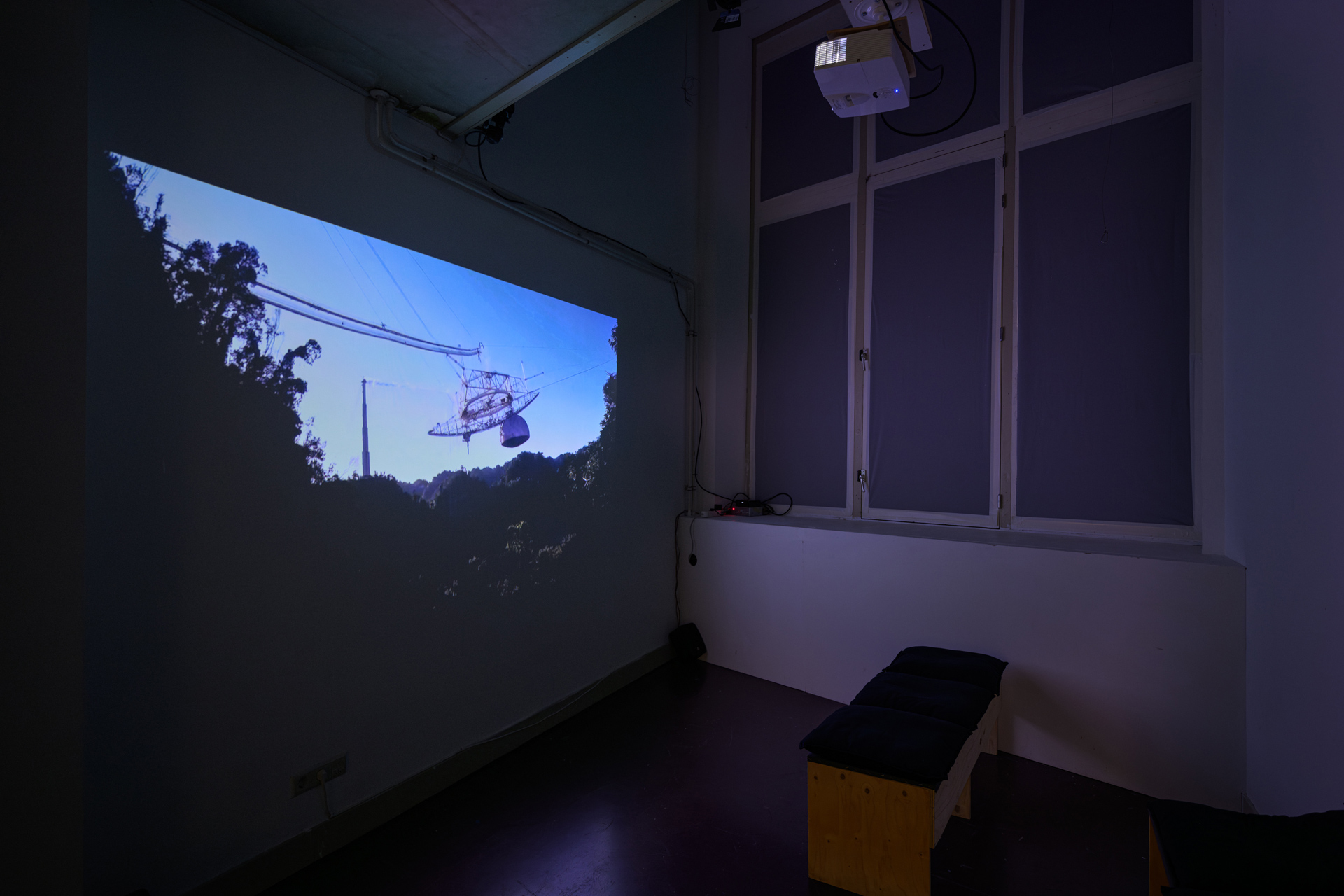
In a side space, Brittany Nelson’s video I Can Hardly Bear It When It is Over, I Can Hardly Bear It When It Starts (2022) offers a poetic reflection on the collapse of the Arecibo Telescope in Puerto Rico in 2020. Interwoven with this imagery are excerpts from letters exchanged in the 1970s between science fiction writer James Tiptree Jr. (a male pseudonym of Alice Sheldon) and Ursula K. Le Guin., Sheldon’s work explored closeted sexuality and desires through the metaphors of alien encounters. Over 500 pieces of letters filled with flirting and homoerotics, have been transformed into a single poetic narrative, referencing both personal and cosmic collapsing.
Today, 30 years after Butler imagined her novel, the effects of climate change, the war in Ukraine, the genocide in Gaza, the recent inauguration of Donald Trump, and the rise of radical right-wing politics across Europe make the imagined future of Parable of the Sower increasingly reflective of our present. In Taking Root Among the Stars, the works of AiRich, Black Quantum Futurism, Maartje Folkeringa, Anna Hoetjes, Adriana Knouf, Brittany Nelson, Ada M. Patterson, Sondi, Müge Yılmaz, and Fei Yining serve as a reminder of the urgent need to imagine alternative futures and paths of the present.
Taking Root Among the Stars is on view until 2 February 2025 at W139, Participating artists: Anna Hoetjes, Müge Yilmaz, Ada M. Patterson, Adriana Knouf, AiRich, Black Quantum Futurism, Brittany Nelson, Fei Yining, Maartje Folkeringa, Sondi
Katia Krupennikova
is curator en schrijver