Liveable and sustainable workshops – Harriet Rose Morley’s Waste Not, Want Not: An Incomplete Manual for Artists, Technicians and Workshops
During her Technical Fellowship at the Rijksakademie, Harriet Rose Morley investigated the role ecological sustainability played in technical creative workshops. Her recent publication Waste Not, Want Not: An Incomplete Manual for Artists, Technicians and Workshops is the outcome of this research. In it she invites artists, technicians and creative producers to think carefully about the longterm impacts of their work with materials, and the underlying conditions and practices which sustain the bodies that that work in a space so that work done now will continue long into the future.
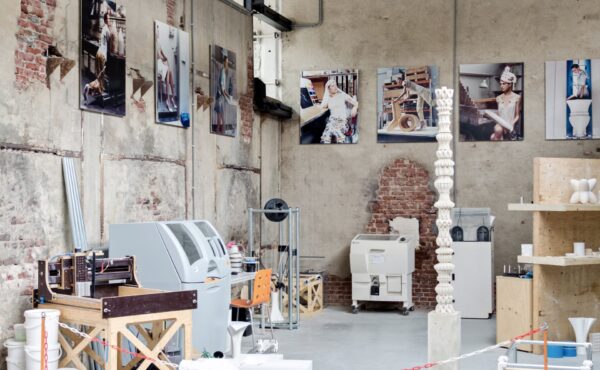
Morley’s research, which was developed over a year in which she was a Technical Fellow in the metal and wood workshops at the Rijksakademie, took her to technical workspaces of artist residencies across the UK and Northern Europe, and into conversation with the technicians, artists and organisational staff who work within them. On these visits she observed numerous ‘small but meaningful adjustments and “hacks”’ which endeavoured to improve the conditions of sustainable practice within the workshops. Waste Not, Want Not, the resulting manual, collects these case studies and looks at specific practices, such as how an old phone book shredder was repurposed at MAKE Eindhoven to recycle mould making materials, or an Alternative Foundry using end of life vegetable oil in Edinburgh Sculpture Workshop. There are also practical guides which offer methods for making potentially intimidating encounters more accessible, such as a guide for visiting scrapyards, discussions around workshop signage and reflections on how community guidelines can create more welcoming environments. For Morley these ‘bottom-up’ initiatives are important. ‘Everything that I’ve come across is quite commonsensical,’ she says. What continuously struck Morley was not the discovery of new methods, but how little infrastructure was in place for workshops to share this information among themselves. Her aim is to start thinking about ‘how they can be firstly collected and shared but also become embedded into the longer term.’
Throughout her working life as an artist, Morley has crossed the threshold of many workshop spaces. Both through this personal experience and her ongoing research, it became clear for Morley that sustainable practice does not exist in a vacuum. There are a myriad of contexts which shape the way people work in workshops, and these spill into how ecological sustainability is approached. Often overlooked, and yet inescapably present is the social and emotional quality of this work, which is usually collaborative and takes place in communal environments. ‘For me,’ Morley explains ‘making is an extremely intimately vulnerable process, but somehow workshops don’t necessarily feel like spaces where this vulnerability is allowed.’ She observed that no one really talks about this aspect ‘but what I’ve seen is that everyone is thinking about it.’ Acknowledging this affective context in which work is made is important, because ‘how people feel in workshops impacts how people work in workshops and how people work with materials.’
What Morley means is that when workshops are welcoming and accessible for all who use them, ecologically sustainable practices have a far greater chance of succeeding and being maintained. It is often the case that the barriers that prevent artists and technicians from trying new ways of working has more to do with whether they feel invited and encouraged to do so, not their unwillingness to work differently. Simple considerations, such as adjustments to the height of a workbench, let people know that ‘a range of bodies, needs and approaches are anticipated and welcomed.’
‘making is an extremely intimately vulnerable process, but somehow workshops don’t necessarily feel like spaces where this vulnerability is allowed.’
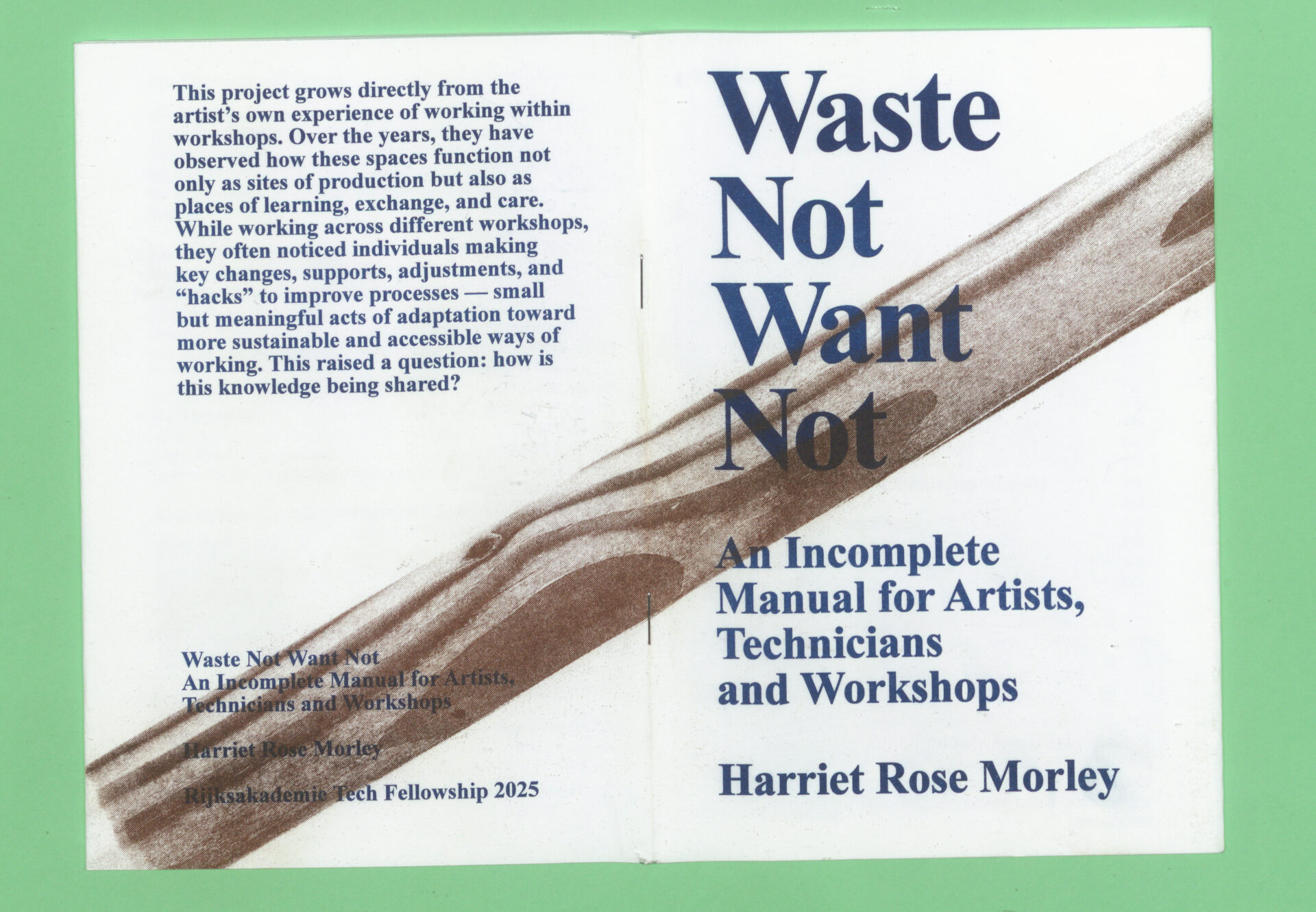
A similarly important factor is the environmental and social context in which a workspace is located, which has a direct impact on what sustainability might look like for them. There can be no one-size-fits-all approach as what works in one organisation may not translate to another. As such, knowledge sharing must be open, adaptable and evolving—inviting people in and welcoming conversation. In highlighting specific case studies, Morley attempts to show how diverse this work can be. She offers not fixed advice, but potential models which can be borrowed from, reused and adapted—in much the same way as the materials, machines and making processes illustrated in the handbook are.
The economic conditions in which workshops, technicians and artists work are also directly connected with how sustainable practices emerge and are maintained. When broaching this topic with those she met, Morley describes how she ‘felt that some people thought ‘why are you trying to address both of these things together, they should be separate issues.’’ She acknowledges that any discussion of working conditions is delicate, but she is deeply curious about the part these conditions play in the conversation about sustainable practices. Because practices which are ecological are already deeply intertwined with those that are economical.
‘The spaces that had the least amount of money or were the most precarious were the spaces that were thinking about ecological sustainability most.’ If resources are tight, then people are more urgently pushed to reuse materials, repurpose waste or streamline processes that will also save money. A pressure on resources will often necessitate the kind of ‘hacks’ Morley has gathered. However, the flip side of this is that there isn’t as much time, money or bandwidth to sustain long term solutions, sustain the people implementing them or to share approaches with others.
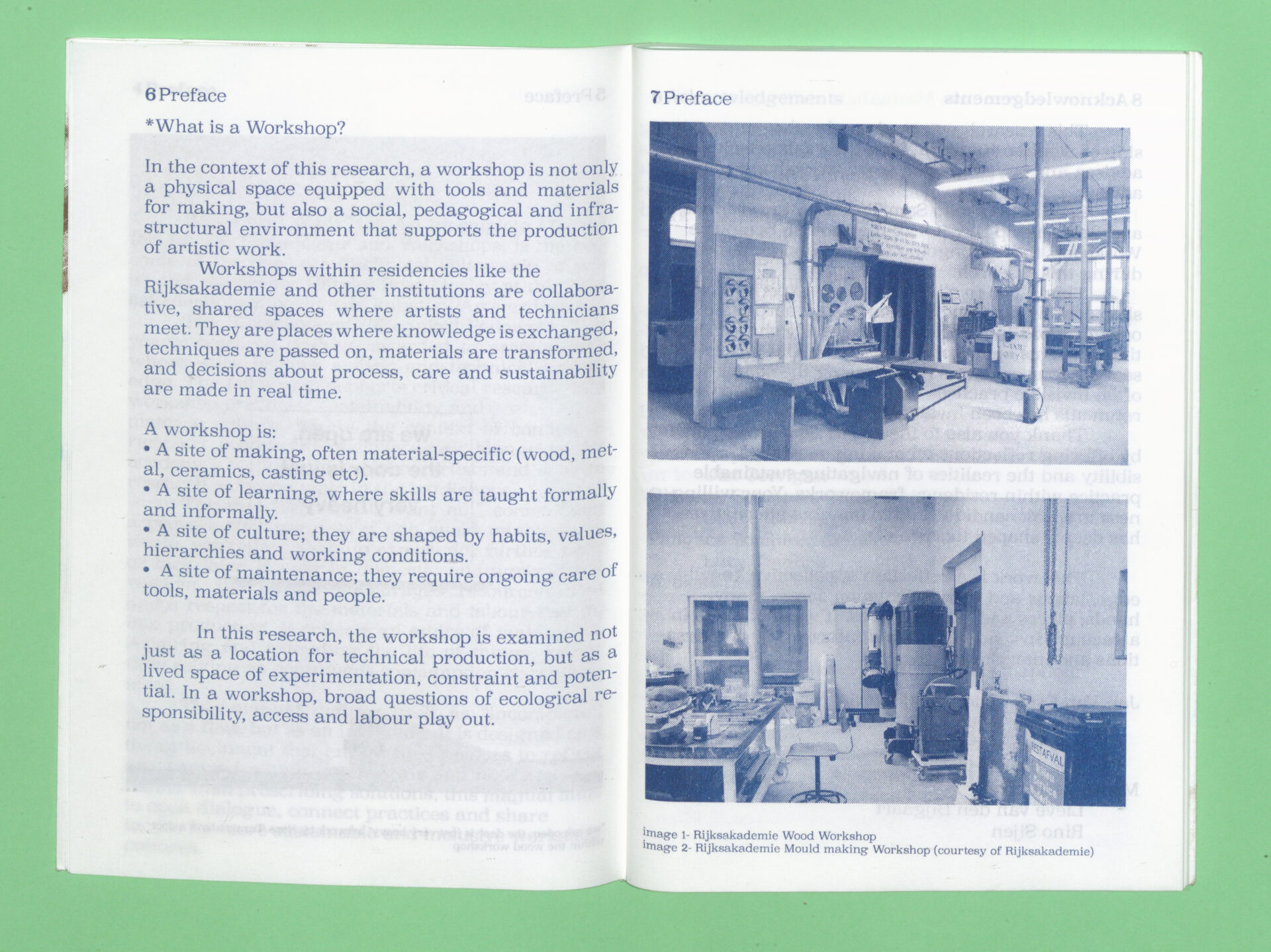
Reflecting on the context in which this research took place, Morley observes that the Technical Fellowship at the Rijksakademie has provided opportunities for practical sustainable and ecological making processes to be researched in depth, some of which are referenced in the handbook. However, as the publication notes, these developments ‘remain reliant on individual motivation and capacity, rather that institutional support.’ If there are no systems in place to ensure these changes are adequately folded into the ongoing years, they may disappear again as soon as those who initiated them leave.
It is particularly important to Morley that the manual is titled ‘incomplete’. This is not the beginning or the end of this conversation, but a snapshot in time of practices already in use. The blank spaces within the book itself invite annotation, note taking, questioning, and Morley hopes in future to make a second edition which builds on the first. The handbook is already acting as ‘a site of exchange’, spilling out and continuing to grow.
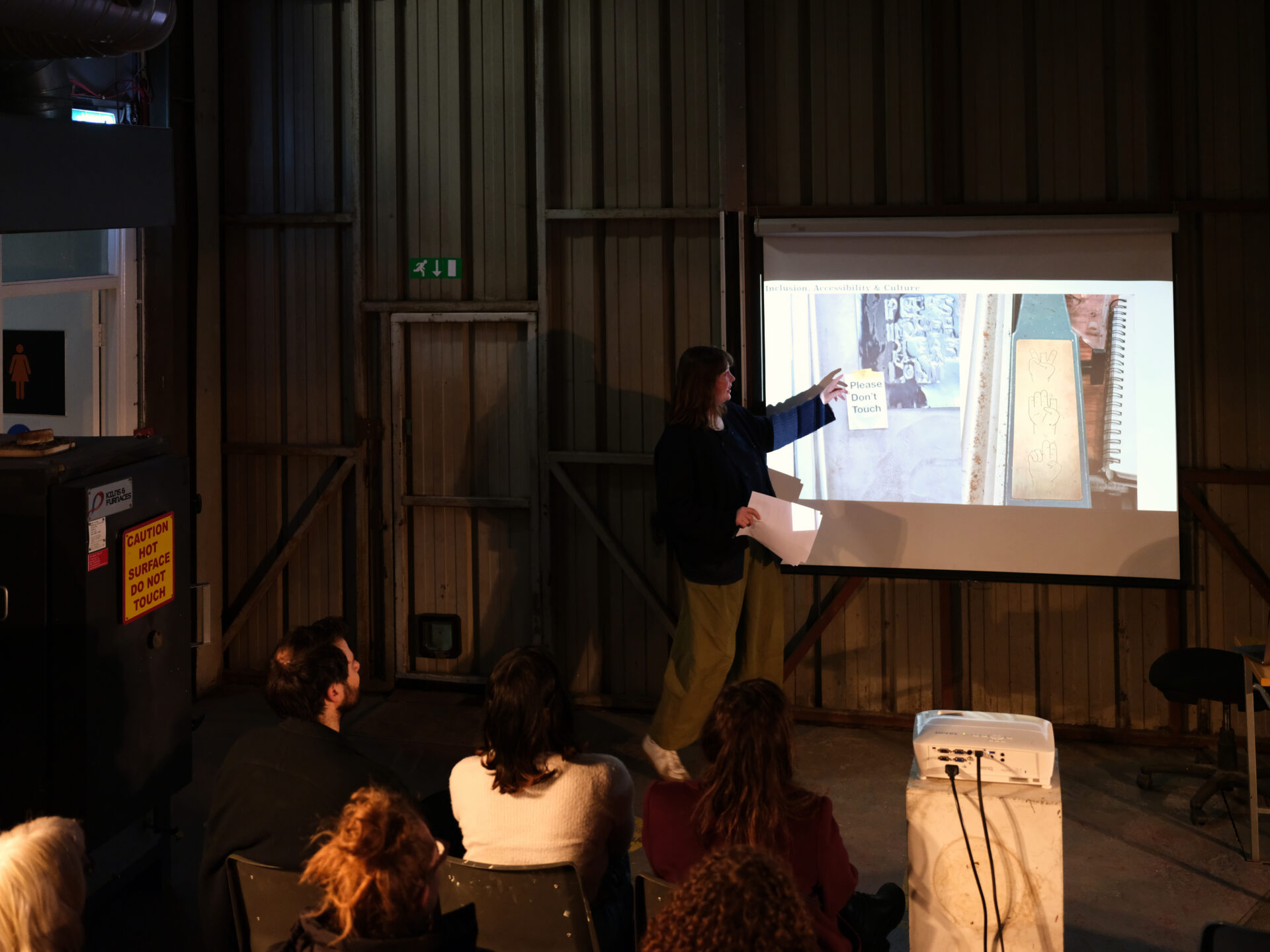
At an artist talk in Dublin, where Morley shares her research in the sculpture workshop of Fire Station Artists’ Studios, the conversation is lively, The audience gathers artists, technicians, curatorial and organisational staff and visitors, all of whom have their own ways of relating to what is being presented. In the background afterwards I can hear discussions taking place about how the workspace could be adjusted, people already feeling freer to contribute.
At the end of the talk, Morley reflects on an anecdote she had read about the design of Lambeth Women’s Training Workshop in the late seventies. Among specifications by the feminist architecture practice Matrix, which included low windowsills and onsite childcare, the women requested that the door to their workshop be lightweight. This seemingly simple request acknowledged the impact a heavy door can have on how welcoming a space seems to those encountering it for the first time—and the necessity of addressing these barriers in order to bring people in.
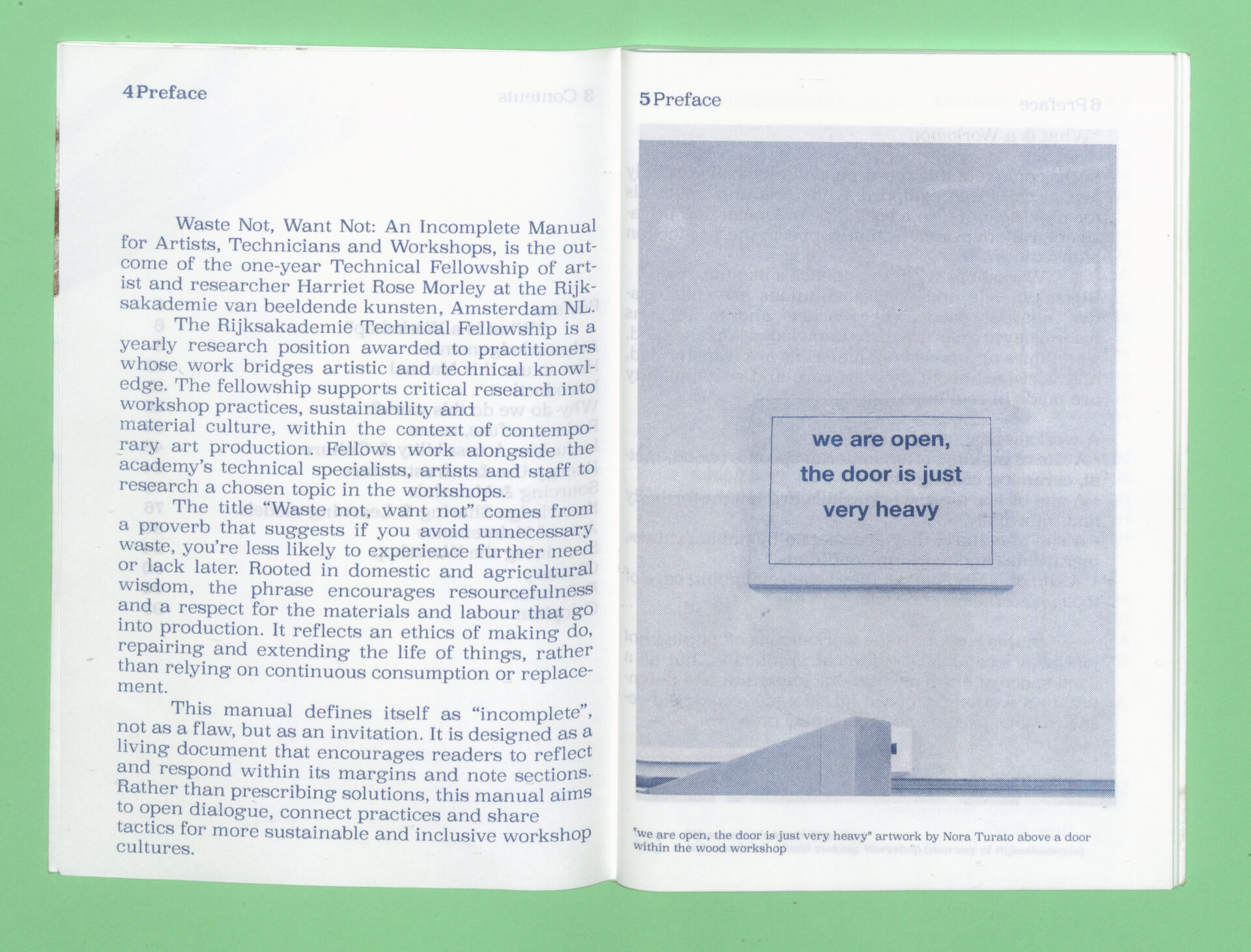
This image of a heavy door made lighter stays with me in thinking about what the honesty in Morley’s publication does for sustainable practices, lightening and opening up what can be a complex weighty conversation. As we chat, our conversation easily slips into other realms. We touch on topics such as the hierarchy between academic and technical education within art schools, historical distinctions between fine art and craft, and the legacy of male dominated workshop environments, illustrating just how difficult it is to address sustainability within artmaking in isolation. Vitally though, while acknowledging all the complexity intertwined with ecological making practices, Morley’s handbook remains grounded in its approach, not allowing that complexity to overwhelm makers into inaction—as conversations about the climate crisis can have the potential to do. The handbook is full of suggestions of practices that lighten this metaphorical door, but it also acknowledges that these practices are evolving, context specific and reliant on the economic, social and emotional wellbeing of the technicians, artists and other workers. Realities that are not just confined to the context of technical workshops and art practices.
‘If the future is to be sustainable, it must also be liveable. That begins not by demanding more from those already holding things together, but by creating conditions that support them in return.’
METROPOLIS M KAN NIET ZONDER JE STEUN
Trouwe lezers vormen het fundament van Metropolis M. Wij kunnen niet zonder je steun. Je kunt ons steunen door een jaarabonnement af te sluiten. Het eerste jaar krijg je 40% korting. Een regulier jaarabonnement kost 58 euro. Er zijn ook kortingsabonnementen. Studenten/65plussers/CJP-ers/Personen met een minimuminkomen en PLATFORM BK-leden betalen slechts 36 euro voor hun jaarabonnement. Op DEZE PAGINA lees je meer over de verschillende abonnementssoorten en kun je je direct aanmelden.
BIJ VOORBAAT DANK!
Harriet Rose Morley (UK) practice examines the gendered and labour politics embedded in technical making across art, design, and architecture. Her ongoing research project, ‘Hard Work, Soft Work’, investigates the intertwined dynamics of technical and relational labour within and beyond workshop environments. In 2025, she was a Technical Fellow at the Rijksakademie in Amsterdam, expanding her inquiry into how material processes, institutional structures, and cooperative labour shape ecological and social cultures of making.
Cara Farnan
is a visual artist and educator