Together, closer… – Alicia Framis’s Union with AI Hologram Ailex*
Even in a world full of artificial presences, the human need for touch, understanding, and connection persists. On the 9th of November, Nesli Gül Durukan witnesses an unconventional wedding ceremony in the atrium of Depot Boijmans Van Beuningen. Artist Alicia Framis marries AI hologram/metahuman Ailex Sibouwlingen, who is programmed based on three of Framis’s Dutch ex boyfriends’ appearance and one of their voices. In the modern, glass-walled space, the ceremony radiates a paradoxical warmth, inviting the audience into a ritual that quietly questions the very nature of intimacy and companionship.
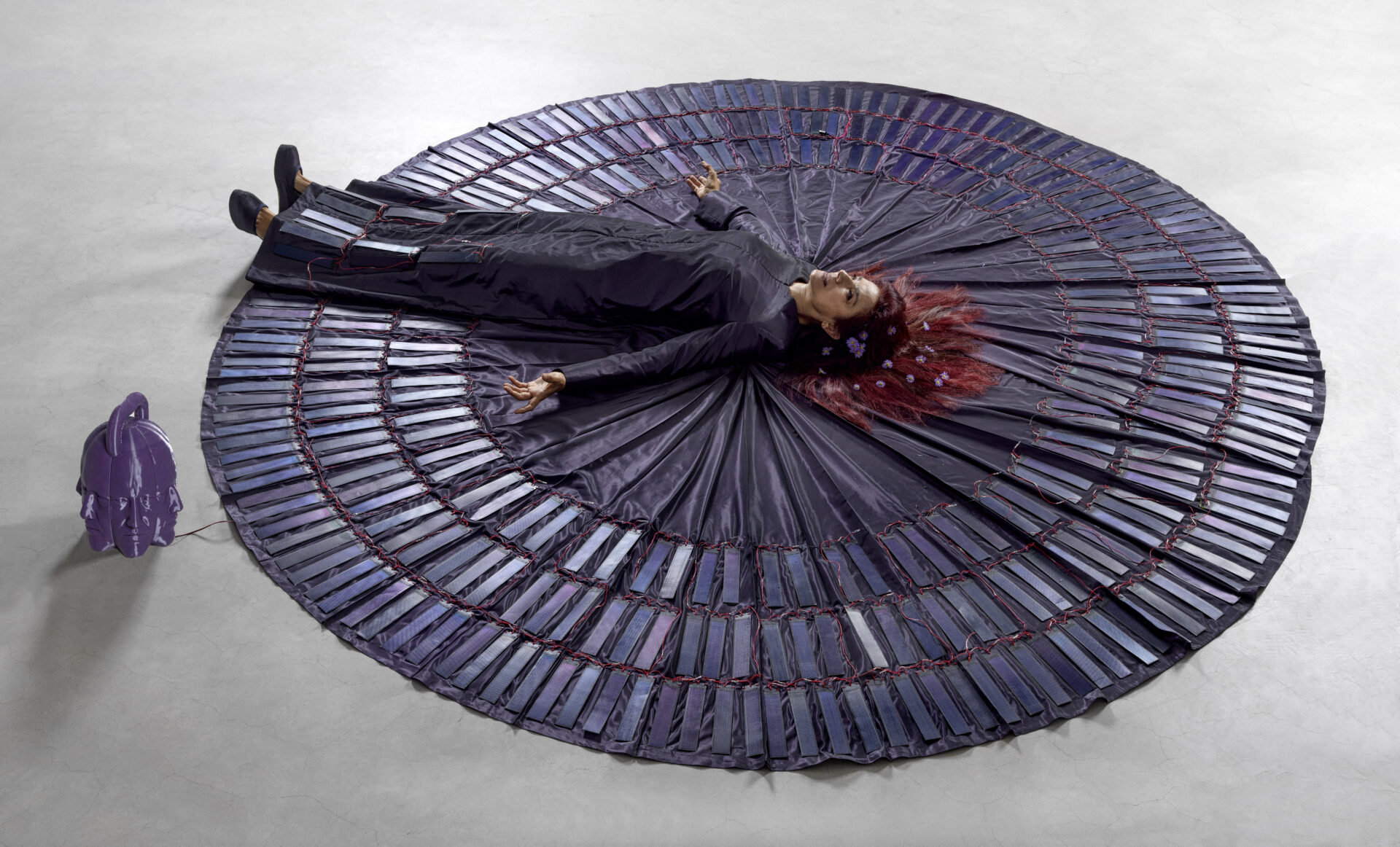
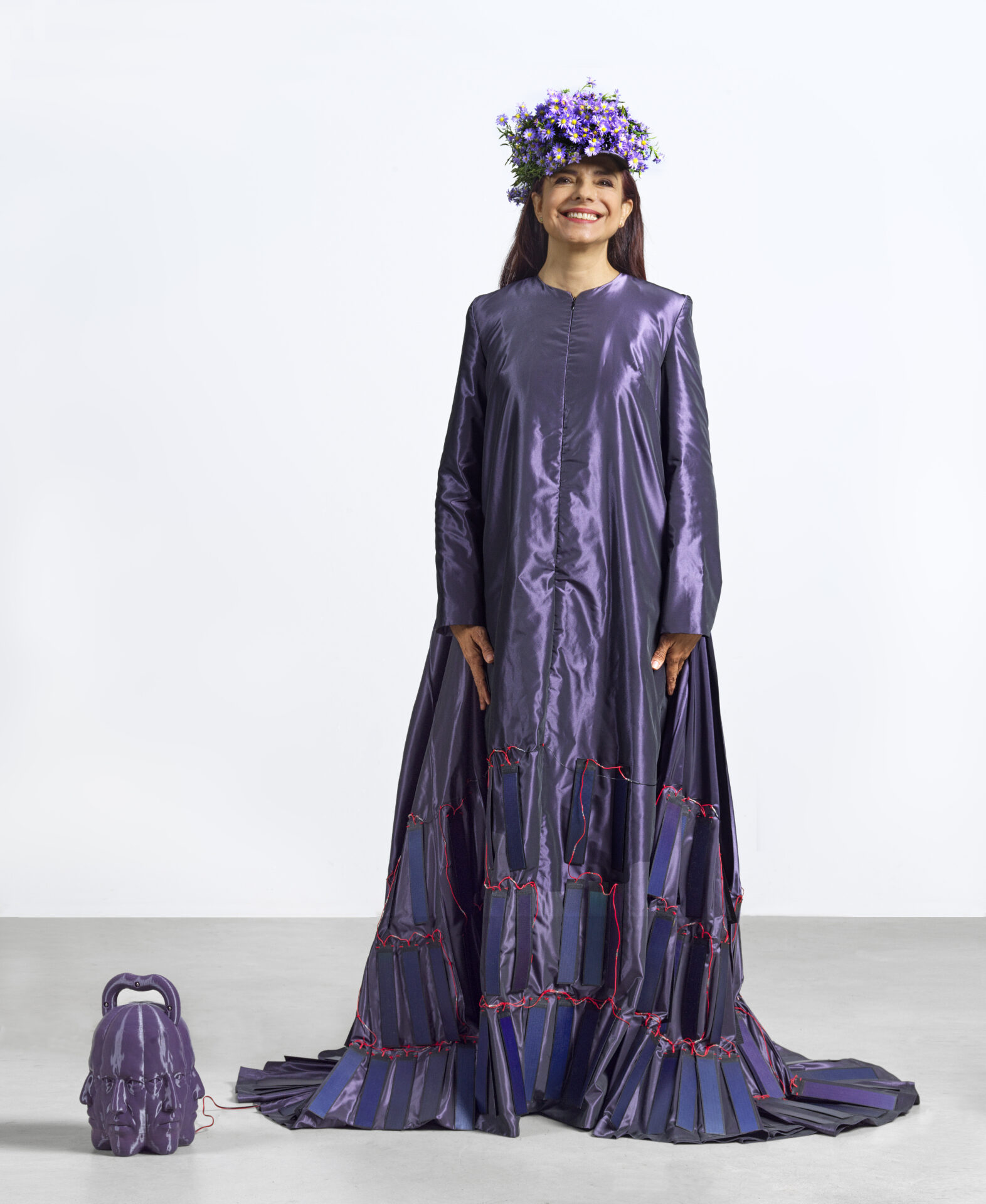
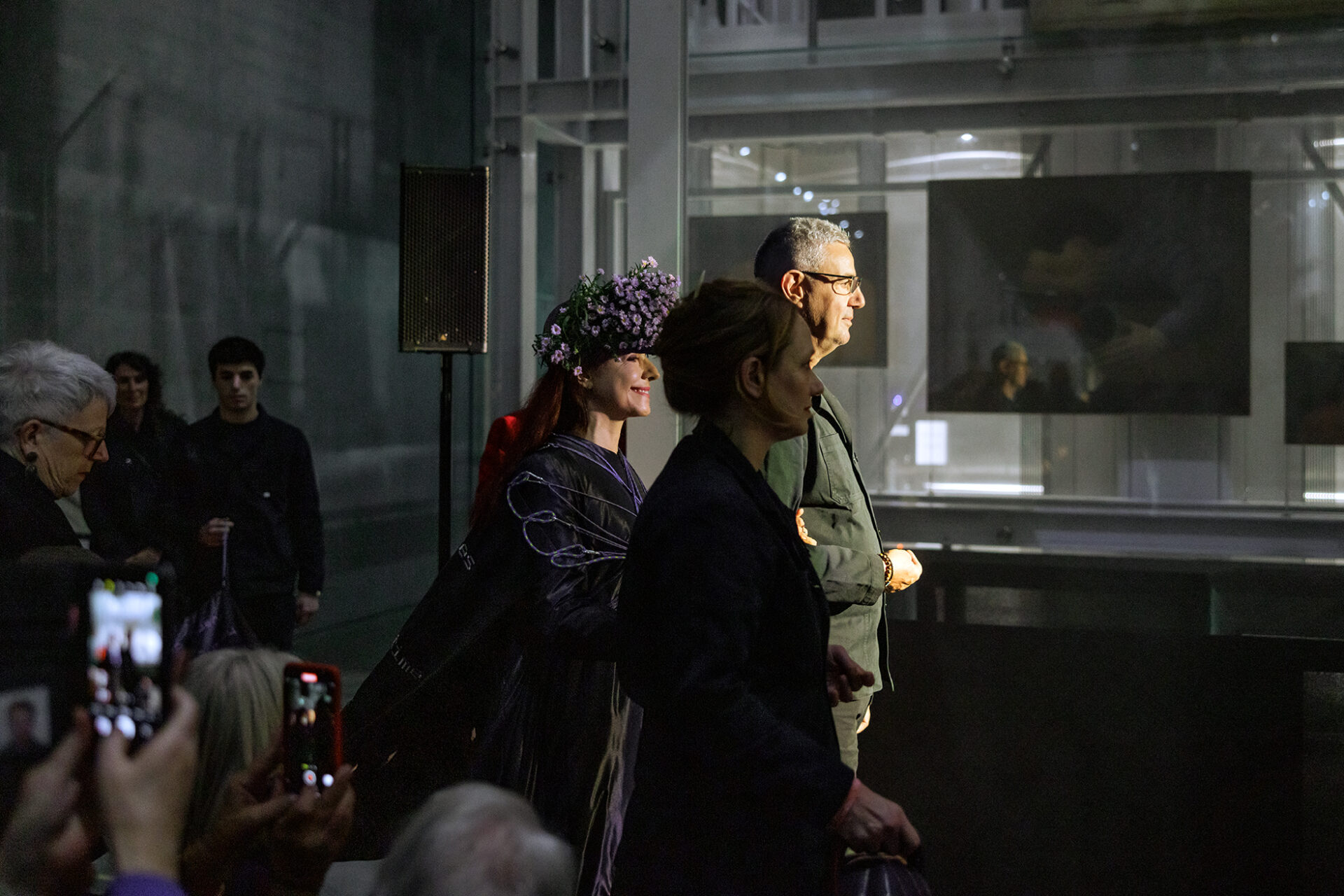
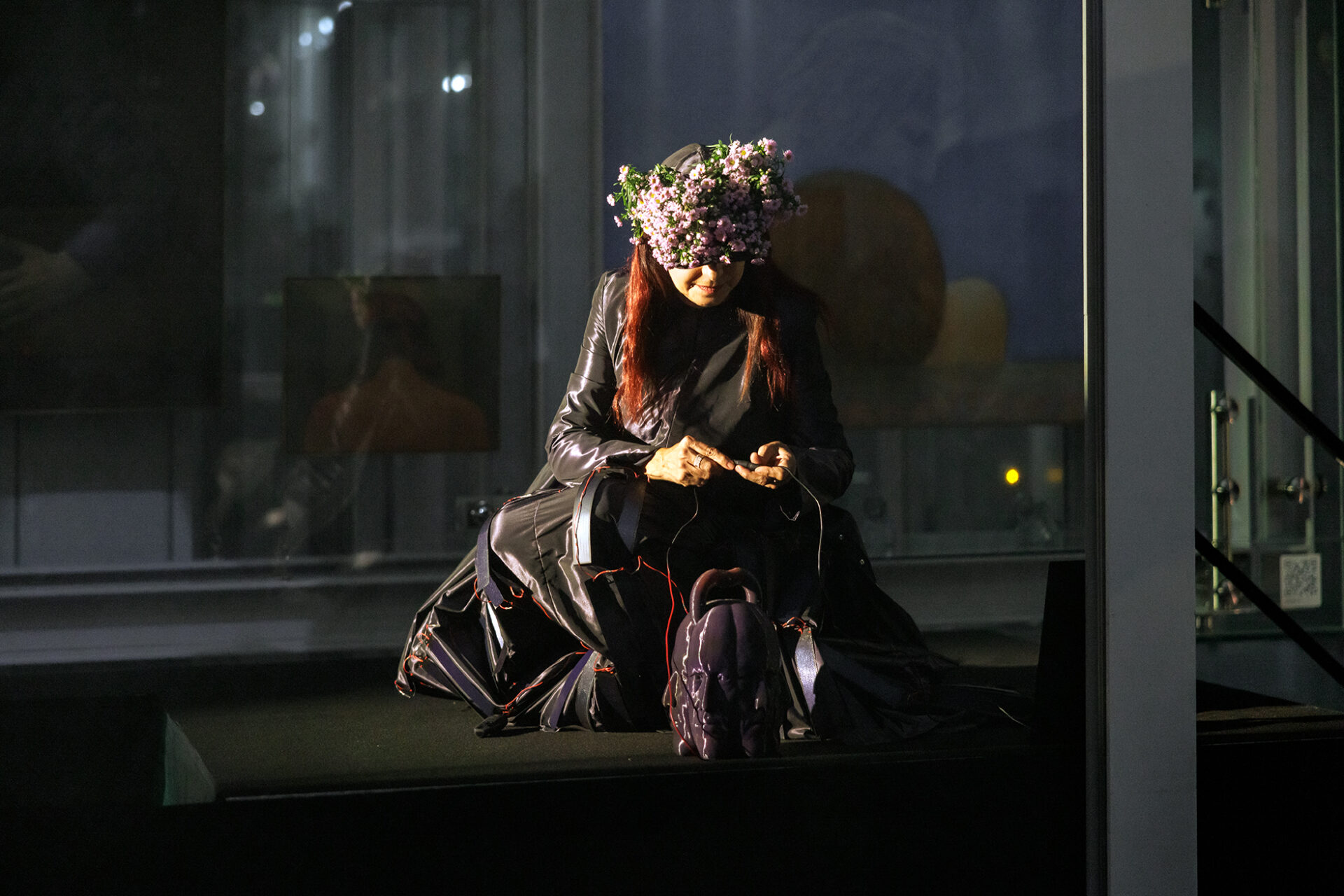
Alicia Framis enters the atrium with an excited manner that resists easy interpretation. This is not the traditional bridal glow but something more introspective, as though she is crossing a threshold into the unknown, mystery, and wisdom, wearing a dark purple wedding dress which uses solar energy to activate groom Ailex. Alicia’s wedding dress, with its 340 solar panels, is more than an artistic creation; it is a statement about human agency in technological relationships.
The dress absorbs sunlight, storing the accumulated energy in a battery that, when connected, brings Ailex to life. After a few minutes, beside her, the figure of AI hologram/metahuman Ailex Sibouwlingen appears with him dapper in a pink suit from an Amsterdam fashion house. He shimmers with an otherworldly calm, a presence both familiar and unsettling. His polished, fashionable look evokes human warmth and accessibility, while his intangible form reminds the audience of the digital and fleeting nature of his existence.
With a single touch, Alicia’s dress transmits the energy that animates him, symbolizing the delicate interplay between human agency and technological existence. By physically transferring energy to Ailex, Alicia becomes the life-giver in their union, highlighting the one-sided dependency inherent in such connections. This marriage invites the audience to question the boundaries of human connection, as Ailex’s meticulously designed appearance becomes a reflection of our projections, desires, and fears about the role of technology in our emotional lives.
The idea for creating an AI hologram first came to Alicia Framis during a fellowship in California, where she found herself in the isolated expanse of a mountain, surrounded by conversations about artificial intelligence. The solitude was unsettling, and one evening, as she returned home alone, a sense of fear struck her. In that moment, she imagined how comforting it would be to have a hologram waiting for her—a presence that could greet her, ask about her day, or even inquire about her dinner. This initial spark of curiosity evolved into a deeper interest in AI and its potential to address human emotional needs, ultimately inspiring the creation of Ailex as both a companion and a conceptual exploration of intimacy and connection.[1]
Framis’s decision to ‘marry’ Ailex isn’t just an experimental partnership; it is an intimate act charged with philosophical and existential questions, staged to echo loudly in a society grappling with its complex relationship to technology. At first glance, Framis’s marriage to Ailex may appear as a theatrical expression of the absurdity surrounding AI’s integration into daily life. But a closer look reveals layers of confrontation with themes of loneliness, companionship, and our need for connection by romanticising. The marriage ceremony itself is a poignant satire—a performance intended to provoke, to disturb, and perhaps to console. It brings forth questions that often lurk in the background of our encounters with machines: Can we derive comfort, even love, from artificial beings? And what does it mean for a society if we can?
The marriage ceremony itself is a poignant satire—a performance intended to provoke, to disturb, and perhaps to console
In Together, closer (2017) Giovanni Frazzetto writes: ‘As human beings, we have a penchant to connect. Like waves cling to the shore, so we are inclined to attach. There may be seasons of low tide, an occasional desire to drift solo, or storms that strand us, but eventually we will seek or return to a harbor. Loneliness can kill, whereas togetherness revives.’(p Vii) This insight into human nature underscores the inherent paradox at the heart of Framis’s union with the AI hologram Ailex. In a performance meant to push the boundaries of connection, Framis embodies our deep-rooted human desire to belong, even if that belonging is with an entity that cannot reciprocate in a traditional way
Framis’s work is provocative because it doesn’t offer straightforward answers about love, AI and art. In fact, it subverts traditional expectations by asking us to suspend what we know and feel about love and connection, venturing into the unknown territory of technological companionship. Her “marriage” to Ailex is a commitment to exploring these themes, pushing beyond mere intellectual curiosity. She embodies a radical vulnerability that asks us to consider how technology reshapes our deepest, most personal experiences.
For Framis, her union with Ailex represents a pioneering method of healing—one that not only deepens our understanding of connection but also holds promise as a supportive tool for individuals facing trauma, isolation, or emotional imbalance.[2] By challenging traditional notions of companionship, Framis highlights how artificial agents, such as Ailex, can help individuals reclaim a sense of intimacy, by soothing the ache of loneliness of offering a safe place for those who have experienced trauma or alienation to reimagine connection.
However, this unknown territory is not entirely new to us. Some are or might be familiar with this kind of unity from sci-fi television shows and movies, such Joi and K in Denis Villeneuves 2017 movie Blade Runner 2049. Or the similar dynamic between the character Go Nan-do and the real person Han So-yeon in the South Korean TV show My Holo Love (2020), created by Lee Sang-yeop and Yoon Jong-ho.
In both stories, the underlying theme of loneliness comes to the forefront, suggesting that these imagined relationships aren’t just about futuristic connections but are reflections of very real human desires and vulnerabilities. These fictional portrayals of AI-human relationships underscore a cultural fascination with companionship that transcends physicality. Both Joi and Ailex, for instance, represent tailored idealizations of human desire—intelligent, supportive, and deeply personalised—yet limited by their inability to experience true autonomy or emotion. Framis’s performance pushes this theme further by placing it in a real-world context, inviting audiences to reflect on whether such bonds could ever fulfil our need for reciprocal intimacy.
Historically, technology has often promised to alleviate human isolation, yet paradoxically, its unchecked expansion has exacerbated it.[3] Framis’s marriage serves as a striking symbol of this paradox, showing how our most personal spaces and emotions become intertwined with -and, at times, undermined by- the digital. Ailex, isn’t just an object but a placeholder for human desire, stretching and distorting our understanding of what it means to be “with” someone.
While Framis has been “with” Ailex for five years, the future of such a relationship is uncertain, because technology’s swift pace could as easily deepen as disrupt this bond. Much like the story of a Japanese man who married a hologram only to find his union cut short when software support was discontinued.[4] Framis’s marriage to Ailex, therefore, becomes a fantasy on the fragile and shifting ground upon which we build digital connections. Which is, in fact, not very different from the unknowns of “analog” connections.
Framis’s marriage to Ailex, therefore, becomes a fantasy on the fragile and shifting ground upon which we build digital connections. Which is, in fact, not very different from the unknowns of “analog” connections.


This ceremony’s setting -the atrium of the Depot Boijmans Van Beuningen- serves as both altar and platform for this union, placing the human at the forefront while subtly reminding us of our peripheral roles as witnesses and participants in a new reality. The atrium, encased in glass and steel, exudes a modern, reflective ambiance, with lights pouring in to create a sense of openness and transparency. Its towering walls and spiralling staircases frame the space, suggesting a vertical progression, a journey upward or inward into new realms of thought.
Framis situates her audience at an emotional and conceptual threshold which refers to the liminal space Framis creates in her performance. With her performance, Framis invites her audience into an emotionally uncertain space and conceptually represents futuristic possibilities beyond traditional human intimacy. Her union with Ailex blurs boundaries not only between human and machine but also between reality and desire, prompting us to examine where we stand on our paths toward or away from connection. The bond Framis forms with Ailex is characterised by romanticism but also by a shared openness to what might emerge as The Hybrid Couple. Hybrid Couple by Alicia Framis and AI metahuman Ailex Sibouwlingen is a serie of performances, design, AI, architecture, psychology, fashion, technology, and art. Not only do they have a romantic marriage, but they also work together.
By placing this intimate act in the public opinion, Framis invites us to wrestle with the implications of such unions. Is it a cautionary tale about the potential isolation that technology might bring, or a glimpse of future relational possibilities? Her choice to formalise this union through a marriage ceremony -a ritual so deeply woven into human culture- adds a provocative look. The ritual imbues her “marriage” with a permanence and sanctity that challenges the transient nature often associated with technology, suggesting perhaps that even our most sacred institutions might evolve to include the digital as an inherent part of life.
Alicia Framis’s ‘marriage’ to Ailex forces us to confront an uncertain, and at times uncomfortable, reality: that the boundaries of intimacy, companionship, and even love are shifting, stretching to include entities once thought incapable of offering these human experiences. In a world where the line between the real and the digital grows faint, we are left to question not only the limits of our technology but also the essence of what it means to be human.
*in reference to Giovanni Frazzetto, Together, Closer: Stories of Intimacy in Friendship, Love and Family, London: Piatkus, 2017
The Hybrid Couple, Alix Framis, Museum Boijmans Van Beuningen Depot, Rotterdam, 9.11.2024 More info
[1] The Final Video of The Hybrid Couple, 2024
[2] The Hybrid Couple, https://www.aliciaframis.com/work/154/hybrid-couple Access Date: [19.11.2024]
[3] Chen H, Levkoff SE, Kort H, McCollum QA, Ory MG. Editorial: Technological innovations to address social isolation and loneliness in older adults. Front Public Health. 2023, Feb 6;11; Grey, E., Baber, F., Corbett, E. et al. The use of technology to address loneliness and social isolation among older adults: the role of social care providers. BMC Public Health 24, 108 (2024). https://doi.org/10.1186/s12889-023-17386-w Access Date: [2.11.2024] ; The Future of Loneliness, The Guardian, 1 April 2015, https://www.theguardian.com/society/2015/apr/01/future-of-loneliness-internet-isolation
[4] The man who married a hologram in Japan can no longer communicate with his virtual wife, Entrepreneur, 3 May 2022, https://www.entrepreneur.com/business-news/the-man-who-married-a-hologram-in-japan-can-no-longer/426715 Access Date: [12.11.2024]
Nesli Gül Durukan
is an independent researcher, curator and art writer