When Clothing Becomes Art – The Fine Arts of Iris van Herpen and Fong-Leng
Traditionally, the museological sphere has maintained a condescending attitude toward fashion, often relegating it to a secondary tier within material culture. This stems from the long-standing debate on whether fashion can be considered art. Yet, in recent decades, the fashion exhibition has secured an increasingly prominent place within international museum programming. This development prompts a critical question: do museums embrace fashion merely as a ‘crowd-puller,’ or does it signal a long-overdue recognition of fashion as a legitimate discipline within the fine arts?
In the Netherlands, this conundrum is currently being examined through two fashion exhibitions; Iris van Herpen: Sculpting the Senses at Kunsthal and Fong-Leng & Fans: 60 jaar Mode & Faam at Museum JAN. Both designers have profoundly shaped the Dutch fashion landscape, and their exhibitions offer a lens through which to consider why fashion deserves its place within the museum — not merely as a blockbuster spectacle, but as an artefact worthy of intellectual, aesthetic, and curatorial contemplation.
From Haute Couture to Conceptual
Over the past three decades, the museum sector has shown a growing interest in fashion — a development that did not occur in isolation, but in tandem with a broader cultural shift within the fashion system itself, where the creative director or head designer of renowned fashion houses, was increasingly regarded as the summum of fashion creation, and celebrated as the ‘star designer’. This evolution took shape in the 1980s, when the so-called golden age of haute couture had long been abandoned, and the commercialization and uniformity of the ready-to-wear production scheme revealed its down sides and gave way to a new paradigm: that of the conceptual designer.
These conceptual designers developed collections rooted in narrative, social reflection, and cultural critique, and consequently, often interrogating the fashion system itself. Their garments were not merely wearable objects but material manifestations of ideas and beliefs. This transition reflected not only a more intellectual design process but also a changing mode of interpretation. As fashion scholar José Teunissen has noted, this shift encouraged a broader audience to perceive fashion not solely as a commodity, but as a cultural phenomenon. Gradually, these conceptual garments began to leave the fashion sphere and entered museum collections. Yet, their inclusion should not be mistaken for a full acknowledgment of fashion as a discipline within the fine arts, as many museum professionals and scholars remain hesitant to adopt such a perspective.
Is Fashion Art?
Design critic and former director of the Design Museum London, Alice Rawsthorn, is among those who reject the idea of fashion as art. In her view, debating whether fashion qualifies as art is pointless: ‘of course it’s not, it’s fashion.’[1] One of her main arguments rests on fashion’s inherently practical function, which, she contends — alongside many other curators, critics, and institutions — sets it apart from art. And indeed, fashion undeniably serves practical purposes. However, it is not limited by them; its scope extends far beyond mere functionality.
A compelling counterpoint comes from one of Fong-Leng’s contemporaries, British fashion designer Zandra Rhodes, known for her distinctive textile prints and exuberantly theatrical garments. Rhodes argues that ‘fashion can tell you what people wore at a certain period just as pottery can tell you what their tea parties were like.’[2] For her, the same degree of artistic expression goes into creating a dress, a piece of pottery, or a painting.
Where Rawsthorn reduces fashion to an object, fashion scholar Valerie Steele instead regards it as a sign. As a phenomenon that requires decoding in order to uncover its multiple layers of meaning, each shaped by a range of cultural and social variables.[3] The museum is the ideal site for such inquiry: it provides the tools, expertise, and interpretive frameworks necessary to conduct this kind of research and to communicate its findings to the public in both a meaningful and approachable way.
Iris van Herpen – Sculpting the Senses
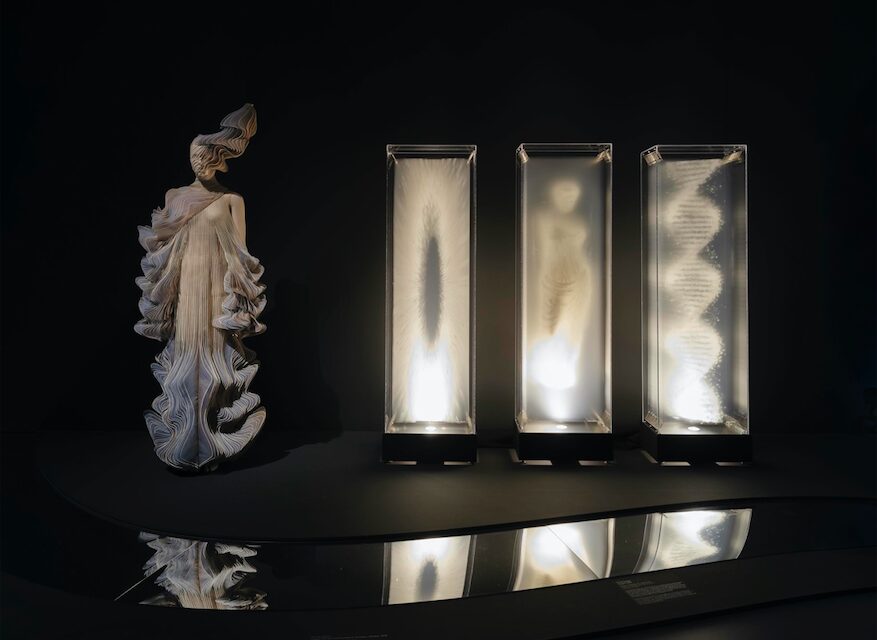
Haute couture designer Iris van Herpen demonstrates that fashion can exist as an embodied sculpture that redefines the relationship between body and material. Her sculptural works have been exhibited in museums across the world and are experienced far more by museum visitors than by fashion consumers. In such a context, fashion is not experienced as a garment, but as an art piece, consequently, audiences need to engage with it in an embodied way that is other than merely a physical interaction. A profound challenge, as fashion, more than any other medium, invites tactile engagement. Logically, it has been the visual sense that has received the most attention in fashion exhibitions. Elements such as sound, light, and controlled movement have to play a crucial role in enabling such a distanced, but still embodied experience.
Sculpting the Senses, first shown at the Musée des Arts Décoratifs in Paris (2023-2024) and currently on view at the Kunsthal Rotterdam, aims to do just that. Organized into nine thematic sections, the exhibition features over 100 works exploring key topics of Van Herpen’s body of work, such as nature, science, mythology, futurism, and the senses. While all these themes are intricately woven throughout. Soundscapes, strategic lighting, and at times artificial sensations of airflow, are employed to support visitors in engaging with the conceptual and aesthetic foundations of her work. This aligns both with the aim of fostering an embodied experience of fashion without physical contact, and with the immersive trend that is currently widely advocated in the museum sphere.
The works are presented in a rather conventional exhibition format, displayed on mannequins. While this might normally create a rather static or uninspiring setting, the presentation is logical, as these pieces are essentially sculptures created around the body and thus function well as art objects to be viewed from a distance. Yet, because they are fundamentally fashion items, one cannot help but want to touch the fabrics. Fortunately, the exhibition includes a mini laboratory section designed for this tactile experience, where small prototypes of her fabrics—molded using her signature techniques—are laid out for visitors to gently handle.
It is beyond dispute that these works are not designed for practicality; on the contrary, they are celebrated for their unwearability and impracticality. Beyond pragmatic concerns, and far removed from standardized off-the-rack fashion, Van Herpen inhabits a realm where theory and artistry intertwine. Her work engages deeply with the frameworks of posthumanism and new materialism, operating at the intersection of philosophy, technology, and critical fashion-making. Her artistry is evident in her use of materials that do not pre-exist but must be brought into being. In collaboration with scientists and textile research institutes, her team transforms these imagined substances into tangible forms. From there, Van Herpen sculpts these new materials around the contours of the body, constructing compositions that occupy space much like a painter works upon a canvas. Van Herpen’s studio, far from being filled with digital machines, was instead packed with traditional sewing machines.
This transformation of the body into both medium and subject extends into Van Herpen’s collaborations with artists across disciplines. A striking example is her Biopiracy (2014) collection presentation, for which she collaborated with artist Lawrence Malstaf, known for working at the intersection of biology and physicality. During the presentation, models were suspended in large-scale, vacuum-sealed, ziplock-like plastic bags that were placed in the centre of the catwalk. The collection and installation posed the urgent question: Are humans still the sole proprietors of our bodies? These reflections on body politics go far beyond the notion of fashion as merely practical or as something intended only to cover the body, questioning where the boundary between fashion and art lies—and arriving at a stage where it becomes not only repetitive but also ridiculous.
It is beyond dispute that these works are not designed for practicality; on the contrary, they are celebrated for their unwearability and impracticality.
Fong-Leng & Fans – 60 jaar Fashion & Faam
Van Herpen’s work represents the ultimate, and rather obvious, example in the debate over whether fashion can be regarded as art. The work of groundbreaking and influential Dutch designer, Fong-Leng, arguably offers an even more intriguing case. Her designs are more often understood as applied art, in which a strong sense of practicality remains interwoven with the expressive.
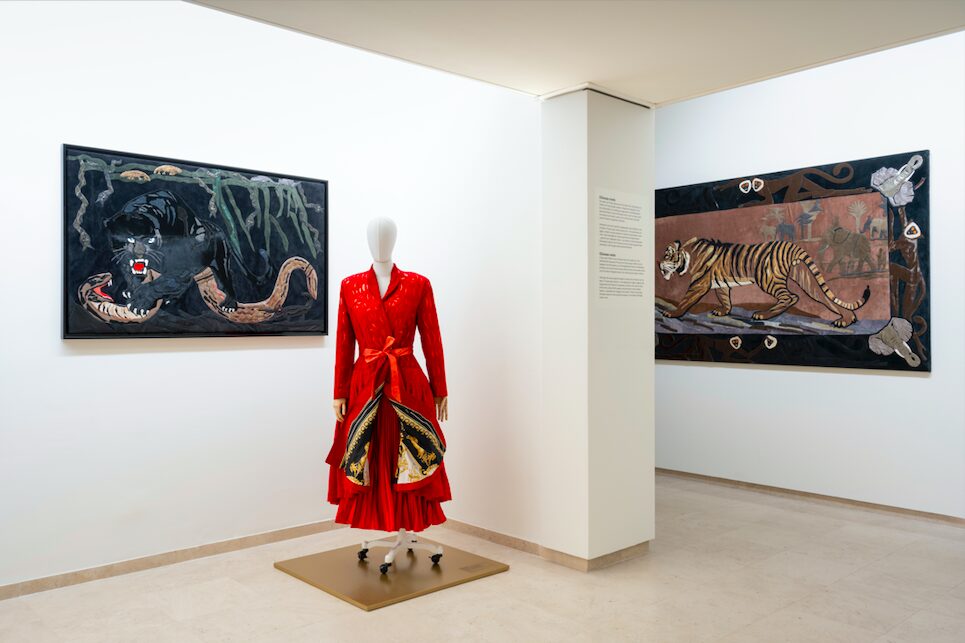
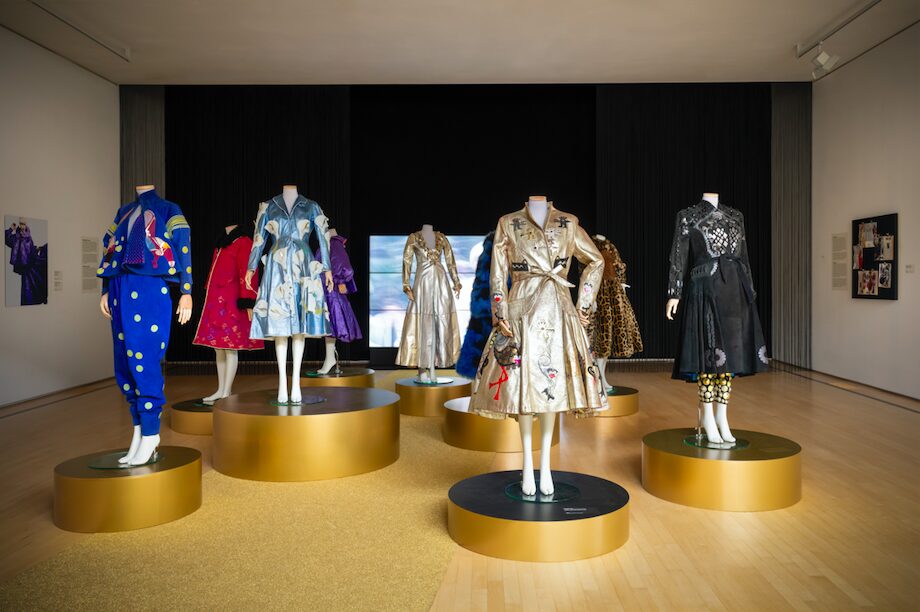
Museum JAN at Amstelveen currently pays a long-overdue tribute to her oeuvre with the exhibition Fong-Leng & FAAM, presenting a selection of her most iconic pieces alongside contemporary creations by young Dutch designers. The exhibition underlines how Fong-Leng occupies a pioneering position in the Dutch fashion landscape. Emerging at the end of the 1960s, she began creating garments that stood in stark contrast to the prevailing fashion mentality of the time. Designers such as Frans Molenaar (1940–2015), Dick Holthaus (1928–2015) and Max Heymans (1918–1997), followed the classical Parisian example, crafting refined women’s suits in mostly conservative tones of navy, black, beige, and occasionally a more pronounced hue.
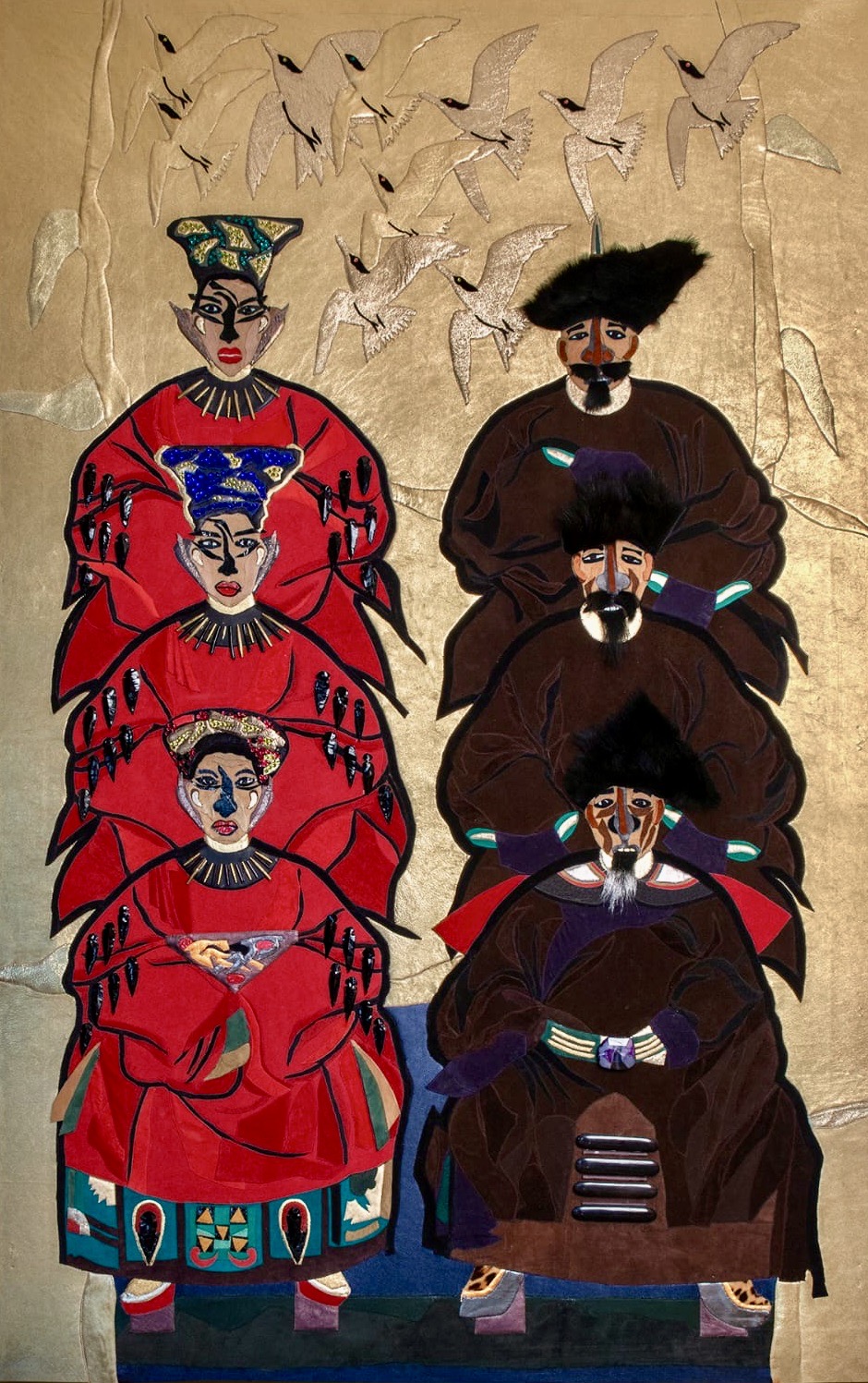
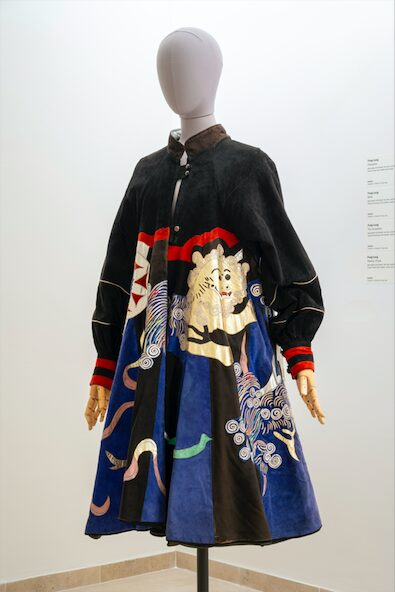
Fong-Leng’s designs, by contrast, were exuberant and unapologetically expressive. With her dramatic robe manteau silhouettes, her bold use of color, platinum-dyed suede, intricate appliqués of prowling leopards and lush flowers, and her love for pleats on top of pleats, she channeled the Dutch aesthetic fashion norm.
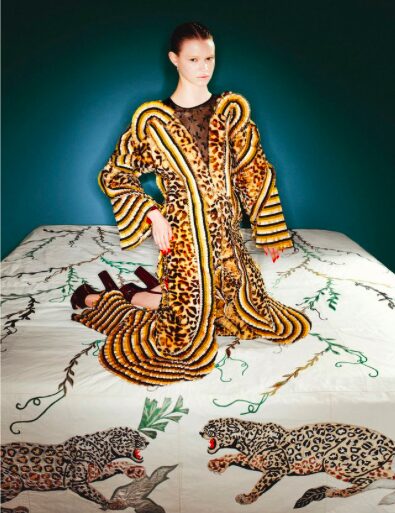
Despite the wearable nature of her pieces, Fong-Leng’s work demonstrates a strong artistic vision while challenging essentialist conceptions of “high fashion” in the Netherlands during the 1970s and 1980s. Her creations engage with her bicultural identity—born to a Dutch mother and Chinese father—and produce a visual language that is both vibrant and expressive, consciously diverging from established aesthetic norms. Artistic research conducted by interdisciplinary artist Willem de Rooij, demonstrates this clearly. His installation The Impassioned No (2015) showed fifty mannequins dressed in Fong-Leng’s 1980s sportswear collections. Fong-Leng’s works were displayed on mannequins without any alteration by De Rooij, who acted in reality more as a curator than an autonomous artist. This approach cleverly underscores how Fong-Leng’s creations are complete works of art in themselves, requiring only the viewer’s willingness to recognize them as such. In creating this work, De Rooij reflects on Fong-Leng’s transition from crafting unique, handmade pieces for individual clients to engaging in standardized production for the masses. This reinterpretation illustrates how Fong-Leng’s creations can effortlessly enter the realm of art while still retaining a sense of their original, practical function.
Whether fashion can be considered art should not hinge on the argument that it serves a practical purpose, as Iris van Herpen demonstrates that functionality is not by default assigned to fashion. Conversely, Fong-Leng shows that even when fashion is wearable, it can be perceived as impractical or extraordinary simply because it deviates from prevailing ideals and aesthetic norms.
Iris van Herpen, Sculpting the Senses, Kunsthal Rotterdam, t/m 1.3.2026
Fong-Leng, 60 jaar fashion en faam, Museum jan, Amstelveen, t/m 6.4.2026
[1]: Barnard, Malcolm. 2007. Fashion Theory: A Reader. London: Routledge, 104.
[2]: Barnard, Malcolm. 2007. Fashion Theory: A Reader. London: Routledge, 103.
[3]: Steel, Valerie. “A Museum of Fashion Is More Than a Clothes-Bag.” Fashion Theory: The Journal of Dress, Body & Culture 2, no. 4 (1998): 332.
Karmen Samson
is modebeoefenaar en onderzoeker met interesses in materiële cultuur en museologie