Against Erasure: Remembering Otherwise – Positions: Unearthing at Stroom Den Haag
What happens when remembering becomes the only way to resist colonial erasure? Positions: Unearthing at Stroom Den Haag begins from this question, asking how artistic practices might bring into view histories that official archives have neglected, suppressed, or deliberately erased. The exhibition forms the latest chapter in the Positions programme, launched in 2022 as a platform for artists connected to The Hague to develop research-based projects and situate artistic work within broader social conversations.
Bringing together works by The Hague-based artists Roger Anis, Marie Civikov, Priyageetha Dia and Ben Yau, the exhibition traces how colonial histories continue to reverberate across generations and geographies. Moving between personal archives and geopolitical narratives, the exhibition traces a trajectory from the intimate scale of family memory to the wider structures of empire, labour and environmental extraction.
Curator Leana Boven frames these gestures as forms of counter-archiving: practices that challenge dominant historical narratives by bringing forward traces that colonial archives overlooked or deliberately excluded. In thinking through these processes, Boven draws, among others, on Toni Morrison’s concept of rememory, which describes how experiences persist beyond the moment in which they occurred, inhabiting landscapes and bodies. Read through this lens, remembering becomes less a matter of retrieving a fixed past than of activating traces embedded in environments, objects and collective practices.
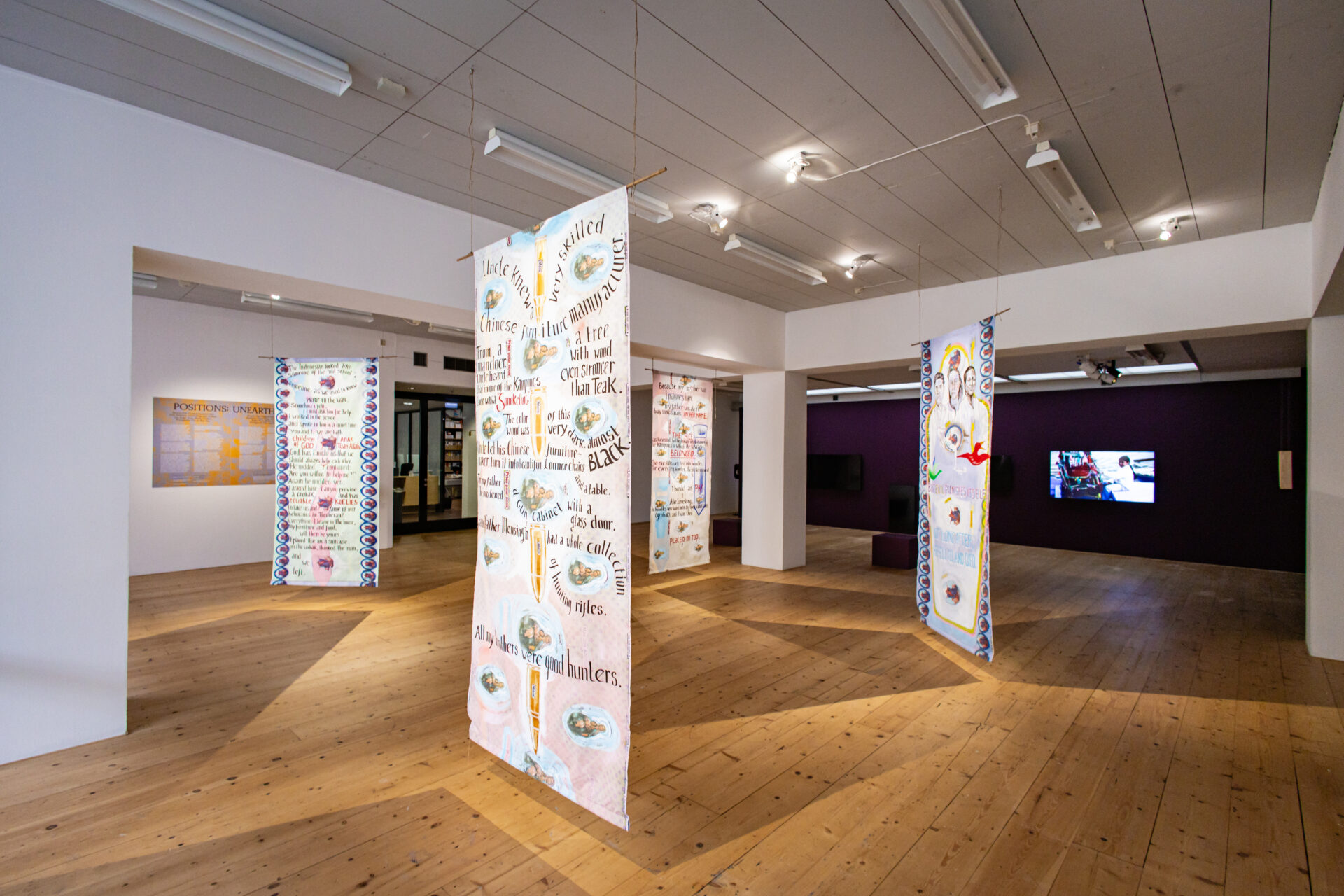
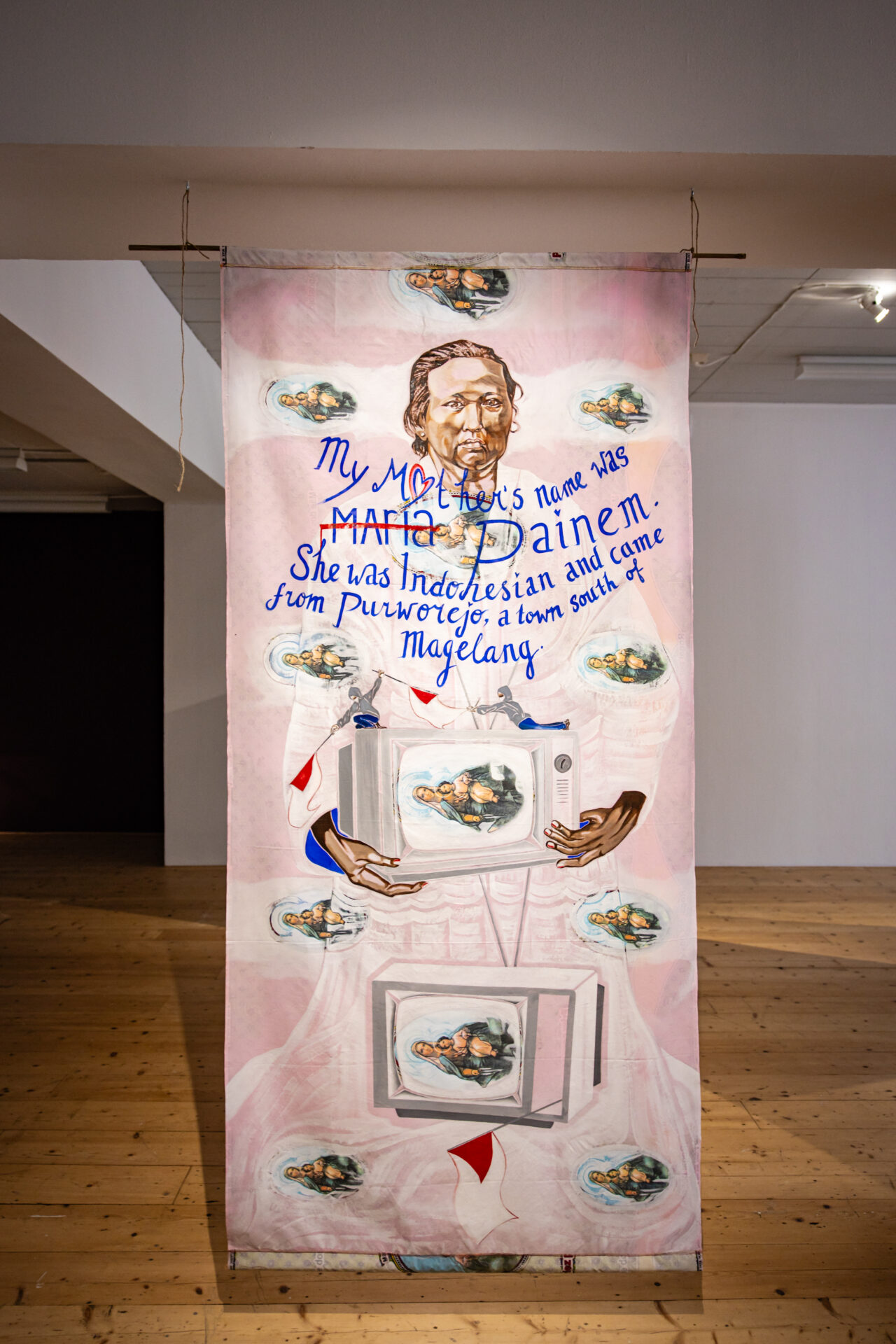
Upon entering the exhibition, four large textile banners by Marie Civikov hang loosely in the space. Painted in acrylic and oil on artificial Javanese waxblock-print fabric, they weave together images, handwritten text, and fragments from family memoirs. In It’s Not the Eyes That Can’t See But the Hearts That Are Blind (2026), Civikov traces her grandmother’s life across colonial Indonesia and Bulgaria under communist rule, exposing remembering as an uneven and incomplete process.
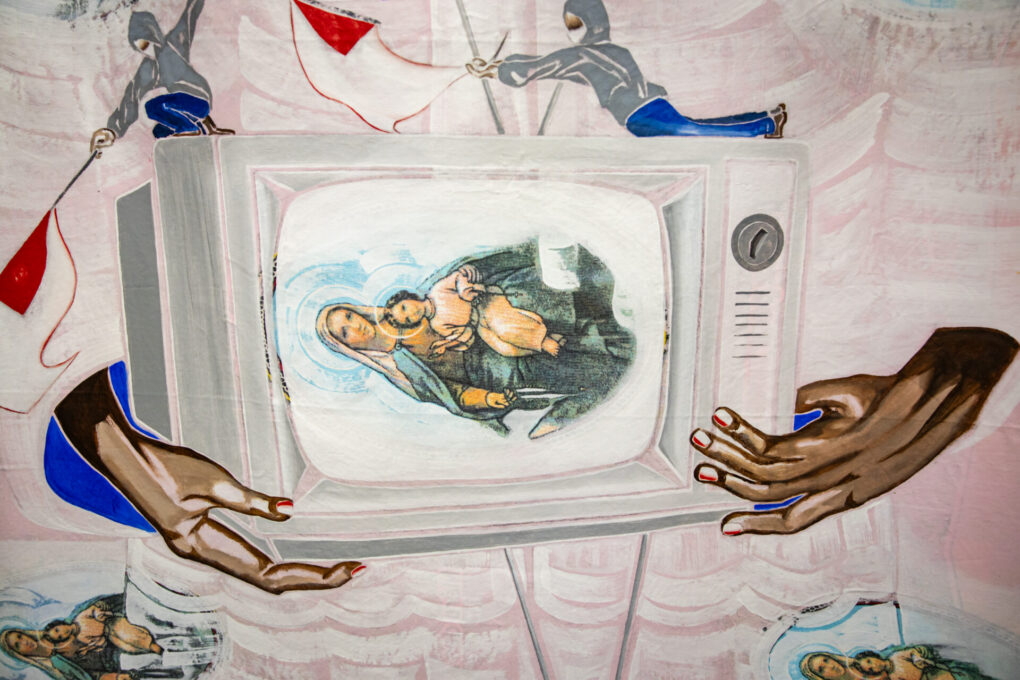
One of the panels, In Her Name, portrays the grandmother as a solemn frontal figure surrounded by small medallions repeating the Madonna and Child motif. While the composition evokes devotional imagery, it is quietly unsettled: a television set occupies the centre, displaying the same icon, suggesting memory as something mediated rather than preserved. On the reverse, dense handwritten text recounts rice fields worked by women from nearby kampongs, rural villages in Indonesia, lingering on repetitive labour to reveal the hierarchy’s structuring life in the Dutch East Indies.
Across the series, intimate fragments expand into broader colonial histories, referencing trade, extraction, and displacement. The title, drawn from a Quranic verse cited by Palestinian journalist Wael Al-Dahdouh, anchors the work in the present, insisting that such histories are not closed, but continue to unfold in many places, such as Palestine, if we are willing to recognise them.
remembering becomes less a matter of retrieving a fixed past than of activating traces embedded in environments, objects and collective practices.
From the neighbouring installation, a low chant spreads across the gallery. The voices belong to Roger Anis’ A Home on the Nile (2026), which consists of four screens set against deep purple walls. While Civikov’s intimate process of piecing together family memory feels like a puzzle that refuses to fully resolve, Anis proposes a more affirmative form of remembering as pointing toward forms of care yet to be realised.
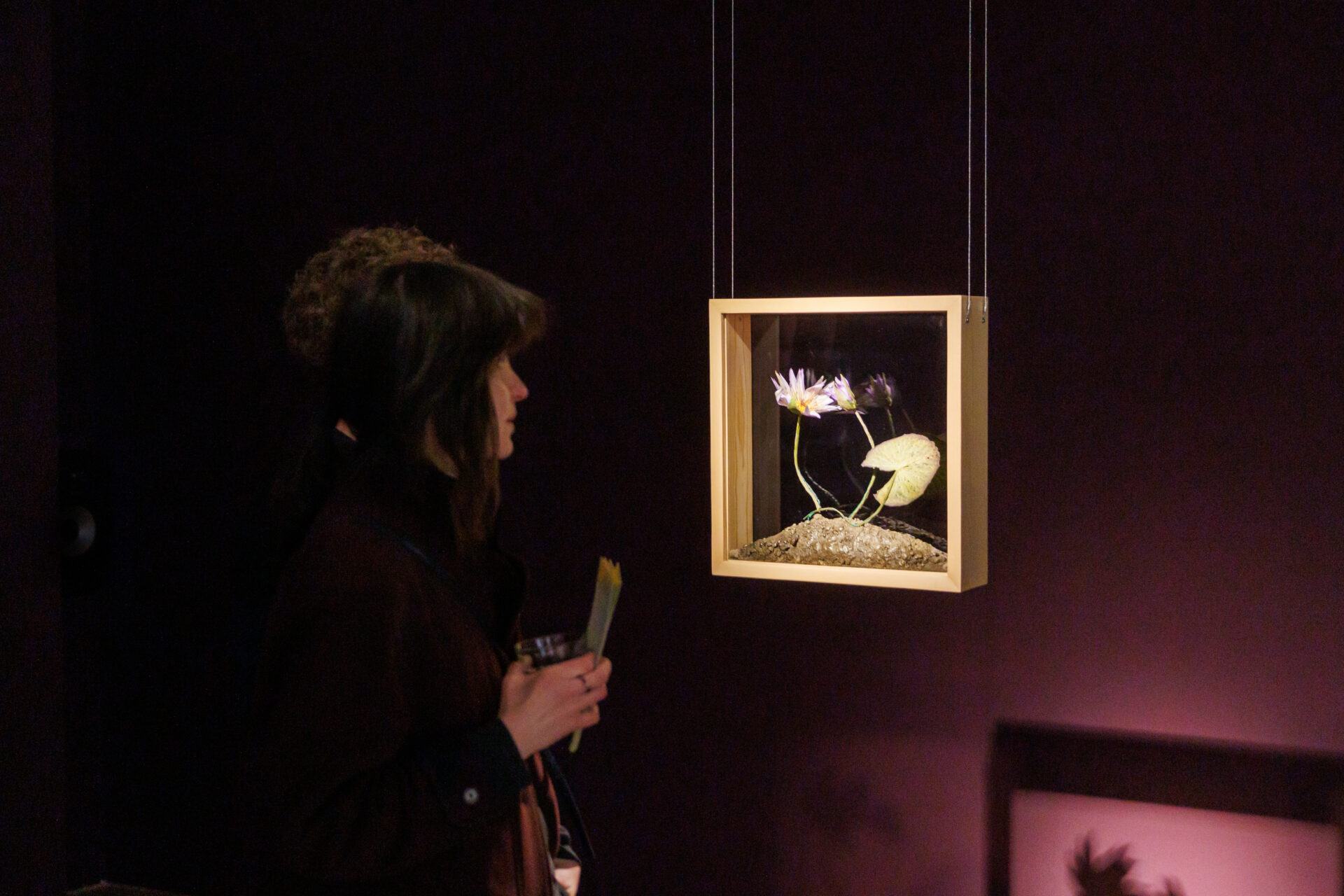
Developed in collaboration with a fishing community on the island of Qursaya in Cairo, the work follows gestures of daily life along the Nile. A fisherman dives into the dark water with his bare hands while a child steers the boat beside him. The camera lingers on these acts of coordination, tracing a relation between bodies and the river. Gradually, a lotus flower enters the narrative. Its petals open in time-lapse before it is cut from the water and passed from hand to hand, moving through fields and villages before returning to the river. The journey culminates in the revival of the Nile Parade, a celebration that once honoured the river’s cycles of water and fertility. For Anis, such rituals function as living forms of memory carried through collective practice rather than written records.
Nearby, a dried lotus flower rests inside a glass case. Isolated from its environment, it becomes both a memory and a warning. Once widespread along the Nile, the blue lotus has largely disappeared, pointing to the ecological fragility that underlies the work.
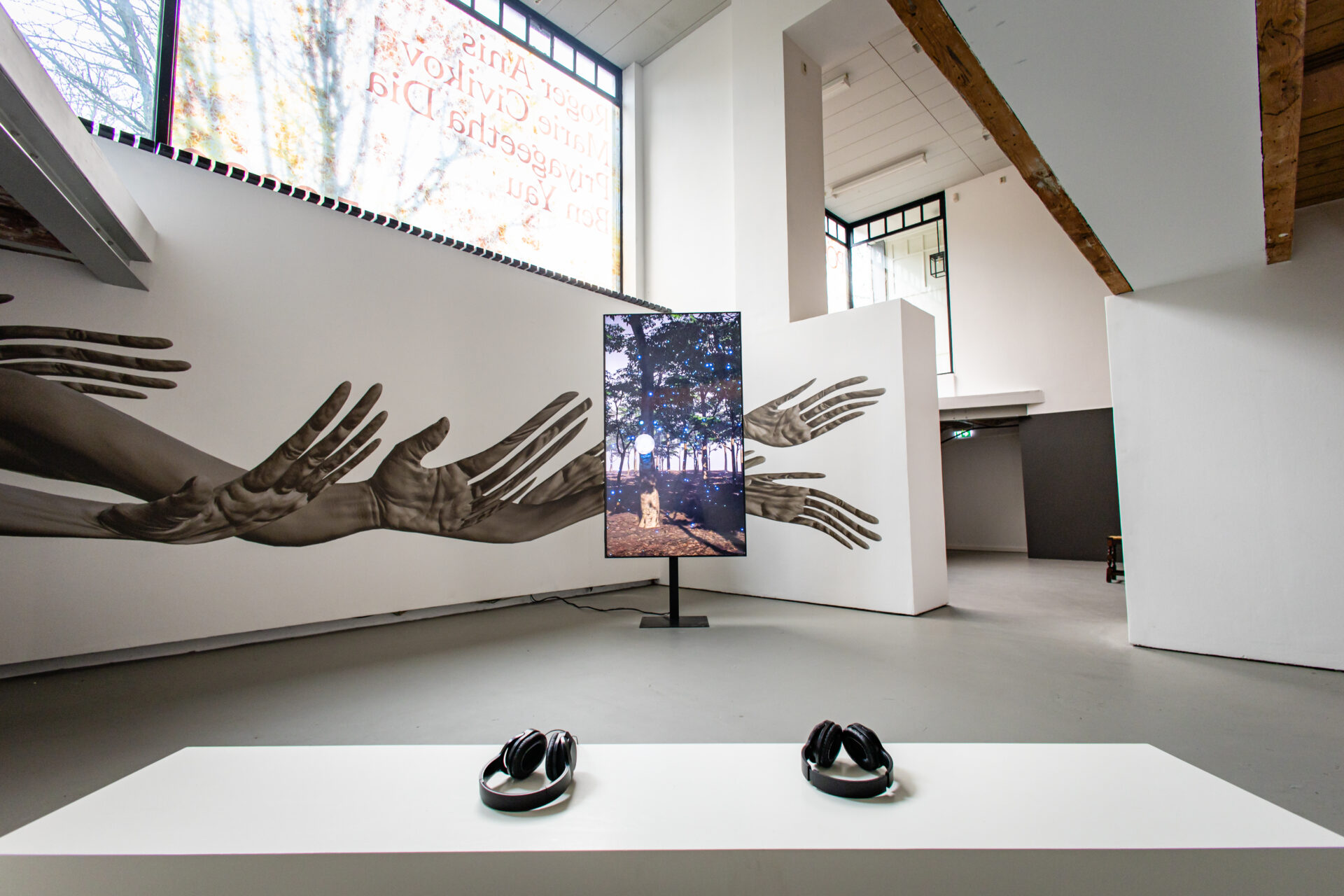
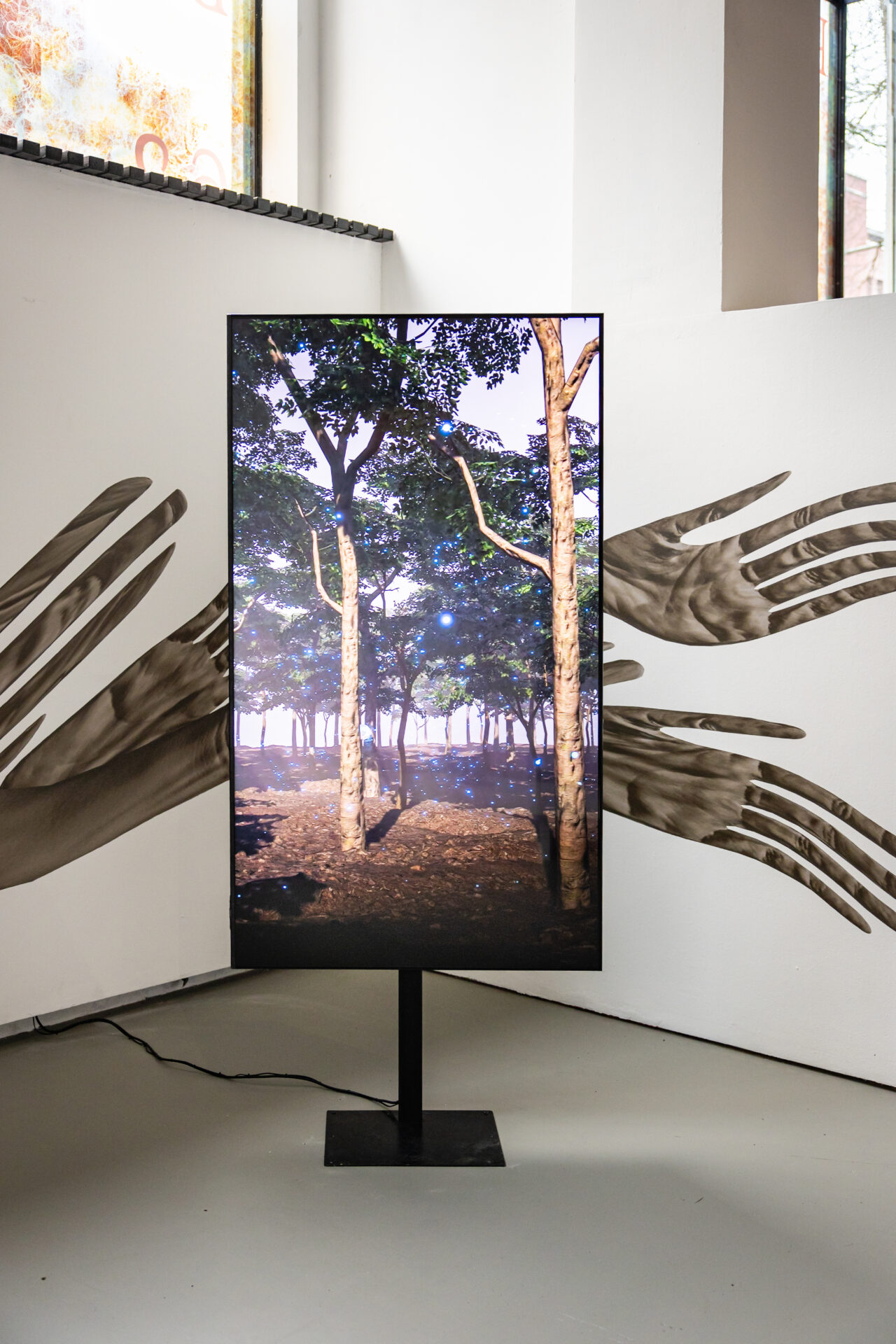
Downstairs, the atmosphere shifts. Leaving behind the pastel tones of Civikov’s banners and the sense of hope carried by the chant in Anis’s work, I feel as if I am descending into a darker register of the exhibition, where remembering begins to surface its more unsettling histories. With Priyageetha Dia’s Spectre System (2024), the exhibition moves into the spectral landscapes of colonial plantation economies. A vertical screen stands before a mural of elongated hands whose fluid forms recall the elasticity of rubber, the material that shaped the colonial economy of the Malay Peninsula. Vegetation, industrial fragments and disembodied forms drift through a terrain that feels both familiar and unstable. At its centre are the Inaivu, entities drawn from Tamil and Malay traditions of remembrance, moving through the landscape as carriers of ancestral rituals and knowledge.
In Dia’s work, the concept of rememory becomes almost tangible. The Inaivu move through memory as something embedded in time, bodies and spaces. This brings to my mind the Indigenous feminist concept of cuerpo-territorio (body-territory), articulated by Maya-Xinka activist Lorena Cabnal, which understands body and land as inseparable, both marked by histories of extraction and control.[1] Dia’s work suggests that these logics have not disappeared: they have simply shifted form. If (re)memory can travel between bodies, land, and time, might remembrance then become a resource for collective repair?
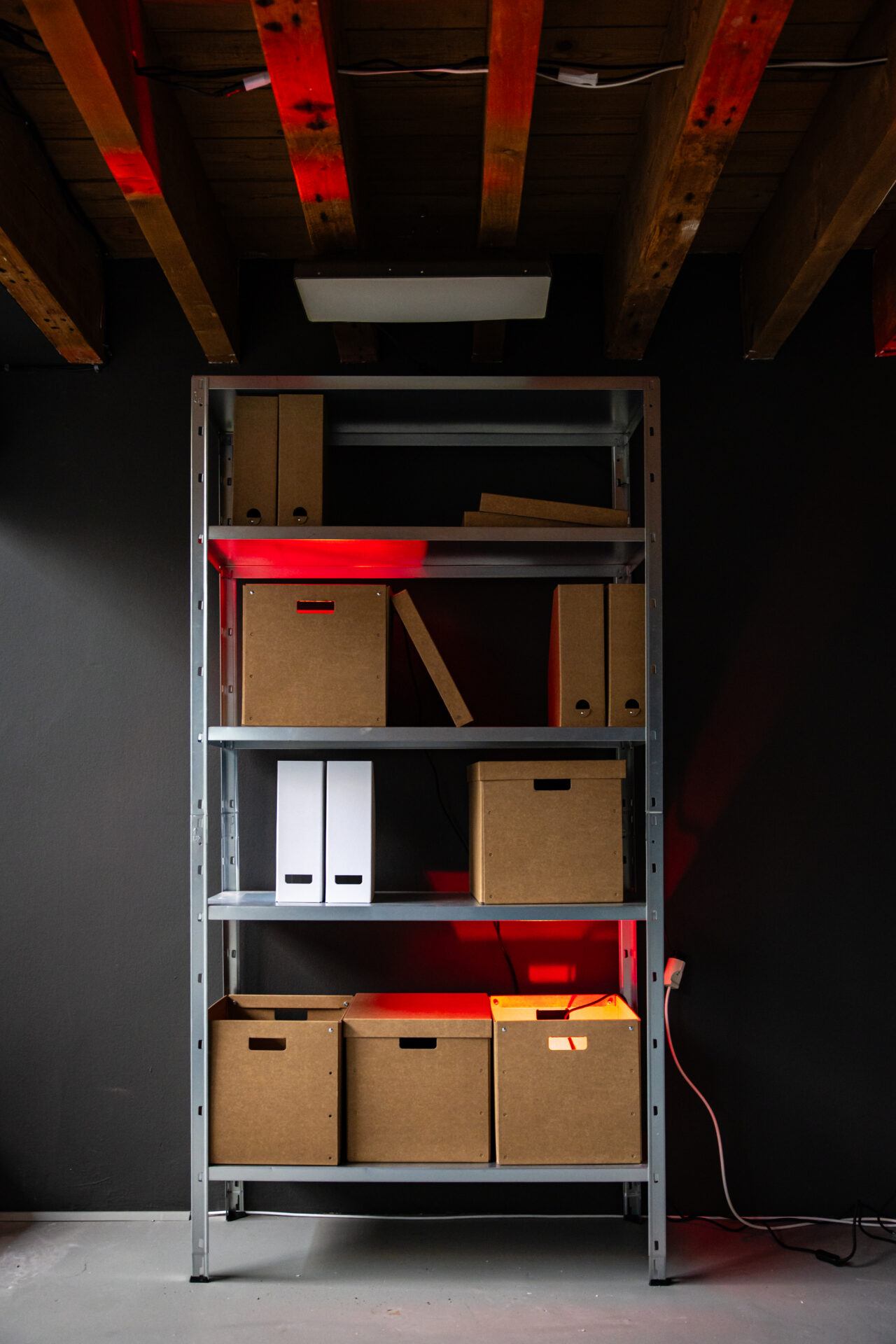
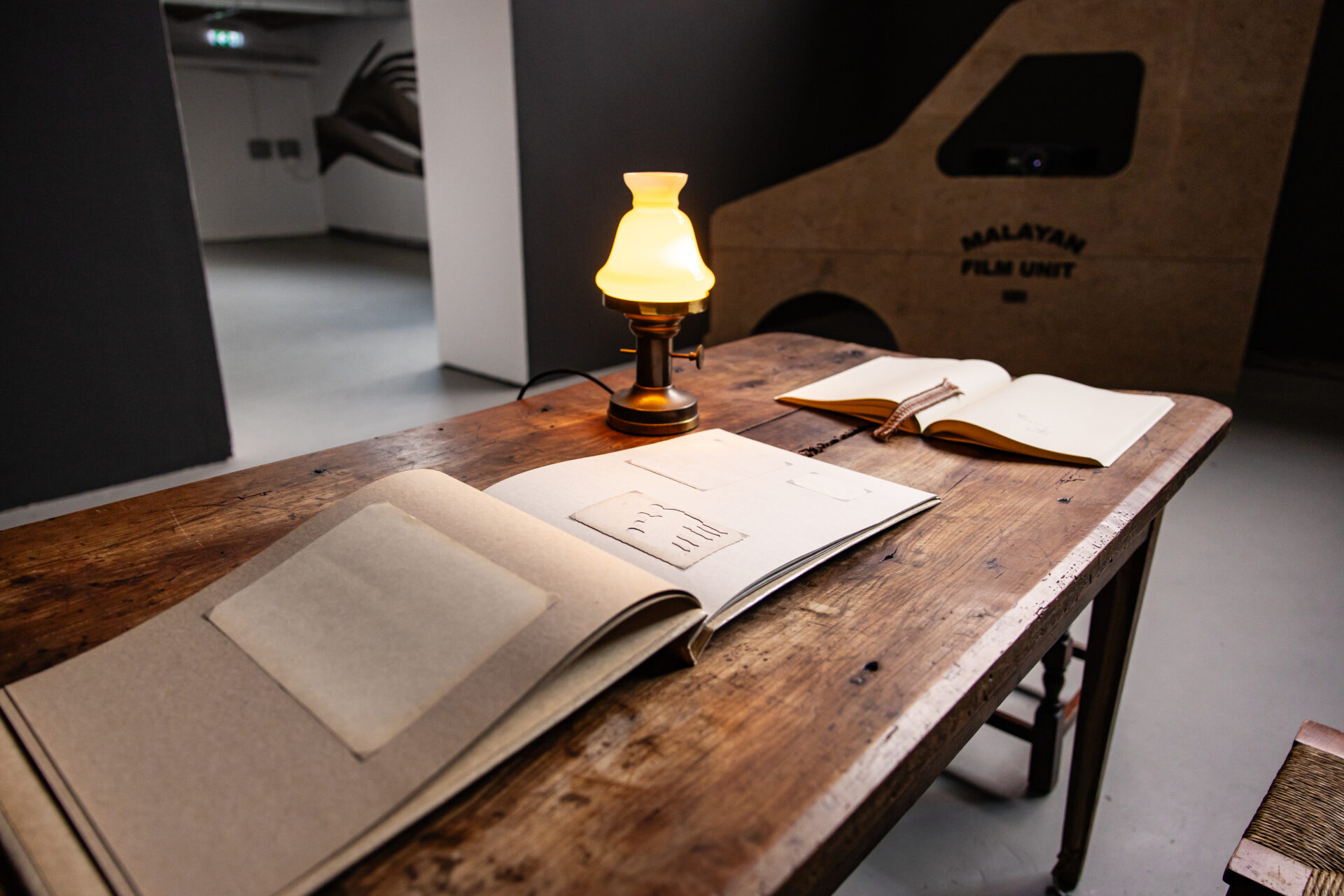
In a nearby room, Ben Yau approaches this question from a more analytical angle, making visible how colonial erasure was actively produced. Returning to British rule in Malaya and the rubber economy that sustained it, his installation unfolds through three interconnected vignettes: brief, concentrated scenes that condense larger historical processes. The room resembles an archival storage space. Metal shelves hold brown document boxes while a wooden table stands beneath a single hanging bulb. One vignette is activated through sound. An imagined confession by a British officer recounts Operation Legacy, the covert programme through which thousands of colonial records deemed embarrassing to the British government were destroyed before Malayan independence. As the voice calmly describes the burning of documents, the light above the table remains off, leaving the room in half-shadow. Another vignette appears through projection. Archival footage references the Malayan Film Unit, established in 1946 to produce propaganda films portraying colonial rule as orderly and benevolent.
The final vignette unfolds at the table. As an interview begins, the desk lamp switches on, illuminating two altered books: a family album with figures cut out, leaving only silhouettes, and a sparse genealogy where most branches remain blank. The recording belongs to Eddy Wong, who recounts how he began tracing the story of his grandfather, who disappeared during the anti-colonial struggle when Wong’s father was still a child. The grandfather’s body was never recovered; the grave carried only his name.
Starting, like Civikov, from a personal attempt to reconstruct family history through fragments and inherited silences, Yau uses remembering to expose how colonial power systematically produced absence, creating perhaps the clearest articulation of its meaning as counter-archiving in the exhibition. By attending to what is missing as much as what remains, Yau foregrounds the structures that shape historical visibility, without attempting to stabilise an entirely new narrative. It is a proposal for exactly this restructuring of memory that Morrison’s concept of rememory articulates.
When I ask curator Leana Boven what felt urgent to articulate through this exhibition, and why now, she turns to Langston Hughes’s poem Tired (1935):
‘Let us take a knife
And cut the world in two—
And see what worms are eating
At the rind.’ [2]
For Boven, the poem captures the exhaustion many feel in the face of repeating cycles of violence, but also the urgency of naming them rather than looking away. Positions: Unearthing succeeds in making this exhaustion palpable, unfolding as a movement from the tentative hope of reconstruction toward a more difficult clarity. Across the works in the exhibition, counter-archiving operates both as a method and a proposition. It allows these histories to re-enter the present, but it also reveals its own limits: what has been destroyed cannot be fully restored, only traced through fragments. If the past continues to inhabit the present, as these works suggest, then remembering may not simply be about recovery. It may also be a necessary step toward imagining different futures.
METROPOLIS M KAN NIET ZONDER JE STEUN
Trouwe lezers vormen het fundament van Metropolis M. Wij kunnen niet zonder je steun. Je kunt ons steunen door een jaarabonnement af te sluiten. Het eerste jaar krijg je 40% korting. Een regulier jaarabonnement kost 58 euro. Er zijn ook kortingsabonnementen. Studenten/65plussers/CJP-ers/Personen met een minimuminkomen en PLATFORM BK-leden betalen slechts 36 euro voor hun jaarabonnement. Op DEZE PAGINA lees je meer over de verschillende abonnementssoorten en kun je je direct aanmelden.
BIJ VOORBAAT DANK!
[1] Sofía Zaragocin and Martina Angela Caretta, “Cuerpo-Territorio: A Decolonial Feminist Geographical Method for the Study of Embodiment,” Annals of the American Association of Geographers 111, no. 5 (2020): 1–16, https://doi.org/10.1080/24694452.2020.1812370.
[2] Langston Hughes, “Tired,” in The Collected Poems of Langston Hughes, ed. Arnold Rampersad and David Roessel (New York: Vintage Books / Random House, 1995), 135.
The exhibition Positions: Unearthing is on show until the 3rd of May at Stroom Den Haag
Maria Chiara Miccoli
is a Southern Italian art historian and cultural practitioner based in Amsterdam