The Meaning and Making of Gaps – What is Infrastructural Critique? A conference in celebration of the life and work of Marina Vishmidt
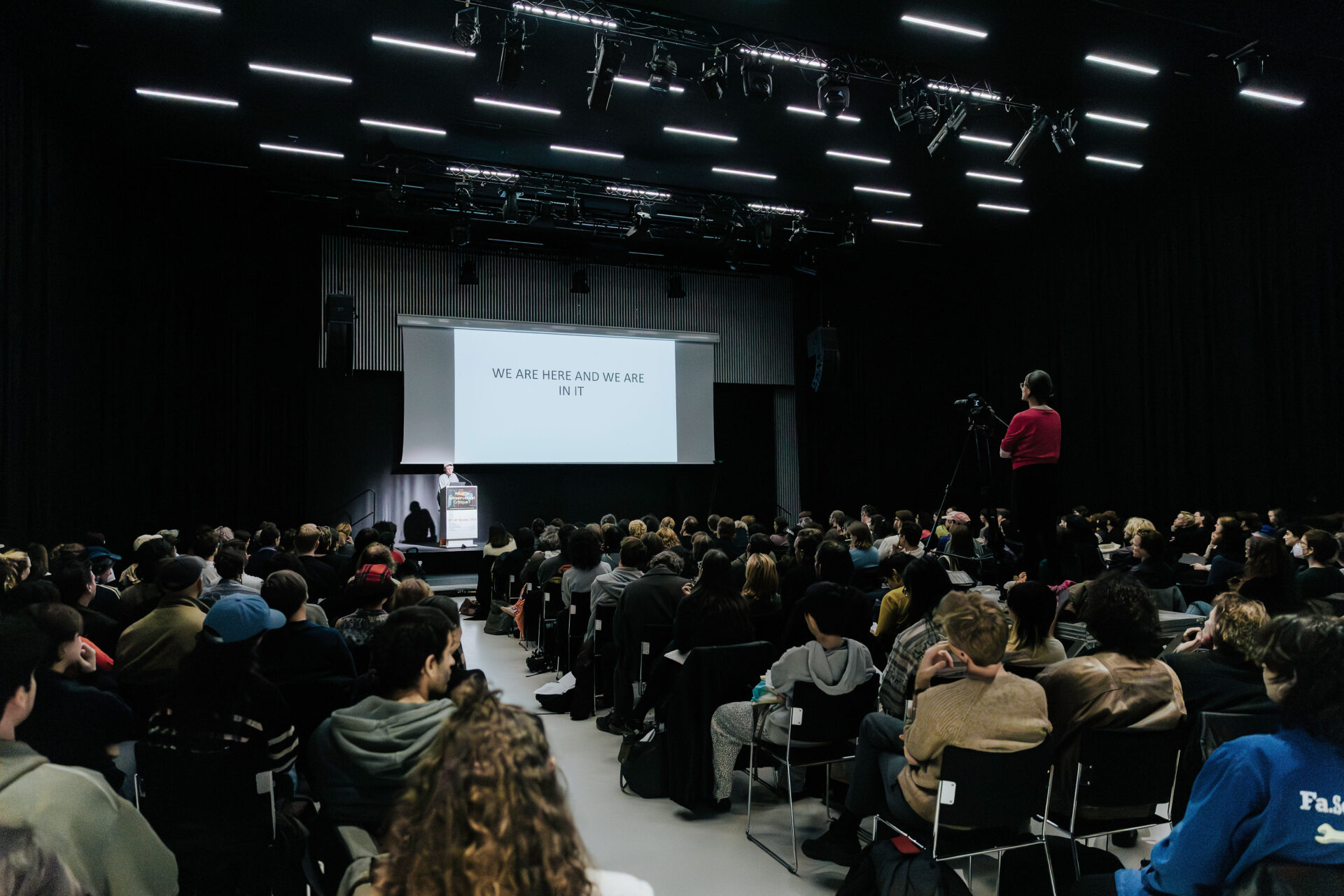
The conference What is Infrastructural Critique? at Die Angewandte in Vienna, brought together artists, critical theorists and collaborators to honor the late writer, art theorist and educator Marina Vishmidt and celebrate her intellectual legacy by thinking through her concept of ‘infrastructural critique’, by which she meant a materialist approach to the infrastructures of contemporary art oriented towards aesthetics and political struggle in all of its interconnected modes and scales. Curators, artists and educators such as Marwa Arsanios, Hannah Black, Kerstin Schroedinger and Angela Melitopoulos, Taylor Le Melle Mattin, Natascha Sadr Haghighian and Kerstin Stakemeier discussed the nature of infrastructural critique and its relation to ecology, institutional critique, political economy and logistics, the politics of abolition in contemporary art and much more. Frida Sandström went to Vienna
‘Reading this now I kind of wonder about ‘re-distribution’ as distinguished from dispossession,’ Kerstin Stakemeier writes in the essay “Marina’s cues” published in e-flux in May last year. It was a month after her friend and collaborator Marina Vishmidt’s passing in April 2024, after which friends, comrades, collaborators and readers assembled around her writing. From the 29th until the 31st of October the three-day conference “What is Infrastructural Critique? A conference in celebration of the life and work of Marina Vishmid” took place at the University of Applied Arts in Vienna to celebrate Vishmidt’s life and work.

This interdisciplinary event that was both a memorial and a celebration, a workshop and a presentation, materialized what Vishmidt’s partner, Danny Hayward underscored in his opening lecture. Namely, that rather than unfinished, Vishmidt’s writings are ‘radically open’. It is this movement of opening that the conference, as part of a manifold of other initiatives of the kind, materialized. Assembling writers, artists, and academics from a broad range of fields and social contexts who all had an affinity with Vishmidt’s life work, the conference was not an attempt to conclude her thinking, but rather to keep it open for as many as possible. This distinction is crucial for the understanding of critique that both Vishmidt and the conference suggested.
‘What is needed is the material reality that makes abstract concepts mean something’
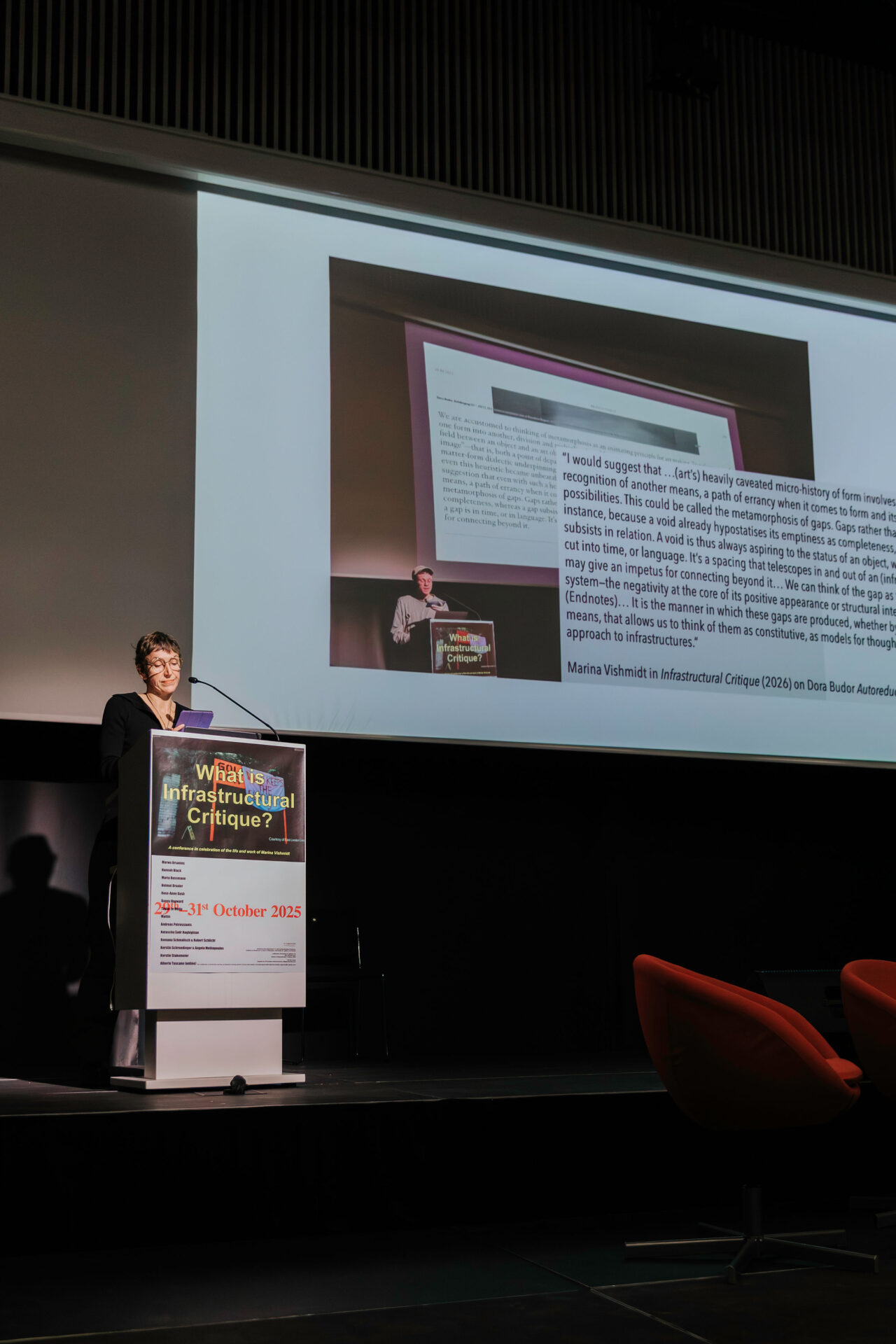
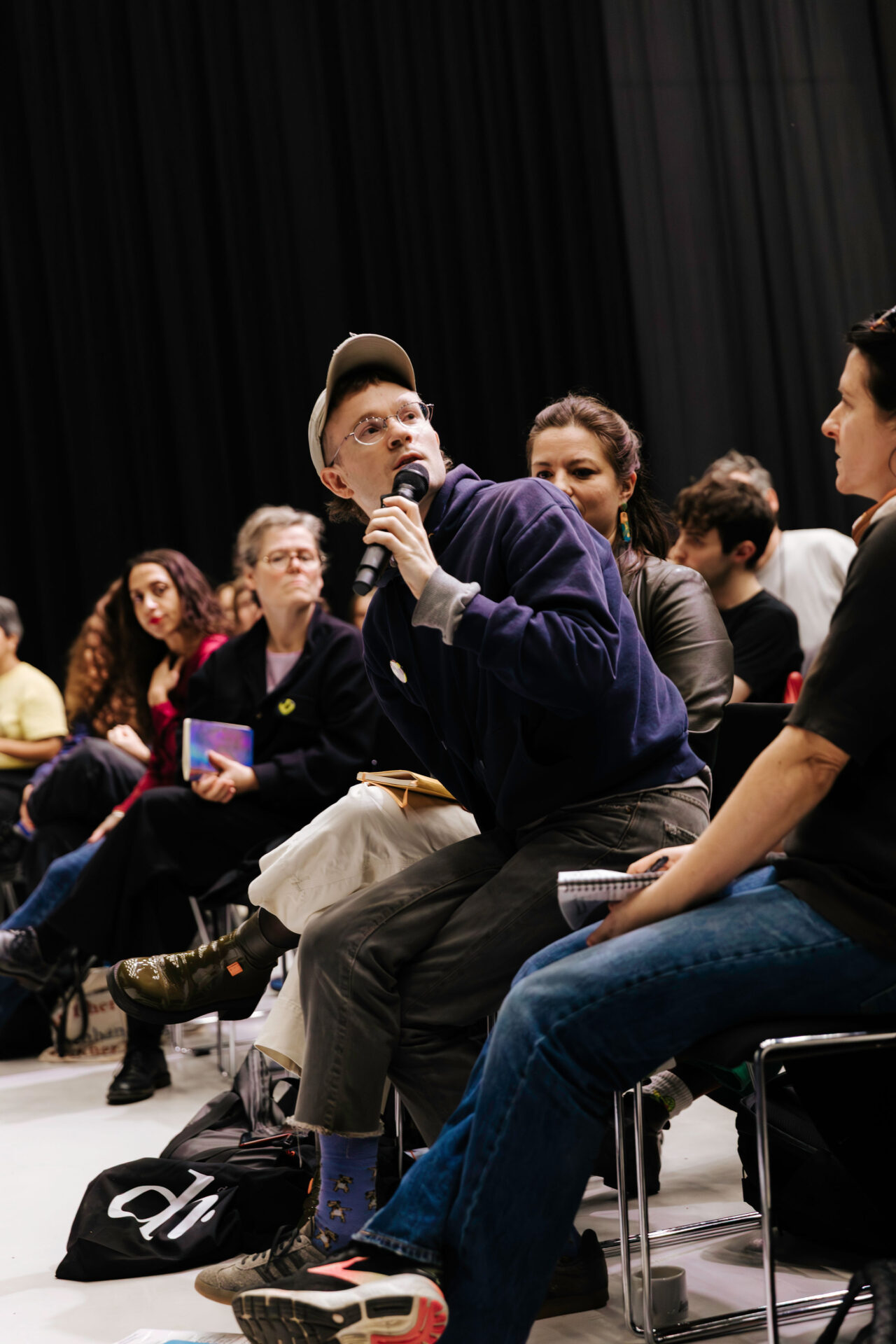
Given the lively productivity of Vishmidt’s pluralized thinking practice, a large number of texts remain unpublished, talks unheld, and a number of conversations were abruptly halted. And still, so many threads continue to be woven between those who remain. Central for the conference was the term ‘infrastructural critique’ which Vishmidt coined and used in a number of texts, and which she introduced extensively in the drafted book Infrastructural Critique: between Reproduction and Abolition, which will be posthumously published by Verso in 2026.
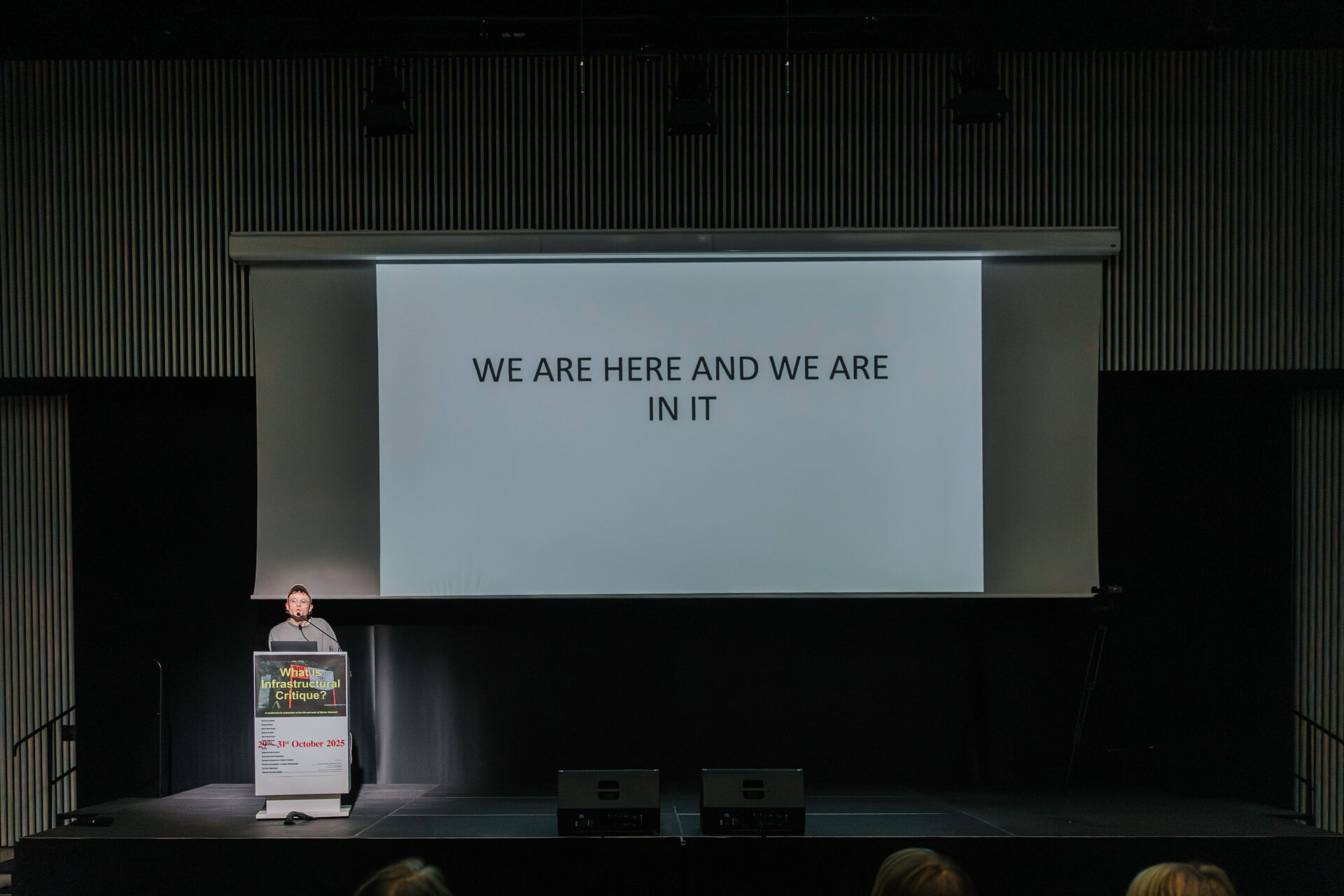
In his opening lecture, Hayward departs from Vishmidt’s planned lectures at the Angewandte for the spring semester of 2024, out of which several weeks were marked by her sudden passing. Referencing the forthcoming book, which he has edited together with Larne Abse Gogartry and Kerstin Stakemeier, Hayward describes the manuscript as a dialectical image, as once describes by Walter Benjamin, the movement of which ‘should have been hers’ but which now is in our hands. Throughout the conference, readers and writers showed examples of moving along as cues of Vishmidt’s thinking, re-distributing meaning and references through cinema and politics, colonial warfare and social reproduction. Some of these cues will also be published in a forthcoming anthology based on the workshop Marina’s Cues: Infrastructures of Disalienation, which took place at Leuphana University in January.
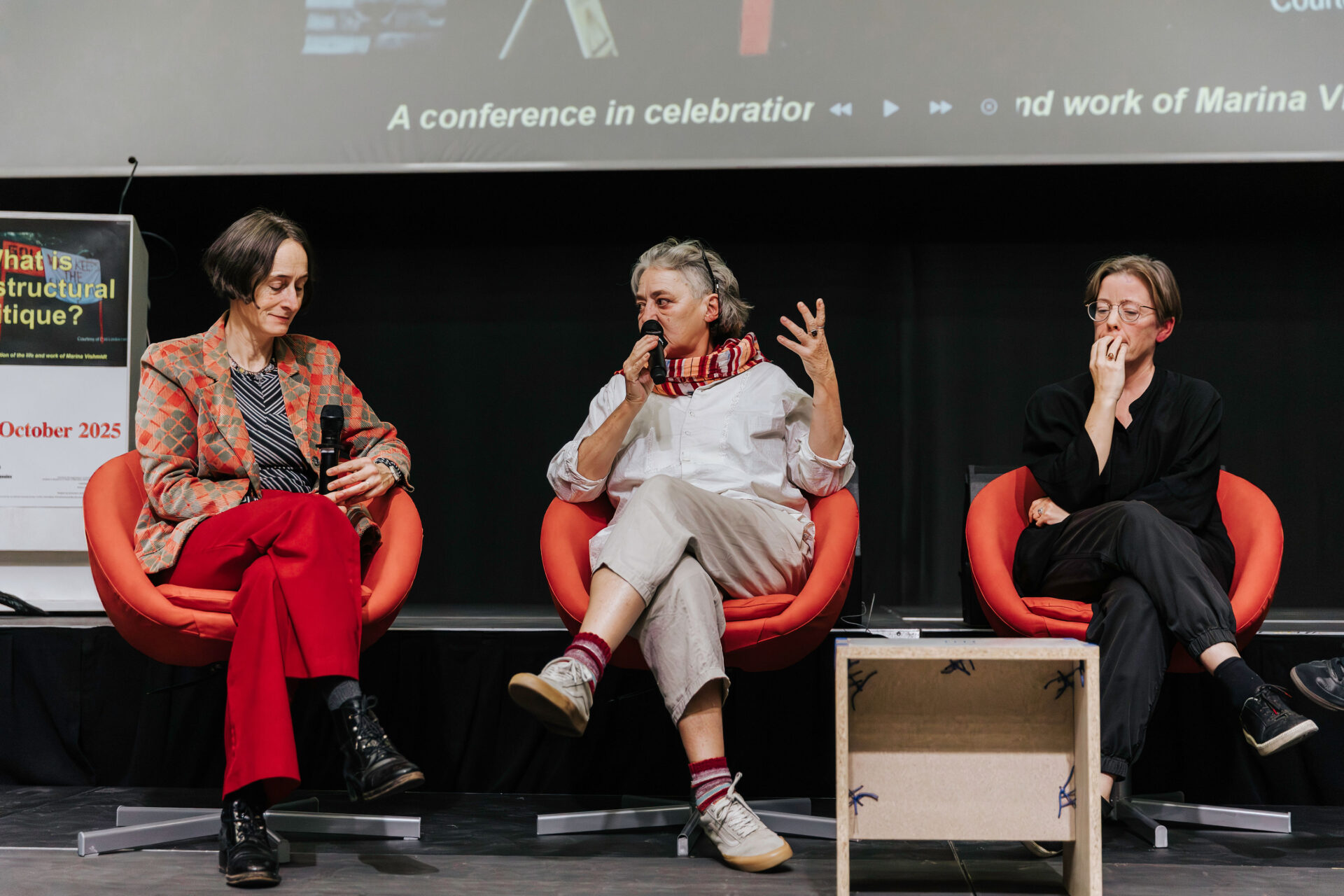
As Hayward cites in his lecture, Laurent Berlant, who also recently passed, wrote in 2016 that ‘movement is what distinguishes infrastructures from institutions.’ As they add, the difference between both is ‘a matter of perspective.’ In Hayward’s reading the institution self-contradicts itself performatively. In the main lecture hall of the University of Applied Arts, where the pro-Palestinian solidarity with which Vishmidt was so deeply engaged remains repressed, these words echo like her own criticism.
As Hayward recalls, Vishmidt suggested a form of engagement that allows us to ‘devote oneself to the matter without adding too much of ourselves.’ This self-decentered form of critique is central to infrastructural critique is different from the institutional critique canonized since the 1970s. It has less to do with safe-guarding the artist’s or the intellectual’s critical subjectivity, but more with a practice that makes its material circumstances ‘speak’, as Hayward suggests in yet another Benjaminian vein.
Indeed, Vishmidt was an intellectual comrade working incessantly across and against fields, always with her feet in concrete organizing – from artist’s actions to strikes and solidarity work. This baseline was also central in her writings, where the use of the notion of infrastructure, alongside Berlant’s proposal, proves a refusal of the orthodox Marxist notion of superstructure, and rather departs from a perspective of social reproduction which always must be immanently and socially critiqued.
In a drafted introduction to the book forthcoming with Verso, published by e-flux earlier this year, Vishmidt writes: ‘attention to infrastructure is inseparable from the attempt to develop a materialist theory of “conditions.” This means the material conditions of the institution’s reproduction, both in and beyond the art field.” Moreover, she underscores, how the ‘social abstraction’ including colonialism and race, must be attended to alongside the social history of art, labor and organizing.
In her engagement with what she came to call ‘infrastructural critique’, Vishmidt always wrote, to borrow Hayward’s formulation, ‘with and alongside people.’ This collectivizing and pluralizing approach to critique is central to the social reproduction immanent to infrastructure, that also is life.
During her presentation in Vienna, Stakemeier – who has been writing extensively on the relation between social reproduction and social and aesthetic autonomy together with Vishmidt – underscores the need to ‘congeal life into abstraction, so that abstraction becomes a living form.’ In these dialectics of abstraction, understood as a life practice rather than a mere intellectual one, the ‘criticism of complicity’ – as suggested by Andreas Petrossiants – allows us to understand infrastructural critique in times of genocide, and through the historical lens of its normalization. Hayward adds: ‘What is needed is the material reality that makes abstract concepts mean something.’
Speaking of meaning, the text that I’m currently writing is a paradox itself. Not only since I speak of Vishmidt and the conference quite formally, but also as the subject of the critic – which I inherently take when reporting from this kind of event – that embodies the infrastructure that Vishmidt referred to. She repeatedly referred to ‘the paradoxes of self-abolition’ through the lens of social reproduction. The critic here stands out a particularly central for the necessity of radicalizing reproduction and hence, our understanding of subjectivity. This is where the notion of critique – the least discussed during the conference – comes in. As Hannah Black suggests in her presentation, abolition can be understood as ‘the refusal to reproduce a specific kind of subject.’
That the critic’s self-critique constitutes the history of this dialectical practice was central to the conversations that I had with Marina myself, and comes to the fore during these collective reflections of one who, like Marina, practiced criticism with and against its preconceived subject. At the conference, the subject of the critic is understood in an extended sense, through the form of the institutions that critics affirm or negate. Importantly, this institution may as much be self-organized in solidarity, as one ‘of denial’ – as Rose-Anne Gush puts it in her extraordniary paper on the relation between colonial land-grabbing and land art.
In Black’s presentation, the institutional (or critical) denial is exemplified in the curatorial unwillingness to include the Palestinian experience in the current capitalization of a ‘woke’ artworld. Following both Black and Gush, this reproduces the denial of the ongoing genocide.
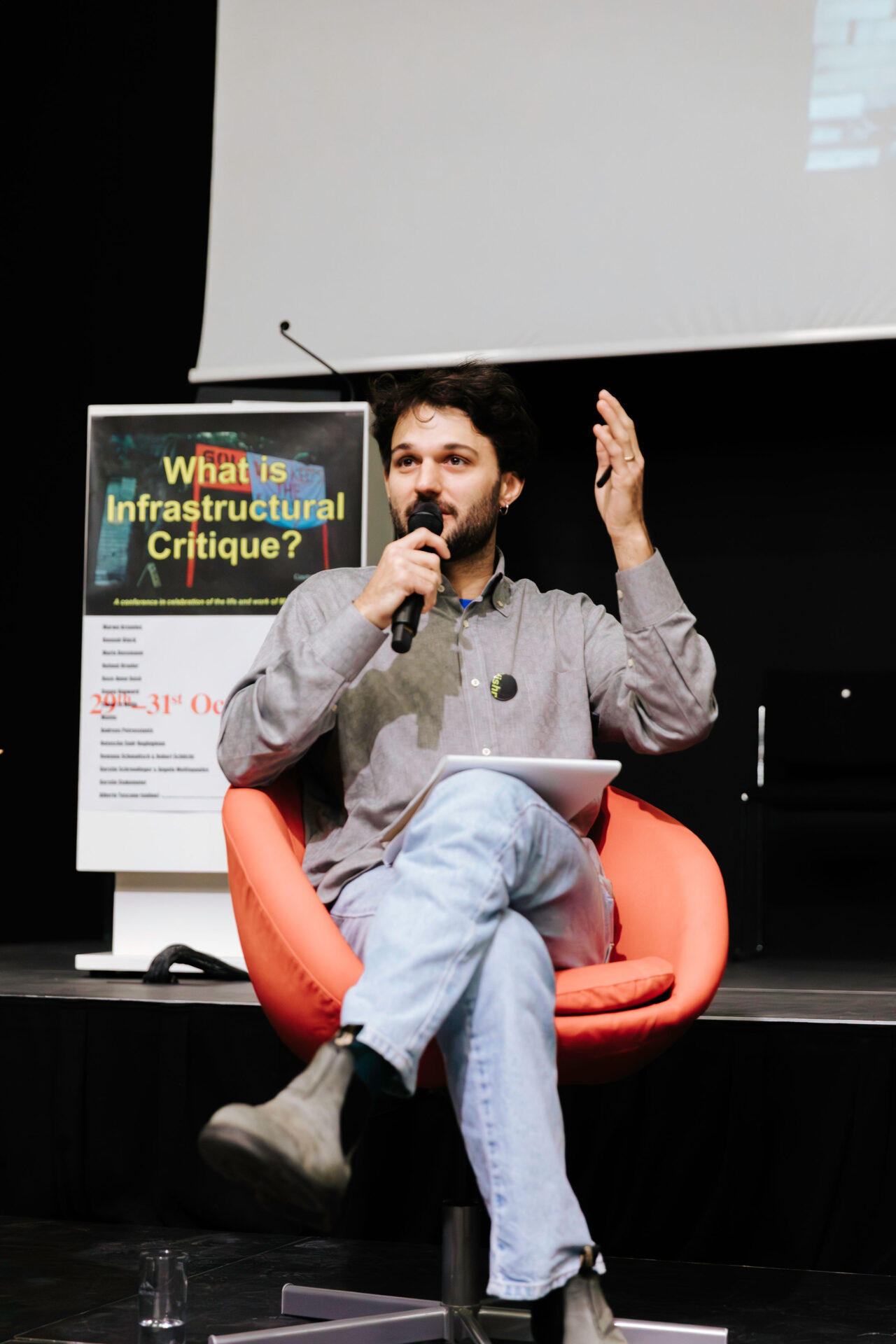
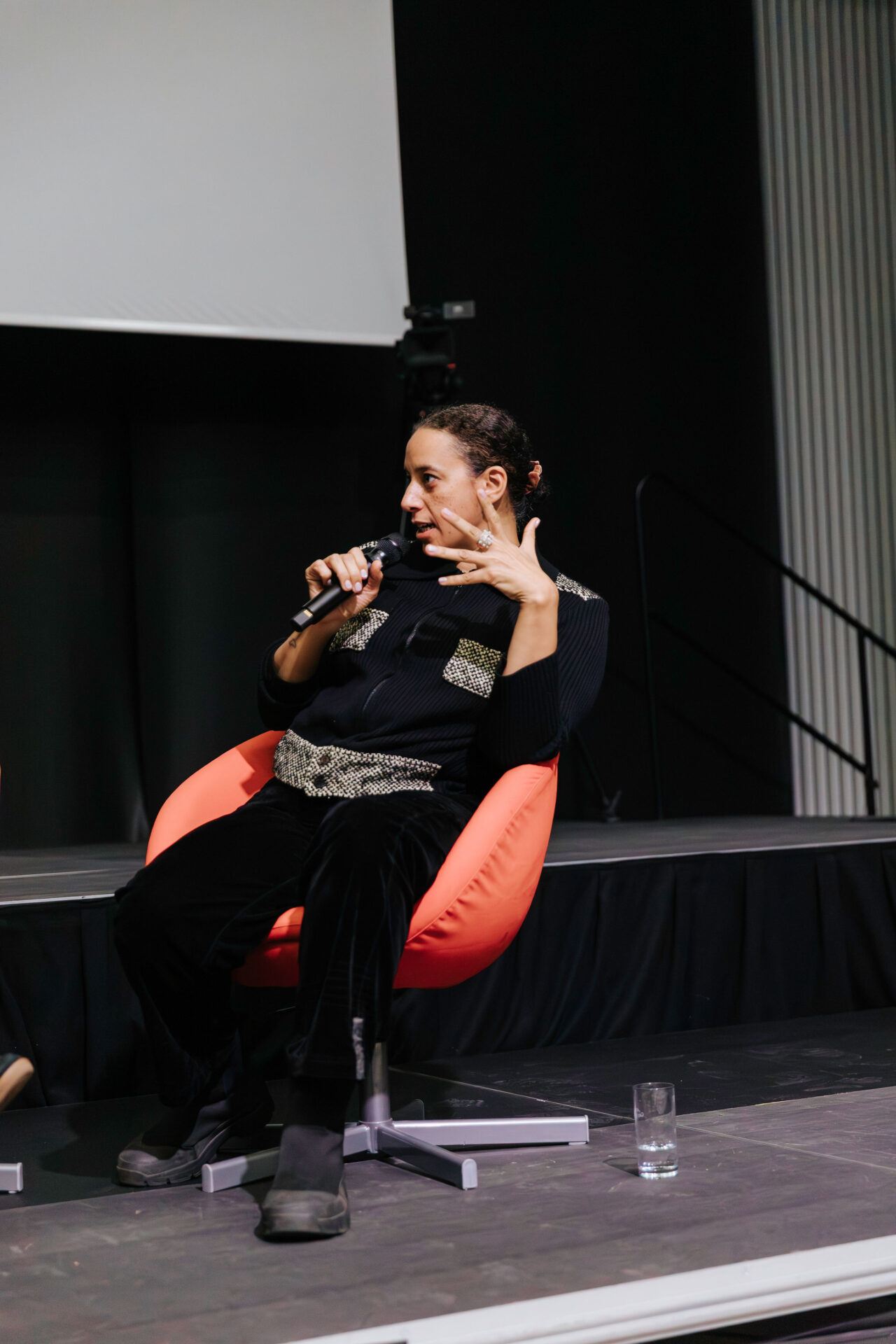
We may say that infrastructural critique is a means for survival under colonization
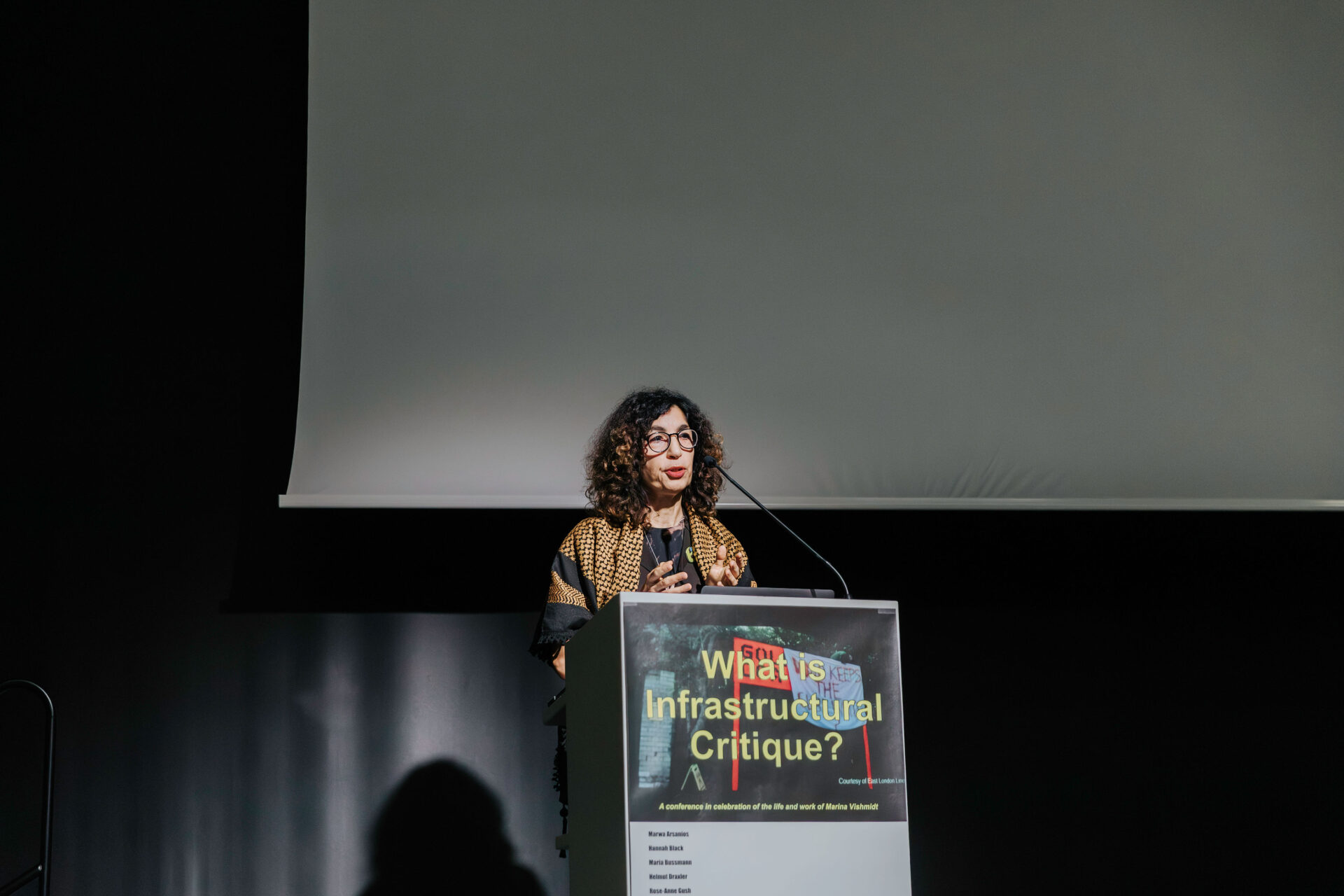
If contemporary art today must be understood through the lens of complicity rather than self-criticism, as Natascha Sadr Haghighian suggests in the same vein, the role of the critic is also, naturally, inherently changed. Put differently, the critic is complicit until proven otherwise. This is where the radicalization and refusal of reproduction comes in.
While Gush underscores the centrality of Vishmidt’s unionized thinking of using the institution rather than abandoning it, Sadr Haghighian describes the contemporary, ‘woke’ art institution as disintegrated into dust. I was likely not the only one in the audience who immediately saw the deserts of dust that now cover Gaza in front of me, forming seas of former reproductive units, now crushed into indistinguishable particles upon which Palestinians dig themselves to reach relatives, homes and other lost infrastructures.
When Sadr Haghighian asks ‘how to separate the dust’ she suggests a form of critique – which etymologically means separation – based on the clarity that colonial destruction causes for those who survive. As Fumi Okiji has underscored, which Marina once introduced me to, immanent critique is not a choice but a necessity for black lives. Extending Okiji’s proposal, we may say that infrastructural critique is a means for survival under colonization.
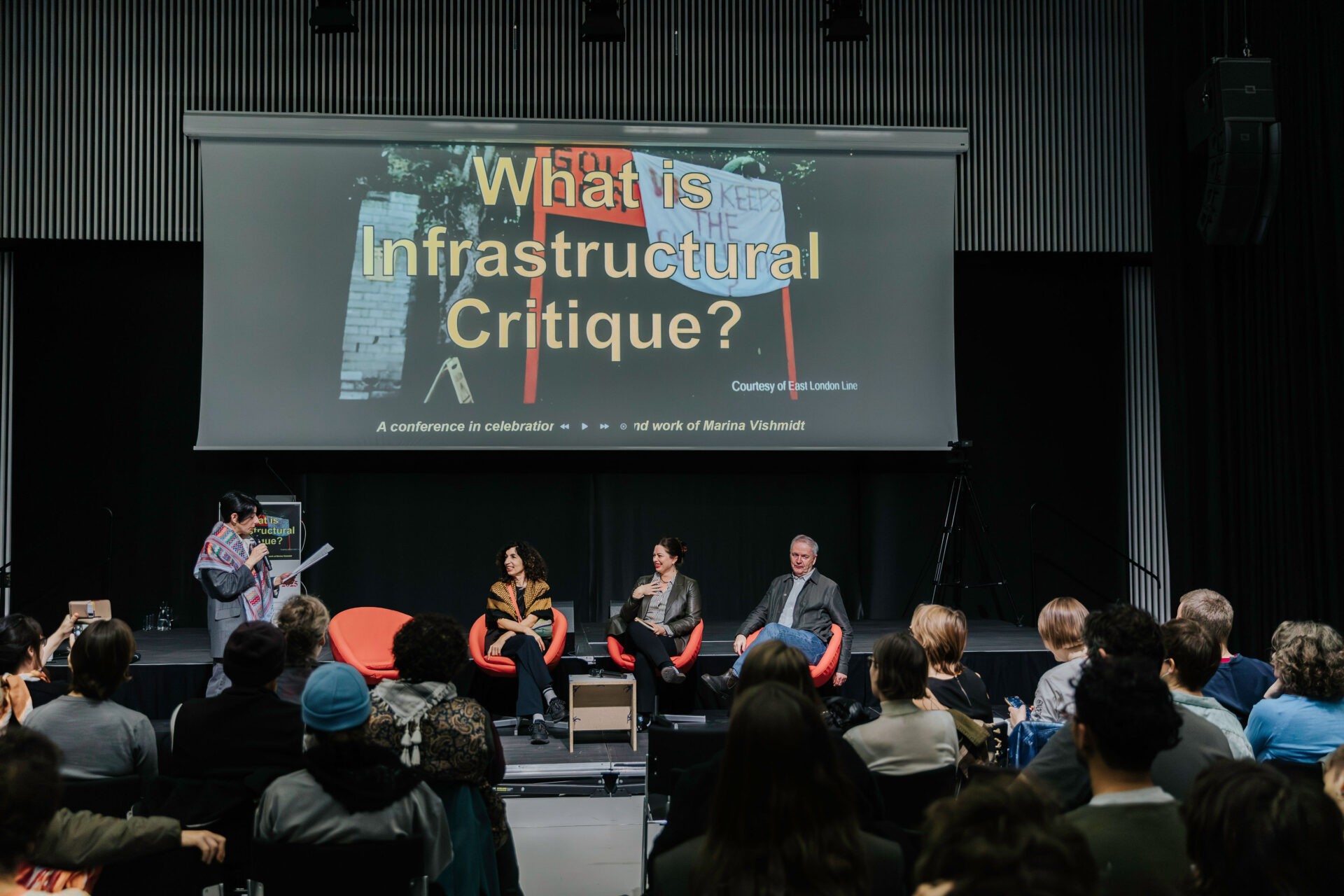
Time is a recurring notion in the proposals for how to read infrastructural critique. Besides the references to memory politics under German Staatsraison, and memories from comradely conversations with Marina – time was referenced through a historical materialist lens of the dialectical image and hence also the movement which the media of film, central to Marina’s thinking and practice, allows for. To borrow Hannah Black’s words, film thus allows for a ‘trans-subjective infrastructure of social life.’ Sounds great, but what does that mean?
In Marwa Arsanios’ presentation, communization is central to such trans-subjective infrastructure, in which film – at the core of her artistic practice – allows for another relation to (stolen) land. Introducing the notion of ‘mashaa’ (common) with a concrete example in Northern Syria as reflected in her ongoing film project Who is Afraid of Ideology (since 2017), Arsanios underscores the importance to reorganize art as a way to produce a cut in the colonial mode of production.
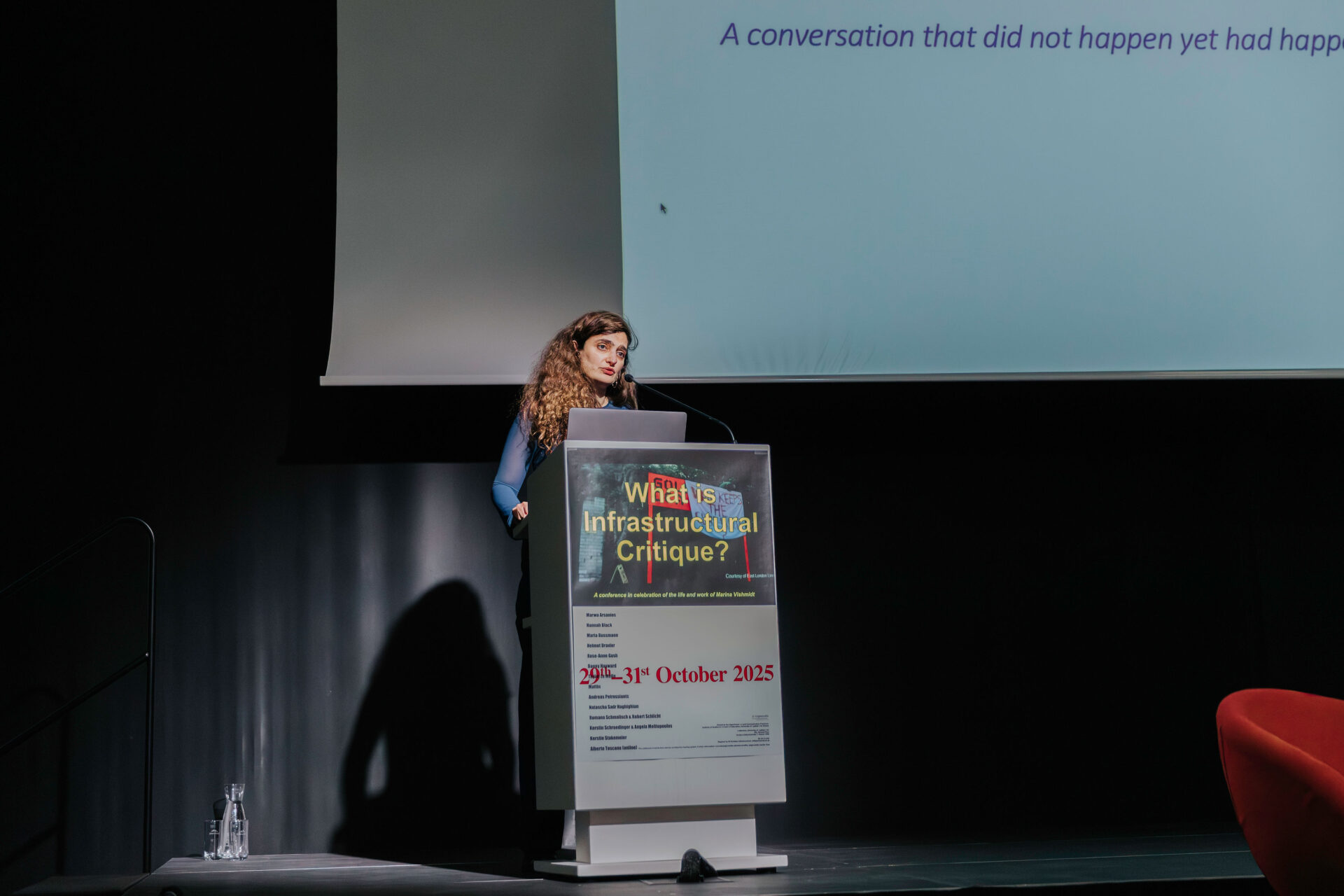
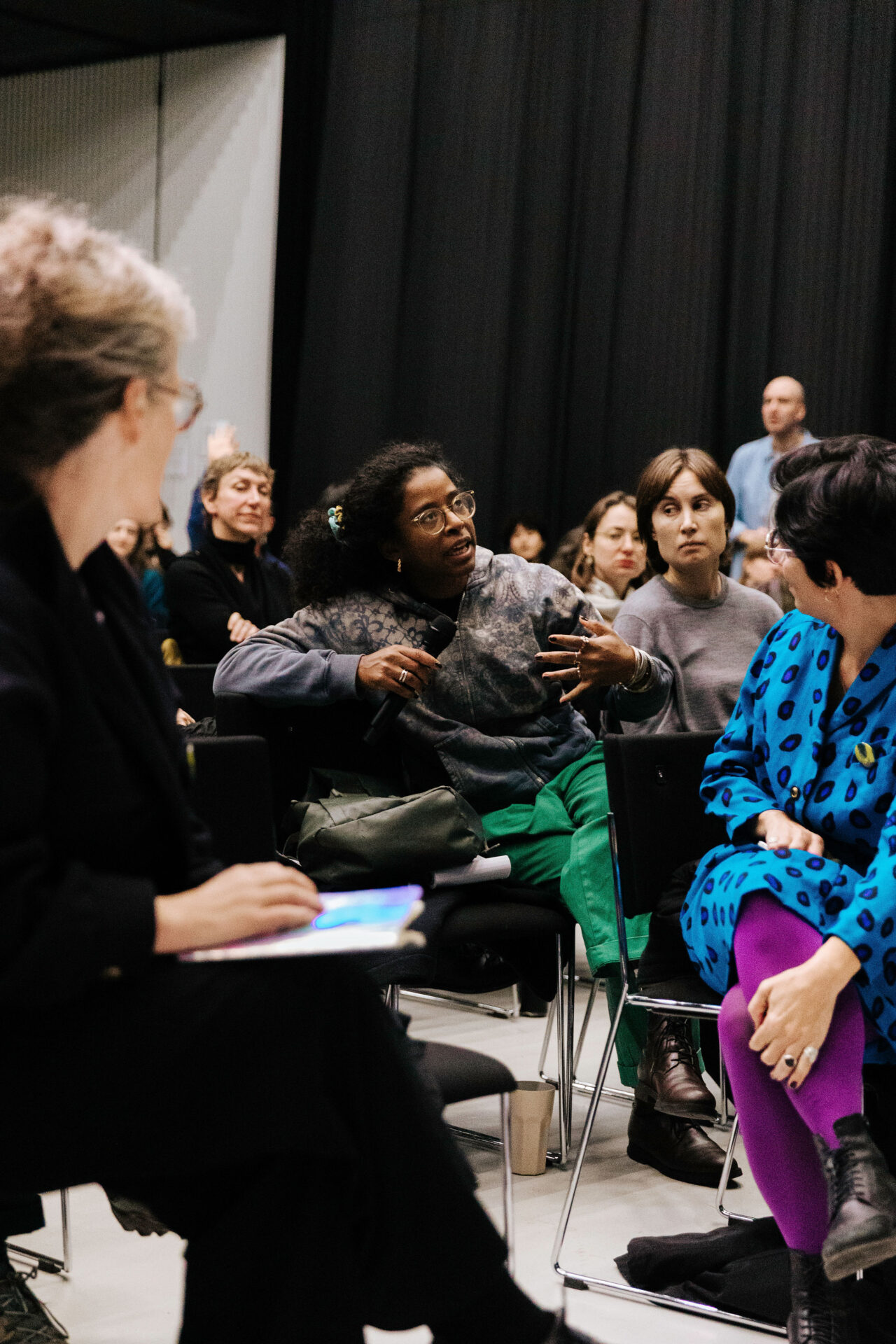
In Albeto Toscano’s presentation, in which he made a reading of Hewey P. Newton’s approach to the racist media in the 1960s USA, he described surviving as a way of ‘using the institution against itself.’ As he added, such an approach inherently causes transitions – biological, social or infrastructural. Although Toscano did not touch on the material aspect of trans from the point of view of gender transition, the ‘cut’ that he and several other speakers referred to throughout the conference became a clear example of what infrastructural critique may imply as an everyday practice.
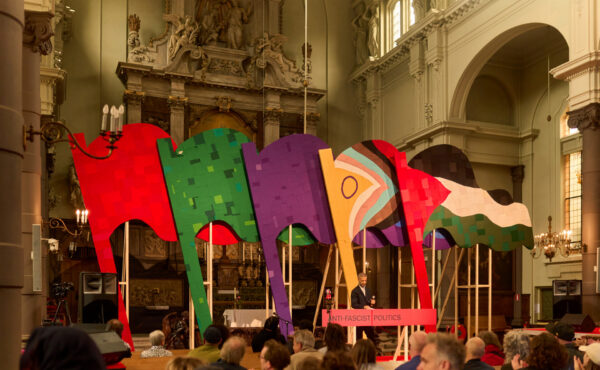
Following the current neo-fascist movement in which trans lives are under increasing threath, Mattin’s presentation that built on Vishmidt’s analysis, he underscores the fascist ‘I’ as a self-imagined, impenetrable surface without gaps.
According to Stakemeier’s parallel proposal, in which she suggests a ‘popular front of the senses’, the very modern self is made a gap by means of dissociation – a form of emancipation and refusal that both abolishes and reproduces the infrastructure of the senses. Dissociation hence becomes a form of materialist critique that refuses transcendence and self-reproduction, but which critically realigns experience with and against subjectivation. Such a form of re-distribution is not only a pre-defined method but an open practice of reading, reflecting and living. This is what the question ‘what is infrastructural critique’ inherently asks from us, rather than answering it. And neither did the conference, luckily.
Marina Vishmidt was Professor of Art Theory at the Angewandte between October 2023 and April 2024.
Forthcoming is her book Infrastructural Critique: Contemporary Art Between Reproduction and Abolition, Verso, 2026
What is Infrastructural Critique?: A conference in celebration of the life and work of Marina Vishmidt, University of Applied Arts in Vienna, 29-31 October 2025
The conference took place at the Department of Art and Communication Practices at the University of Applied Arts, Vienna, and was curated by Danny Hayward and Rose-Anne Gush, and organized by Sofia Bempeza, Rose-Anne Gush, Danny Hayward, Annette Krauss
Frida Sandström
is een schrijver, criticus en onderzoeker uit Kopenhagen