The Shape of Memory – Wild Summer of Art at Brutus
This year’s Wild Summer of Art at Brutus is anything but “wild”. Instead, the annual survey of Rotterdam’s art scene presents a multi-layered and intricate meditation on memory.
Traces We Keep is the third instalment of Wild Summer of Art at Brutus in Rotterdam, co-curated by Yannik Güldner and Jeanette Bisschops. Working from a pre-selection made by Rotterdam-based scouts, the curators shaped a loose narrative around the theme of memory, how it is fractured, held and reimagined.
The show brings together fifty artists and collectives (!) at all stages of their careers, from rising talent to seasoned practitioners embedded in Rotterdam’s contemporary art landscape – among them Alexandra Phillips, Anouk Kruithof, Benjamin Francis, Cihad Caner, AYO, Ilke Gers, Jason Hendrik Hansma, Katarina Jazbec, Liza Wolters, Mel Chan, Mylan Hoezen, Puck Schot, Robert Glas, Toon Fibbe and Vlada Predelina.This mass amalgamation of practices at different stages of development works to build and maintain connections across varying artistic communities and approaches.
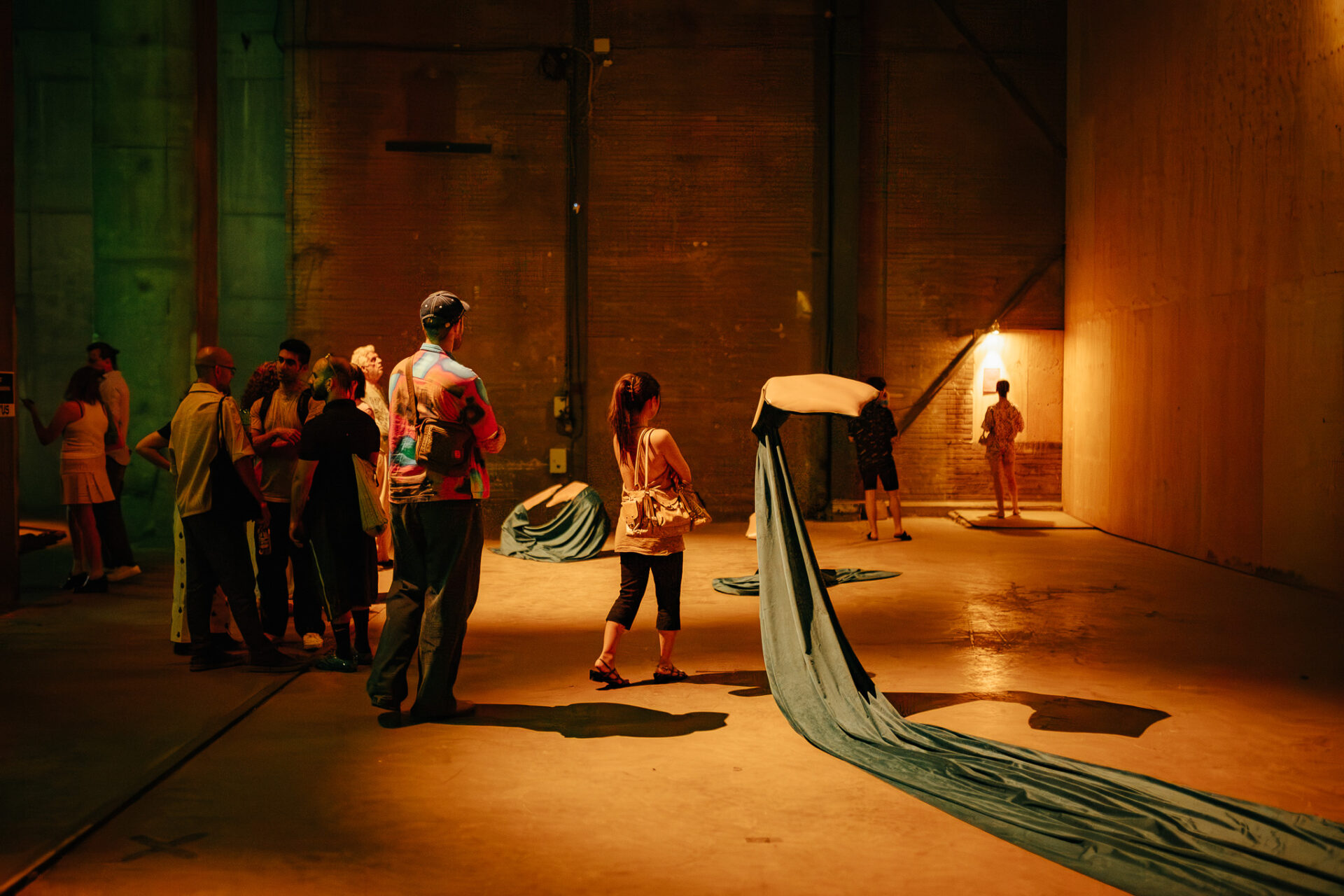
Brutus is presented as an “artist-driven playground”. It describes itself as “a cross between a maze and a time machine, a bomb shelter and a launch pad, a laboratory and an industrial ruin, a cabinet of curiosities and a think tank”. Located in a former port warehouse and chain and anchor factory, Brutus becomes a maze of artistic expression in what at first feels like an abandoned building complex.
However, far from abandoned, the space of Brutus is occupied by incredibly rich artistic ruminations that utilise its dilapidated aesthetic to speak towards themes such as memory and ruins. The monumental building of Brutus acts as the backdrop for Traces We Keep but also as a catalyst to bring the past and the present into dialogue with one another, posing questions such as “What do we carry with us from the past?” and “What do we ourselves leave behind for the future”.
Md-2 architects’ work Unchain these memories acts as the scenographic context for the exhibition as a whole. This work draws on the history of the Brutus complex as an old chain and anchor factory. Remnants of these anchors and chains are positioned throughout Traces We Keep. In one case the chains gather together in a clump to support a video piece that gives more insight into the history of this factory. In another case a lone anchor sits in the entrance of a hallway.
In addition to this a single chain is hung next to each artwork with the name of the responsible artist secured within it. Besides for the map in the handout, the labeled chains are the only structural device that helps place each work with the artist who made it. In this way Traces We Keep uses the physical remnants of Brutus as a way to navigate through an exhibition that otherwise one could feel quite lost in. The history of the exhibition space becomes a tangible thread that weaves the different works together as well as with the context of the building they appear in.
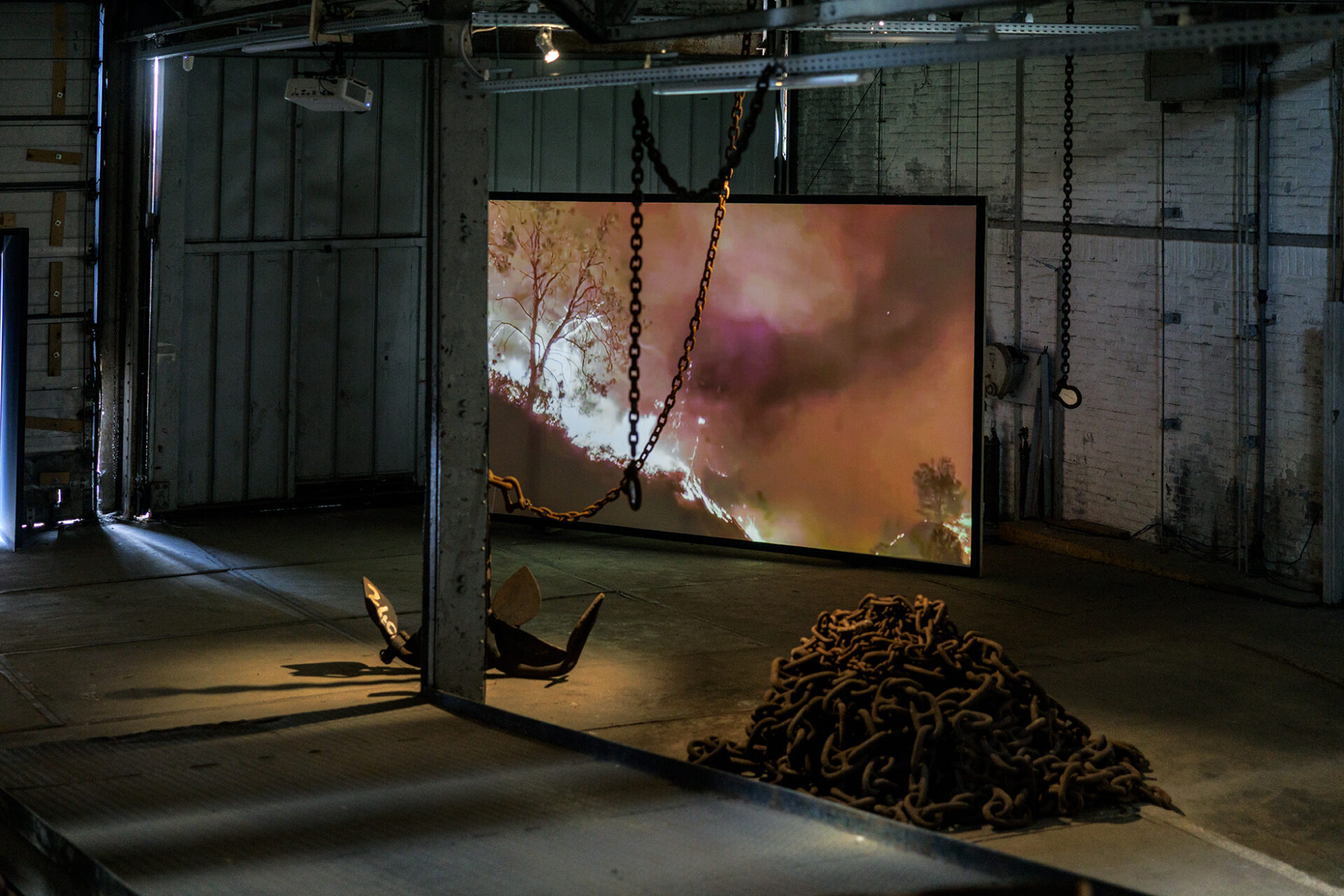
The first work you encounter when entering Traces We Keep is Jason Hendrik Hansma’s In Our Real Life (Embers), 2024. This large-scale video installation is made up of amateur footage of bushfires. A score made by DJ Ssaliva accompanies the footage and echoes throughout a significant portion of the first and second rooms – in a sense accompanying not only Hendrik Hansma’s work but also the viewers initial and broader movements through Traces We Keep. The music is eerie, loud and all-encompassing with an electronic vibrational quality that reverberates throughout the space. The content of the video piece immediately introduces the viewer to images of a wild uncontainable energy, one of ruin, destruction and of aftermath.
This successfully sets the tone for what is to come in the rest of the exhibition, a bold and courageous reflection on the explosive world we find ourselves in. However, Traces We Keep somehow manages to explore this explosive world with a great level of delicacy. This is possibly one of the biggest strengths of the exhibition, an ability to place the words tender and daring next to each other, to hold them in one handful or to carry them in one pocket. I was particularly struck by the show’s gentleness amongst its boldness, not depicting a simple and singular narrative but rather one that folds in on itself in both painful and meaningful ways.
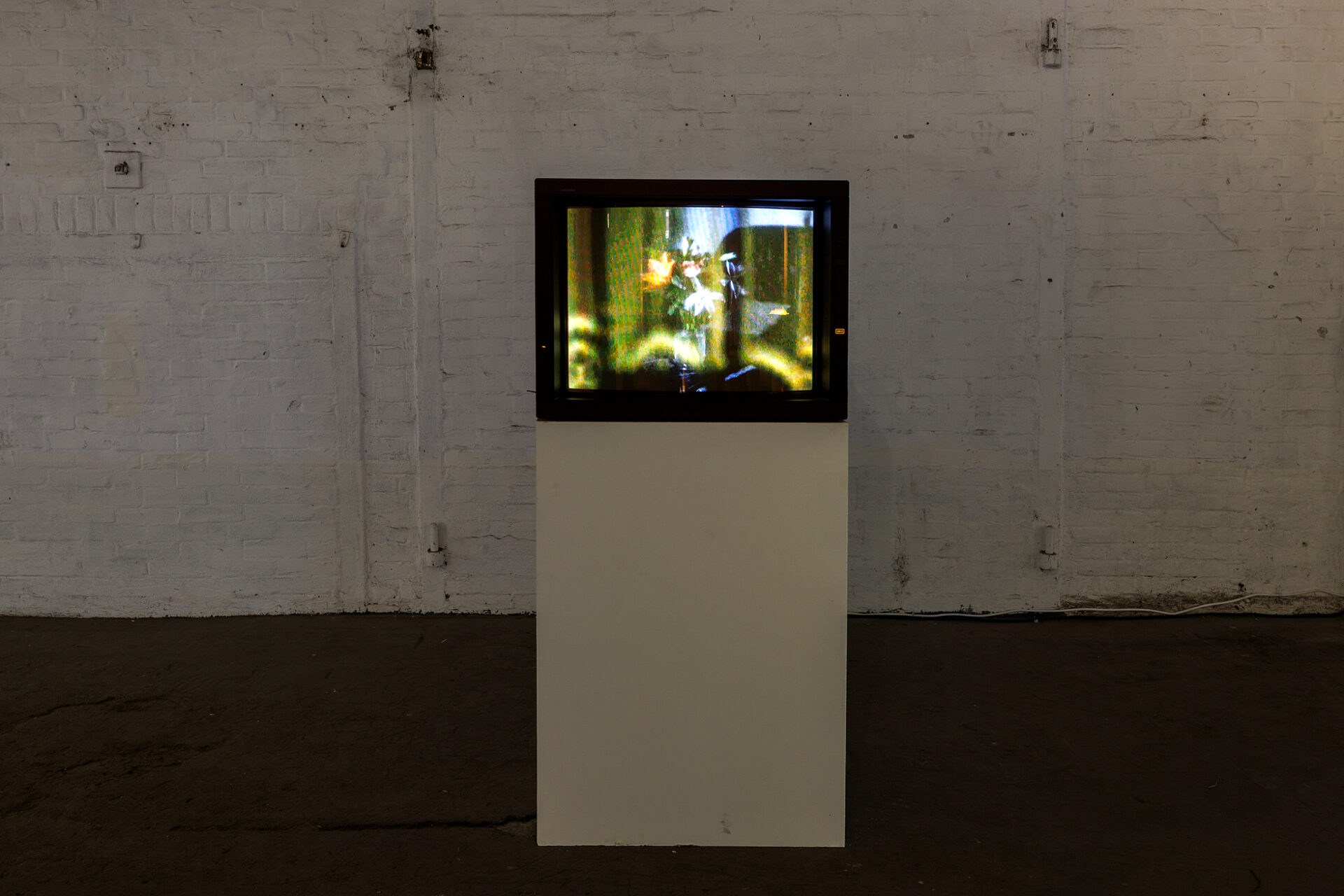
This can be seen in the work by Liza Wolters IT MIGHT BE GONE, IT MIGHT BECOME, 2020. This is a video work where a camera is fixed on a singular vase of flowers through what seems to be a window. The shot stays stable but the outside world is partially visible through shifting light reflections in the glass that you see the flowers through. A moment of stillness, of prettiness, of care and of curation is interspersed with the reality of passing vehicles and further evidence of the surrounding city. IT MIGHT BE GONE, IT MIGHT BECOME reflects on the tensions between inside and outside and the absurdity but necessity of continuing on with life in the midst of global turmoil. It places the viewer between calmness and chaos, motion and stillness, refuge and dislocation, expertly musing on the reality of a world defined by, often, heartbreaking contradictions.
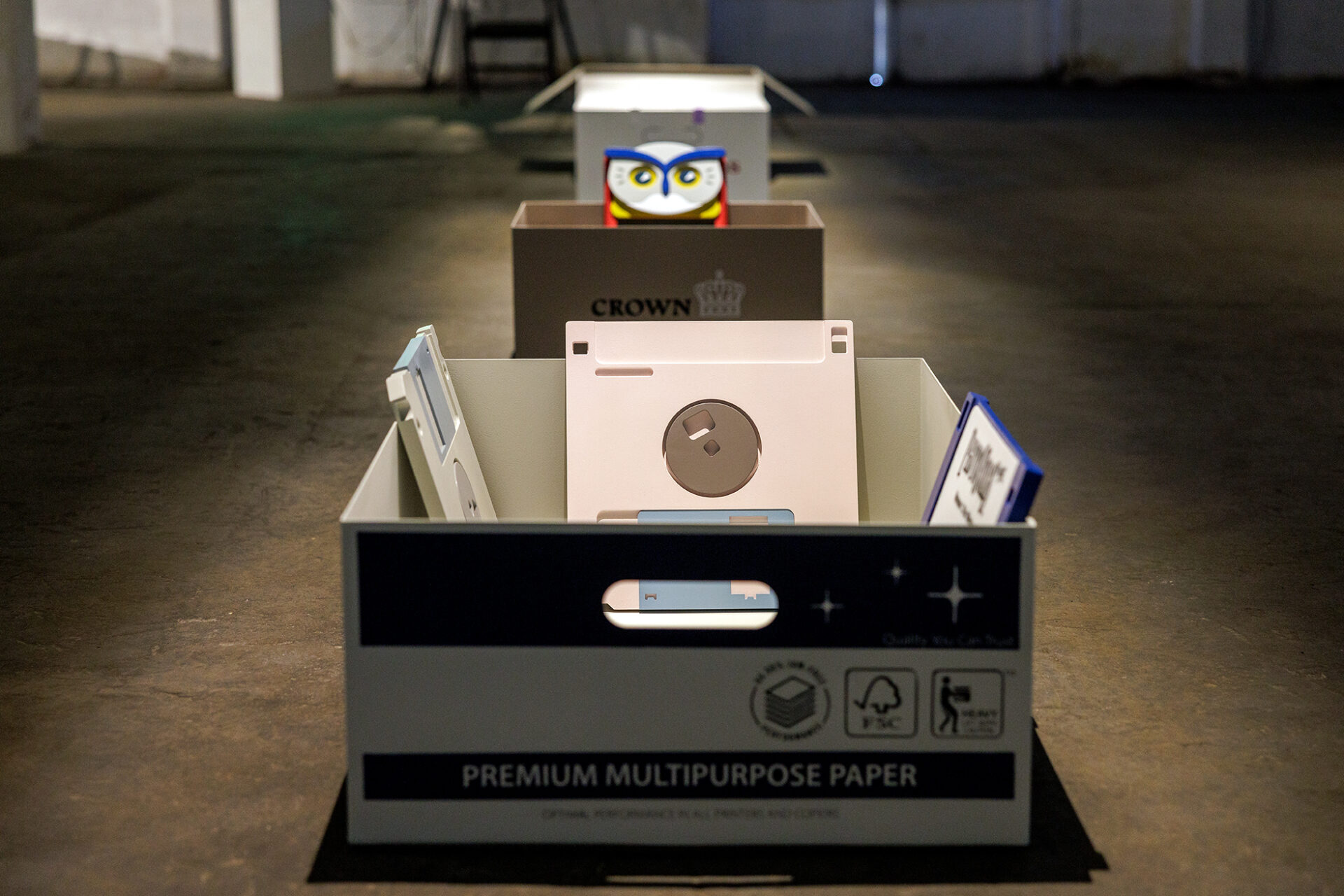
Another clear example of changes in scale is Attic Memory by Ruben Mols where digital cultural artefacts are replicated at larger scales than their original size and placed inside moving boxes. These artefacts include a large-scale computer keyboard, a Tamagotchi and various floppy disks.
The enlarged size of the objects is a more literal example of how Traces We Keep plays with scale but it also reflects on the quality and shape of memory, something that is also subject to changing scales inside the mind. The placement of these objects inside what seems to be moving boxes successfully reflects on an ambiguity central to this show: Are we in preparation, packing and leaving or are we dealing with the aftermath, unboxing and processing? It is unclear what is taking place in Attic Memory as much as it is unclear how we should proceed in the world we find ourselves in. Traces We Keep gracefully places itself within these ambiguities.
Wild Summer of Art, Brutus, Rotterdam t/m 24.8.2025
WSoA artists:
Aaryan Sinha, Adrian Kiss, Alaa Abu Asad, Alexandra Phillips, Angeliki Diakrousi, Anouk Kruithof, Benjamin Francis, Cemre Kara, Cihad Caner, AYO, Danae Io, Doris Kolpa, Elio Mazur, Feline Hjermind, Florian Braakman, Ilke Gers, Ines Borovac, Inez Vierdag, Jason Hendrik Hansma, Joost Vermeer, Juliette Lizotte, Katarina Jazbec, Liza Wolters, Lotus Rooijakkers, Mathieu Wijdeven & Mateo Vega, Meghan Clarke, Mel Chan, Mylan Hoezen, Nadim Choufi, Nanno Simonis, Noor Boiten, Puck Schot, Raziel Perin, Robert Glas, Ruben Kotkamp, Ruben Mols, Scott van Kampen Wieling, Theophile Blandet, Toon Fibbe, Ulufer Çelik, Vlada Predelina, Zalán Szakács en Zoë D’hont.
Commissions: Elsemarijn Bruys & Loma Doom (Femke Dekker), Lana Mesic, TiSiTi (Tara Reece, Ceola Tunstall-Behrens en Tisa World).
Hannah Fleishman
is an artist, based in Amsterdam