‘The earth is trembling’ – Édouard Glissant’s archipelagic model of exchange
At West Den Haag we are invited to dwell, linger and stumble through Hans Ulrich Obrist’s archival exhibition dedicated to Édouard Glissant. Hannah Fleishman visits the show, which challenges our linear and vertical approach to exhibition making.
When I was asked to write about Hans Ulrich Obrist’s archival exhibition Édouard Glissant at West Den Haag, I quickly realized that a straightforward exhibition review might not be the best way forward. Instead of primarily delving into the curatorial and aesthetic choices, (which seem to purposefully understate themselves), it made more sense to respond to Glissant’s ideologies explored in the exhibition.
In recent years, there has been a renewed attention to Glissant’s work. Many university students and artists seem drawn to his writing, perhaps because his imbrication of politics and poetics creates a space for forms of research that are less rigid and more exploratory. His idea of ‘archipelagic thinking’ also feels urgently relevant in a world increasingly dominated by nationalism and border politics.
The exhibition itself reflects Obrist’s longstanding intellectual and artistic exchange with Glissant. Glissant acted as a mentor to Obrist playing a fundamental role in his curatorial practice. Their relationship played itself out through various extensive conversations, both private and public. Obrist recorded many of these conversations, developing a vast archive of the collaborative thought between the two of them. This resulted in the production of the publication, The archipelago conversations which compiles the interviews between Obrist and Glissant between 1999 and 2011. Alongside the Archipelago Conversations the exhibition Edouard Glissant at West Den Haag offers another deep dive into this rich archive. The exhibition is composed mainly of archival footage including panel discussions, conferences, and more intimate interviews filmed in Glissant’s home where he appears seated on a sofa in a dark blue dressing gown. The presentation unfolds as a portrait of a friendship as well as an intellectual relationship. It is an exchange of trust and of expansive, playful thought.
Spread across four rooms, the archival footage is shown on screens set below eye level, each accompanied by a single wooden chair. This staging creates a horizontal plane of encounter. Instead of elevating the footage to a position of authority, both viewer and material are brought down together. The effect is intimate: in certain recordings it feels as though Glissant sits across from you in conversation. This horizontal mode also resonates with his rejection of hierarchical thinking. Instead, Glissant favours the rhizome; an underground network without fixed origins or ends.
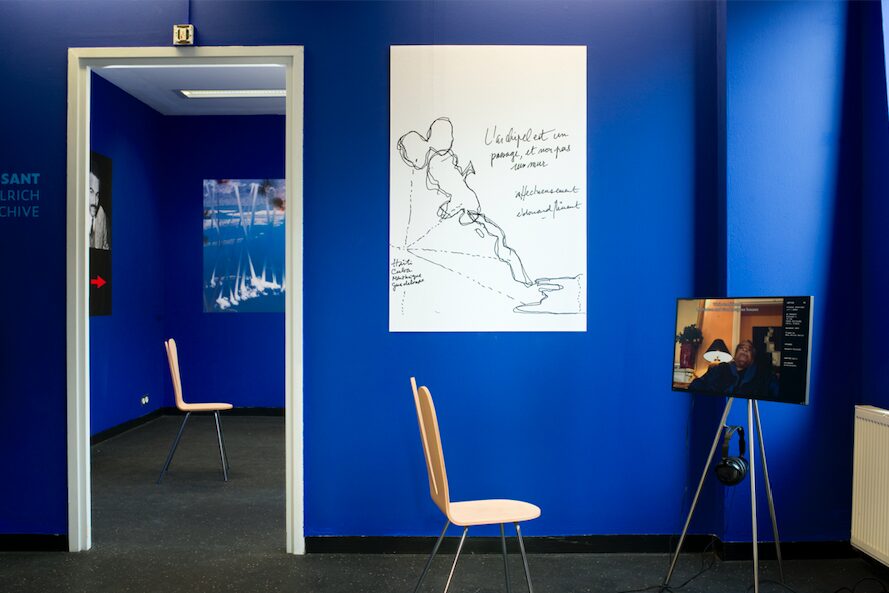
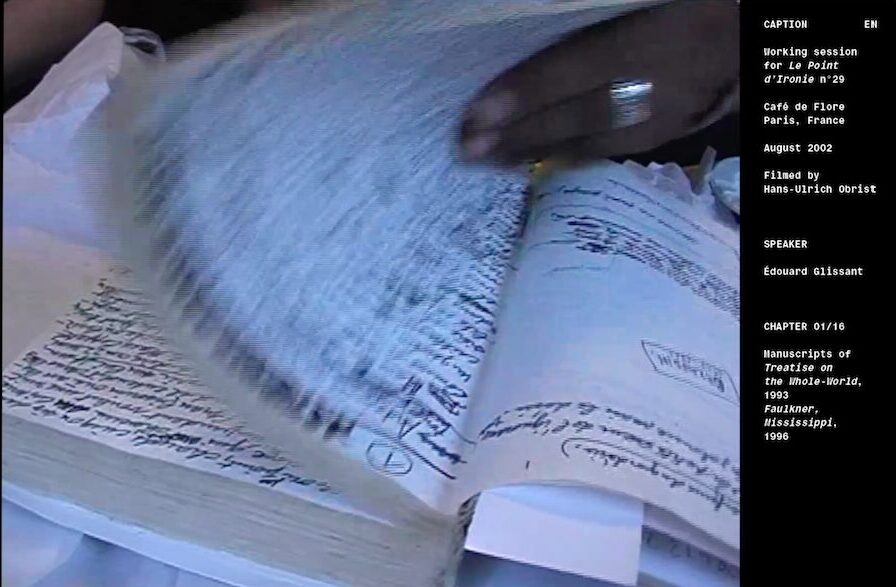
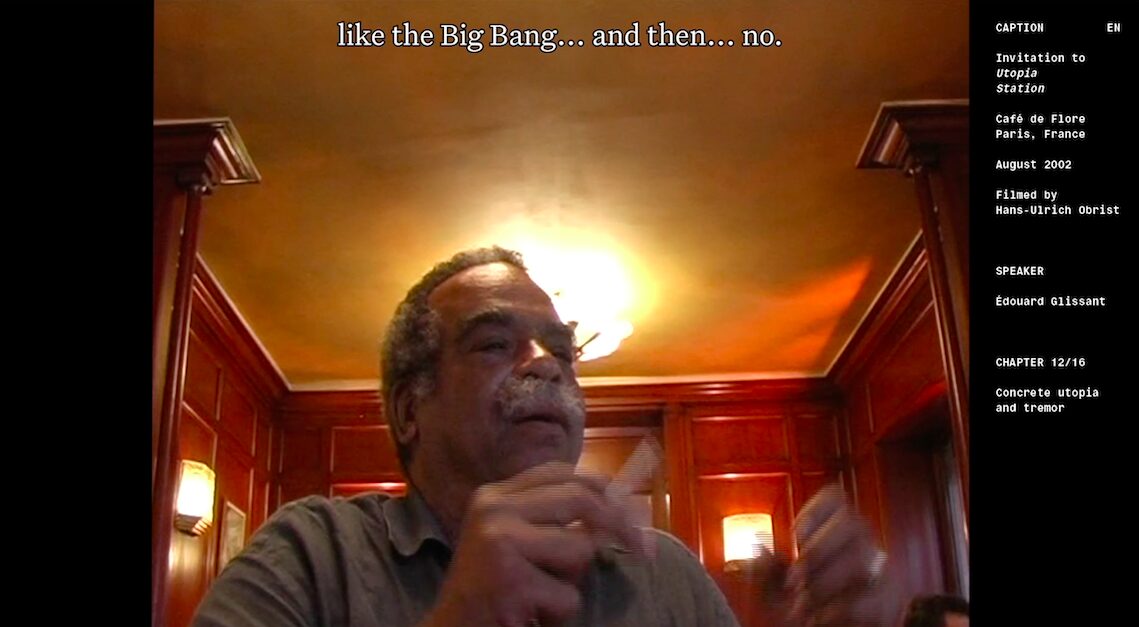
Each video is accompanied by a panel of metadata, including the caption of the footage, date and location of recording. Such as: from private interview: the question of memory, the museum as politics: the problem of globalization, and Utopia station: thinking of tremor. Alongside the videos are other archival objects including Glissant’s books, as well as poster works by contemporary artists, further expanding the dialogue. Despite the conceptual fullness of the exhibition, the curatorial choices are understated, the screens are low, the chairs are simple, there is not grandeur or fluff surrounding the contents in the room. The exhibition is understated, but in its restraint it makes space for Glissant’s ideas to saturate the atmosphere of the blue-painted rooms. If one lingers, the gravity of his thought becomes palpable. For this reason, it feels more apt to dwell on Glissant’s concepts than to assess the exhibition in formal terms. Two threads in particular stand out: his notions of archipelagic thought, and his theory of tremblement.
At one point in conversation with Obrist, Glissant remarks: ‘The earth is trembling.’ Trembling, for him, is both a condition and an action. It describes the instability of our contemporary world, shaken by eruptions, wars, genocides, floods, and constant streams of information. But it is also a strategy: a way of resisting fixed systems of thought, countering imperial and rigid structures with openness and unpredictability. Glissant calls trembling ‘a thinking in which we can lose time, lose time searching, in which we can wander and counter all systems of terror, domination, and imperialism with the poetics of trembling. It allows us to be in real contact with the world and with the peoples of the world.’
To deepen this thinking, one might turn to theorist André Lepecki, who in his essay “Stumble Dance” (2008) considers the politics of the body’s relationship to the ground. Western dance, he argues, often treats the ground as flat, neutral, ahistorical, as merely a stage for human happening. In contrast, he proposes a politics of stumbling, of being moved by the irregularities and histories sedimented beneath our feet. The stumble disrupts mastery, opening us to new and unexpected ways of being in contact with the world. Glissant’s trembling shares this impulse. It insists that thought must not seek stability at all costs but must remain sensitive to cracks, ruptures and the unpredictable ground of relation. In our present moment, marked by nationalist closures, ecological instability, and incessant flows of information, Glissant’s poetics of trembling feel more urgent than ever. The earth is indeed trembling, and his thinking offers a way not to deny this condition but to turn it into potentiality: to let it guide us toward new forms of relation and presence.
In reference to his birthplace, the Caribbean islands, Glissant refers to himself as a philosopher of the archipelago. Simply put, an archipelago is a cluster of islands. Archipelagic thinking stands in opposition to continental thinking which favours unity and coherence facilitated by systematic organisational structures. In contrast, the configuration of the archipelago focuses on incoherence and asymmetry, creating complex networks that encourage horizontal exchange between isolated parts. Continental thinking relates to space as fixed blocks. This informs a centralised and systematic knowledge production highlighting the idea of a single truth. Inspired by the dispersed and diverse archipelago, archipelagic thinking encourages various emergent truths and a dynamic relationship to identity. Glissant refers to the archipelago as ‘a place where we can begin to understand and resolve the contradictions of the world.’ He states that ‘Continents weigh us down. They are thick and sumptuous. Archipelagos are able to diffract, they create diversity and expansiveness. […] Being in harmony with the world through archipelagos means inhabiting this diffraction.’ Diffraction describes a process by which any wave (sound, light, radio, water etc) diverges from straight line transmission due to an obstacle in its path. This idea of diffraction also relates back to Lepecki’s thinking about stumbling over obstacles, or potential irregularities – prioritising an intuitive feeling-based approach to navigating through the world.
The configuration of the archipelago focuses on incoherence and asymmetry, creating complex networks that encourage horizontal exchange between isolated parts
The importance of the lateral plane recurs throughout both the exhibition and Glissant’s thinking more generally. We encounter it in the horizontal staging of the videos, in the archipelagic model of exchange, and in the drifting, wandering state that resists linear upward progression. In one of the recordings, Glissant reflects on his resistance to vertical structures through the metaphor of the tree. The singular tree, he suggests, is a system of roots and branches that converges toward one point of origin. ‘The tree is that which excludes everything else,’ he remarks. ‘If I were asked to draw a tree, I would never draw a tree. I would draw a forest. I would draw a jungle.’ Against the rigidity of arboreal models, Glissant proposes rhizomatic structures that extend laterally, proliferating across multiple centres rather than enforcing a singular hierarchy.
It then makes sense that Obrist has made the curatorial choices he has in this archival exhibition. He creates multiple points of access. It is not possible to see and understand everything from start to finish, but perhaps these ideas of origin and destination purposefully do not exist. It is not an exhibition to be ‘consumed’ quickly, but one that rewards slow, porous attention. The viewer wanders through a mind map of Glissant’s ideas with various locational hubs. The exhibition offers the possibility of stumbling upon portals into his thinking but also into his relationship with Obrist. To write about Obrist’s exhibition, then, is less to evaluate its success as a display and more to linger within the atmospheres it creates. By allowing Glissant’s words, gestures, and concepts to occupy the space with such intimacy, the exhibition becomes less a monument than an invitation to think laterally, to dwell in trembling and to drift among archipelagos of thought. In refusing verticality and fixed interpretations, it gestures toward a way of inhabiting the world that is fragile and porous. Perhaps this is the most faithful way to approach Glissant: not by attempting to pin down his ideas into singular meaning, but by remaining with their ambiguity and their diffraction.
On the 25th of October, West hosts the international symposium Trembling Worlds, on the work and influence of Édouard Glissant. More information HERE.
The exhibition Édouard Glissant – Hans Ulrich Obrist’s Archive is on show until the 1st of March 2026 at West Den Haag
Hannah Fleishman
is an artist, based in Amsterdam