Shadows, monsters, dark voids and grunts – Temper Tantrum Bonehouse at W139
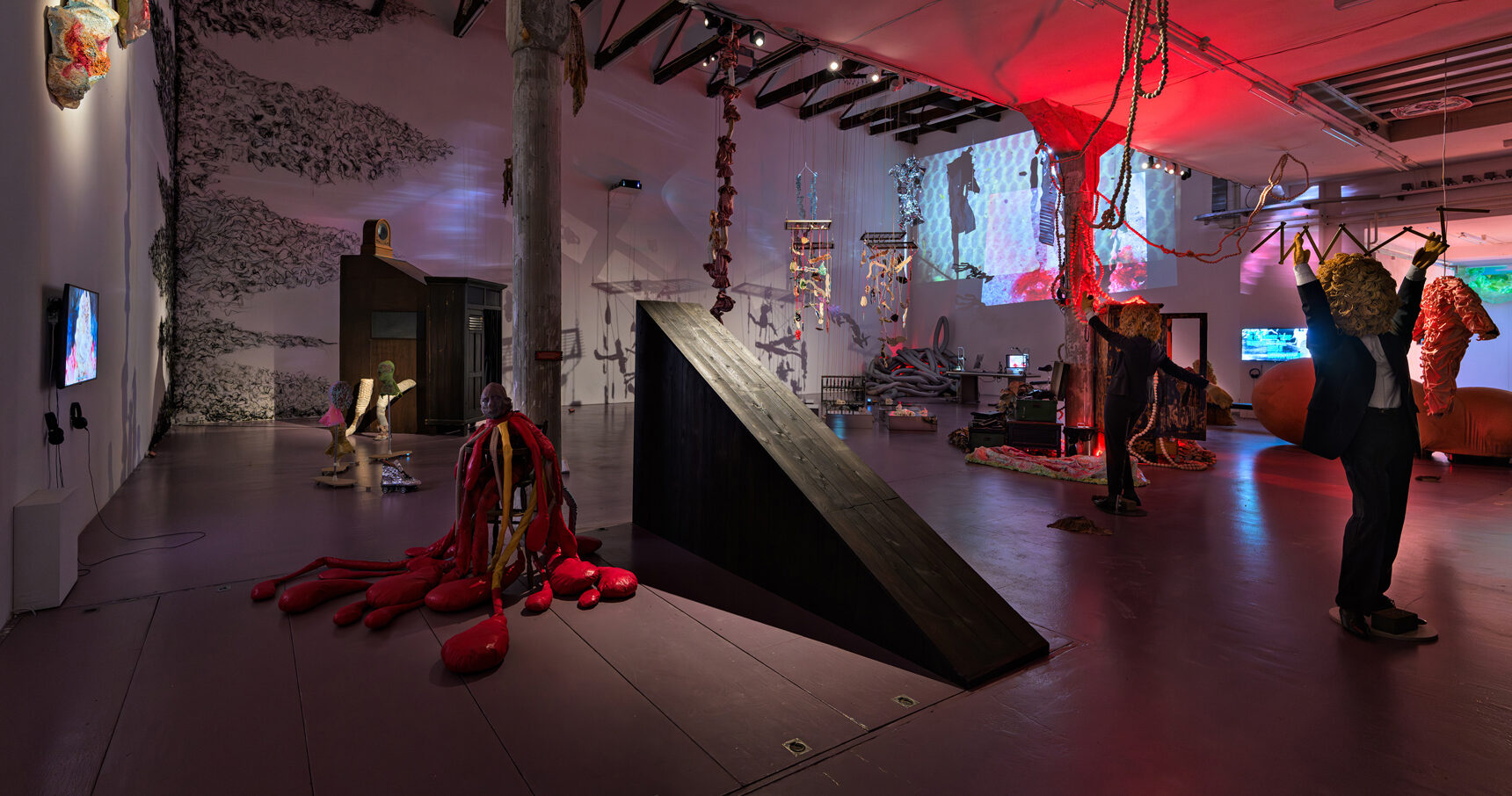
W139 has transformed into an uncanny hybrid world. Its goal is not to provoke fear or shock, but to investigate what we view as strange or unsettling and why. The group exhibition initiated by Mette Sterre Temper Tantrum Bonehouse (Chilling Incisions Calling Things That Have No Name) addresses questions on bodies and power by creating an immersive environment where counter-knowledge can be shared and continuously updated.
The location of W139 carries a particular relevance for this exhibition: the nearby Dam Square was once a site of public executions and witchcraft accusations during the 16th and 17th century. Around the corner at De Waag, anatomy lessons turned into public dissections and experiments. These spectacles of punishment highlight important moments in the city’s history of bodily control and disposal. Questions of who held authority over these bodies (and on what basis) resonate throughout the exhibition.
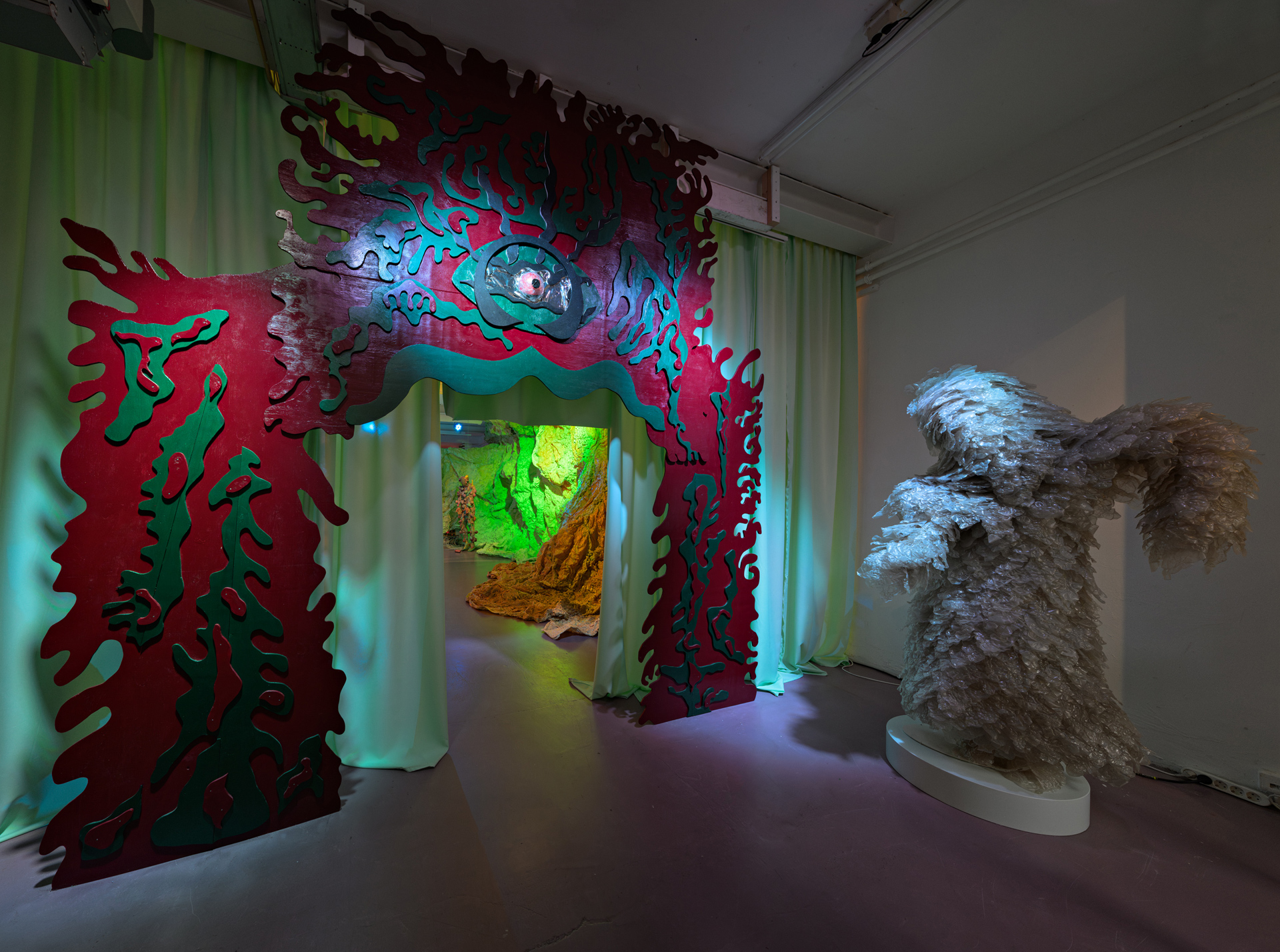
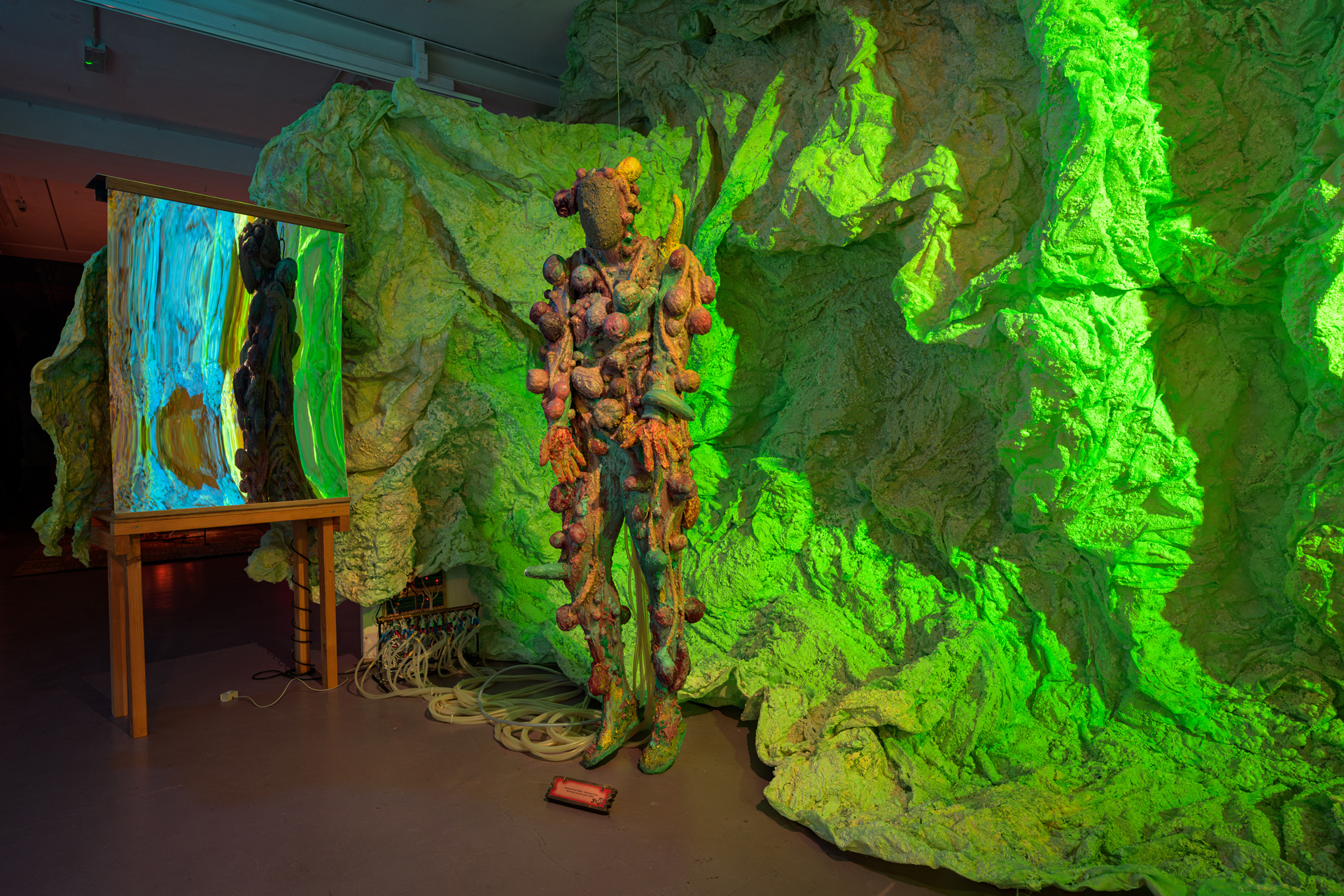
When entering the space, I am immediately put into an altered and underwater-like environment: moving textures, distorting mirrors and hybrid bodies dominate the space. Mette Sterre’s installation Seapussy Power Galore – Absession (if you don’t know, you don’t grow) (2022), is a dynamic, constantly shifting world. Several of her body masks, used for her performances, can be found throughout the space. Here, a humanlike sea creature covered in flesh-coloured, pulsing bumps greets you. The environment feels detached from human hierarchies, existing in continuous transformation and offering new narratives about how bodies relate to each other and their surroundings.
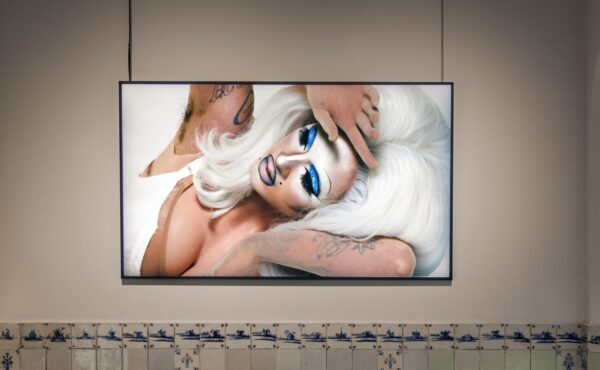
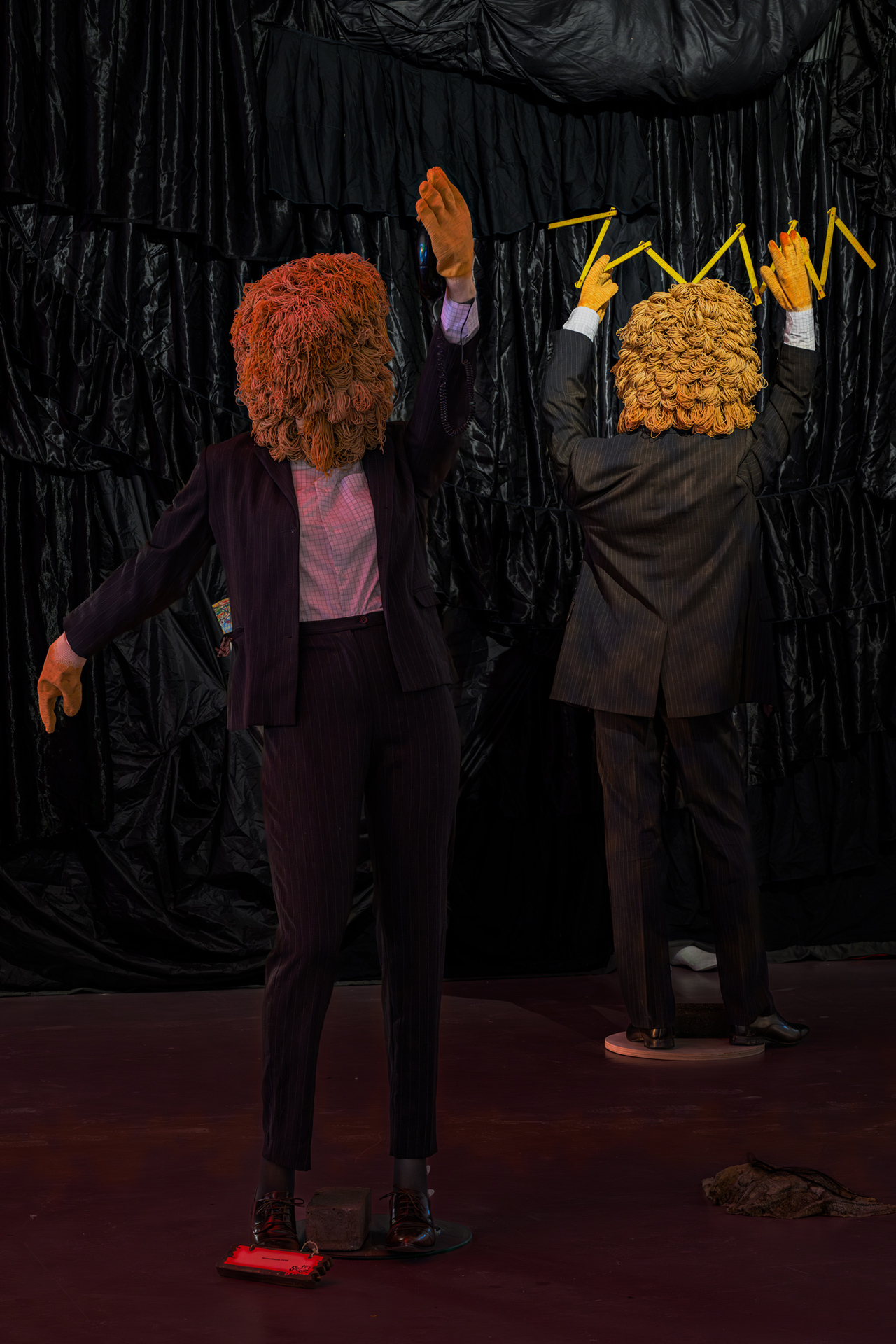
Continuing the exploration of bodily transformations, we enter a dark room in the back, where Lolly Adam’s Miss HerNia’s Avatar (2024) emerges against a brick wall draped in black curtains. The artist’s alter ego dances endlessly in a black void, appearing part-human, part-sewage with transparent sections revealing exaggerated textures of her internal body. By turning abject elements into a performance, Adam asserts power, simultaneously questioning conventional labels of beauty and ugliness, suggesting their fluidity. Adam’s other video work Pick Me (2024), presents Miss HerNia’s origin story: emerging from sewage, blending the story of the Whitechapel fatberg with a majestic, mythic framework, where she becomes an anti-hero whose presence confronts the grotesque and contaminated material from which she emerges.
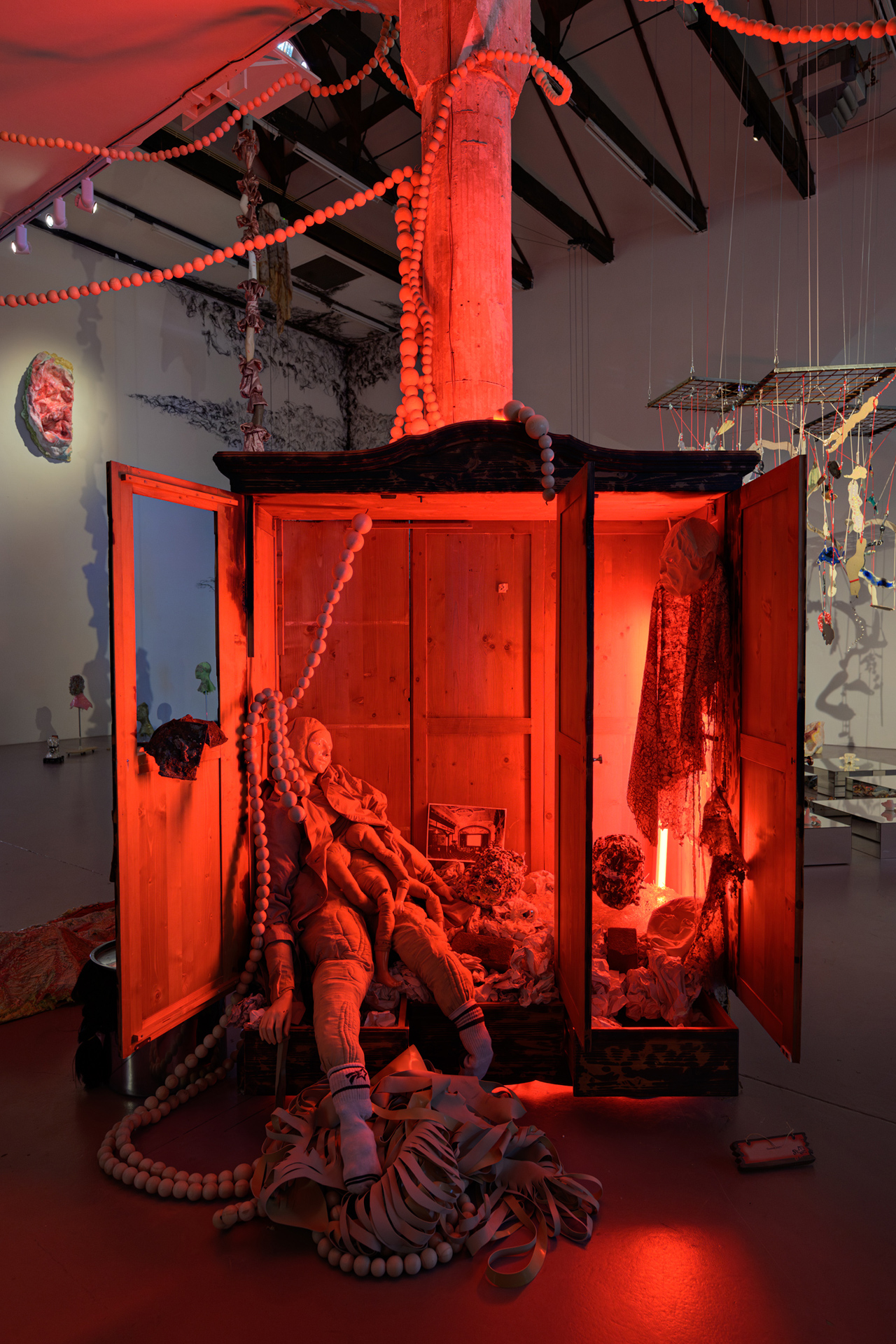
The exploration of marginalized knowledge continues as the exhibition shifts from hybrid bodies to alternative narratives and storytelling forms. No Need to Confess (2025), an installation by Aimé Philips & Nina Läuger, invites visitors to listen to fragments of stories from people who have had direct or indirect experiences with abortion from inside a confession booth. Addressing both abortion and the censorship surrounding it, the work exposes systems that attempt to control reproductive rights and bodily autonomy. Turning whispered stories in the confession booth, traditionally associated with silence and shame, into an accessible space where these experiences can be heard and witnessed. In a different approach to storytelling, Diane Mahín’s Grunt (2024), emerges from beneath a staircase and reduces language to raw, bodily sounds. By stripping communication down to grunts and non-verbal expression, the work highlights alternative ways of conveying meaning and poses what kinds of stories can be shared without words.
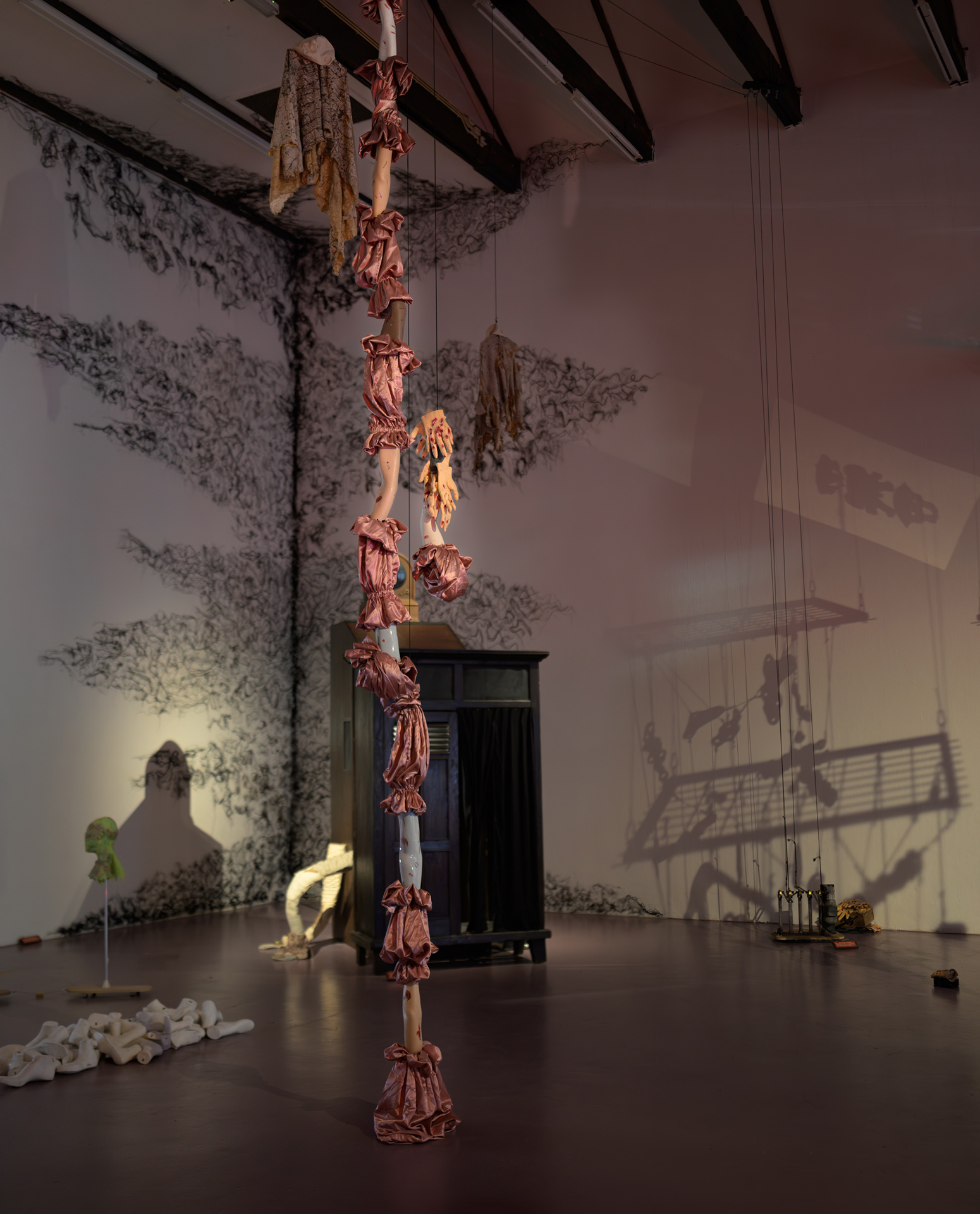
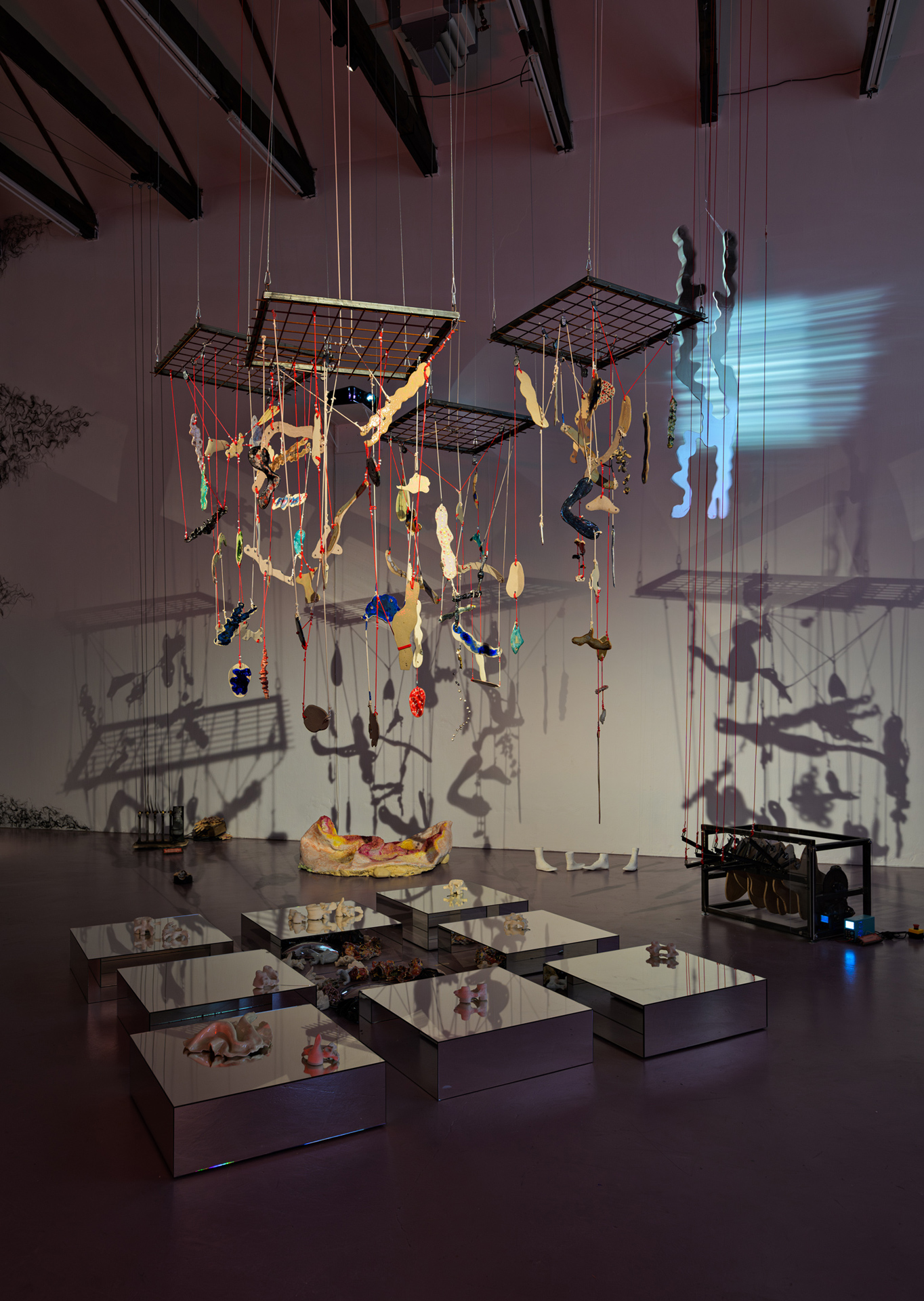
While Mahín reshapes passing on information through sound, Mette Sterre’s work Parading Pareidolia (2025), translates meaning into movement and shadow. The kinetic installation is made up of ceramic pieces suspended from the ceiling, connected to differently shaped wooden cut-outs, guiding their movements. When the cutouts move, the ceramics follow, creating slowly shifting forms reflected in mirrors placed on the floor, as well as in shadows on surrounding walls. In constant motion, fragmented and reassembled, the installation suggests that copies, echoes and shadows contain their own forms of knowledge. The work seems to question how knowledge circulates, through technology, social media or human interaction, and whether information ever remains stable. The exhibition also includes several of Sterre’s recent works, for example Contorted Strangler Funeral Bell (2025), Closeted (2025), Arteria Auricularis (That’s why the chemical symbol for gold is Au) (2025), and I Kid You Not – Artillery Atrocity (2025).
How much power truth holds in the information we consume is a question explored in Monster Chetwynd’s Free Energy(2021). The video combines performance, history and puppetry in a kind of documentary style centred on Nikola Tesla. By mixing fact and fiction, the work highlights the instability of truth and invites reflection on how media shapes our perception of reality today. Expanding this idea of restriction and perception to non-human experience Özgür Atlagan’s Despondence Warden (2021-2025) brings our focus to the body of an elephant. The work is based on an elephant pacing in front of a gate at ARTIS zoo, and shows how animals, too, are subject to limitations of systemic forces.
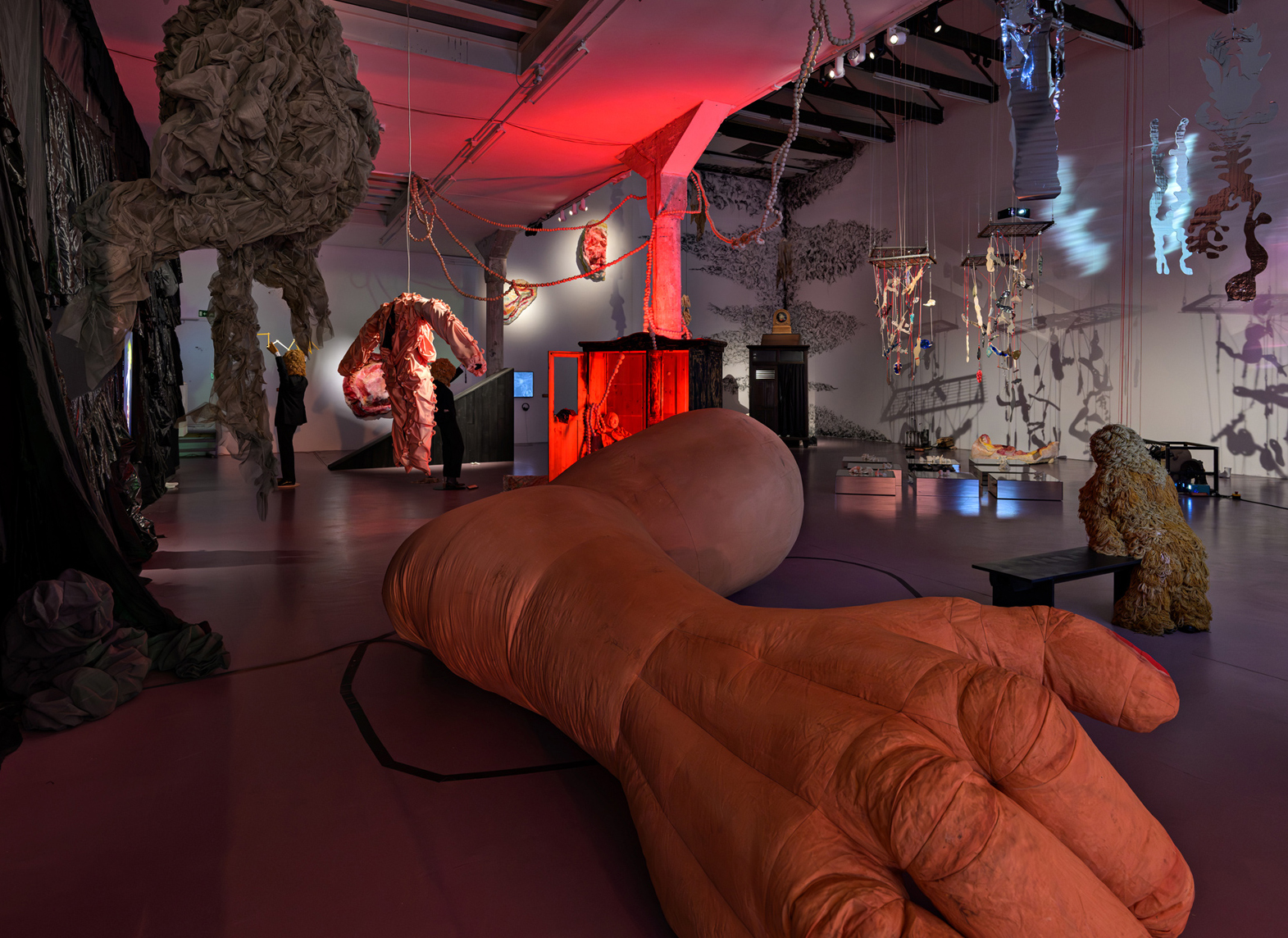
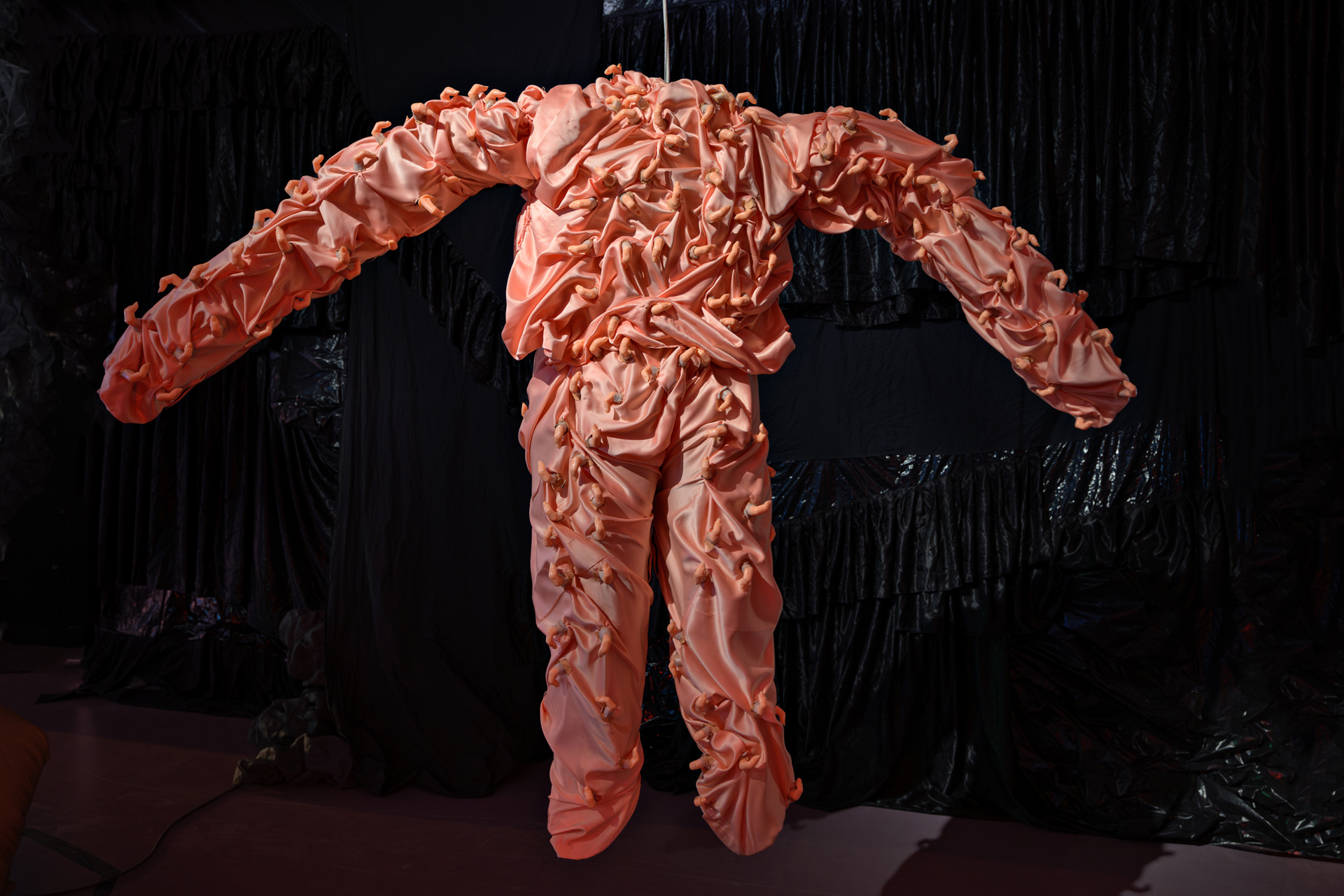
What stayed with me is not only the questions the exhibition raises, about control, knowledge or systemic forces, but how the works pose these questions by being playful and absorbing. Many contemporary exhibitions attempt at a certain immersive layer, but not all succeed. Temper Tantrum Bonehouse however creates a performative landscape, of which the visitor is as much a part, as its performers and objects. What helps achieve this, I think, is the ways our bodies are made aware of the space: the installation texture that make us feel underwater, the distorting mirror or the giant hand that alters our sense of scale, or the whispers from inside of the confession booth set against the chaotic sounds from outside. It is through this immersion that preconceived notions of the body lose their power, creating space for new and absurd power relations. These shifting movements, sounds, and scattered forms create a sense of ongoing transformation, where no notion feels fixed. In this setting, bodies and narratives do not just point to their constraints, but reveal how much can emerge in the act of being in flux.
Temper Tantrum Bonehouse (Chilling Incisions Calling Things That Have No Name) is on show until the 16th of November at W139
Rebeka Erdélyi
is an Amsterdam-based art historian and curator whose current research focuses on post-socialist memory, nostalgia, and the (re)positioning of Central and Eastern European art in an international context.